On This Page
Description
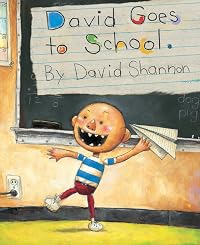
David's activities in school include chewing gum, talking out of turn, and engaging in a food fight, causing his teacher to say over and over, "No, David!"Tags
Recommendations



Member Reviews
Um, no. Listen, I'm as playful and noncormformist as the next girl, but if David doesn't learn that No Means No and Keep Your Hands to Yourself he's gonna hurt someone and get himself in trouble. I have no idea why one would want to share this with their children - I know my lively boys and I would not have liked David, or laughed at him, or learned anything from this book.
Just because a child is energetic is no excuse to be heedless of other people. Maybe if David's energy is channeled to kind and productive ends we'd all have a chance to get along.
Besides which, I can't stand it when illustrations and text are meant to look like a child created them, but fail - it feels both precious and patronizing.
Just because a child is energetic is no excuse to be heedless of other people. Maybe if David's energy is channeled to kind and productive ends we'd all have a chance to get along.
Besides which, I can't stand it when illustrations and text are meant to look like a child created them, but fail - it feels both precious and patronizing.
I liked this book because of the main character David. David is believable character that has been well developed in many books. David has a hard time paying attention and following direction in school like many other young students. Young students can relate to many of David’s actions such as, “raise your hand”, “keep hands to yourself” and “wait your turn”. Also, the language is very clear and precise for young readers to understand the story. The big idea of this story is that even though David misbehaves in school, he is still a good kid.
Shannon does it again, this time putting David in a school setting. His behaviors are those we see every day: not raising his hand, chewing gum, staying past the bell at recess. He's an "every boy" character, and girls and boys alike know EXACTLY how he feels. Of course, he does it all in one day, so we're a bit horrified at the extent of his misbehavior, but on balance he's not so different from the rest of us!
David, the out-of-control monster-child ready to disrupt the class. Shannon remembers the word 'no' all too clearly from his childhood, and, as he says in his introduction, 'It seems that kids haven't changed much over the years, and neither have school rules, some of which date back even further than the invention of sneakers.' In David Goes to School, young David shows up late to class, goes wacko at the blackboard, chews gum in class, yells answers out of turn, pulls pigtails, stares out the window, cuts in line, has a food fight ('I don't care who started it!' says the teacher), lingers at recess, and draws on his desk. Colorful, hilarious, childlike illustrations examine our strangely appealing demon-boy at eye level, which is show more especially disgusting as David stretches an enormous mass of bubble gum from his pointy-toothed maw. After an intense day of exuberant misbehaving, however, he stays after school and washes all the desks until they sparkle. The day ends with a gold star and a pat on the head. show less
I like the book David Goes to School for many reasons. First, I like that each page only has a short phrase on it. It is very easy to read. Next, I enjoyed the illustrations. The story is mainly told through the illustrations. The pictures show David doing an action that is "against the rules" such as looking out the window, or calling out while everyone else is raising their hand. Finally, I like that the story ends on a positive note with the teacher praising David. I think the main idea of this story is to teach students about classroom rules and to demonstrate how they should not act in the classroom.
I enjoyed reading this story, that tells the message that there on consequences for misbehaving, because of its exciting illustrations and the creative presentation of the text. The wild depiction of the main character, David, and the chaos shown of what he gets into at school through the illustrations, made the story very exciting and were the main tool used to show the reader what was going on so that they could understand the events in the story. For example, an illustration of David misbehaving while finger-painting, with his hands covered in paint and trying to get it on his classmate, clearly explains to the reader while the text says "keep your hands to yourself". The fact that the illustrations take the stage in telling the show more story made it very engaging to the reader since they had to deeply "read" the images on the page. I also loved the way the book presented all of the text in the story to make it look like hand written by a child on handwriting paper strips. This aided to the setting of being at school and created an authenticity of the child-like tone given off throughout the story. For example, across one of the page spreads is a long, ripped piece of paper with the text, "sit down, David!", written on it in messy, childish handwriting, which is fun for children to read and engages them in the story while adding to the overall theme of being at an elementary school. show less
I have to say I was surprised that I really liked this book. In a series of books called “No David,” this story is a great because it shows all the different things that children do in school to get in trouble and how at the end David helps the teacher and goes home a happy child. Children can identify with David and the feel good ending when realizing that David is happy and gets his star. Some adults can identify with David too!
It is the illustrations that make this book. David is bald-headed with a round head. His teeth look like those of a jack-o-lantern and his eyes are round and beady. David looks like a little monster. The illustrations have David primarily, with a classroom in the background. You never see the face of the show more teacher as though she is only somewhat important. This reminded me of Peanuts cartoon when the adults were never visible and made a weird sound when they spoke. The artwork is colorful and the facial expressions are priceless. Finally, the way Mr. Shannon adds the words adds even more to the story because they are on first grade paper. The illustrations really do make this book!
The language and writing together make this book a great read-aloud and fun to read. The writing is simple, “David, raise your hand!” “PAY ATTENTION!” “Shhhhhhhhh!” are just a few examples of what is written on a page. The best page being the second to last page, “GOOD JOB, DAVID!” David’s facial expression changes to one of happiness, especially when he gets his gold star. The language is simple, yet powerful at the same time. This book sends a message that children make bad choices, but they are not bad people. show less
It is the illustrations that make this book. David is bald-headed with a round head. His teeth look like those of a jack-o-lantern and his eyes are round and beady. David looks like a little monster. The illustrations have David primarily, with a classroom in the background. You never see the face of the show more teacher as though she is only somewhat important. This reminded me of Peanuts cartoon when the adults were never visible and made a weird sound when they spoke. The artwork is colorful and the facial expressions are priceless. Finally, the way Mr. Shannon adds the words adds even more to the story because they are on first grade paper. The illustrations really do make this book!
The language and writing together make this book a great read-aloud and fun to read. The writing is simple, “David, raise your hand!” “PAY ATTENTION!” “Shhhhhhhhh!” are just a few examples of what is written on a page. The best page being the second to last page, “GOOD JOB, DAVID!” David’s facial expression changes to one of happiness, especially when he gets his gold star. The language is simple, yet powerful at the same time. This book sends a message that children make bad choices, but they are not bad people. show less
Members
- Recently Added By
Lists

Back to School (recc titles)
21 works; 1 member

Honey For a Child's Heart
1,152 works; 25 members
Author Information

64+ Works 53,586 Members
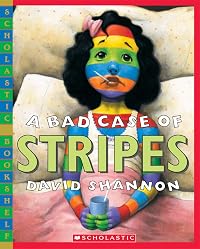
David Shannon was born October 5, 1960, Washington, D.C. He is an American author and illustrator. He graduated from the Art Center College of Design and now lives in Los Angeles. In 1998 he won the Caldecott Honor for his No, David!. He also wrote A Bad Case of Stripes, How Georgie Radbourn Saved Baseball, and The Amazing Christmas Extravaganza. show more He has also illustrated Audrey Wood's The Bunyans, various books by Jane Yolen including The Ballad of the Pirate Queens and Encounter, as well as Melinda Long's How I Became a Pirate and Pirates Don't Change Diapers. Shannon currently lives in Los Angeles with his wife and daughter. (Bowker Author Biography) show less
Awards and Honors
Awards
Series

Common Knowledge
- Canonical title
- David Goes to School
- Alternate titles
- David Goes to School
- People/Characters
- David
Classifications
Statistics
- Members
- 5,893
- Popularity
- 2,199
- Reviews
- 141
- Rating
- (4.04)
- Languages
- 5 — Chinese, English, French, Spanish, Thai
- Media
- Paper, Ebook
- ISBNs
- 34
- ASINs
- 8