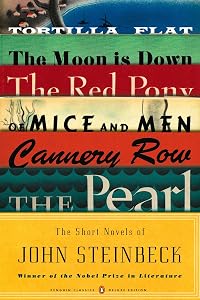
The Short Novels
by John Steinbeck
On This Page
Description
Collects six short novels from one of the most influential authors of the twentieth century.Tags
Recommendations
















Member Reviews
THE PEARL:
Read this in honor of Steinbeck's birthday. I think I first encountered this beautiful, heart-breaking, mythic tale in junior high school, but remembered only the vague feeling of doom rather than specifics of the story. Kino, an impoverished Indian pearl fisherman, finds the "Pearl of the World", and dreams of marrying his wife in church, in new clothes, and sending his baby son to school one day. His small village follows Kino and his wife Juana to the pearl dealers where he hopes to sell this natural wonder and secure his family's future. We know the dealers are out to cheat him, and from the beginning it seems that even Kino does not truly believe in his dream, but he has committed to it and must follow where it takes show more him. This is a perfect gem (pardon) of a story, with exquisite prose and a terrifying inevitability.
Reviewed in 2014 show less
Read this in honor of Steinbeck's birthday. I think I first encountered this beautiful, heart-breaking, mythic tale in junior high school, but remembered only the vague feeling of doom rather than specifics of the story. Kino, an impoverished Indian pearl fisherman, finds the "Pearl of the World", and dreams of marrying his wife in church, in new clothes, and sending his baby son to school one day. His small village follows Kino and his wife Juana to the pearl dealers where he hopes to sell this natural wonder and secure his family's future. We know the dealers are out to cheat him, and from the beginning it seems that even Kino does not truly believe in his dream, but he has committed to it and must follow where it takes show more him. This is a perfect gem (pardon) of a story, with exquisite prose and a terrifying inevitability.
Reviewed in 2014 show less
John Steinbeck: The Red Pony
This is one of Steinbeck's shorter novels. It revolves around the life of Jody, a boy of ten years (although constantly referred to as 'the young boy" despite the passage of time), his mother (always referred to as 'her', 'his mother', or 'Mrs.Tiflin'), his father, Carl, (a taciturn, strict disciplinarian), and a ranch hand, Billy Buck ("...a broad, bandy-legged little man with a walrus mustache, with square hands, puffed and muscled on the palms".) Only two other characters appear, briefly. One is Gitano, an old paisano who shows up one day because he was born on the property and wants to die there to complete the circle of his life, and Grandfather, Mrs.Tiflin's father, who comes for a visit, and who lives show more in the memories of his glory days as the leader of settlers pushing westward to the sea.
Not a great deal happens in the story; it is like a miniature painting that illuminates life and lives. Perspective in life matters, and a child like Jody, is sensitive to every nuance of attitude and behaviour, how a word of praise can please and promise, while criticism confounds and confuses. The flip-side of perspective is empathy: understanding another's hope and fears, cares and hurts. Carl is not a bad father, but he lacks empathy and even Billy remonstrates against him a couple of times concerning Jody. At the end of the story, it is interesting that Grandfather and Jody both find, and extend important empathise to each other.
The story is also about the hard lesson that loving and caring for another person, or creature, are no guarantees of happiness because death is part of life; it is inescapable, but at times worse because it seems arbitrary and unjust. Steinbeck's miniature includes death in life, life from death and, while it can still be embraced, death as a fitting end to life. There is also the hard lesson for Jody that even a seemingly omnipotent adult cannot control fate and circumstance.
Grandfather lives for his past and laments that "Westering" has died out in people. For Grandfather, this refers to his leading "a bunch of people made into one big crawling beast" in the push westward to to the sea. For Steinbeck, I think Grandfather's "Westering" is a metaphor for the human search for something bigger, the power of a common cause that binds people together to pursue a common goal.
There is a line in the story that a reader could almost skip over, but I think it encapsulates Steinbeck's themes of perspective, empathy, and understanding, and, more perniciously, their complete absence when dealing with an 'other', especially from the perspective of a "big crawling beast". Grandfather is speaking: "...later, when the troops were hunting Indians and shooting children and burning teepees, it wasn't much different from your mouse hunt."
Steinbeck is a writer concerned with life, with the interactions of family and others in society, set in the simple environments of ordinary people. The people are not rich, not upwardly mobile, not obsessed with status, nor material symbols, nor conspicuous consumption, nor with any of the pressures attendant to these. Strip all of this away, and you have the unadorned lives of ordinary people trying to survive, to live, to manage the pleasures and pains of life. show less
This is one of Steinbeck's shorter novels. It revolves around the life of Jody, a boy of ten years (although constantly referred to as 'the young boy" despite the passage of time), his mother (always referred to as 'her', 'his mother', or 'Mrs.Tiflin'), his father, Carl, (a taciturn, strict disciplinarian), and a ranch hand, Billy Buck ("...a broad, bandy-legged little man with a walrus mustache, with square hands, puffed and muscled on the palms".) Only two other characters appear, briefly. One is Gitano, an old paisano who shows up one day because he was born on the property and wants to die there to complete the circle of his life, and Grandfather, Mrs.Tiflin's father, who comes for a visit, and who lives show more in the memories of his glory days as the leader of settlers pushing westward to the sea.
Not a great deal happens in the story; it is like a miniature painting that illuminates life and lives. Perspective in life matters, and a child like Jody, is sensitive to every nuance of attitude and behaviour, how a word of praise can please and promise, while criticism confounds and confuses. The flip-side of perspective is empathy: understanding another's hope and fears, cares and hurts. Carl is not a bad father, but he lacks empathy and even Billy remonstrates against him a couple of times concerning Jody. At the end of the story, it is interesting that Grandfather and Jody both find, and extend important empathise to each other.
The story is also about the hard lesson that loving and caring for another person, or creature, are no guarantees of happiness because death is part of life; it is inescapable, but at times worse because it seems arbitrary and unjust. Steinbeck's miniature includes death in life, life from death and, while it can still be embraced, death as a fitting end to life. There is also the hard lesson for Jody that even a seemingly omnipotent adult cannot control fate and circumstance.
Grandfather lives for his past and laments that "Westering" has died out in people. For Grandfather, this refers to his leading "a bunch of people made into one big crawling beast" in the push westward to to the sea. For Steinbeck, I think Grandfather's "Westering" is a metaphor for the human search for something bigger, the power of a common cause that binds people together to pursue a common goal.
There is a line in the story that a reader could almost skip over, but I think it encapsulates Steinbeck's themes of perspective, empathy, and understanding, and, more perniciously, their complete absence when dealing with an 'other', especially from the perspective of a "big crawling beast". Grandfather is speaking: "...later, when the troops were hunting Indians and shooting children and burning teepees, it wasn't much different from your mouse hunt."
Steinbeck is a writer concerned with life, with the interactions of family and others in society, set in the simple environments of ordinary people. The people are not rich, not upwardly mobile, not obsessed with status, nor material symbols, nor conspicuous consumption, nor with any of the pressures attendant to these. Strip all of this away, and you have the unadorned lives of ordinary people trying to survive, to live, to manage the pleasures and pains of life. show less
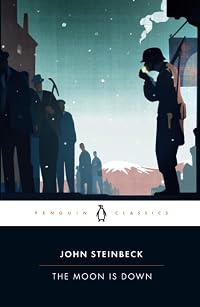
When the enemy forces take over a small town in an unnamed country, the occupation happens so quickly that the locals are too shocked at first to react. The town is of great importance to the enemy, both for it's coal mine and it's coastal location. Colonel Lanser, the head of the invading army decides to establish his headquarters in the house of popular Mayor Orden, in hopes the inhabitants will believe the mayor is collaborating with them and decide to follow his example. But as the occupiers impose their harsh rules, first forcing the workers to continue mining coal for them, then executing a man following a mock trial, the inhabitants begin to form a resistance.
This short novel was reportedly written as a piece of propaganda show more during WWII to encourage members of the resistance all over Europe and give them a guide of sorts on how to organize themselves. It was illegally published in Nazi-occupied France by a French Resistance publishing house, and then translated into several other languages and widely read. Several readers have stated that Steinbeck distanced himself from his usual approach with this novel because of the obvious pro-resistance stance and the didactic approach he adopted, but I disagree with this point of view. When compared with the kind of propaganda used by the Nazis during the war, which told the audience what to think (and later influenced advertising as we know it), Steinbeck's was a very subtle approach. He created complex characters, at least on the side of the occupiers; Colonel Lanser has fought in the first war and doesn't believe in what he is doing, his subordinates think of their families and hobbies, miss their homes and wish to be liked by the locals; one nearly losing his mind because of the difficulty of their situation. Steinbeck doesn't go out of his way to make a case for the occupiers either, but then, rare is the fiction writer who has come in defence of war and tyranny. His storytelling skills are evident here, with the attention to detail which characterizes his work and makes it seem so real and honest. Had the author taken a more hard-hitting approach, this piece of fiction would not have retained literary merit seven decades later, nor would it be likely that I'd have enjoyed reading it as much as I did. Recommended. show less
This short novel was reportedly written as a piece of propaganda show more during WWII to encourage members of the resistance all over Europe and give them a guide of sorts on how to organize themselves. It was illegally published in Nazi-occupied France by a French Resistance publishing house, and then translated into several other languages and widely read. Several readers have stated that Steinbeck distanced himself from his usual approach with this novel because of the obvious pro-resistance stance and the didactic approach he adopted, but I disagree with this point of view. When compared with the kind of propaganda used by the Nazis during the war, which told the audience what to think (and later influenced advertising as we know it), Steinbeck's was a very subtle approach. He created complex characters, at least on the side of the occupiers; Colonel Lanser has fought in the first war and doesn't believe in what he is doing, his subordinates think of their families and hobbies, miss their homes and wish to be liked by the locals; one nearly losing his mind because of the difficulty of their situation. Steinbeck doesn't go out of his way to make a case for the occupiers either, but then, rare is the fiction writer who has come in defence of war and tyranny. His storytelling skills are evident here, with the attention to detail which characterizes his work and makes it seem so real and honest. Had the author taken a more hard-hitting approach, this piece of fiction would not have retained literary merit seven decades later, nor would it be likely that I'd have enjoyed reading it as much as I did. Recommended. show less
“Anything that just costs money is cheap.”
― John Steinbeck
A man does not need money to get what he needs or wants in Tortilla Flat. Everything - from jugs of wine to the amorous affections of some of the local women - can be bartered for, begged for, shared, and borrowed. But now a wonderful and terrible thing has happened. Young Danny, unfettered by such soul-sucking things like possessions, money and a roof, has come into property. His grandfather, that viejo, has died and bequeathed to Danny, his favorite grandson – his only grandson – not one, but two houses in Tortilla Flat in Monterey. What was his abuelo thinking to burden poor Danny with such responsibilities? Danny gets used to having a roof over his head and his show more friends, those noble – and until now – homeless - paisanos, Pilon, Pablo, Jesus Maria, all eventually come to share Danny’s roof. They even decide that the Pirate, with his suspected hidden treasure and his ability to garner food, is also in need of Danny’s roof and their watchful eye. The Pirate’s five dogs, his fiercely loyal canines, are welcome guests too as long as they stay in their corner. This unusual family of paisanos is happy now. Adventures are embarked upon – individually and as a group. This rag-tag group of paisanos is living the life! For what does one need for happiness in Tortilla Flat but a jug of wine drunk from fruit jar glasses, a warm fire in the stove, and the lively conversations of one’s friends at day's end? The only thing needed to elevate a pleasant evening such as this to a truly great and memorable one is a nice, lively fight (after all, what is a nice little brawl between friends?). And Danny. The paisanos need Danny. It’s a shame that Danny does not know this.
Tortilla Flat has the wonderful Steinbeck humor I love. It is full of his astute and satirical observations: “Two gallons is a great deal of wine, even for two paisanos. Spiritually, the jugs may be graduated thus: Just below the shoulder of the first bottle, serious and concentrated conversation. … A thumb every other song each one knows. The graduations stop here, for the trail splits and there is no certainty. From this point on anything can happen.” In my opinion, not quite as funny as Cannery Row or Sweet Thursday, but it certainly has its moments. I loved the way the simple-minded and sweet Pirate outsmarts his paisano amigos with his – well - simple- mindedness. The story of the Pirate and his homage to St. Francisco – by both him and his fiercely loyal and, as fate would have it, spiritually devout, dogs - was the highlight of the story for me and worth the price of admission. show less
― John Steinbeck
A man does not need money to get what he needs or wants in Tortilla Flat. Everything - from jugs of wine to the amorous affections of some of the local women - can be bartered for, begged for, shared, and borrowed. But now a wonderful and terrible thing has happened. Young Danny, unfettered by such soul-sucking things like possessions, money and a roof, has come into property. His grandfather, that viejo, has died and bequeathed to Danny, his favorite grandson – his only grandson – not one, but two houses in Tortilla Flat in Monterey. What was his abuelo thinking to burden poor Danny with such responsibilities? Danny gets used to having a roof over his head and his show more friends, those noble – and until now – homeless - paisanos, Pilon, Pablo, Jesus Maria, all eventually come to share Danny’s roof. They even decide that the Pirate, with his suspected hidden treasure and his ability to garner food, is also in need of Danny’s roof and their watchful eye. The Pirate’s five dogs, his fiercely loyal canines, are welcome guests too as long as they stay in their corner. This unusual family of paisanos is happy now. Adventures are embarked upon – individually and as a group. This rag-tag group of paisanos is living the life! For what does one need for happiness in Tortilla Flat but a jug of wine drunk from fruit jar glasses, a warm fire in the stove, and the lively conversations of one’s friends at day's end? The only thing needed to elevate a pleasant evening such as this to a truly great and memorable one is a nice, lively fight (after all, what is a nice little brawl between friends?). And Danny. The paisanos need Danny. It’s a shame that Danny does not know this.
Tortilla Flat has the wonderful Steinbeck humor I love. It is full of his astute and satirical observations: “Two gallons is a great deal of wine, even for two paisanos. Spiritually, the jugs may be graduated thus: Just below the shoulder of the first bottle, serious and concentrated conversation. … A thumb every other song each one knows. The graduations stop here, for the trail splits and there is no certainty. From this point on anything can happen.” In my opinion, not quite as funny as Cannery Row or Sweet Thursday, but it certainly has its moments. I loved the way the simple-minded and sweet Pirate outsmarts his paisano amigos with his – well - simple- mindedness. The story of the Pirate and his homage to St. Francisco – by both him and his fiercely loyal and, as fate would have it, spiritually devout, dogs - was the highlight of the story for me and worth the price of admission. show less
Collected here for the first time in a deluxe paperback volume are six of Nobel Prize winner John Steinbeck’s most widely read and beloved short novels— Tortilla Flat , The Red Pony , Of Mice and Men , The Moon Is Down , Cannery Row and The Pearl . From Steinbeck’s tale of commitment, loneliness, and hope in Of Mice and Men , to his tough yet charming portrait of people on the margins of Monterey society in Cannery Row , to The Pearl ’s mythic examination of the fallacy of the American dream, Steinbeck created stories that were realistic, rugged, and imbued with energy and resilience.
I'm taking my time with this collection and savoring every word. The feel of the collection is wonderful in your hands, and each story is as good as the last. I will try to review as I go.
Tortilla Flat is a wonderfully hilarious, saddening, and well written novel. You grow to love each character despite himself. It's amusing to look into the minds of some who are so obviously selfish and completely unaware of themselves, and how they turn their selfishness into what they see as good friendship. In the end though, you can see that they all really love each other and grow as people, and for this reason the end is a bit heartbreaking.
The Red Pony will be a tough read for any animal lover, or anyone who doesn't like descriptive scenes of... show more gore, I suppose, is the right word for it. Nothing that doesn't fit or was thrown in for shock effect, but still a difficult pill to swallow. I feel as though this was an unfinished work, but I don't know for sure. Something about the ending doesn't feel just right. But I do like that Steinbeck hints that the last few years have really led Jody to become closer to manhood.
Of Mice & Men is of course a classic. Even if someone doesn't know John Steinbeck from Steven King they will know something about Mice & Men. I first read this in high school and while I remembered I liked it and the jist of the storyline, I had forgotten a lot of it. My mind is no steel trap, especially when it comes to books unfortunately. Re-reading it was just as incredible, if not more so, the second time around. I think this should be recommended reading for everyone in high school, as it is such a raw look at the ups and downs of humanity and existence. The whole cast of characters is so alive and varying and, I know I use this word a lot, realistic. And even the worst people have a shred of humanity in them, of hurt or pain or longing. It's a wonderful, heartbreaking, incredible story for all ages and should be read and re-read.
The Moon is Down:
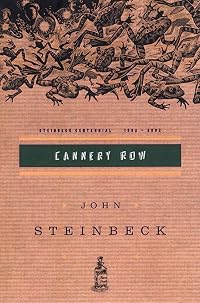
Cannery Row:
The Pearl: show less
Tortilla Flat is a wonderfully hilarious, saddening, and well written novel. You grow to love each character despite himself. It's amusing to look into the minds of some who are so obviously selfish and completely unaware of themselves, and how they turn their selfishness into what they see as good friendship. In the end though, you can see that they all really love each other and grow as people, and for this reason the end is a bit heartbreaking.
The Red Pony will be a tough read for any animal lover, or anyone who doesn't like descriptive scenes of... show more gore, I suppose, is the right word for it. Nothing that doesn't fit or was thrown in for shock effect, but still a difficult pill to swallow. I feel as though this was an unfinished work, but I don't know for sure. Something about the ending doesn't feel just right. But I do like that Steinbeck hints that the last few years have really led Jody to become closer to manhood.
Of Mice & Men is of course a classic. Even if someone doesn't know John Steinbeck from Steven King they will know something about Mice & Men. I first read this in high school and while I remembered I liked it and the jist of the storyline, I had forgotten a lot of it. My mind is no steel trap, especially when it comes to books unfortunately. Re-reading it was just as incredible, if not more so, the second time around. I think this should be recommended reading for everyone in high school, as it is such a raw look at the ups and downs of humanity and existence. The whole cast of characters is so alive and varying and, I know I use this word a lot, realistic. And even the worst people have a shred of humanity in them, of hurt or pain or longing. It's a wonderful, heartbreaking, incredible story for all ages and should be read and re-read.
The Moon is Down:
Cannery Row:
The Pearl: show less
Picked up the collection so I could read Cannery Row while visiting Monterey. Imagining the old Cannery Row while visiting the tourist trap it has become was a little bewildering, but fun, too, with the tasteful placards and quotes from the book along the recreation trail. I got a real kick out of the story, though was sent off balance by the finish.
Started The Pearl and was captivated, but ran out of time on this book borrowed from the local library.
Started The Pearl and was captivated, but ran out of time on this book borrowed from the local library.
Members
- Recently Added By
Author Information

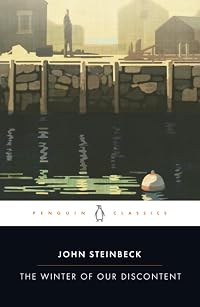
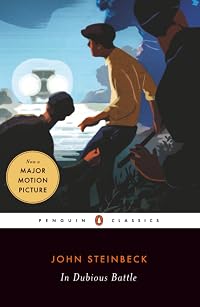
In recent years Steinbeck has been elevated to a more prominent status among American writers of his generation. If not quite at the world-class artistic level of a Hemingway or a Faulkner, he is nonetheless read very widely throughout the world by readers of all ages who consider him one of the most "American" of writers. Born in Salinas County, show more California on February 27, 1902, Steinbeck was of German-Irish parentage. After four years as a special student at Stanford University, he went to New York, where he worked as a reporter and as a hod carrier. Returning to California, he devoted himself to writing, with little success; his first three books sold fewer than 3,000 copies. Tortilla Flat (1935), dealing with the paisanos, California Mexicans whose ancestors settled in the country 200 years ago, established his reputation. In Dubious Battle (1936), a labor novel of a strike and strike-breaking, won the gold medal of the Commonwealth Club of California. Of Mice and Men (1937), a long short story that turns upon a melodramatic incident in the tragic friendship of two farm hands, written almost entirely in dialogue, was an experiment and was dramatized in the year of its publication, winning the New York Drama Critics Circle Award. It brought him fame. Out of a series of articles that he wrote about the transient labor camps in California came the inspiration for his greatest book, The Grapes of Wrath (1939), the odyssey of the Joad family, dispossessed of their farm in the Dust Bowl and seeking a new home, only to be driven on from camp to camp. The fiction is punctuated at intervals by the author's voice explaining this new sociological problem of homelessness, unemployment, and displacement. As the American novel "of the season, probably the year, possibly the decade," it won the Pulitzer Prize in 1940. It roused America and won a broad readership by the unusual simplicity and tenderness with which Steinbeck treated social questions. Even today, The Grapes of Wrath remains alive as a vivid account of believable human characters seen in symbolic and universal terms as well as in geographically and historically specific ones. Ma Joad is one of the most memorable characters in twentieth-century American fiction. It is her courage that sustains the family. Steinbeck's best and most ambitious novel after The Grapes of Wrath is East of Eden (1952), a saga of two American families in California from before the Civil War through World War I. Cannery Row (1945), The Wayward Bus (1947), and Sweet Thursday (1955) are lighter works that find Steinbeck returning to the lighthearted tone of Tortilla Flat as he recounts picaresque adventures of modern-day picaros. The Winter of Our Discontent (1961) struck some reviewers as being appropriately titled because of its despairing treatment of humanity's fall from grace in a wasteland world where money is king. Steinbeck also wrote important nonfiction, including Russian Journal (1948) in collaboration with the photographer Robert Capa; Once There Was a War (1958) and America and Americans (1966), which features pictures by 55 leading photographers and a 70-page essay by Steinbeck. His interest in marine biology led to two books primarily about sea life, Sea of Cortez (1941) (with Edward F. Ricketts) and The Log from the Sea of Cortez (1951). Travels with Charley (1962) is an engaging account of his journey of rediscovery of America, which took him through approximately 40 states. Steinbeck was married three times and died in New York City on December 20, 1968 of heart disease and congestive heart failure. He was 66, and had been a life-long smoker. (Bowker Author Biography) show less
Series
Belongs to Publisher Series
Work Relationships
Common Knowledge
- Canonical title
- The Short Novels
- Original publication date
- 1953-01
- First words
- [Introduction] For something like twenty years now critical lightning has been playing around the head of John Steinbeck, and the thunder of the pundits has echoed in the literary quarterlies.
This is the story of Danny and of Danny's friends and of Danny's house. - Last words
- (Click to show. Warning: May contain spoilers.)And the music of the pearl drifted to a whisper and disappeared.
- Original language
- English
- Canonical DDC/MDS
- 813.5
Classifications
Statistics
- Members
- 2,058
- Popularity
- 10,053
- Reviews
- 18
- Rating
- (4.21)
- Languages
- Dutch, English, German
- Media
- Paper, Ebook
- ISBNs
- 16
- ASINs
- 41