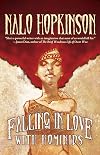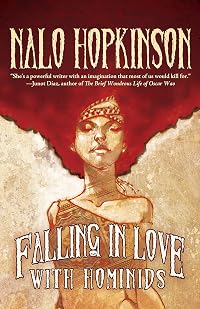
Falling in Love with Hominids
by Nalo Hopkinson
On This Page
Description
"In this long-awaited collection, Hopkinson continues to expand the boundaries of culture and imagination. Whether she is retelling The Tempest as a new Caribbean myth, filling a shopping mall with unfulfilled ghosts, or herding chickens that occasionally breathe fire, Hopkinson continues to create bold fiction that transcends boundaries and borders."--Back cover.Tags
Recommendations











Member Reviews
Nalo Hopkinson has been on my radar as an author I need to read for awhile but I hadn't, so as soon as I saw this title, I knew I had to request it. I'm not normally a giant fan of short stories, preferring longer works as a way to really get into a story. So I was very pleased that I fell into this collection and if not out-right loved every story, at least liked them all.
As with any short story collection, there are some gems that shine brighter than others. Hopkinson tells stories where the magical is ordinary; stories that show the best and the worst of human nature; stories that are uplifting, horrifying, or sad in turn. She makes the reader check his or her assumptions on humanity, on sexuality, on race, and on reality. In short, show more she writes what speculative fiction should be at its best.
Some of my favorites:
The collection starts off with a bang with "The Easthound," a story of a group of children just trying to survive in a world where growing up means becoming a monster.
"Message in a Bottle" explores what exactly is art.
"The Smile on the Face" is the story of the power of mythology and the power of womanhood.
"Left Foot, Right" is about loss, redemption, and survival.
"Old Habits" takes a peek at the lives of ghosts.
"A Raggy Dog, a Shaggy Dog" is about how hard it is to find love... and orchids.
"Flying Lessons" broke my heart once I understood it.
"Blushing" is the familiar tale of Bluebeard... or is it?
A fantastic collection that any speculative fiction fan should read.
Review copy courtesy of the publisher via Netgalley show less
As with any short story collection, there are some gems that shine brighter than others. Hopkinson tells stories where the magical is ordinary; stories that show the best and the worst of human nature; stories that are uplifting, horrifying, or sad in turn. She makes the reader check his or her assumptions on humanity, on sexuality, on race, and on reality. In short, show more she writes what speculative fiction should be at its best.
Some of my favorites:
The collection starts off with a bang with "The Easthound," a story of a group of children just trying to survive in a world where growing up means becoming a monster.
"Message in a Bottle" explores what exactly is art.
"The Smile on the Face" is the story of the power of mythology and the power of womanhood.
"Left Foot, Right" is about loss, redemption, and survival.
"Old Habits" takes a peek at the lives of ghosts.
"A Raggy Dog, a Shaggy Dog" is about how hard it is to find love... and orchids.
"Flying Lessons" broke my heart once I understood it.
"Blushing" is the familiar tale of Bluebeard... or is it?
A fantastic collection that any speculative fiction fan should read.
Review copy courtesy of the publisher via Netgalley show less
In the foreword to Falling in Love with Hominids, Nalo Hopkinson writes that as a teen she despaired of the human race. I remember that feeling; perhaps as recently as last week. Then again, I also empathize with her closing line, “so part of the work of these past few decades of my life has been the process of falling in love with hominids.“
Me too, Ms. Hopkinson. Me too.
This is an imaginative, provocative collection of stories that reflect the complexities of human existence, the moments of good and the impulses of bad. The collection contains eighteen pieces that were written over the course of years, some written to specific themes, and published in variety of venues. Each piece has a short introduction that generally provides show more background to the story, usually in regards to the story influences. “Shift,” for instance, mentions Peter Straub, “Ours Is the Prettiest” gives some background to Bordertown, while “Delicious Monster” mentions the plant that inspired it. I appreciate the information and the variety of insights; anthologies that are presented without context often feel disjointed, while authors that provide long explanations for the story origins distract from the actual pieces.
And what a collection this is. Explaining the subject and emotion of her works is challenging–I don’t read much in the literary fiction genre, and there aren’t many like her in sci-fi and fantasy. It’s rather like Octavia Butler sat down to brainstorm with Angela Carter in a beach cottage rented from Jeff Vandermeer. Though the stories draw on fantastical elements, they are usually written in contemporary setting with folk-tale structure. A few have a pronounced horror feel, such as “Blushing,” which clearly originates with the Bluebeard tale. “The Easthound” opens with a look at a post-apocalypse life of a group of children starving themselves, hoping that by preventing puberty they prevent the dreaded “sprout.” Others are more balanced, but still flirt with the awful. In “Soul Case,” a group of indigenous people protecting themselves against invasion at great cost. The ghosts in “Old Habits” are forced to relive the moments of their death every day–in a shopping mall. Beauty, horror, sacrifice, sexuality, miracles and greed are all wrapped up together.
Hopkinson’s stories frequently reflect her upbringing in the Caribbean, drawing upon a diversity of mythology, language and cultures not often seen in sci-fi and fantasy. The inclusion gives a chance to integrate issues from the various backgrounds without feeling didactic. “Ours is the Prettiest” has a glancing look at domestic abuse in lesbian relationships. In”The Smile on the Face,” a self-conscious teenage Gilla asks her mother for micro-braids, indirectly raising the volatile topic of ‘nappy hair:’
“Her mum came over, put her warm palms gently on either side of Gilla’s face and looked seriously into her eyes… “you want to tame your hair,’ her mother said… ‘You want hair that lies down and plays dead, and you want to pay a lot of money for it.”
There were a few missteps for me. Possibly it is me and the short story form; I’m impatient with stories that clearly feel like an exercise in cleverness, such as “Snow Day” which was a challenge to reference certain works. “Message in a Bottle” has the feel of a budding novella, and the truncated ending did a disservice both to the fascinating sci-fi concepts and the desperate emotion of one of the characters.
The writing is lovely, vivid; sometimes challenging when it integrates the patois of the multi-lingual. Sometimes its playful, particularly in “Emily Breakfast,” which centers on a talented cat and a missing chicken. Sometimes the language is clear but its the ideas that cause mind-stretch, as when a time-traveler tries to explain a particular shell:
“Every shell is a life journal, made out of the very substance of its creator, and left as a record of what it thought, even if we can’t understand exactly what it thought. Sometimes interpretation is a trap. Sometimes we need to simply observe.“
Well said. show less
Me too, Ms. Hopkinson. Me too.
This is an imaginative, provocative collection of stories that reflect the complexities of human existence, the moments of good and the impulses of bad. The collection contains eighteen pieces that were written over the course of years, some written to specific themes, and published in variety of venues. Each piece has a short introduction that generally provides show more background to the story, usually in regards to the story influences. “Shift,” for instance, mentions Peter Straub, “Ours Is the Prettiest” gives some background to Bordertown, while “Delicious Monster” mentions the plant that inspired it. I appreciate the information and the variety of insights; anthologies that are presented without context often feel disjointed, while authors that provide long explanations for the story origins distract from the actual pieces.
And what a collection this is. Explaining the subject and emotion of her works is challenging–I don’t read much in the literary fiction genre, and there aren’t many like her in sci-fi and fantasy. It’s rather like Octavia Butler sat down to brainstorm with Angela Carter in a beach cottage rented from Jeff Vandermeer. Though the stories draw on fantastical elements, they are usually written in contemporary setting with folk-tale structure. A few have a pronounced horror feel, such as “Blushing,” which clearly originates with the Bluebeard tale. “The Easthound” opens with a look at a post-apocalypse life of a group of children starving themselves, hoping that by preventing puberty they prevent the dreaded “sprout.” Others are more balanced, but still flirt with the awful. In “Soul Case,” a group of indigenous people protecting themselves against invasion at great cost. The ghosts in “Old Habits” are forced to relive the moments of their death every day–in a shopping mall. Beauty, horror, sacrifice, sexuality, miracles and greed are all wrapped up together.
Hopkinson’s stories frequently reflect her upbringing in the Caribbean, drawing upon a diversity of mythology, language and cultures not often seen in sci-fi and fantasy. The inclusion gives a chance to integrate issues from the various backgrounds without feeling didactic. “Ours is the Prettiest” has a glancing look at domestic abuse in lesbian relationships. In”The Smile on the Face,” a self-conscious teenage Gilla asks her mother for micro-braids, indirectly raising the volatile topic of ‘nappy hair:’
“Her mum came over, put her warm palms gently on either side of Gilla’s face and looked seriously into her eyes… “you want to tame your hair,’ her mother said… ‘You want hair that lies down and plays dead, and you want to pay a lot of money for it.”
There were a few missteps for me. Possibly it is me and the short story form; I’m impatient with stories that clearly feel like an exercise in cleverness, such as “Snow Day” which was a challenge to reference certain works. “Message in a Bottle” has the feel of a budding novella, and the truncated ending did a disservice both to the fascinating sci-fi concepts and the desperate emotion of one of the characters.
The writing is lovely, vivid; sometimes challenging when it integrates the patois of the multi-lingual. Sometimes its playful, particularly in “Emily Breakfast,” which centers on a talented cat and a missing chicken. Sometimes the language is clear but its the ideas that cause mind-stretch, as when a time-traveler tries to explain a particular shell:
“Every shell is a life journal, made out of the very substance of its creator, and left as a record of what it thought, even if we can’t understand exactly what it thought. Sometimes interpretation is a trap. Sometimes we need to simply observe.“
Well said. show less
Falling in love with hominids - despite our many failings.
(Full disclosure: I received a free electronic ARC for review through NetGalley. Trigger warning for sexual assault. The individual story summaries contain general plot details and/or vague spoilers. If you're rather approach the collection with unsullied eyes, skip these.)
"Millie liked sleeping with the air on her skin, even though it was dangerous out of doors. It felt more dangerous indoors, what with everyone growing up."
("The Easthound")
"Who knows what a sea cucumber thinks of the conditions of its particular stretch of ocean floor?"
("Message in a Bottle")
Confession time: This is my very first time reading Nalo Hopkinson, despite the fact that I've collected several of her show more novels over the years. (So many books, so little time!) Given how much I enjoyed Falling in Love with Hominids, I aim to rectify this ASAP.
Falling in Love with Hominids is Hopkinson's second collection of short fiction, published some fourteen years after Skin Folk. She's also edited/contributed to four others: Whispers from the Cotton Tree Root: Caribbean Fabulist Fiction (2000); Mojo: Conjure Stories (2003); So Long Been Dreaming: Postcolonial Science Fiction & Fantasy (2004); and Tesseracts Nine: New Canadian Speculative Fiction (2005). Born in Jamaica and raised in a middle/creative class literary environment, Hopkinson moved to Toronto at the age of sixteen and currently lives in Riverside, California. Her work often draws on Caribbean history and language, and exhibits wonderful diversity: gender, race, sexuality, nationality, you name it.
These hallmarks are on full display in Falling in Love with Hominids, which features eighteen new and previously published tales. An eclectic mix of fantasy, science fiction, magical realism, fairy tale retellings, and the outright absurd, the stories found here are both highly entertaining and marvelously profound. The protagonists grapple with a variety of issues, from the mundane to the otherworldly: navigating the perilous landscape of adolescence; the politics of black hair; sexual abuse and assault; racism, misogyny, and homophobia; grief and loss; what it means to be human (and whether this status can even be relegated to humans); and the possibilities of alien visitation and botanic sentience.
Ever since starting the Dive Into Diversity reading challenge this year, I've made it a point to take notes on diverse characters in my reads. After the first three stories in Falling in Love with Hominids, I nearly gave up - diversity is the rule here, not the exception, as is so often the case. Only three stories don't feature a character who is explicitly non-white, LGBTQ, disabled, etc.; and in these cases, the cast is rather small, and race isn't mentioned at all.
The other fifteen stories showcase casts that are as diverse as the plots are imaginative; characters who are black, Native American (Rosebud Sioux, to be exact), Indian, Latino, Armenian (maybe), and biracial; multiple gay and lesbian protagonists, some in committed relationships, others not - one gay man even recently out of the closet, after a decades-long marriage that resulted in children; interracial relationships and blended families; fat women and seemingly disabled children. In a refreshing change of page, it's white, heterosexual characters who are the rarity.
As is the case with most anthologies, I enjoyed some stories more than others. Even so, there isn't a single dud here: every story is enjoyable enough, though it's true that some will stick with me much longer than others.
** begin spoilers **
"The Easthound" - In Millie and Jolly's world, adolescence is a time fraught with danger and despair - for it's when kids mature that they begin to "sprout." Like their parents (all dead now) at the outset of the pandemic, teenagers transform into monsters seemingly overnight: rapidly growing, ravenous cannibal creatures that are a strange mix of those two horror movie staples, zombies and werewolves. Though they burn out quickly - done in by their taxing metabolism - usually they survive just long enough to crack open the skulls (or chests, or abdominal cavities) of their friends and loved ones. For this reason, most warrens of children exile their more mature members. When Millie wakes one morning to find what passes for Jolly's bed empty, she goes out in search of her twin. Wonderfully creepy, and an apt metaphor for the teenage years. 5/5 stars.
"Soul Case" - This historically-inspired fantasy (Hopkinson first devised this story while writing her upcoming novel Blackheart Man, about a "maroon" community of escaped slaves set several hundred years in the future) features a magical battle between the Garfun village and their more well-armed invaders. The three "Knowledgables" are able to thwart the attack, but not without great cost to one of the witches - who, before the day is done, will sacrifice herself to save her community from karmic retribution. 5/5 stars (and Blackheart Man cannot get here soon enough!).
"Message in a Bottle" - In an attempt to protect the significant treasures of the past, future humans send genetically modified human clones back in time to pose as children and act as "curators" of a sort. Due to their unusual features, these time travelers are mistaken for disabled, contemporary humans (Delayed Growth Syndrome, or DGS kids) and are often marginalized: not only do they look odd, they act a little off too. That's because they're really adults, outfitted with the memories and knowledge of their Originals. Greg's niece Kamla is one such future anthropologist: and it's a piece in his exhibit that she's sworn to protect. With ruminations on philosophy, art, and the very nature of what it means to be human, this is a weighty read - but a fun one, too! The animal lover in me especially appreciated Kamla's take on sea cucumbers and molluscs. 5/5 stars, and then some.
"The Smile on the Face" - Rooted (see what I did there?) in the story of Margaret of Antioch, teenager Gilla channels the spirit of the half-dead cherry tree in her front yard to fend off a sexual assault. There's so, so much to love about this story.
The ancient tree began talking to Gilla when she hit puberty and started to "fill out"; her large breasts and butt frequently make her the target of unwanted male attention, while her ample belly and unruly hair prove additional sources of stress. (In one especially memorable exchange, Gilla begs her mom - a Professor of African and Middle Eastern Studies - for micro-braids: “You want hair that lies down and plays dead, and you want to pay a lot of money for it, and you want to do it every six weeks.”)
Naturally the class predator Roger begins his campaign against Gilla by spreading rumors and slut-shaming before graduating to sexual assault and attempted rape - during a game of Postman, no less. When Gilla publicly accuses him of rape, nearly everyone rushes to her defense - save for Gossip Girl Clarissa, to whom Gilla makes this promise: "if something bad ever happens to you and nobody will believe your side of the story, you can talk to me. Because I know what it's like." Young women supporting other young women? Love. 5/5 stars.
"Left Foot, Right" - In the tradition of fairy tale heroines who always seem to suffer some form of foot trouble, Jenna continues to limp around town in one battered pump weeks after the death of her sister, Zuleika - to whom the shoes originally belonged. (The girls were fighting over the footwear when their car swerved off the road and into a river. I can relate, in a way; decades after the fact, my right hand still bears a scar from when my younger sister Meesh cut me with my own cheap plastic ballet slipper.) Every week Jenna revisits the site of the accident, tossing a brand-new pair of pumps into the water as an offering. But only when Jenna confronts the second life lost that day can she and her sister finally move on. I love reimagined fairy tales, and this one's no exception. 5/5 stars.
"Old Habits" - A spirit remains tethered to the place its body died - and in "Old Habits," that place is the mall. Every day the ghosts are forced to relive their deaths. Not that they mind, or at least not as much as you'd think; for these morbid reruns are their only chance to experience the trappings of corporeal existence. This story's great on its own - the narrator's death scene is an exercise in tragicomedy - but it's Black Anchor Ohsweygian's demise that really struck a chord with me. (A homeless woman killed by an overzealous mall cop - how timely.) 5/5 stars.
"Emily Breakfast" - When one of their three fire-breathing chickens ("Chickens are descended from dragons, you idiot.") goes missing, it's up to Cranston and Sir Maracle's flying cat, Rose of Sharon, to hunt down the kidnapper and bring Emily Breakfast home. I loved the unusual menagerie of animals, but the overall tone is a little too cutesy-fantastical for my taste. At least Breakfast, Lunch, and Dinner are rescue chickens though? 3/5 stars.
"Herbal" - After an elephant rampages through her apartment, Jenny finds that she misses the big guy. Fun and weirdly absurd (floating pachyderms!), but a little on the short side. 3/5 stars.
"A Young Candy Daughter" - You think being a parent is hard? Try raising a young God (a black girl named La'Shawna ftw!), learning how to do good in the world. Think: that one episode of The X-Files where Mulder tries to craft the perfect wish. 5/5 stars.
"A Raggy Dog, a Shaggy Dog" - Tammy Griggs is a fat ("Lots of surface for my tattoos.") botanist who discovers that one of her orchids has hijacked a rat, modifying its anatomy to transform it into the ultimate urban pollinator - so naturally, she decides to use this new species to find a date of her own. It's a win-win! Well, except for the poor robo-rat. 4/5 stars, mostly because the rodents broke my heart. Rats and mice rock, okay.
"Shift" - Hopkinson describes this as "a paradigm shift on The Tempest." I haven't read the source material, but no matter: I enjoyed "Shift" just the same. Caliban fled from his mother Sycorax, who's confined to the sea. Immediately upon washing ashore, he meets his new girlfriend, an unnamed white woman who wears her golden hear in plaits and (he thinks) has a thing for black men (much like Miranda). But his sister Ariel is in hot pursuit, determined to deliver Mother's favorite child back to her. Caliban, who transforms into the man (or boy, in mom's case) the women in his life picture him to be. When confronted by Sycorax and Ariel, the new woman unexpectedly challenges Caliban: "Who do you think you are?" 5/5 stars.
"Delicious Monster" - After a life spent living in the closet, Carlos has finally found happiness. The bad news? It's with a God who must soon depart, in order to fulfill an ancient promise between two families. A rumination on parents and children, and the passing of torches. 4/5 stars.
"Snow Day" - Ships from another world appear in the midst of a Toronto winter and ask the Earth's animals - human and non - to make a choice: are you an Adventurer or a Beautiful Loser? Hopkinson's submission to the Canada Reads Project, this short story incorporates the titles of that year's five shortlisted novels: Beautiful Losers by Leonard Cohen; No Crystal Stair by Mairuth Sarsfield; Rockbound by Frank Parker Day; Volkswagon Blues by Jacques Pulin; and - my favorite - Margaret Atwood's Oryx and Crake. "Oh, hell yeah. I used 'oryx and crake' in a sentence." I cheered. 4/5 stars, mostly because I wanted more.
"Flying Lessons" - Learning to leave your body during sexual abuse...I think? It's a short and obscure one. 4/5 stars.
"Whose Upward Flight I Love" - In which the park service wrestles with trees fighting to break free of the ground to which they've been tethered and return to their homeland. I think this is a metaphor for romantic relationships, but damned if I know. 3/5 stars.
"Blushing" - This retelling of the Bluebeard folktale sees the nobleman marrying a woman who, much to his surprise and delight, is as depraved as he. The twist really caught me by surprise. 4/5 stars.
"Ours Is the Prettiest" - This short story is Hopkinson's contribution to the shared-world anthology Bordertown, recently revived by Ellen Kushner and Holly Black (submission solicited by same). This is the first I've heard of it, so I was a little in the dark. Though the characters and their backstories eluded me, I still found the tale enjoyable enough and (mostly) easy to follow. It takes place on Jou'vert, the annual parade that kicks off the week-long Jamboree. Damiana is trying to keep Beti away from Gladstone, her paramour of several weeks who's prone to fits of jealousy and violence, and is currently in a fit because she spotted Beti talking to another woman. But it's not Gladstone Beti's worried about - not when she's being pursued by her brother from the Other Side. 4/5 stars.
"Men Sell Not Such in Any Town" - In which the rich want nothing more than to want more, and are willing to pay handsomely for the privilege. Masochism, delivered by robots. 3/5 stars.
** end spoilers **
I struggled for the better part of a week with the overall rating for this anthology. Normally, I try to average out each individual story rating; given the number of threes here, I'd normally give Falling in Love with Hominids four stars overall. But the best stories are so damn shiny that I just couldn't bring myself to do it! "Message in a Bottle," "The Smile on the Face," and "A Young Candy Daughter" are all so lovely and memorable and downright trenchant that they could carry the collection on their own. If they had to, which they don't.
Final verdict: 4.5 stars, rounded up to 5 where necessary.
http://www.easyvegan.info/2015/08/14/falling-in-love-with-hominids-by-nalo-hopki... show less
(Full disclosure: I received a free electronic ARC for review through NetGalley. Trigger warning for sexual assault. The individual story summaries contain general plot details and/or vague spoilers. If you're rather approach the collection with unsullied eyes, skip these.)
"Millie liked sleeping with the air on her skin, even though it was dangerous out of doors. It felt more dangerous indoors, what with everyone growing up."
("The Easthound")
"Who knows what a sea cucumber thinks of the conditions of its particular stretch of ocean floor?"
("Message in a Bottle")
Confession time: This is my very first time reading Nalo Hopkinson, despite the fact that I've collected several of her show more novels over the years. (So many books, so little time!) Given how much I enjoyed Falling in Love with Hominids, I aim to rectify this ASAP.
Falling in Love with Hominids is Hopkinson's second collection of short fiction, published some fourteen years after Skin Folk. She's also edited/contributed to four others: Whispers from the Cotton Tree Root: Caribbean Fabulist Fiction (2000); Mojo: Conjure Stories (2003); So Long Been Dreaming: Postcolonial Science Fiction & Fantasy (2004); and Tesseracts Nine: New Canadian Speculative Fiction (2005). Born in Jamaica and raised in a middle/creative class literary environment, Hopkinson moved to Toronto at the age of sixteen and currently lives in Riverside, California. Her work often draws on Caribbean history and language, and exhibits wonderful diversity: gender, race, sexuality, nationality, you name it.
These hallmarks are on full display in Falling in Love with Hominids, which features eighteen new and previously published tales. An eclectic mix of fantasy, science fiction, magical realism, fairy tale retellings, and the outright absurd, the stories found here are both highly entertaining and marvelously profound. The protagonists grapple with a variety of issues, from the mundane to the otherworldly: navigating the perilous landscape of adolescence; the politics of black hair; sexual abuse and assault; racism, misogyny, and homophobia; grief and loss; what it means to be human (and whether this status can even be relegated to humans); and the possibilities of alien visitation and botanic sentience.
Ever since starting the Dive Into Diversity reading challenge this year, I've made it a point to take notes on diverse characters in my reads. After the first three stories in Falling in Love with Hominids, I nearly gave up - diversity is the rule here, not the exception, as is so often the case. Only three stories don't feature a character who is explicitly non-white, LGBTQ, disabled, etc.; and in these cases, the cast is rather small, and race isn't mentioned at all.
The other fifteen stories showcase casts that are as diverse as the plots are imaginative; characters who are black, Native American (Rosebud Sioux, to be exact), Indian, Latino, Armenian (maybe), and biracial; multiple gay and lesbian protagonists, some in committed relationships, others not - one gay man even recently out of the closet, after a decades-long marriage that resulted in children; interracial relationships and blended families; fat women and seemingly disabled children. In a refreshing change of page, it's white, heterosexual characters who are the rarity.
As is the case with most anthologies, I enjoyed some stories more than others. Even so, there isn't a single dud here: every story is enjoyable enough, though it's true that some will stick with me much longer than others.
** begin spoilers **
"The Easthound" - In Millie and Jolly's world, adolescence is a time fraught with danger and despair - for it's when kids mature that they begin to "sprout." Like their parents (all dead now) at the outset of the pandemic, teenagers transform into monsters seemingly overnight: rapidly growing, ravenous cannibal creatures that are a strange mix of those two horror movie staples, zombies and werewolves. Though they burn out quickly - done in by their taxing metabolism - usually they survive just long enough to crack open the skulls (or chests, or abdominal cavities) of their friends and loved ones. For this reason, most warrens of children exile their more mature members. When Millie wakes one morning to find what passes for Jolly's bed empty, she goes out in search of her twin. Wonderfully creepy, and an apt metaphor for the teenage years. 5/5 stars.
"Soul Case" - This historically-inspired fantasy (Hopkinson first devised this story while writing her upcoming novel Blackheart Man, about a "maroon" community of escaped slaves set several hundred years in the future) features a magical battle between the Garfun village and their more well-armed invaders. The three "Knowledgables" are able to thwart the attack, but not without great cost to one of the witches - who, before the day is done, will sacrifice herself to save her community from karmic retribution. 5/5 stars (and Blackheart Man cannot get here soon enough!).
"Message in a Bottle" - In an attempt to protect the significant treasures of the past, future humans send genetically modified human clones back in time to pose as children and act as "curators" of a sort. Due to their unusual features, these time travelers are mistaken for disabled, contemporary humans (Delayed Growth Syndrome, or DGS kids) and are often marginalized: not only do they look odd, they act a little off too. That's because they're really adults, outfitted with the memories and knowledge of their Originals. Greg's niece Kamla is one such future anthropologist: and it's a piece in his exhibit that she's sworn to protect. With ruminations on philosophy, art, and the very nature of what it means to be human, this is a weighty read - but a fun one, too! The animal lover in me especially appreciated Kamla's take on sea cucumbers and molluscs. 5/5 stars, and then some.
"The Smile on the Face" - Rooted (see what I did there?) in the story of Margaret of Antioch, teenager Gilla channels the spirit of the half-dead cherry tree in her front yard to fend off a sexual assault. There's so, so much to love about this story.
The ancient tree began talking to Gilla when she hit puberty and started to "fill out"; her large breasts and butt frequently make her the target of unwanted male attention, while her ample belly and unruly hair prove additional sources of stress. (In one especially memorable exchange, Gilla begs her mom - a Professor of African and Middle Eastern Studies - for micro-braids: “You want hair that lies down and plays dead, and you want to pay a lot of money for it, and you want to do it every six weeks.”)
Naturally the class predator Roger begins his campaign against Gilla by spreading rumors and slut-shaming before graduating to sexual assault and attempted rape - during a game of Postman, no less. When Gilla publicly accuses him of rape, nearly everyone rushes to her defense - save for Gossip Girl Clarissa, to whom Gilla makes this promise: "if something bad ever happens to you and nobody will believe your side of the story, you can talk to me. Because I know what it's like." Young women supporting other young women? Love. 5/5 stars.
"Left Foot, Right" - In the tradition of fairy tale heroines who always seem to suffer some form of foot trouble, Jenna continues to limp around town in one battered pump weeks after the death of her sister, Zuleika - to whom the shoes originally belonged. (The girls were fighting over the footwear when their car swerved off the road and into a river. I can relate, in a way; decades after the fact, my right hand still bears a scar from when my younger sister Meesh cut me with my own cheap plastic ballet slipper.) Every week Jenna revisits the site of the accident, tossing a brand-new pair of pumps into the water as an offering. But only when Jenna confronts the second life lost that day can she and her sister finally move on. I love reimagined fairy tales, and this one's no exception. 5/5 stars.
"Old Habits" - A spirit remains tethered to the place its body died - and in "Old Habits," that place is the mall. Every day the ghosts are forced to relive their deaths. Not that they mind, or at least not as much as you'd think; for these morbid reruns are their only chance to experience the trappings of corporeal existence. This story's great on its own - the narrator's death scene is an exercise in tragicomedy - but it's Black Anchor Ohsweygian's demise that really struck a chord with me. (A homeless woman killed by an overzealous mall cop - how timely.) 5/5 stars.
"Emily Breakfast" - When one of their three fire-breathing chickens ("Chickens are descended from dragons, you idiot.") goes missing, it's up to Cranston and Sir Maracle's flying cat, Rose of Sharon, to hunt down the kidnapper and bring Emily Breakfast home. I loved the unusual menagerie of animals, but the overall tone is a little too cutesy-fantastical for my taste. At least Breakfast, Lunch, and Dinner are rescue chickens though? 3/5 stars.
"Herbal" - After an elephant rampages through her apartment, Jenny finds that she misses the big guy. Fun and weirdly absurd (floating pachyderms!), but a little on the short side. 3/5 stars.
"A Young Candy Daughter" - You think being a parent is hard? Try raising a young God (a black girl named La'Shawna ftw!), learning how to do good in the world. Think: that one episode of The X-Files where Mulder tries to craft the perfect wish. 5/5 stars.
"A Raggy Dog, a Shaggy Dog" - Tammy Griggs is a fat ("Lots of surface for my tattoos.") botanist who discovers that one of her orchids has hijacked a rat, modifying its anatomy to transform it into the ultimate urban pollinator - so naturally, she decides to use this new species to find a date of her own. It's a win-win! Well, except for the poor robo-rat. 4/5 stars, mostly because the rodents broke my heart. Rats and mice rock, okay.
"Shift" - Hopkinson describes this as "a paradigm shift on The Tempest." I haven't read the source material, but no matter: I enjoyed "Shift" just the same. Caliban fled from his mother Sycorax, who's confined to the sea. Immediately upon washing ashore, he meets his new girlfriend, an unnamed white woman who wears her golden hear in plaits and (he thinks) has a thing for black men (much like Miranda). But his sister Ariel is in hot pursuit, determined to deliver Mother's favorite child back to her. Caliban, who transforms into the man (or boy, in mom's case) the women in his life picture him to be. When confronted by Sycorax and Ariel, the new woman unexpectedly challenges Caliban: "Who do you think you are?" 5/5 stars.
"Delicious Monster" - After a life spent living in the closet, Carlos has finally found happiness. The bad news? It's with a God who must soon depart, in order to fulfill an ancient promise between two families. A rumination on parents and children, and the passing of torches. 4/5 stars.
"Snow Day" - Ships from another world appear in the midst of a Toronto winter and ask the Earth's animals - human and non - to make a choice: are you an Adventurer or a Beautiful Loser? Hopkinson's submission to the Canada Reads Project, this short story incorporates the titles of that year's five shortlisted novels: Beautiful Losers by Leonard Cohen; No Crystal Stair by Mairuth Sarsfield; Rockbound by Frank Parker Day; Volkswagon Blues by Jacques Pulin; and - my favorite - Margaret Atwood's Oryx and Crake. "Oh, hell yeah. I used 'oryx and crake' in a sentence." I cheered. 4/5 stars, mostly because I wanted more.
"Flying Lessons" - Learning to leave your body during sexual abuse...I think? It's a short and obscure one. 4/5 stars.
"Whose Upward Flight I Love" - In which the park service wrestles with trees fighting to break free of the ground to which they've been tethered and return to their homeland. I think this is a metaphor for romantic relationships, but damned if I know. 3/5 stars.
"Blushing" - This retelling of the Bluebeard folktale sees the nobleman marrying a woman who, much to his surprise and delight, is as depraved as he. The twist really caught me by surprise. 4/5 stars.
"Ours Is the Prettiest" - This short story is Hopkinson's contribution to the shared-world anthology Bordertown, recently revived by Ellen Kushner and Holly Black (submission solicited by same). This is the first I've heard of it, so I was a little in the dark. Though the characters and their backstories eluded me, I still found the tale enjoyable enough and (mostly) easy to follow. It takes place on Jou'vert, the annual parade that kicks off the week-long Jamboree. Damiana is trying to keep Beti away from Gladstone, her paramour of several weeks who's prone to fits of jealousy and violence, and is currently in a fit because she spotted Beti talking to another woman. But it's not Gladstone Beti's worried about - not when she's being pursued by her brother from the Other Side. 4/5 stars.
"Men Sell Not Such in Any Town" - In which the rich want nothing more than to want more, and are willing to pay handsomely for the privilege. Masochism, delivered by robots. 3/5 stars.
** end spoilers **
I struggled for the better part of a week with the overall rating for this anthology. Normally, I try to average out each individual story rating; given the number of threes here, I'd normally give Falling in Love with Hominids four stars overall. But the best stories are so damn shiny that I just couldn't bring myself to do it! "Message in a Bottle," "The Smile on the Face," and "A Young Candy Daughter" are all so lovely and memorable and downright trenchant that they could carry the collection on their own. If they had to, which they don't.
Final verdict: 4.5 stars, rounded up to 5 where necessary.
http://www.easyvegan.info/2015/08/14/falling-in-love-with-hominids-by-nalo-hopki... show less
I found these stories, by turns, enchanting and mystical and startling, and sometimes horrifying. My favorite was the longest, and set in the Borderlands shared universe - "Ours is the Prettiest," which is worth the price of the book by itself This one brought elements of Mardi Gras together with Caribbean mythology and the tangled webs of love and jealousy and need that wind up ensnaring humans and fae alike. So much imagination and vivid imagery was stuffed into this one story, it was breathtaking. But that was true of even the shortest pieces. Many of the characters are drawn from layers of society that are often ignored or overlooked in fiction as they are in real life, as if they have no agency in their own right. But they do, and show more Nalo Hopkinson shows us just how powerful they can be. show less
A fantastic collection of stories from Hopkinson, showing the depth and range in her skill as a writer. The stories in this collection are strange, beautiful, and often unsettling. The opening story, “The Easthound,” begins with kids playing word games against an apocalyptic backdrop (a sweetspot for me). Beginning with this playful banter, the story grows more and more tense as we learn what the source of the apocalypse is. Meanwhile, “Emily Breakfast,” presents a lovely domestic normalcy, involving picking homegrown spinach, tending to the chickens — although it's a normalcy that includes cats with wings and other animal deviations. “Blushing” is a completely terrifying Bluebeard retelling. And there are many more tales show more in this collection that are equally worth exploring. show less
This was my first exposure to this author, and I was very impressed. Overall, the good stuff was VERY good, and the misses were far outnumbered by the hits. Giving a solid 4 stars for the collection, and I'll be looking for more from her.
My quick reviews of the stories:
The Easthound - outstanding start to the collection. Great post-apocalyptic story, nice and moody. 5 *'s
Soul Case - short, efficient story. I like stories that give just a glimpse of a world, without feeling like they need to give away too much. 5 *s
Message in a bottle - wow, great story, with a lot of background and follow-through that could be expanded and explored, but ends just in time to leaving me simultaneously feeling satisfied yet wanting to see more. 5 *
The show more Smile on the Face - Not as gripping as the previous stories. Servicable. 3 *'s
Left Foot, Right - Sad, touching story 4 *'s
Old Habits - What if when we die we just become ghosts where we died? And if that place was the mall? Horrifying! 4 *'s
Emily Breakfast - what a fun story with lots of little unexpected gems - 5 *'s
Herbal - I would do the same if an elephant crashed my pad - 4 *'s
A Young Candy Daughter - This might be the first story that took place in less time than it took to read. Lots of fun. 5 *'s
A Raggy Dog, a Shaggy Dog - A bit creepier than we've seen so far, but I liked it - 5 *'s
Shift - oof... first (and hopefully only) misstep. I hate stories that are told in second person, and while I've got nothing against re-tellings in general, I really get annoyed when either I don't realize that it's a retelling, or I'm not familiar enough with the source to appreciate it. Luckily, the author's intro discussed that this was based on The Tempest, which I have not read, so that earns the single *.
Delicious Monster - good one - 4 *'s
Snow Day - oooh, a story with a puzzle in it! I found 1 2/3 of the books (giving myself partial credit for one). Story itself another great tight one. 5 *'s
Flying Lessons - dreamy but unclear - 3 *'
Whose Upward Flight I Love - Fantastic Flying Firs! 4 *'
Blushing - Creepy, gory, good - 4 *'s
Ours Is the Prettiest - sadly, another one that I had to bail about halfway through. I'm not familiar with the source shared world, and it wasn't compelling enough to motivate me to finish - 2 *'s
Men Sell Not Such in Any Town - Tiny little thing to end the book. Like a shiny jewel. 4 *'s show less
My quick reviews of the stories:
The Easthound - outstanding start to the collection. Great post-apocalyptic story, nice and moody. 5 *'s
Soul Case - short, efficient story. I like stories that give just a glimpse of a world, without feeling like they need to give away too much. 5 *s
Message in a bottle - wow, great story, with a lot of background and follow-through that could be expanded and explored, but ends just in time to leaving me simultaneously feeling satisfied yet wanting to see more. 5 *
The show more Smile on the Face - Not as gripping as the previous stories. Servicable. 3 *'s
Left Foot, Right - Sad, touching story 4 *'s
Old Habits - What if when we die we just become ghosts where we died? And if that place was the mall? Horrifying! 4 *'s
Emily Breakfast - what a fun story with lots of little unexpected gems - 5 *'s
Herbal - I would do the same if an elephant crashed my pad - 4 *'s
A Young Candy Daughter - This might be the first story that took place in less time than it took to read. Lots of fun. 5 *'s
A Raggy Dog, a Shaggy Dog - A bit creepier than we've seen so far, but I liked it - 5 *'s
Shift - oof... first (and hopefully only) misstep. I hate stories that are told in second person, and while I've got nothing against re-tellings in general, I really get annoyed when either I don't realize that it's a retelling, or I'm not familiar enough with the source to appreciate it. Luckily, the author's intro discussed that this was based on The Tempest, which I have not read, so that earns the single *.
Delicious Monster - good one - 4 *'s
Snow Day - oooh, a story with a puzzle in it! I found 1 2/3 of the books (giving myself partial credit for one). Story itself another great tight one. 5 *'s
Flying Lessons - dreamy but unclear - 3 *'
Whose Upward Flight I Love - Fantastic Flying Firs! 4 *'
Blushing - Creepy, gory, good - 4 *'s
Ours Is the Prettiest - sadly, another one that I had to bail about halfway through. I'm not familiar with the source shared world, and it wasn't compelling enough to motivate me to finish - 2 *'s
Men Sell Not Such in Any Town - Tiny little thing to end the book. Like a shiny jewel. 4 *'s show less
WELL this book was awesome. Hopkinson is on my list of favourites after this one. There's so much queer stuff in these stories, in whatever sense of that word you want to use! All the stories are so different. There's a lot that is sci fi and magical realism and fantasy, and whatever weird stuff there is in between. There's girls turning into dragons, flying elephants, rat/plant hybrid creatures, gods in human form, serial killers, mythical creatures, and people of colour and queers and black culture all over the frikking place. It's a beautiful and refreshing collection and I also love the title and the cover. Hooray!
Members
- Recently Added By
Lists

Books Read in 2018
4,360 works; 110 members

Horror Books
52 works; 3 members

Vlogbrothers Book Recommendations
307 works; 4 members
Author Information

81+ Works 6,263 Members
Some Editions
Awards and Honors
Awards
Distinctions
Work Relationships
Contains
Common Knowledge
- Original publication date
- 2015-08-11
- Original language
- English
Classifications
- Genres
- Fiction and Literature, Fantasy, Science Fiction, Horror
- DDC/MDS
- 813.54 — Literature & rhetoric American literature in English American fiction in English 1900-1999 1945-1999
- LCC
- PR9199.3 .H5927 .F35 — Language and Literature English English Literature English literature: Provincial, local, etc.
- BISAC
Statistics
- Members
- 427
- Popularity
- 72,256
- Reviews
- 28
- Rating
- (3.88)
- Languages
- English
- Media
- Paper, Audiobook, Ebook
- ISBNs
- 6
- ASINs
- 4