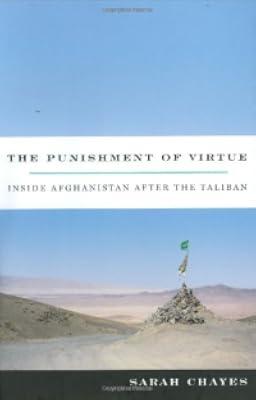
The Punishment of Virtue: Inside Afghanistan After the Taliban
by Sarah Chayes
On This Page
Description
A National Public Radio reporter covering the last stand of the Taliban in their home base of Kandahar in Afghanistan's southern borderland, Sarah Chayes became deeply immersed in the unfolding drama of the attempt to rebuild a broken nation at the crossroads of the world's destiny. Her NPR tour up in early 2002, she left reporting to help turn the country's fortunes, accepting a job running a nonprofit founded by President Hamid Karzai's brother. With remarkable access to leading players in show more the postwar government, Chayes witnessed a tragic story unfold-the perverse turn of events whereby the U.S. government and armed forces allowed and abetted the return to power of corrupt militia commanders to the country, as well as the reinfiltration of bands of Taliban forces supported by U.S. ally Pakistan. In this gripping and dramatic account of her four years on the ground, working with Afghanis in the battle to restore their country to order and establish democracy, Chayes opens Americans' eyes to the sobering realities of this vital front in the war on terror. She forged unparalleled relationships with the Karzai family, tribal leaders, U.S. military and diplomatic brass, and such leading figures in the Kandahar government as the imposing and highly effective chief of police-an incorruptible supporter of the Karzai regime whose brutal assassination in June 2005 serves as the opening of the book. Chayes lived in an Afghan home, gaining rich insights into the country's culture and politics and researching the history of Afghanistan's legendary resistance to foreign interference. She takes us into meetings with Hamid Karzai and the corrupt Kandahar governor, Gul Agha Shirzai, into the homes of tribal elders and onto the U.S. military base. Unveiling the complexities and traumas of Afghanistan's postwar struggles, she reveals how the tribal strongmen who have regained power-after years of being displaced by the Taliban-have visited a renewed plague of corruption and violence on the Afghan people, under the complicit eyes of U.S. forces and officials. The story Chayes tells is a powerful, disturbing revelation of misguided U.S. policy and of the deeply entrenched traditions of tribal warlordism that have ruled Afghanistan through the centuries. show lessTags
Recommendations

Member Reviews
Chayes went to Afghanistan after 9/11 as an NPR reporter, and stayed to work on democratization/reconstruction initiatives. She offers an account of Afghanistan’s history of being conquered and then throwing off the conquerors, mainly by resisting any central governance, though she argues that the Russian invasion changed things by being so widespread and bloody that PTSD is a dominant factor in subsequent events. She also suggests (sometimes by her own example) how American assumptions and lack of knowledge interacted with Afghan cultural practices in the worst possible way—Americans listened to the words, while Afghans looked to see who was sitting with whom, and when Americans made common cause with warlords, that spoke for show more itself. She blames Pakistani interference, and American unwillingness to recognize that their supposed allies were acting against them, for a lot of the chaos. She also details exactly what it meant for American attention to leave Afghanistan for the new Iraq war, though things weren’t exactly going swimmingly before then. The narrative ends in 2006, but you can see why the next fifteen years didn’t improve. show less
Sarah Chayes was an NPR reporter started reporting from Afghanistan in 2001. Eventually she quit her job to help found an NGO which ran development projects in Kandahar (the so-called 'capital' of the Taliban). Eventually, as the Taliban insurgency against the NATO-supported govt. began to pick up and reporters and journalists retreated "behind the wire" she became virtually the only American living in Kandahar itself. This is a chronicle of her time there between 2001 and 2005 and her assessment of what went wrong. The story starts with a funeral - that of her friend, the chief of police in Kandahar - and the author's determination to figure our how exactly he died and who killed him.
This is an outstanding book and probably the best show more look at what went wrong in the American-led occupation of Afghanistan from the ground level. Sarah Chayes herself comes across as tough, highly independent-minded, deeply sympathetic to the plight of the ordinary Afghan. Its an extraordinary book by an extraordinary person. show less
This is an outstanding book and probably the best show more look at what went wrong in the American-led occupation of Afghanistan from the ground level. Sarah Chayes herself comes across as tough, highly independent-minded, deeply sympathetic to the plight of the ordinary Afghan. Its an extraordinary book by an extraordinary person. show less
Written by journalist Sarah Chayes, this is a story about Afghanistan that is both insightful and absorbing while managing to avoid so many cliches that are dragged up by other books written by 'insiders' about Afghanistan.
Chayes originally travelled to Afghanistan as a journalist after September 2001 and remains int he country working as an aid-worker. While sometimes bewildered by a strange culture and society, she soon gains a good understanding of how things work, to the point that she is often telling the US military and Afghan political aparatus how they should be doing their job, with varying degrees of success.
This would be a very good introductory volume for a reader who wanted to understand the development of Afghanistan show more since the supposed defeat of the Taliban - it touches on the important points, including the history of Afghanistan, yet never becomes too technical or esoteric. There are extensive endnotes that will point the interested reader to other sources on the subject. show less
Chayes originally travelled to Afghanistan as a journalist after September 2001 and remains int he country working as an aid-worker. While sometimes bewildered by a strange culture and society, she soon gains a good understanding of how things work, to the point that she is often telling the US military and Afghan political aparatus how they should be doing their job, with varying degrees of success.
This would be a very good introductory volume for a reader who wanted to understand the development of Afghanistan show more since the supposed defeat of the Taliban - it touches on the important points, including the history of Afghanistan, yet never becomes too technical or esoteric. There are extensive endnotes that will point the interested reader to other sources on the subject. show less
An excellent account of the events in Afghanistan since September of 2001, by an ex-journalist who has been on the ground in the country for virtually the whole time and has been close to many of the key players, both Afghan and American.
Regardless of whether the author's analysis of the situation in Afghanistan is correct, I know a lot more about it after reading this book.
Deels gelezen. Mee gestopt omdat ik zin had in iets dat vlotter leest, maar op zich zegt dat meer over mij op dat moment dan over het boek. Ik las ca. 100 bladzijden en zal vermoedelijk nooit vergeten hoe de auteur (een Amerikaanse reporter in Afghanistan) beschrijft hoe "onvrij" haar berichtgeving is. Haar hoofdredacteur beslist was de Amerikaanse burger wil lezen en wat niet, ookal doet dat de waarheid veel oneer aan. Ze heeft een stukje naïviteit bij mij weggegomd. Misschien herneem ik het ooit nog eens.
Een persoonlijk verslag van Sarah Chayes over haar tijd in Afghanistan. Persoonlijk & inkijkje in buitenlands politiek.
Oct 15, 2010Dutch
Members
- Recently Added By
Lists

LtGen James Mattis' Reading List
58 works; 2 members

Women in Islam
120 works; 8 members
Author Information

6+ Works 575 Members
An award-winning former NPR correspondent, defense official and social entrepreneur with ten years' experience; in Afghanistan, Sarah Chayes is a senior associate at the Carnegie Endowment and the author of The Punishment of Virtue. She lives in Washington, DC.
Common Knowledge
- Original publication date
- 2006
- Important places
- Kandahar, Afghanistan; Kabul, Afghanistan; Afghanistan; Pakistan
- First words
- The road to Kahkrez is graveled now, a hard right turn off cement thick enough to bear the weight of Soviet tanks.
- Blurbers
- Coll, Steve; Junger, Sebastian
Classifications
Statistics
- Members
- 293
- Popularity
- 110,016
- Reviews
- 8
- Rating
- (4.00)
- Languages
- Dutch, English
- Media
- Paper, Audiobook, Ebook
- ISBNs
- 11
- ASINs
- 4