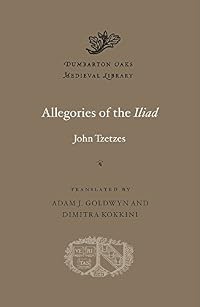
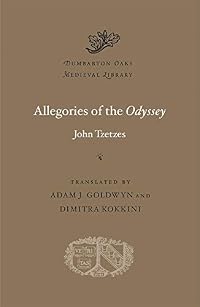
Allegories of the Iliad (Dumbarton Oaks Medieval Library)
by John Tzetzes
29 Members (5.00)
On This Page
Description
In the early 1140s, the Bavarian princess Bertha von Sulzbach arrived in Constantinople to marry the Byzantine emperor Manuel Komnenos. Wanting to learn more about her new homeland, the future empress Eirene commissioned the grammarian Ioannes Tzetzes to compose a version of the Iliad as an introduction to Greek literature and culture. He drafted a lengthy dodecasyllable poem in twenty-four books, reflecting the divisions of the Iliad, that combined summaries of the events of the siege of show more Troy with allegorical interpretations. To make the Iliad relevant to his Christian audience, Tzetzes reinterpreted the pagan gods from various allegorical perspectives. As historical allegory (or euhemerism), the gods are simply ancient kings erroneously deified by the pagan poet; as astrological allegory, they become planets whose position and movement affect human life; as moral allegory Athena represents wisdom, Aphrodite desire. As a didactic explanation of pagan ancient Greek culture to Orthodox Christians, the work is deeply rooted in the mid-twelfth-century circumstances of the cosmopolitan Comnenian court. As a critical reworking of the Iliad, it must also be seen as part of the millennia-long and increasingly global tradition of Homeric adaptation. show lessTags
Recommendations









Member Reviews
Members
- Recently Added By
Published Reviews
This new volume from the Dumbarton Oaks Medieval Library brings (on facing pages) text and English translation of a long and curious work (not represented yet in TLG) of the 12th-century polymath John Tzetzes. The editors/translators provide a short general introduction, and at the end minimal notes on the text, 35 pages of very short notes on the translation (the majority of which are show more cross-references to lines of the Iliad), a short bibliography, and an index of proper names.
Allegories of the Iliad, a poem in the 15-syllable πολιτικὸς στίχος (over 6600 of them!), is an odd mishmash that bears the marks of its checkered history. It is partly brief plot summary (ὑπόθεσις), partly extended paraphrase of the epic in simpler Greek, partly allegorical explanation of almost all divine and supernatural elements, and partly self- advertisement of the author. Tzetzes began the work as a commission for the empress Eirene (Bertha von Sulzbach, from Bavaria), wife of Manual I Komnenos, probably in the 1140s, but the elaborate Prolegomena (over 1200 lines) contain appeals for guidance from the dedicatee as to what exactly she wants the work to be. Apparently, she never gave a clear answer and eventually lost interest in the work (or in the author). The separate books in which Tzetzes summarizes and explains the books of the Iliad vary widely in length and content. After the long Prolegomena and a treatment of Book 1 in 375 lines, his Books 2-15 are much less ambitious (averaging only 149 lines each). Then at Book 16 it is revealed that the task has been taken up afresh for a new patron, Konstantinos Kotertzes, who was apparently willing to pay for more extensive and more learned material (the treatments of Books 16-24 average 330 lines each). show less
Allegories of the Iliad, a poem in the 15-syllable πολιτικὸς στίχος (over 6600 of them!), is an odd mishmash that bears the marks of its checkered history. It is partly brief plot summary (ὑπόθεσις), partly extended paraphrase of the epic in simpler Greek, partly allegorical explanation of almost all divine and supernatural elements, and partly self- advertisement of the author. Tzetzes began the work as a commission for the empress Eirene (Bertha von Sulzbach, from Bavaria), wife of Manual I Komnenos, probably in the 1140s, but the elaborate Prolegomena (over 1200 lines) contain appeals for guidance from the dedicatee as to what exactly she wants the work to be. Apparently, she never gave a clear answer and eventually lost interest in the work (or in the author). The separate books in which Tzetzes summarizes and explains the books of the Iliad vary widely in length and content. After the long Prolegomena and a treatment of Book 1 in 375 lines, his Books 2-15 are much less ambitious (averaging only 149 lines each). Then at Book 16 it is revealed that the task has been taken up afresh for a new patron, Konstantinos Kotertzes, who was apparently willing to pay for more extensive and more learned material (the treatments of Books 16-24 average 330 lines each). show less
added by cinaedus
Author Information
5+ Works 52 Members
Some Editions
Series
Belongs to Publisher Series
Classifications
- Genres
- Literature Studies and Criticism, Fiction and Literature, Poetry
- DDC/MDS
- 883.01 — Literature & rhetoric Classical & modern Greek literatures Classical Greek epic poetry and fiction Pseudo-Callisthenes
- LCC
- PA5390 .A6313 — Language and Literature Greek language and literature. Latin language and literature Byzantine and modern Greek literature Individual authors
- BISAC
Statistics
- Members
- 29
- Popularity
- 949,738
- Rating
- (5.00)
- Languages
- English
- Media
- Paper
- ISBNs
- 1