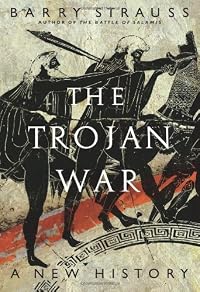
The Trojan War: A New History
by Barry S. Strauss 
On This Page
Description
"The Trojan War is the most famous conflict in history, the subject of Homer's Iliad, one of the cornerstones of Western literature. Although many readers know that this literary masterwork is based on actual events, there is disagreement about how much of Homer's tale is true. Drawing on recent archeological research, historian and classicist Barry Strauss explains what really happened in Troy more than 3,000 years ago." "Strauss shows us where Homer nods, and sometimes exaggerates and show more distorts, as well. He puts the Trojan War into the context of its time, explaining the strategies and tactics that both sides used, and compares the war to contemporary battles elsewhere in the eastern Mediterranean. With his vivid reconstructions of the conflict and his insights into the famous characters and events of Homer's great epic, Strauss tells the story of the fall of Troy as history without losing the poetry and grandeur that continue to draw readers to this ancient tale."--BOOK JACKET. show lessTags
Recommendations







Member Reviews
Arguments about whether the Trojan War actually happened may well predate Homer. Certainly they predate any existing copies of Homer, since Thucydides had trenchant comments on just what might or might not have happened.
This book isn't one of those arguments; it accepts the Trojan War as real. I wouldn't go so far as to call it a history. It's more of a projection: Take the story of the Iliad and retell it, cutting out only those parts which are clearly impossible in the light of archaeology and modern science. The result is at least 75% Homer, no more than 25% observed facts. Was there a city of Ilium (Wilusa), i.e. Troy? Certainly. Was it badly damaged, very likely sacked, around the end of the Mycenaean era in Greece? Yes. Were the show more attackers Greeks? Very possibly. Were they led by a King of Mycenae? It would make sense, since Mycenae was a very great city. Was the king's name Agamemnon? It's possible. Did he have a supporter named Achilles? We can't absolutely rule it out. Did they have a quarrel about two women whose names we know, did it result in a Trojan attack on the ships, and did that lead ultimately to the death of the Trojan prince Hector....?
Well, let's look at some realities. By all accounts, the Trojan epic and romance attributed to Homer (the Iliad is an epic; the Odyssey a romance) were composed about four hundred years after the event -- maybe more. So, for four hundred years, the story would have had to be preserved in folktales and oral epics -- the Greeks lost the skill to write after the Mycenaean era, and didn't regain it until they borrowed a new writing system hundreds of years later.
But oral history is pretty predictable: it forgets complicated facts and boils everything down to stories of individuals. Take the story of the Battle of Otterburn in 1388; the Earl of Douglas, who was raiding Northumberland, won a battle against Henry "Hotspur" Percy. The ballad of Chevy Chase, which was picked up a few hundred years later, knows of the battle but throws out all the details and ends up telling us that Percy and Douglas actually fought hand to hand -- making a battle into a series of single combats just as the Iliad is a series of single combats. Or take the Song of Roland. We know that Roland was a real noble at the time of Charlemagne. But he was just some border lord who got himself killed. By the time of the Roland, he is the greatest knight of Christendom, who defeats an entire enemy army even as he's dying -- dying not, we note, because he was overwhelmed by his enemies but because he blew his horn so loudly that he damaged his skull. Enemies couldn't kill him; he had to do it himself.
And this sort of distortion can happen quickly. There's a sea chanty, "Santy Anno," which described Santa Anna beating Zachary Taylor in the Mexican War, even though the reverse was true. That chanty was first collected less than a century after the Mexican War, in a time when written records were readily accessible.
And we're supposed to accept the accuracy of a story transmitted orally for close to half a millennium with no written support whatsoever?
This book is highly readable, even fascinating -- I breezed through it. But believable? Come on.... show less
This book isn't one of those arguments; it accepts the Trojan War as real. I wouldn't go so far as to call it a history. It's more of a projection: Take the story of the Iliad and retell it, cutting out only those parts which are clearly impossible in the light of archaeology and modern science. The result is at least 75% Homer, no more than 25% observed facts. Was there a city of Ilium (Wilusa), i.e. Troy? Certainly. Was it badly damaged, very likely sacked, around the end of the Mycenaean era in Greece? Yes. Were the show more attackers Greeks? Very possibly. Were they led by a King of Mycenae? It would make sense, since Mycenae was a very great city. Was the king's name Agamemnon? It's possible. Did he have a supporter named Achilles? We can't absolutely rule it out. Did they have a quarrel about two women whose names we know, did it result in a Trojan attack on the ships, and did that lead ultimately to the death of the Trojan prince Hector....?
Well, let's look at some realities. By all accounts, the Trojan epic and romance attributed to Homer (the Iliad is an epic; the Odyssey a romance) were composed about four hundred years after the event -- maybe more. So, for four hundred years, the story would have had to be preserved in folktales and oral epics -- the Greeks lost the skill to write after the Mycenaean era, and didn't regain it until they borrowed a new writing system hundreds of years later.
But oral history is pretty predictable: it forgets complicated facts and boils everything down to stories of individuals. Take the story of the Battle of Otterburn in 1388; the Earl of Douglas, who was raiding Northumberland, won a battle against Henry "Hotspur" Percy. The ballad of Chevy Chase, which was picked up a few hundred years later, knows of the battle but throws out all the details and ends up telling us that Percy and Douglas actually fought hand to hand -- making a battle into a series of single combats just as the Iliad is a series of single combats. Or take the Song of Roland. We know that Roland was a real noble at the time of Charlemagne. But he was just some border lord who got himself killed. By the time of the Roland, he is the greatest knight of Christendom, who defeats an entire enemy army even as he's dying -- dying not, we note, because he was overwhelmed by his enemies but because he blew his horn so loudly that he damaged his skull. Enemies couldn't kill him; he had to do it himself.
And this sort of distortion can happen quickly. There's a sea chanty, "Santy Anno," which described Santa Anna beating Zachary Taylor in the Mexican War, even though the reverse was true. That chanty was first collected less than a century after the Mexican War, in a time when written records were readily accessible.
And we're supposed to accept the accuracy of a story transmitted orally for close to half a millennium with no written support whatsoever?
This book is highly readable, even fascinating -- I breezed through it. But believable? Come on.... show less
This is not the book that I expected. Strauss, a fairly well-known Cornell historian, oscillates between historical fiction and a genuine history of the Trojan War. Part of the narrative is a retelling of the Iliad and speculative reconstruction of people and events, part discusses ancient sources and archaeological evidence. It requires a fair amount of attention to keep these separate. While there is ample archaeological evidence that the Iliad is generally based on actual events, it is unlikely that most of the details are factual in any significant way.
The Trojan War, is a very readable book, aimed at a general audience. Strauss synthesizes recent archaeological work, providing an overview of what is know and what is disputed. He show more frequently draws on surviving Bronze Age Hittite and Egyptian texts to contextualize Homer and the Trojan War, showing that the Iliad does accurately preserve many Bronze Age customs and practices. As a military historian, Strauss is especially attuned to strategy and tactics, noting the Achaeans' use of asymmetrical tactics and the Trojans failure to do the same.
This is a good book for anyone looking for an overview of the Trojan War, as long as you are careful to differentiate the more fictional elements from the historical narrative. Strauss provides abundant notes and bibliographical references for further study. show less
The Trojan War, is a very readable book, aimed at a general audience. Strauss synthesizes recent archaeological work, providing an overview of what is know and what is disputed. He show more frequently draws on surviving Bronze Age Hittite and Egyptian texts to contextualize Homer and the Trojan War, showing that the Iliad does accurately preserve many Bronze Age customs and practices. As a military historian, Strauss is especially attuned to strategy and tactics, noting the Achaeans' use of asymmetrical tactics and the Trojans failure to do the same.
This is a good book for anyone looking for an overview of the Trojan War, as long as you are careful to differentiate the more fictional elements from the historical narrative. Strauss provides abundant notes and bibliographical references for further study. show less
Siguiendo a la “Ilíada” como hilo conductor, el autor realiza una aproximación a lo que pudo ser históricamente la guerra de Troya. Para ello, recaba información no sólo en Homero sino también en las historias narradas en el llamado Ciclo Épico; y argumenta sus conclusiones atendiendo a restos arqueológicos y textuales hititas, egipcios y micénicos para valorar lo narrado desde lo posible a lo improbable.
Más didáctico que erudito, la habilidad narrativa de Strauss presenta los hechos como una novela, especulando con los sentimientos y pulsiones de los personajes pero sin desdeñar las pruebas arqueológicas que sustentan sus elucubraciones y aportando una profusa bibliografía para quien quiera profundizar en la show more versátil sociedad de la Edad del Bronce tardía. show less
Más didáctico que erudito, la habilidad narrativa de Strauss presenta los hechos como una novela, especulando con los sentimientos y pulsiones de los personajes pero sin desdeñar las pruebas arqueológicas que sustentan sus elucubraciones y aportando una profusa bibliografía para quien quiera profundizar en la show more versátil sociedad de la Edad del Bronce tardía. show less
Given the topic, the author had to engage in a lot of educated guesses. But I felt that the book adds plausible background and detail to The Iliad. If you like the Iliad, I think you'd like this book. And if you've never read The Iliad, this may be helpful to read before you do (as long as you're okay with spoilers).
An interesting commentary on the Iliad, but not one that focuses on the text itself, but rather compares the story to what we now of Bronze Age Greece. A lot of discussion is devoted to the question of the historicity of the tale. It's a very light read, without much substance...but I don't think it really sheds much light on the subject.
Strauss is a fabulous and imaginative writer which really makes the classic, standard story of Troy come alive. I thoroughly enjoyed his Salamis work and this one is up to his same high standard. It relates the latest research but in a compelling narrative. This work is highly recommended and even if you disagree with his conclusions the work is well worth considering. The work is geared for the educated non-specialist reader but I could see this volume as popular for undergraduates as well.
He has a substantive ending section relating the recent work in the field as well.
He has a substantive ending section relating the recent work in the field as well.
This book was not what I expected. I thought it would focus on archeological evidence as a support for the existence of Troy. Instead the author asks us to imagine what a real battle at Troy would have been like. He does this by comparing events in The Iliad with practices and events from other bronze age sources. It certainly provokes some interesting thoughts and is presented well. I found it to be most intriguing during the sections when the actual archeological evidence is being discussed. I only wish there had been more of an in-depth look at the physical evidence. Overall a good read and the author does a good job of describing what an actual bronze age battle at Troy would have looked like.
Members
- Recently Added By
Lists

A Ukraine Reading List
121 works; 90 members
Author Information

27+ Works 3,445 Members
Barry Strauss is Professor of History and Classics, Bryce and Edith M. Bowmar Professor in Humanistic Studies at Cornell University. He is the author of seven books on ancient history, including The Death of Caesar, The Spartacus War, and The Trojan War: A New History. His books have been translated into eleven foreign languages.
Barry S. Strauss is a LibraryThing Author, an author who lists their personal library on LibraryThing.
Series
Belongs to Publisher Series
Economica [Laterza] (490)
Work Relationships
Common Knowledge
- Original publication date
- 2006
- People/Characters
- Heinrich Schliemann; Achilles; Agamemnon; Helen of Troy; Aeneas; Ajax, son of Telamon (show all 19); Andromache; Pallas Athena; Diomedes; Hector; Helen of Sparta; Homer; Menelaus; Nestor; Odysseus; Paris of Troy; Patroclus; Priam; Zeus
- Important places
- Troy
- Important events
- Trojan War; Bronze Age
- Dedication
- For Scott and Karen, Judy and Jonathan.
Larry and Maureen, and Ronna and Richard - First words
- A NOTE ON ANCIENT HISTORY AND ARCHAEOLOGY
Ancient Greek history traditionally begins in the year 776 B.C., when the first Olympic Games are supposed to have been held.
INTRODUCTION
Troy invites war. - Blurbers
- Max Boot; Nathaniel Fick; Victor Davis Hanson; Steven Pressfield; Donald Kagan; Paul Cartledge (show all 10); Bettany Hughes; Natalia Irizzary-Cole; Derek Leebaert; David L. Robbins
- Original language
- English
Classifications
- Genres
- History, Nonfiction, Anthropology, General Nonfiction
- DDC/MDS
- 939.21 — History & geography History of ancient world (to ca. 499) Other parts of ancient world Western Asia Minor Mysia, Troas
- LCC
- BL793 .T7 .S78 — Philosophy, Psychology and Religion Religions. Mythology. Rationalism Religions. Mythology. Rationalism History and principles of religions European. Occidental Classical (Etruscan, Greek, Roman)
- BISAC
Statistics
- Members
- 777
- Popularity
- 35,800
- Reviews
- 18
- Rating
- (3.47)
- Languages
- 6 — English, French, German, Italian, Spanish, Turkish
- Media
- Paper, Audiobook, Ebook
- ISBNs
- 15
- ASINs
- 5