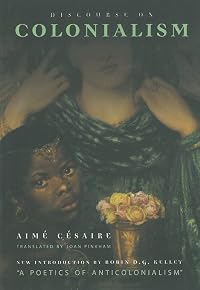
Discourse on Colonialism
by Aimé Césaire
On This Page
Description
Césaire's essay stands as an important document in the development of third world consciousness - a process in which [he] played a prominent role. (Library Journal) This classic work, first published in France in 1955, profoundly influenced the generation of scholars and activists at the forefront of liberation struggles in Africa, Latin America, and the Caribbean. Nearly 20 years later, when published for the first time in English, Discourse on Colonialism inspired a new generation engaged show more in the Civil Rights, Black Power, and anti-war movements and has sold more than 75,000 copies to date. Aimé Césaire eloquently describes the brutal impact of capitalism and colonialism on both the colonizer and colonized, exposing the contradictions and hypocrisy implicit in western notions of progress and civilization upon encountering the savage, uncultured, or primitive. Here, Césaire reaffirms African values, identity, and culture, and their relevance, reminding us that the relationship between consciousness and reality are extremely complex. . . . It is equally necessary to decolonize our minds, our inner life, at the same time that we decolonize society. A reading of an interview with Césaire by the poet René Depestre is also included. ©1972, 2000 Monthly Review Press. Produced and published by Echo Point Books & Media, an independent bookseller in Brattleboro, Vermont. show lessTags
Recommendations






























Member Reviews
Wow! Aimé Césaire lets European philosophers speak for themselves. This reveals some quite disturbing internalizations.
He quotes Ernest Renan, a French humanist philosopher:
"We aspire not to equality but to domination. The country of a foreign race must become once again a country of serfs, of agricultural laborers, or industrial workers. It is not a question of eliminating the inequalities among men but of widening them and making them into a law."
"With us, the common man is nearly always a declasse nobleman, his heavy hand is better suited to handling the sword than the menial tool. Rather than work, he chooses to fight, that is, he returns to his first estate. Regere imperio populos, that is our vocation. Pour forth this show more all-consuming activity onto countries which, like China, are crying aloud for foreign conquest. Turn the adventurers who disturb European society into a ver sacrum, a horde like those of the Franks, the Lombards, or the Normans, and every man will be in his right role. Nature has made a race of workers, the Chinese race, who have wonderful manual dexterity and almost no sense of honor; govern them with justice, levying from them, in return for the blessing of such a government, an ample allowance for the conquering race, and they will be satisfied; a race of tillers of the soil, the Negro; treat him with kindness and humanity, and all will be as it should; a race of masters and soldiers, the European race. Reduce this noble race to working in the ergastulum like Negroes and Chinese, and they rebel. In Europe, every rebel is, more or less, a soldier who has missed his calling, a creature made for the heroic life, before whom you are setting a task that is contrary to his race, a poor worker, too good a soldier. But the life at which our workers rebel would make a Chinese or a fellah happy, as they are not military creatures in the least. Let each one do what he is made for, and all will be well."
He deconstructs typical pro-colonialist arguments, interwoven with countless historical and gruesome events and the thoughts of the so-called civilized Europeans.
He reveals that Hitler’s rise was deeply grounded in Europe’s own past. Gruesome and systematic crimes against Brown, Black, and Yellow people were not only tolerated but enforced and exploited for profit. Hitler's regime did not emerge in a vacuum. If we had respected different peoples and cultures all along, our own European culture might have been different and more peaceful.
Our whole world might have been different! I dream of a world where hatred toward different cultures and religions cannot take root. Where it withers the moment we remember that we are all human, all deserving of dignity, no matter our origin.
You can’t sow violence and expect to reap peace. Hitler's regime internalized global patterns of hatred and redirected them inward, toward domestic targets. We have to stop the cycle of violence. show less
He quotes Ernest Renan, a French humanist philosopher:
"We aspire not to equality but to domination. The country of a foreign race must become once again a country of serfs, of agricultural laborers, or industrial workers. It is not a question of eliminating the inequalities among men but of widening them and making them into a law."
"With us, the common man is nearly always a declasse nobleman, his heavy hand is better suited to handling the sword than the menial tool. Rather than work, he chooses to fight, that is, he returns to his first estate. Regere imperio populos, that is our vocation. Pour forth this show more all-consuming activity onto countries which, like China, are crying aloud for foreign conquest. Turn the adventurers who disturb European society into a ver sacrum, a horde like those of the Franks, the Lombards, or the Normans, and every man will be in his right role. Nature has made a race of workers, the Chinese race, who have wonderful manual dexterity and almost no sense of honor; govern them with justice, levying from them, in return for the blessing of such a government, an ample allowance for the conquering race, and they will be satisfied; a race of tillers of the soil, the Negro; treat him with kindness and humanity, and all will be as it should; a race of masters and soldiers, the European race. Reduce this noble race to working in the ergastulum like Negroes and Chinese, and they rebel. In Europe, every rebel is, more or less, a soldier who has missed his calling, a creature made for the heroic life, before whom you are setting a task that is contrary to his race, a poor worker, too good a soldier. But the life at which our workers rebel would make a Chinese or a fellah happy, as they are not military creatures in the least. Let each one do what he is made for, and all will be well."
He deconstructs typical pro-colonialist arguments, interwoven with countless historical and gruesome events and the thoughts of the so-called civilized Europeans.
He reveals that Hitler’s rise was deeply grounded in Europe’s own past. Gruesome and systematic crimes against Brown, Black, and Yellow people were not only tolerated but enforced and exploited for profit. Hitler's regime did not emerge in a vacuum. If we had respected different peoples and cultures all along, our own European culture might have been different and more peaceful.
Our whole world might have been different! I dream of a world where hatred toward different cultures and religions cannot take root. Where it withers the moment we remember that we are all human, all deserving of dignity, no matter our origin.
You can’t sow violence and expect to reap peace. Hitler's regime internalized global patterns of hatred and redirected them inward, toward domestic targets. We have to stop the cycle of violence. show less
This was incredible. Exploring the contradiction and hypocrisy of Europe after the horrors of Nazism are revealed and arguing, successfully at that too, that Hitler wasn't the anomaly that he was–and is still, painted to be. Cesaire mostly uses French colonial history and the horrors done in Algeria, Madagascar, Vietnam as examples. No doubt it must have been a shock and a joke to the communities that had experienced and lived with the trauma European colonialism had wrought on them, when their colonizers were condemning Germany. The ironic tone of the writing, at parts strangely funny while showing contradiction, gave an even greater effect to the work the writing was supposed to do. Even though half the planet was still colonized show more when it was published (1950), and colonial exploitation has taken stealthier and more insidious forms since then, this book still remains both fortunately and unfortunately fresh and required reading. show less
An angry snarl of resentment and righteous anger, an indictment of centuries of crimes. It hides under the rather innocuous title 'Discourse of Colonialism', but instead might be appropriate 'Damn you and damn your hypocrisy and hate that led to hundreds of years of atrocities', or something like that.
The book moves from condemnation of wars and injustice, to attacks on now-obscure colonial theorists and 'racialists'. Cesaire makes the bold statement that Nazism is so infamous in Europe because it committed the same atrocities that the Europeans did to other, non-white nations. Slavery, mass extermination, economic exploitation, racial/social engineering, and so forth.
Cesaire does stray into a few grey areas, though. He cites the show more Soviet Union as a possible source of post-colonial liberation. That state is just imperialism with a new coat of paint. He also does make a few wrong statements which modern anthropology has corrected, but he'd likely be fine with that. In fact, he'd be proud to see the advances in some of these fields.
These little nitpicks do not detract from the overall strength of his feeling. The book itself is not without flaws, but it helped to spark a movement, of peoples rising up and a radical change in intellectual discourse. That alone gives it a place in history. show less
The book moves from condemnation of wars and injustice, to attacks on now-obscure colonial theorists and 'racialists'. Cesaire makes the bold statement that Nazism is so infamous in Europe because it committed the same atrocities that the Europeans did to other, non-white nations. Slavery, mass extermination, economic exploitation, racial/social engineering, and so forth.
Cesaire does stray into a few grey areas, though. He cites the show more Soviet Union as a possible source of post-colonial liberation. That state is just imperialism with a new coat of paint. He also does make a few wrong statements which modern anthropology has corrected, but he'd likely be fine with that. In fact, he'd be proud to see the advances in some of these fields.
These little nitpicks do not detract from the overall strength of his feeling. The book itself is not without flaws, but it helped to spark a movement, of peoples rising up and a radical change in intellectual discourse. That alone gives it a place in history. show less
A passionate and an apt assessment of the crimes and atrocities committed by the European colonisers against the colonised for centuries that continued to be committed in Indochina, Madagascar and elsewhere, even after World War II. Aimé Césaire also denounces what he terms the "pseudo-humanism" of the Europeans, for they only realised the horrors of Nazism when they were the direct victims of it.
Imagine if Thomas Bernhard had had personal injustice to complain about, instead of poor health: you'd get this book. I'm not sure the thinking is all that coherent, but the indignation is glorious.
A short, passionate read that outlines how colonialism paved the way for fascism, and that colonialism is an intrinsic part of European "humanization". Essential literature for anyone who wants to educate themselves on decolonisation - not just of the world, but also of the mind.
Political essay by the father of "Negritude" as concept and movement, shaping the Third World reaction to and view of Europe and the United States through its description of the barbarism of the colonizer and unhappiness of the colonized. Describes the American form of imperialism as the only variety of oppression that surpasses European imperialism in barbarity.
Members
- Recently Added By
Lists

Black Authors
386 works; 32 members

The Black Archives: All Power To the People! Reading List
79 works; 10 members

Books Read in 2019
4,052 works; 110 members
Author Information

62+ Works 3,051 Members
Poet and politician Aimé Césaire was born in Basse-Pointe, Martinique on June 26, 1913. He attended high school and college in France. While in Paris, he helped found the journal Black Student in the 1930s. During World War II, he returned to Martinique and was mayor of Fort-de-France from 1945 to 2001, except for a break from 1983 to 1984. He show more also served in France's National Assembly from 1946 to 1956 and from 1958 to 1993. In 1946, he helped Martinique shed its colonial status and become an overseas department of France. Some of his best known works include the book Discourse on Colonialism, the essay Negro I Am, Negro I Will Remain, and the poem Notes from a Return to the Native Land. He was being treated for heart problems and other ailments when he died on April 17, 2008. (Bowker Author Biography) show less
Some Editions
Work Relationships
Common Knowledge
- Original publication date
- 1950
- Canonical DDC/MDS
- 848.99729824
Classifications
- Genres
- Nonfiction, General Nonfiction, History, Philosophy, Literature Studies and Criticism
- DDC/MDS
- 848.99729824 — Literature & rhetoric French Literature French miscellaneous writings 1900- French-language literature outside of France (Francophone) North America Mexico, Central America, West Indies, Bermuda West Indies (Antilles) and Bermuda; Caribbean Windward Islands and other southern islands Martinique Essays
- LCC
- JV51 .C413 — Political Science Colonies and colonization. Emigration and immigration. International migration Colonies and colonization. Emigration and Colonies and colonization
- BISAC
Statistics
- Members
- 1,150
- Popularity
- 22,003
- Reviews
- 10
- Rating
- (4.24)
- Languages
- 7 — Dutch, English, French, German, Portuguese, Slovenian, Turkish
- Media
- Paper, Audiobook, Ebook
- ISBNs
- 21
- ASINs
- 9