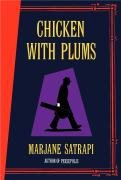
Chicken with Plums
by Marjane Satrapi
On This Page
Description
The author relates the story of her great-uncle, Nasser Ali Khan, one of Iran's most acclaimed musicians, who discovers that his beloved instrument has been irrevocably damaged and renounces the world, its pleasures, and life itself.Tags
Recommendations









Member Reviews
Summary: Marjane Satrapi's uncle was Nasser Ali Khan, the celebrated musician. In 1958, when his wife broke his instrument, he attempts to replace it, but it seems as though the passion that animated his music has gone out of him, and no new instrument sounds the same. Thrown into a deep depression, Khan makes the decision that he's going to die, and takes to his bed, unable to be roused by his wife, children, friends, or even his own memories of the past or glimpses of the future.
Review: This is a slim little book, but it tells an elegant story. It's structured very non-linearly - there's lots of looping forwards and backwards in time, since most of the book takes place inside Khan's head as he's laying in bed, thinking about his life, show more and waiting to die. Satrapi does some interesting things with these flashbacks, not just in terms of how the story itself, but also how the length and placement of these flashback panels influence the rhythm of how the story unfolds, and how the true meaning of Khan's decisions slowly unfurls in the mind of the reader. However, I thought this story wasn't quite as well developed as it could have been. Part of this was that the notion of "everything is awful, so I may as well die" is not a natural one for me, so I found it somewhat hard to empathize with Khan. I also would have liked to have seen more about his relationships with his children - what was there was very interesting, but it could certainly have been more developed. So, overall, this book tells a short but surprisingly complex little story in Satrapi's signature style, even if it didn't have the emotional heft of something like Persepolis. 4 out of 5 stars.
Recommendation: If you like Satrapi's work, this is also worth a try, but I think it would also be of interest to a reader who is interested in non-linear narratives, and the way that stories can be built. show less
Review: This is a slim little book, but it tells an elegant story. It's structured very non-linearly - there's lots of looping forwards and backwards in time, since most of the book takes place inside Khan's head as he's laying in bed, thinking about his life, show more and waiting to die. Satrapi does some interesting things with these flashbacks, not just in terms of how the story itself, but also how the length and placement of these flashback panels influence the rhythm of how the story unfolds, and how the true meaning of Khan's decisions slowly unfurls in the mind of the reader. However, I thought this story wasn't quite as well developed as it could have been. Part of this was that the notion of "everything is awful, so I may as well die" is not a natural one for me, so I found it somewhat hard to empathize with Khan. I also would have liked to have seen more about his relationships with his children - what was there was very interesting, but it could certainly have been more developed. So, overall, this book tells a short but surprisingly complex little story in Satrapi's signature style, even if it didn't have the emotional heft of something like Persepolis. 4 out of 5 stars.
Recommendation: If you like Satrapi's work, this is also worth a try, but I think it would also be of interest to a reader who is interested in non-linear narratives, and the way that stories can be built. show less
The book had been hiding, unread, for years! No longer! It is the story of Marjane's great-uncle, the tar player Nasser Ali, a sad story brilliantly drawn: the musician, trapped by convention and family demands in a marriage with a woman he does not love, who does not understand his creative passion for playing the tar.
Should an artist marry - regardless whether out of love or convention - and submit to the duties of family demands? Or - as Diotima teaches Socrates - aren't the children he creates with his music more beautiful and immortal than the physical ones?
Should an artist marry - regardless whether out of love or convention - and submit to the duties of family demands? Or - as Diotima teaches Socrates - aren't the children he creates with his music more beautiful and immortal than the physical ones?
In Marjane Satrapi's "Chicken with Plums", we see the story of her great-uncle, a famous musician who one day decided to lay down and die after his instrument broke. As he lies in bed, his mind travels to different memories, and even though we only see fragments of his life, we grasp his progression through different stages. The stark black and white drawings fill the characters' faces with feelings using just a few lines, as conflict is shown in the mind of the main character, but also his family and close friends. The book displays amazing skill not just in the art, but in the development of the people and the story; each flashback adds new understanding to the question of why he chose to give up on life, and the answer becomes show more increasingly complicated. show less
I can't help but think that author Marjane Satrapi's later works (like this one) will always be measured against her autobiographical Persepolis I and II, and will consequently come up lacking. The graphic novel format is fascinating, and Chicken with Plums made me want to start reading it again to confirm the events of the timeline and to appreciate the choices Satrapi made in her narration. What is love? What is art? What is life without art or love? These are some of the main concerns examined briefly here.
Nice short story from Satrapi. Through one man's reminiscences we glimpse details about life in Iran. Nicely paced, with a gentle humour - definitely a lighter read than Persepolis, but it is well formed, touching and convincing.
Of course, I was impressed with previous graphic novels by Marjane Satrapi, but this particular book has turned out to be my favorite one. I don’t want to tell what this story is about specifically because that would give away the major plot element. Believe me when I say that this book was planned and set up perfectly. The cartoon frames will be repeated in the story, but you as the reader will know exactly in what context you first saw them and, later, what they really mean.
I’m not sure if this is a real story, fiction based on a real story, or pure fiction. That really doesn’t matter because the telling of it is fabulous. It’s the story of Marjane’s great uncle Nasser Ali Khan, a musician trapped in a marriage to a woman he show more did not love and father of four children.
What I like about Satrapi graphic novels is their ability to bring the reader into the tiny bits and pieces of history and culture of Iran asthe author remembers it from her youth. She does not politicize her stories but mentions government changes as part of the cultural landscape of her own family’s life. She talks about a “tar” and then goes on to explain what it is (a musical instrument) and depicts why it was important to her great uncle’s life.
The characters are perfect. She gives each individual not only a strong voice, but a pictured presence that mirrors each person’s personality. Sometimes you almost don’t have to read the dialogue to know what the characters are saying to each other.
Satrapi is a no holds barred author and graphic artist. She likes to “tell it like it is” and often provokes a response by putting some incongruous content into her books (for example, the farting son, the morbidly obese teenage granddaughter, or the grandson with the “fuck” tee shirt). These tiny things, often not necessary, certainly do liven up her books.
In summary, I loved this book and think this one is Marjane Satrapi’s best so far. show less
I’m not sure if this is a real story, fiction based on a real story, or pure fiction. That really doesn’t matter because the telling of it is fabulous. It’s the story of Marjane’s great uncle Nasser Ali Khan, a musician trapped in a marriage to a woman he show more did not love and father of four children.
What I like about Satrapi graphic novels is their ability to bring the reader into the tiny bits and pieces of history and culture of Iran asthe author remembers it from her youth. She does not politicize her stories but mentions government changes as part of the cultural landscape of her own family’s life. She talks about a “tar” and then goes on to explain what it is (a musical instrument) and depicts why it was important to her great uncle’s life.
The characters are perfect. She gives each individual not only a strong voice, but a pictured presence that mirrors each person’s personality. Sometimes you almost don’t have to read the dialogue to know what the characters are saying to each other.
Satrapi is a no holds barred author and graphic artist. She likes to “tell it like it is” and often provokes a response by putting some incongruous content into her books (for example, the farting son, the morbidly obese teenage granddaughter, or the grandson with the “fuck” tee shirt). These tiny things, often not necessary, certainly do liven up her books.
In summary, I loved this book and think this one is Marjane Satrapi’s best so far. show less
After something as strong as Persepolis, I was not so sure that Marjane could pull it off, but this is a hell of a graphic novel. The way the story goes, and moves and makes its turn is just amazing. Her story telling is strong, in a compelling way she was able to tell whithin few pages the whole life of this sad tar player. I never thought that chicken with plums could be so tasty.
Members
- Recently Added By
Published Reviews
ThingScore 75
Nasser is also visited by his children and his brother, thinks about the pleasures of the world — including his favorite dish, which gives the book its title — and reviews old hurts to his reputation and how others treated him. His suicide through neglect is a bit over-glamorized here, but it raises important questions of the nature of suffering in art.
added by lampbane
Lists

Middle East and Maghreb Graphic Novels
46 works; 3 members

Books Read in 2013
1,629 works; 51 members

Penguin Random House
458 works; 4 members
Author Information

20+ Works 29,523 Members
Some Editions
Awards and Honors
Series
Belongs to Publisher Series
Work Relationships
Has the adaptation
Common Knowledge
- Canonical title
- Chicken with Plums
- Original title
- Poulet aux prunes
- Original publication date
- 2004
- People/Characters
- Nasser Ali Khan
- Important places
- Tehran, Iran
- Related movies
- Poulet aux prunes (2011 | IMDb)
- First words*
- Téhéran 1958
- Last words*
- (Click to show. Warning: May contain spoilers.)À vrai dire, pas du tout.
- Original language
- French
*Some information comes from Common Knowledge in other languages. Click "Edit" for more information.
Classifications
Statistics
- Members
- 1,332
- Popularity
- 17,899
- Reviews
- 59
- Rating
- (3.68)
- Languages
- 16 — Catalan, Chinese, Czech, Danish, Dutch, English, Finnish, French, German, Italian, Norwegian (Bokmål), Polish, Portuguese, Spanish, Swedish, Turkish
- Media
- Paper
- ISBNs
- 28
- UPCs
- 1
- ASINs
- 4