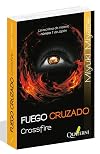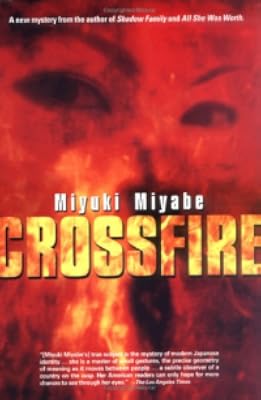
Crossfire
by Miyuki Miyabe
On This Page
Description
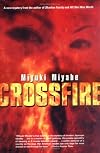
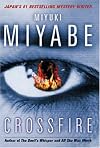
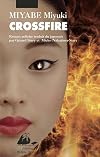
Imagine possessing the paranormal ability to set someone on fire. Toast. Just by thinking about it. Junko Aoki has those pyrokinetic powers, and--in the third novel by Japanese horror-mystery writer Miyuki Miyabe to be translated into English--she's using them to leave a trail of smoldering bodies across Tokyo.Tags
Recommendations
















Member Reviews
Bought second hand as part of my personal challenge to read more 1001 books written by women and it didn't disappoint!
Not my useful fare, this is part thriller, part sci-fi, part moral questioning. I loved the fact that the detective and the vigilante were both women, 3-dimensional and strong.
A woman with a strange gift comes across a group of young men stashing a body, after she intervenes, she realises they are part of a gang that have been preying on young girls. Killing the women, dumping the bodies and getting away with it. But if the law doesn't have the resources or the teeth to deal with such criminals, can those with the right powers? Do any of us have the right to go above the law? Even if it is to correct an injustice?
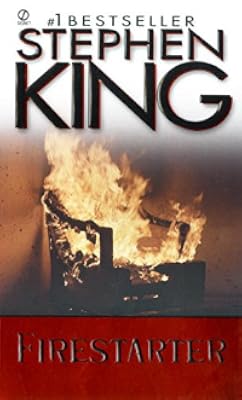
I show more found this gripping and thought-provoking. It does, as another reviewer wrote, bare resemblance to Stephen King's work, but the rich Tokyo backdrop and the well-drawn female roles set it in its own category. Highly recommended. show less
Not my useful fare, this is part thriller, part sci-fi, part moral questioning. I loved the fact that the detective and the vigilante were both women, 3-dimensional and strong.
A woman with a strange gift comes across a group of young men stashing a body, after she intervenes, she realises they are part of a gang that have been preying on young girls. Killing the women, dumping the bodies and getting away with it. But if the law doesn't have the resources or the teeth to deal with such criminals, can those with the right powers? Do any of us have the right to go above the law? Even if it is to correct an injustice?
I show more found this gripping and thought-provoking. It does, as another reviewer wrote, bare resemblance to Stephen King's work, but the rich Tokyo backdrop and the well-drawn female roles set it in its own category. Highly recommended. show less
A young pyrokinetic woman in Japan goes on a vigilante killing spree. Generally a decent genre exercise, this doesn't go to any of the highs that I would have liked it to. It's ultimately fine, I don't have too many negatives but I can't say I was particularly impressed. The ending is somewhat lackluster, I seem to be drawn to stories with downer endings but this one felt forced. Not sure I will pick up anything else from this author.
A different sort of 1001 book - this novel focuses on Junko, a young woman with the power to start fires with her mind, and the arson detective investigating a series of what look like vengeance killings involving fire. The novel contrasts the isolation of Junko with a different kind of isolation for the detective, a middle-aged woman on the arson squad who was seemingly put in the role to meet a diversity goal. I raced through the book as it followed both Junko and the detective. I did find a few things to be a bit odd, including Junko's developing relationship with a young man she meets later in the novel, but overall I liked the book.
Part "Death Wish" and part police procedural, Miyabe's novel is a long, intense read with deep emotional impact. Junko Aoki is alone, both physically and emotionally, spending her days and nights tracking criminals who've escaped the Japanese legal system and disposing of them. The ties she makes with other people are tenuous and short-lived, and she doesn't hesitate to take out people who've committed minor offenses who stand in the way of her targets. Possessing the supernatural ability to manifest and control fire, Junko keeps her abilities hidden from coworkers and neighbors while also seeking a secure method of releasing the pressure that builds up inside her body.
Chikako Ishizu is a detective with the Arson Squad, a middle of the show more road cop promoted due to the police force's affirmative action policies. Middle-aged and motherly, she is efficient and takes her job seriously but will never be one of the "good old boys." A strange series of murders involving intense heat without the use of accelerants catches her eye and she and Makihara, another detective with a reputation for supernatural conspiracy theories, set out to find out the truth.
Underneath what appears to be a routine "cop versus criminal" novel lies a tale of loneliness, isolation, revenge and hope, with a little bit of violent vigilante action thrown into the mix for good measure. As with Miyabe's novel Shadow Family, a bit of time may be needed to memorize a list of Japanese names and police rankings, but it's very much worth it. show less
Chikako Ishizu is a detective with the Arson Squad, a middle of the show more road cop promoted due to the police force's affirmative action policies. Middle-aged and motherly, she is efficient and takes her job seriously but will never be one of the "good old boys." A strange series of murders involving intense heat without the use of accelerants catches her eye and she and Makihara, another detective with a reputation for supernatural conspiracy theories, set out to find out the truth.
Underneath what appears to be a routine "cop versus criminal" novel lies a tale of loneliness, isolation, revenge and hope, with a little bit of violent vigilante action thrown into the mix for good measure. As with Miyabe's novel Shadow Family, a bit of time may be needed to memorize a list of Japanese names and police rankings, but it's very much worth it. show less
Crossfire is a Japanese novel that I read because it is on the 1001 Books You Must Read Before You Die list. I was a bit skeptical about why it would be on the list, since it looked like just a run-of-the-mill mystery novel. Usually the mysteries that make it onto the list, though, are there because they provide a certain kind of insight into a culture or a time period, so I had that in mind while I read.
Junko is our main character, and we find out early on that she has a supernatural power: pyrokinesis. Once that fact is established, the novel concerns itself with the role or responsibilities of a person with powers like that, Junko's self-image as a result of her power, and the experience of being "other" in society. It also covers show more the major bases of a suspense novel. The Tokyo of this book isn't really the one I tend to visualize, full of modern skyscrapers, clean but crowded streets, bright neon signs. The parts of Tokyo Miyabe presents us with are remote, sparsely inhabited at night, decidedly middle-to-lower class.
I think that this view of Tokyo is part of the reason the book is on the list. Other than providing a look at the underside of Japan's public face, I'm not sure what new ground is really covered here. The writing is serviceable, but not striking (though I'm reading in translation, of course). The emotional part of the story doesn't have many twists and turns, and the mysteries that are not revealed to the reader right away comprise a pretty small piece of the overall puzzle. It was a decent read, but not a page-turner.
Recommended for: believers in vigilante justice, people interested in seeing another view of Japanese society
Quote: They were all raised to think of themselves as special, as better than others, and they needed to find something to prove it to themselves, to justify their sense of entitlement. But what if they never found that "something"? All they were left with was their enormous conceit. They were like flower bulbs raised in water, floating in a transparent, colorless pool of nihilism. Surrounding the bulb was nothing - nothing that could give them a true sense of themselves. show less
Junko is our main character, and we find out early on that she has a supernatural power: pyrokinesis. Once that fact is established, the novel concerns itself with the role or responsibilities of a person with powers like that, Junko's self-image as a result of her power, and the experience of being "other" in society. It also covers show more the major bases of a suspense novel. The Tokyo of this book isn't really the one I tend to visualize, full of modern skyscrapers, clean but crowded streets, bright neon signs. The parts of Tokyo Miyabe presents us with are remote, sparsely inhabited at night, decidedly middle-to-lower class.
I think that this view of Tokyo is part of the reason the book is on the list. Other than providing a look at the underside of Japan's public face, I'm not sure what new ground is really covered here. The writing is serviceable, but not striking (though I'm reading in translation, of course). The emotional part of the story doesn't have many twists and turns, and the mysteries that are not revealed to the reader right away comprise a pretty small piece of the overall puzzle. It was a decent read, but not a page-turner.
Recommended for: believers in vigilante justice, people interested in seeing another view of Japanese society
Quote: They were all raised to think of themselves as special, as better than others, and they needed to find something to prove it to themselves, to justify their sense of entitlement. But what if they never found that "something"? All they were left with was their enormous conceit. They were like flower bulbs raised in water, floating in a transparent, colorless pool of nihilism. Surrounding the bulb was nothing - nothing that could give them a true sense of themselves. show less
The setting is urban Tokyo. Junko Aiko is an avenger, a pyrokinetist who metes out ultimate justice to those whose crimes have gone unpunished by the law. She works alone, tracking down scum whom the police have not successfully prosecuted.
The police case file about her is growing, her handiwork becoming readily identifiable but her methods are none-the-less puzzling. What sort of weapon does she carry? Why don't her victims run away? She has already been responsible for a number of deaths - mysterious fires have almost totally consumed their victims, giving the police just enough evidence to identify them, but nothing to explain how she does it.
Detective Chikako Ishuzu of the arson squad of the Tokyo Metropolitan Police Department does show more not believe what the mounting evidence is telling her. A human flame-thrower? Someone who can cause instant combustion? Ishuzu is a sceptic, not a believer in paranormal powers, and it takes another detective and a 13 year old girl to convince her.
But what if Junko is merely one of a number with similar powers handed down from generation to generation? What if there was a group who wanted to control and exploit these powers for their own ends? What if some of the police upper echelons were part of this group, meting out their own justice where they thought the courts had failed?
Told from two points of view CROSSFIRE asks the reader to believe in such paranormal powers. A cinematic quality to the narration helps you visualize Junko's targets as they burst into flames. And then Junko the stalker becomes the stalked....
CROSSFIRE is a thriller, sitting at the horror end of crime fiction. show less
The police case file about her is growing, her handiwork becoming readily identifiable but her methods are none-the-less puzzling. What sort of weapon does she carry? Why don't her victims run away? She has already been responsible for a number of deaths - mysterious fires have almost totally consumed their victims, giving the police just enough evidence to identify them, but nothing to explain how she does it.
Detective Chikako Ishuzu of the arson squad of the Tokyo Metropolitan Police Department does show more not believe what the mounting evidence is telling her. A human flame-thrower? Someone who can cause instant combustion? Ishuzu is a sceptic, not a believer in paranormal powers, and it takes another detective and a 13 year old girl to convince her.
But what if Junko is merely one of a number with similar powers handed down from generation to generation? What if there was a group who wanted to control and exploit these powers for their own ends? What if some of the police upper echelons were part of this group, meting out their own justice where they thought the courts had failed?
Told from two points of view CROSSFIRE asks the reader to believe in such paranormal powers. A cinematic quality to the narration helps you visualize Junko's targets as they burst into flames. And then Junko the stalker becomes the stalked....
CROSSFIRE is a thriller, sitting at the horror end of crime fiction. show less
As I started reading this book, I found it very interesting. The concept of a girl with the power to start fires and the subsequent fleshing out of how the power works and the ways in which it affects her life were new and interesting. The way it fit in with her ordinary life was very convincing.
Then I got farther into the book and I found that I didn't really like the main character. Because of her power, she considers herself a "loaded gun" and thus sets it as her personal task to rid the world of the worst criminals, usually those that the law can't or failed to touch. Perhaps because of this, she's always focused on completing her mission, and there's not much of a person to her. She seemingly feels no remorse after burning people show more alive.
The story then expands to include a detective investigating the fires the main character has started. That is mostly boring because the reader already knows exactly what happened while she's walking around considering whether the damage could have been done by a flamethrower.
Eventually, though, the story does get a bit better. The main character starts to have some doubts about the way she's been living her life. The detective starts to clue in to what's going on and discovers some things the main character didn't know about. We also get some new characters, and by the end it's pretty good.
Aside from the plot, I personally found it interesting to read a (somewhat) modern-day Japanese novel. There were lots of unusual names (from my perspective), some different customs, and it was interesting to see the charactes' attitudes about women in the workforce or their place as wives and mothers. There were also some ideas about Japenese youth, but because of the plot we didn't see a very representative sample.
Overall it was new and interesting. Not bad, but not my cup of tea. show less
Then I got farther into the book and I found that I didn't really like the main character. Because of her power, she considers herself a "loaded gun" and thus sets it as her personal task to rid the world of the worst criminals, usually those that the law can't or failed to touch. Perhaps because of this, she's always focused on completing her mission, and there's not much of a person to her. She seemingly feels no remorse after burning people show more alive.
The story then expands to include a detective investigating the fires the main character has started. That is mostly boring because the reader already knows exactly what happened while she's walking around considering whether the damage could have been done by a flamethrower.
Eventually, though, the story does get a bit better. The main character starts to have some doubts about the way she's been living her life. The detective starts to clue in to what's going on and discovers some things the main character didn't know about. We also get some new characters, and by the end it's pretty good.
Aside from the plot, I personally found it interesting to read a (somewhat) modern-day Japanese novel. There were lots of unusual names (from my perspective), some different customs, and it was interesting to see the charactes' attitudes about women in the workforce or their place as wives and mothers. There were also some ideas about Japenese youth, but because of the plot we didn't see a very representative sample.
Overall it was new and interesting. Not bad, but not my cup of tea. show less
Members
- Recently Added By
Lists

1001 Books You Must Read Before You Die
1,448 works; 1,134 members
Author Information

158+ Works 3,186 Members
Awards and Honors
Work Relationships
Contains
Common Knowledge
- Canonical title
- Crossfire
- Original title
- クロスファイア (Kurosufaia) (Kurosufaia)
- Original publication date
- 1998 (original Japanese) (original Japanese); 2005 (English translation) (English translation)
- People/Characters
- Chikako Ishizu; Junko Aoki; Makihara
- Important places
- Tokyo, Japan
- Related movies
- Crossfire (2000 | IMDb)
- First words
- The abandoned factory appeared in a dream.
- Last words
- (Click to show. Warning: May contain spoilers.)Like love itself.
- Original language
- Japanese
Classifications
- Genres
- Fiction and Literature, Mystery, Horror
- DDC/MDS
- 813 — Literature & rhetoric American literature in English American fiction in English
- LCC
- PL856 .I856 .K8713 — Language and Literature Languages and literatures of Eastern Asia, Africa, Oceania Languages of Eastern Asia, Africa, Oceania Japanese language and literature Japanese literature Individual authors and works
- BISAC
Statistics
- Members
- 215
- Popularity
- 152,261
- Reviews
- 11
- Rating
- (3.40)
- Languages
- 5 — English, French, Japanese, Russian, Spanish
- Media
- Paper
- ISBNs
- 6