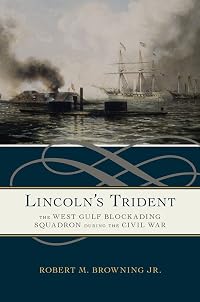
Lincoln's Trident: The West Gulf Blockading Squadron during the Civil War
by Mr. Robert M. Browning Jr.
On This Page
Description
In Lincoln's Trident, Coast Guard historian Robert M. Browning Jr. continues his magisterial series about the Union's naval blockade of the Confederacy during the American Civil War. Established by the Navy Department in 1862, the West Gulf Blockading Squadron operated from St. Andrews Bay (Panama City), Florida to the Rio Grande River. As with the Navy's blockade squadrons operating in the Atlantic, the mission of the West Gulf Blockading Squadron was to cripple the South's economy by show more halting imports and disrupting cotton exports, the South's main source of hard currency. The blockade also li show lessTags
Recommendations
















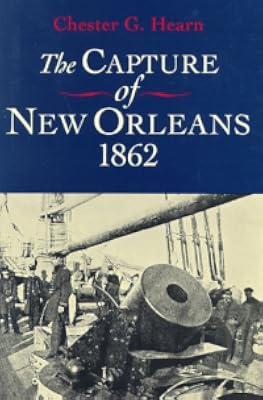
Member Recommendations
Member Reviews
A rather sprawling work that is essentially two books. On one hand it works as a military life of David Glasgow Farragut, as where he went there was effective action. On the other there are a litany of half-baked engagements that were, as often as not, embarrassments, if not out and out defeats for Union arms; particularly when it came to shutting down trade on the coast of Texas. This is largely a reflection of Farragut's vigor, but it is also a commentary on the limits of Union resources and the failure of the U.S. Army to cooperate effectively with the USN on a reliable basis.
Another complicating factor is that of the free port of Matamoros, where the government of the Republic of Mexico sought to maintain its neutrality, and where show more the USN had to step carefully when seeking to stop contraband trade; with very limited results. Browning's conclusion is that the Union blockade of the Confederacy only put a limited dent in the cotton trade; the blockade's real triumph was to short-circuit Confederate internal trade (particularly after the fall of Vicksburg) and to prevent the importation of the capital goods (machinery and tools) that would have really energized the Confederate industrial effort. show less
Another complicating factor is that of the free port of Matamoros, where the government of the Republic of Mexico sought to maintain its neutrality, and where show more the USN had to step carefully when seeking to stop contraband trade; with very limited results. Browning's conclusion is that the Union blockade of the Confederacy only put a limited dent in the cotton trade; the blockade's real triumph was to short-circuit Confederate internal trade (particularly after the fall of Vicksburg) and to prevent the importation of the capital goods (machinery and tools) that would have really energized the Confederate industrial effort. show less
Though there is no shortage of military histories of the Civil War, the vast majority of them focus primarily or exclusively on the campaigns on the land. This has the effect of unjustly minimizing the naval side of the war, which was decisive to its outcome. Faced with the North's industrial predominance the South hoped to offset it by importing goods from the factories of Britain and France, which made the naval blockade of the Confederacy an essential part of the Union's strategy. In this book, Robert M. Browning provides an operational history of the Union Navy's blockade of the Gulf Coast region. It's the concluding volume of a trilogy that originated with his doctoral dissertation over two decades ago, and in many respects he show more saved the best for last.
Blockading the Gulf Coast posed a number of challenges for the Navy, foremost among them being the disproportionate ratio between the vast amount of coastline and the limited number of ships available. Complicating matters even further was the location of Mexico to the south, the commerce of which could not easily be interdicted without creating diplomatic problems. To this was added the logistical difficulties of maintaining vessels on station far from sources of repair and replenishment, as the Southern states occupied or destroyed nearly all of the U.S. Navy's yards in the region at the start of the conflict.
In the face of these difficulties, the Union Navy rose to the occasion. Browning recounts the various efforts the navy took over the course of the conflict to maintain and support their efforts, from regular supply runs to recapturing and rebuilding lost bases. While their efforts to interdict blockade runners were often frustrated by the superior speed and higher draft of the rebel vessels, over time the efforts of the various squadrons began to tell. Aiding their effort was the gradual isolation and capture of the major Confederate ports in the region, starting with New Orleans in 1862 and culminating with the conquest of Mobile at the end of the war. These did not stop completely the efforts of the blockade runners, but they helped minimize the ability of the Confederacy to draw upon outside resources in their increasingly desperate cause.
To describe these efforts, Browning spent years reviewing the various records and accounts of the blockading squadrons, as well as the more fragmentary collections of the Southern forces. From them he has assembled a long overdue study of this often neglected aspect of the war, one that is even more valuable for his account of the squadron's operations on the lower Mississippi River. While his prose would have benefited from a little polishing, this book combines with its companion volumes to provide a history of the Union blockade which will be the standard by which all future books on the subject will be judged. No student of the Civil War seeking a balanced understanding of the conflict can afford to bypass these important works. show less
Blockading the Gulf Coast posed a number of challenges for the Navy, foremost among them being the disproportionate ratio between the vast amount of coastline and the limited number of ships available. Complicating matters even further was the location of Mexico to the south, the commerce of which could not easily be interdicted without creating diplomatic problems. To this was added the logistical difficulties of maintaining vessels on station far from sources of repair and replenishment, as the Southern states occupied or destroyed nearly all of the U.S. Navy's yards in the region at the start of the conflict.
In the face of these difficulties, the Union Navy rose to the occasion. Browning recounts the various efforts the navy took over the course of the conflict to maintain and support their efforts, from regular supply runs to recapturing and rebuilding lost bases. While their efforts to interdict blockade runners were often frustrated by the superior speed and higher draft of the rebel vessels, over time the efforts of the various squadrons began to tell. Aiding their effort was the gradual isolation and capture of the major Confederate ports in the region, starting with New Orleans in 1862 and culminating with the conquest of Mobile at the end of the war. These did not stop completely the efforts of the blockade runners, but they helped minimize the ability of the Confederacy to draw upon outside resources in their increasingly desperate cause.
To describe these efforts, Browning spent years reviewing the various records and accounts of the blockading squadrons, as well as the more fragmentary collections of the Southern forces. From them he has assembled a long overdue study of this often neglected aspect of the war, one that is even more valuable for his account of the squadron's operations on the lower Mississippi River. While his prose would have benefited from a little polishing, this book combines with its companion volumes to provide a history of the Union blockade which will be the standard by which all future books on the subject will be judged. No student of the Civil War seeking a balanced understanding of the conflict can afford to bypass these important works. show less
Ratings
Members
- Recently Added By
Author Information
9 Works 138 Members
Robert M. Browning Jr. is the chief historian of the U.S. Coast Guard.
Classifications
Statistics
- Members
- 21
- Popularity
- 1,236,025
- Reviews
- 2
- Rating
- (4.33)
- Languages
- English
- Media
- Paper, Ebook
- ISBNs
- 3
- UPCs
- 1