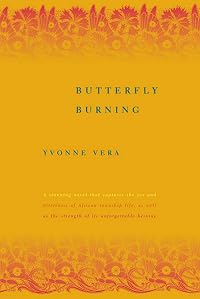
Butterfly Burning
by Yvonne Vera
On This Page
Description
Butterfly Burning brings the brilliantly poetic voice of Zimbabwean writer Yvonne Vera to American readers for the first time. Set in Makokoba, a black township, in the late l940s, the novel is an intensely bittersweet love story. When Fumbatha, a construction worker, meets the much younger Phephelaphi, he"wants her like the land beneath his feet from which birth had severed him." He in turn fills her "with hope larger than memory." But Phephelaphi is not satisfied with their "one-room" love show more alone. The qualities that drew Fumbatha to her, her sense of independence and freedom, end up separating them. And the closely woven fabric of township life, where everyone knows everyone else, has a mesh too tight and too intricate to allow her to escape her circumstances on her own.Vera exploits language to peel away the skin of public and private lives. In Butterfly Burning she captures the ebullience and the bitterness of township life, as well as the strength and courage of her unforgettable heroine. show lessTags
Recommendations






Member Reviews
When I read Under the Tongue a bunch of years ago I couldn't quite get into it. Whether it was the book or me, or both, I don't know; but Vera's writing is very busy, the kind that in a lesser writer would reek of thesaurus overuse. and at that moment I didn't quite think the payoff was worth the effort I had to make to piece it together. This time, something clicked. Which isn't to say that Butterfly Burning is straight-forward. Here's some builders at work:
We are here. This is said urgently and with wisdom. We are here. The here of it and the now of it make the honey. Rocking and touching, each man holds on to the word the other has offered and each word raises the moment. The birth of a word, violent, mute. They are pitched against show more an opposite world so they plunge and pull.
...and so on and so forth. But yes, when you hit that sweet spot between understanding and absorbing, it's often brilliant. It's all in the way that Vera comes at her story; not as particles but as wave forms, oscillations on themes that build both the characters and the plot up rather than starting with the outline and digging in. It's like being caught up in a swirl of pointillist influences, where layers and transparent layers of story are all visible at the same time, as her characters fight to find a fixed point to hold on to or push off from, only to occasionally throw in an unstoppable physical FACT where the characters and the plot can't get through, have to bounce and eddy around. Like that masterful ending of chapter two, where the swirl of half-told details gets jerked awake by a passing car. It's a cliché for a reason, could be anywhere, just happens to be 1940s Rhodesia.
It's set 50 years before it was written, in the "safe" past of apartheid - "safe" in the sense that everyone in it is dead, historians and politicians have drawn a line and accounted for it. Soldiers have come home from fighting a war they lost even when they won, stores have started selling plastic and skin lightening creams, people have started taking English names as soon as they reach the city and settled into asbestos shantytowns. Fumbatha never knew his father, he was hung by the British before he was born, he's born up against a wall; Phephelaphi is younger, she wants to try and be something more than just his girlfriend, a new concept - word is they may let blacks get actual professions soon! Vera coaxes out her characters, carefully, with an archaeologist's brush uncovering every little detail slowly, almost as if she wants to protect them from what's already happened. She has to expose them to do this, so she does it gently.
Butterfly Burning is ridiculously beautiful, even when it gives me a headache. Or heartache. Either works. Sensual, harsh, endlessly detailed from a distance where she never lets you step back and look at it at a safe distance. show less
We are here. This is said urgently and with wisdom. We are here. The here of it and the now of it make the honey. Rocking and touching, each man holds on to the word the other has offered and each word raises the moment. The birth of a word, violent, mute. They are pitched against show more an opposite world so they plunge and pull.
...and so on and so forth. But yes, when you hit that sweet spot between understanding and absorbing, it's often brilliant. It's all in the way that Vera comes at her story; not as particles but as wave forms, oscillations on themes that build both the characters and the plot up rather than starting with the outline and digging in. It's like being caught up in a swirl of pointillist influences, where layers and transparent layers of story are all visible at the same time, as her characters fight to find a fixed point to hold on to or push off from, only to occasionally throw in an unstoppable physical FACT where the characters and the plot can't get through, have to bounce and eddy around. Like that masterful ending of chapter two, where the swirl of half-told details gets jerked awake by a passing car. It's a cliché for a reason, could be anywhere, just happens to be 1940s Rhodesia.
It's set 50 years before it was written, in the "safe" past of apartheid - "safe" in the sense that everyone in it is dead, historians and politicians have drawn a line and accounted for it. Soldiers have come home from fighting a war they lost even when they won, stores have started selling plastic and skin lightening creams, people have started taking English names as soon as they reach the city and settled into asbestos shantytowns. Fumbatha never knew his father, he was hung by the British before he was born, he's born up against a wall; Phephelaphi is younger, she wants to try and be something more than just his girlfriend, a new concept - word is they may let blacks get actual professions soon! Vera coaxes out her characters, carefully, with an archaeologist's brush uncovering every little detail slowly, almost as if she wants to protect them from what's already happened. She has to expose them to do this, so she does it gently.
Butterfly Burning is ridiculously beautiful, even when it gives me a headache. Or heartache. Either works. Sensual, harsh, endlessly detailed from a distance where she never lets you step back and look at it at a safe distance. show less
I thought it to be incredibly lyrical and enjoyable though literary and challenging. I found myself getting distracted by it's beauty and losing sight of the plot. It's not only plot driven, but Yvonne adds her personal philosophies on life, all very contemplating. I loved this book, it will take a few more reads for me to fully comprehend it.
This book is heavy on images and memories, light on plot and character. I feel like Yvonne Vera is a gorgeous writer and could transfer her skills to poetry.
Ratings
Members
- Recently Added By
Author Information

11+ Works 420 Members
Yvonne Vera (1964-2005) was born in Bulawayo, Zimbabwe, and later attended York University in Toronto, gaining her doctorate in English Literature in 1995. Her fiction has won a number of international awards, including the Tucholski Prize from Swedish PEN (2004) and the Macmillan writer's prize for Africa (2002). Her novel Nehanda was show more short-listed for the Commonwealth Prize (Africa, 1995), which she won two years later for Under the Tongue (1997). show less
Some Editions
Awards and Honors
Common Knowledge
- Canonical title
- Butterfly Burning
- Original title
- Butterfly burning
- Original publication date
- 1998
- Important places
- Zimbabwe
Classifications
Statistics
- Members
- 160
- Popularity
- 204,228
- Reviews
- 3
- Rating
- (3.43)
- Languages
- 11 — Catalan, Dutch, English, Finnish, French, German, Italian, Latin, Norwegian (Bokmål), Spanish, Swedish
- Media
- Paper, Ebook
- ISBNs
- 15
- ASINs
- 2