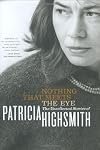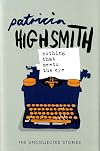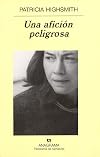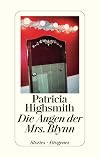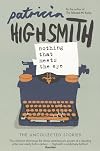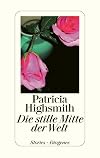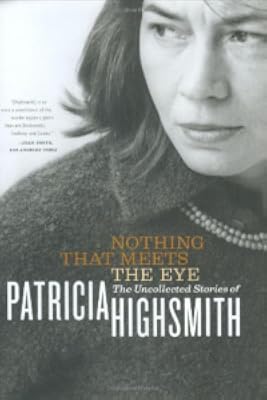
Nothing That Meets the Eye: The Uncollected Stories of Patricia Highsmith
by Patricia Highsmith
On This Page
Description
The Highsmith renaissance continues with this brilliant collection of 28 short stories, a great majority of which have never been seen before. From this new collection, a remarkable portrait of the American psyche at mid-century emerges, unforgettably distilled by the inimitable eye of Patricia Highsmith.Tags
Recommendations











Member Reviews
I really, REALLY like Patricia Highsmith. I think I've read almost all her short story collections over the course of six months. You'll be hard-pressed to convince me that there's someone who writes better short stories.
This collection is composed of stories that were found in her archives after her death and was assembled posthumously. Many were stories that had been published previously and uncollected, but a few were things that hadn't been published before. This also illustrates her taste as much as anything else, because this huge volume is far weaker than any of the other collections I've read by her.
There's still some fantastic stories in here, though. One of my favorites is a really ridiculous story about a rather ostentatious show more man who collects counterfeit paintings, and explains his affinity for them to a woman by completely disassembling his body and proving that almost all his parts are false. It's... bizarre and unexpected, to say the least, and the ending is somewhat out of sync with the rest of the story, something else I liked about it.
Her depictions of people continues to be spot on, though. One of the stories in this collection is about two women of different classes whose eyes meet and both know immediately that the upper-class woman is jealous of the other, who is meeting her lover. Another story is the shortened version of "Cries of Love," a favorite of mine from another collection, but it benefits from the ending she gave it in the collected version. Another is about a woman who collects a series of marriage proposals in the week she spends at a ski resort before she kills herself for being spurned by her lover.
The weakness in a lot of these stories mostly comes from the fact they feel less finished than the ones in the other collections. It seems like they only tell part of a story, and it makes the others seem that much better, because... well, I like her for the rather twisted people she writes, and these have them, but it's like the people don't quite ever finish what they're doing, and it makes the stories slightly less.
These are all definitely worth reading, but I think it does best after all her other collections. show less
This collection is composed of stories that were found in her archives after her death and was assembled posthumously. Many were stories that had been published previously and uncollected, but a few were things that hadn't been published before. This also illustrates her taste as much as anything else, because this huge volume is far weaker than any of the other collections I've read by her.
There's still some fantastic stories in here, though. One of my favorites is a really ridiculous story about a rather ostentatious show more man who collects counterfeit paintings, and explains his affinity for them to a woman by completely disassembling his body and proving that almost all his parts are false. It's... bizarre and unexpected, to say the least, and the ending is somewhat out of sync with the rest of the story, something else I liked about it.
Her depictions of people continues to be spot on, though. One of the stories in this collection is about two women of different classes whose eyes meet and both know immediately that the upper-class woman is jealous of the other, who is meeting her lover. Another story is the shortened version of "Cries of Love," a favorite of mine from another collection, but it benefits from the ending she gave it in the collected version. Another is about a woman who collects a series of marriage proposals in the week she spends at a ski resort before she kills herself for being spurned by her lover.
The weakness in a lot of these stories mostly comes from the fact they feel less finished than the ones in the other collections. It seems like they only tell part of a story, and it makes the others seem that much better, because... well, I like her for the rather twisted people she writes, and these have them, but it's like the people don't quite ever finish what they're doing, and it makes the stories slightly less.
These are all definitely worth reading, but I think it does best after all her other collections. show less
Didn't like Strangers on a Train, decided not to read this one
Ratings
Members
- Recently Added By
Author Information

302+ Works 32,974 Members
Patricia Highsmith wrote twenty-one novels including "Strangers on a Train" & the "Ripley" series. She died in 1995 in Switzerland, where she resided much of her life. (Publisher Provided) Patricia Highsmith (January 19, 1921 -- February 4, 1995) was an American novelist and short story writer, most widely known for her psychological thrillers, show more which led to more than two dozen film adaptations. She was born in Fort Worth, Texas. Highsmith grew up with her maternal grandmother in Astoria, Queens, and attended Barnard College. Her first novel, Strangers on a Train (1950), was adapted for stage and screen numerous times, notably by Alfred Hitchcock in 1951. In addition to her acclaimed series about murderer Tom Ripley, which was made into a film in 1955, she wrote many short stories, often macabre, satirical or tinged with black humor. Highsmith liked to examine the ways in which people can get to the point where they are capable of murder, as well as who they become after they have committed a crime. In carefully constructed stories and novels, she integrated this scrutiny of the human psyche into complex plots that often took unexpected twists. In Strangers on a Train, architect Guy Haines meets Charles Bruno on a train. Bruno conceives a plan to have Haines kill Bruno's father, while Bruno will kill Haines's wife. The effect that this plan has on Haines is the focus of the story. Highsmith's awards include: O. Henry Award for best publication of first story, for "The Heroine" in Harper's Bazaar (1946), Grand Prix de Littérature Policière, for The Talented Mr. Ripley (1957), and the Dagger Award -- Category Best Foreign Novel, for The Two Faces of January from the Crime Writers' Association of Great Britain (1964). Highsmith died of aplastic anemia and cancer in Locarno, Switzerland, at age 74. Her last novel, Small G: A Summer Idyll, was published one month after her death in 1995. (Bowker Author Biography) show less
Some Editions
Series
Belongs to Publisher Series
Virago Modern Classics (620)
Common Knowledge
- Canonical title
- Nothing That Meets the Eye: The Uncollected Stories of Patricia Highsmith
- Original title
- Nothing That Meets the Eye: The Uncollected Stories of Patricia Highsmith
- Original publication date
- 2002
- Blurbers
- Smith, Joan; Davenport-Hines, Richard; Harris, Mark; Cote, David
Classifications
Statistics
- Members
- 413
- Popularity
- 75,049
- Reviews
- 2
- Rating
- (3.90)
- Languages
- 9 — Catalan, Dutch, English, Finnish, French, German, Italian, Portuguese, Spanish
- Media
- Paper, Ebook
- ISBNs
- 22
- ASINs
- 2