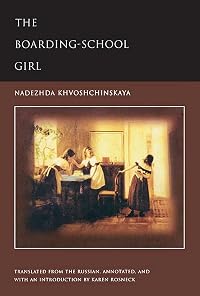
The Boarding-School Girl
by V. Krestovskīĭ
On This Page
Description
This tale of a young woman's not-so-sentimental education is the story of fifteen-year-old Lolenka, who encounters an exiled radical named Veretitsyn and begins to question her education and life. Under his influence, Lolenka breaks with tradition and embarks upon a new life as a translator and an artist, but a chance meeting with Veretitsyn years later leads to a sobering reappraisal of her mentor's convictions.Tags
Recommendations











Member Recommendations
by anonymous user
by anonymous user
Member Reviews
Nadezhda Khvoshchinskaya, like her sister Sofya and so many other women authors, seems to have been largely forgotten, despite having enjoyed considerable popularity over her four decade career, and that’s a real injustice. This is a quiet book but it has elements of feminism, a critique of the education system in Russia at the time, and existential themes that were ahead of their time.
I really felt the claustrophobia in the daily life of this 15 year old girl, which was limited to embroidery, garden walks, and a superficial secondary education that was geared mostly to producing “good young women.” She may be married off by her parents without her knowing her suitor, and is expected to simply submit to both them and to her show more future husband. Without spoiling it, what an absolute triumph its final chapter is.
At school we find rote education and memorization of factoids provided by teachers who aren’t truly looking out for the welfare of their students. Through her characters Khvoshchinskaya also questions some of the things we hold as pillars, such as the images of various “great men” in history. The subjectivity of truth plays in to the novel’s existential themes, which also include the pointlessness of daily tasks and the absurdity of believing in the purity of concepts like courage or empathy for others.
This edition has a fantastic introduction and annotation by Karen Rosneck, who clearly did a lot of research in addition to translating this book. She informs the reader of the larger context of Russian history, as well as the behavior of those in power. Check out this quote in the intro:
“For Verititsyn, Lolenka’s textbooks claim an objective representation of reality that masks their function as instruments of indoctrination. The powerful enjoy the privilege of authorship as a means to control public opinion, obscure wrongdoing, mask personal failings, and depict social inequities as immutable truths in order to justify their own positions of power.”
A couple of quotes from the text:
On exams:
“I don’t care how I answered, good or bad: what’s mine will always be mine. I’m studying for myself, not for the teacher, not for the headmistress, not for any certification of achievement, any book, but for myself, to know.”
On marriage:
“But looking at it from a present-day point of view, what is it? Slavery, the family! …A more elevated woman is subjugated to some nice fellow; she sacrificed herself at the whim of her egotistical mother; she reconciled – that is, reunited again – two bad people so they could cause even more harm together! Somehow, amid the constraints, despite the derision, she passes something mundane on to the children…But is it really humane, is it healthy? She passes on to them the same unfortunate precepts of selflessness that are destroying her! Precepts of submission to tyranny!” show less
I really felt the claustrophobia in the daily life of this 15 year old girl, which was limited to embroidery, garden walks, and a superficial secondary education that was geared mostly to producing “good young women.” She may be married off by her parents without her knowing her suitor, and is expected to simply submit to both them and to her show more future husband. Without spoiling it, what an absolute triumph its final chapter is.
At school we find rote education and memorization of factoids provided by teachers who aren’t truly looking out for the welfare of their students. Through her characters Khvoshchinskaya also questions some of the things we hold as pillars, such as the images of various “great men” in history. The subjectivity of truth plays in to the novel’s existential themes, which also include the pointlessness of daily tasks and the absurdity of believing in the purity of concepts like courage or empathy for others.
This edition has a fantastic introduction and annotation by Karen Rosneck, who clearly did a lot of research in addition to translating this book. She informs the reader of the larger context of Russian history, as well as the behavior of those in power. Check out this quote in the intro:
“For Verititsyn, Lolenka’s textbooks claim an objective representation of reality that masks their function as instruments of indoctrination. The powerful enjoy the privilege of authorship as a means to control public opinion, obscure wrongdoing, mask personal failings, and depict social inequities as immutable truths in order to justify their own positions of power.”
A couple of quotes from the text:
On exams:
“I don’t care how I answered, good or bad: what’s mine will always be mine. I’m studying for myself, not for the teacher, not for the headmistress, not for any certification of achievement, any book, but for myself, to know.”
On marriage:
“But looking at it from a present-day point of view, what is it? Slavery, the family! …A more elevated woman is subjugated to some nice fellow; she sacrificed herself at the whim of her egotistical mother; she reconciled – that is, reunited again – two bad people so they could cause even more harm together! Somehow, amid the constraints, despite the derision, she passes something mundane on to the children…But is it really humane, is it healthy? She passes on to them the same unfortunate precepts of selflessness that are destroying her! Precepts of submission to tyranny!” show less
Ratings
Members
- Recently Added By
Author Information
4 Works 40 Members
Classifications
- Genres
- Fiction and Literature, General Fiction, Historical Fiction
- DDC/MDS
- 891.73 — Literature & rhetoric Literatures of other languages East Indo-European and Celtic literatures Russian and East Slavic languages Russian fiction
- LCC
- PG3337 .K42 .P3613 — Language and Literature Slavic languages and literatures. Baltic languages. Albanian language Slavic. Baltic. Albanian Russian literature Individual authors and works 1800-1870
- BISAC
Statistics
- Members
- 37
- Popularity
- 780,108
- Reviews
- 1
- Rating
- (3.71)
- Languages
- English, Russian
- Media
- Paper
- ISBNs
- 1