Yellow Elephant: A Bright Bestiary
by Julie Larios
On This Page
Description
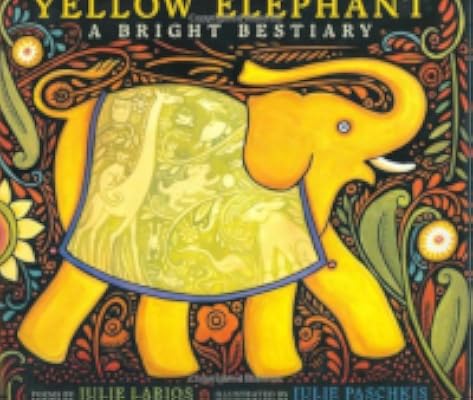
In this bright bestiary, poet Julie Larios and painter Julie Paschkis cast a menagerie of animals in brilliantly unexpected hues--encouraging us to see the familiar in surprising new ways.Tags
Recommendations



Member Reviews
What color is your favorite animal? Is it gray for Elephants or green for frogs? "Yellow Elephant" is a collection of poems that challenges that very thought. This book promotes the exploration of "what ifs" by portraying an assortment of animals in unexpected colors. What if elephants were yellow? Readers are left amazed after spending the entire book seeing these animals in such electrifying new ways.
Some poems rhyme, others don’t, in this simple, enjoyable collection of poems that combine an animal with a color (“Gray mama goose in a tizzy, honk-honk-honking herself dizzy”). The poems that don’t rhyme are equally engaging, as with “Green Frog”: “One hop and her green is gone. See how she swims, blue frog now under blue water.”
The poems are very short—perfect for an introduction to poetry for young students, from which one can sample different poetic elements. Besides the occasional rhyming, there are examples of alliteration (“Purple Puppy”), onomatopoeia (“’Who?’ asks the white owl, all eyes. ‘Who?’”) and repetition (“Pink collar. Pink bell. Pink pillow. Pink bowl.”). Several of the poems show more create sensory images for children, though mostly involving sight and sound. “Orange Giraffe” opens with “Orange sun rising over the savanna—Can you see the orange water over the Juba River?” and then “Can you hear the hyena’s high orange laugh?”
The vocabulary is very accessible to young students, as are occasional similes and metaphors. For example, the poem about a brown mouse describes its skittering all around “like she’s jitterbugging on tinfoil.” The integration of Julie Paschkis’s (Glass Slipper Golden Sandal) lovely illustrations with the text produces a very satisfying package for students’ first experiences with this genre. Target audience grades 1-3.
Larios, J. H., & Paschkis, J. (2006). Yellow elephant: A bright bestiary. Orlando: Harcourt. show less
The poems are very short—perfect for an introduction to poetry for young students, from which one can sample different poetic elements. Besides the occasional rhyming, there are examples of alliteration (“Purple Puppy”), onomatopoeia (“’Who?’ asks the white owl, all eyes. ‘Who?’”) and repetition (“Pink collar. Pink bell. Pink pillow. Pink bowl.”). Several of the poems show more create sensory images for children, though mostly involving sight and sound. “Orange Giraffe” opens with “Orange sun rising over the savanna—Can you see the orange water over the Juba River?” and then “Can you hear the hyena’s high orange laugh?”
The vocabulary is very accessible to young students, as are occasional similes and metaphors. For example, the poem about a brown mouse describes its skittering all around “like she’s jitterbugging on tinfoil.” The integration of Julie Paschkis’s (Glass Slipper Golden Sandal) lovely illustrations with the text produces a very satisfying package for students’ first experiences with this genre. Target audience grades 1-3.
Larios, J. H., & Paschkis, J. (2006). Yellow elephant: A bright bestiary. Orlando: Harcourt. show less
This is a good book to read to a child who uses their imagination. Various animals are poetically illustrated in the usual way we think of the animal, and then through poems we are shown the same animal in a different color. I like the concept and the illustrations.
I have a long affection for children’s picture books, despite having no children. When I saw a review on this and a small sample of the artwork, I was motivated to find out more.
A sort of variation on the beloved “Color Kittens,” this combines a color and a familiar animal, sometimes in unusual combinations.
Each picture is accompanied by a poem, with a strip of colorful detail.
I think the vivid colors will work for young eyes, as well as the crisp lines.
Occasionally it is stylized enough that it may be less accessible, but the variety in style means some pictures should still work well.
I’m in love with the colorful artwork. I’d love to have a a group of these as prints. It even sent me to Paschkis’ site to learn more show more about her work. Alas: no prints of these for sale.
Cross posted at my blog, with additional pictures: https://clsiewert.wordpress.com/2017/11/14/yellow-elephant-a-bright-bestiary-by-... show less
A sort of variation on the beloved “Color Kittens,” this combines a color and a familiar animal, sometimes in unusual combinations.
Each picture is accompanied by a poem, with a strip of colorful detail.
I think the vivid colors will work for young eyes, as well as the crisp lines.
Occasionally it is stylized enough that it may be less accessible, but the variety in style means some pictures should still work well.
I’m in love with the colorful artwork. I’d love to have a a group of these as prints. It even sent me to Paschkis’ site to learn more show more about her work. Alas: no prints of these for sale.
Cross posted at my blog, with additional pictures: https://clsiewert.wordpress.com/2017/11/14/yellow-elephant-a-bright-bestiary-by-... show less
This wonderfully illustrated picture books takes children's poetry into a new light. With the different animals painted in a new light this silly story is sure to bring a smile to any young child. The Yellow Elephant tells a story through its poetry and through the pictures.
This would be a great activity to let the children paint their own animals anyway they see them.
This could also be a great book for the letter E and many activities that could follow in that area.
This would be a great activity to let the children paint their own animals anyway they see them.
This could also be a great book for the letter E and many activities that could follow in that area.
How many people can actually say they understand the various meanings of words? I do not mean literal, but the feeling and emotion one experiences when they see or read a color, for example. In the "Yellow Elephant: A Bright Bestiary," a book of poetry, it helps one develop the sense of words. In particular, it helps one realize how color can effect a person by seeing it or reading the word that describes the it. Colors can mean a variety of different things, like warm and inviting, to angry and frustrated. Children need to be able to make these emotional connections with words while reading, and one way to help children develop this sense is to read the "Yellow Elephant: A Bright Bestiary."
For real -- it's a book of children's poetry that doesn't feel like it has to rhyme obviously all the time. WOAH! Larios does some nice things with rhyme, rhythm, and language, and Paschkis's illustrations are interesting. I like it.
Members
- Recently Added By
Lists

Brilliant poetry collections for kids
51 works; 18 members

Elephants in Books
55 works; 5 members
Author Information
6+ Works 242 Members
All Editions
Awards and Honors
Awards
Common Knowledge
- Canonical title
- Yellow Elephant: A Bright Bestiary
- Last words
- (Click to show. Warning: May contain spoilers.)Ah,
there's her gold baby,
all fuzz,
napping.
Classifications
Statistics
- Members
- 93
- Popularity
- 346,452
- Reviews
- 18
- Rating
- (3.76)
- Languages
- English, French
- Media
- Paper, Ebook
- ISBNs
- 3
- ASINs
- 3