
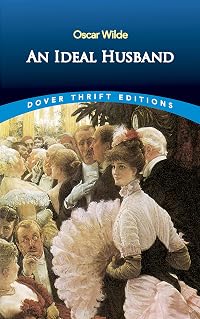
An Ideal Husband
by Oscar Wilde 
On This Page
Description
Oscar Wilde's play An Ideal Husband is a comedy about politics, blackmail and corruption. The action takes place over three days in London, and it questions ideas of public and private honor. It is a play about the past catching up with one in the present..
Tags
Recommendations





Member Reviews
While An Ideal Husband is typical Wilde in many ways, it is not Wilde at his best. Both Lady Windemere's Fan and The Importance of Being Ernest eclipse it. Still, great fun and charged with the kind of wit one expects from Wilde.
There is a play upon role reversal that is hilarious, as it is the woman who puts the man upon a pedestal and then knocks him off. There are the usual high-jinks with letters that come into the wrong hands and a ludicrous, but quite nifty, foiling of the primary villain. In fact, it has every single element that you come to expect and adore in a Wilde production. At the same time, it does manage to deal with at least one very serious issue...that of the ideal. To expect that any person can be ideal and flawless show more is to set one's self up for disaster.
One thing that struck me was the way Wilde wrote his stage directions. For each person as they enter the scene, he describes the type of art piece they would resemble. He had every physical trait and mannerism in his mind as he crafted these characters. I would love to see this play acted. I'm guessing it could be appreciated at one-step higher level seen on stage. show less
There is a play upon role reversal that is hilarious, as it is the woman who puts the man upon a pedestal and then knocks him off. There are the usual high-jinks with letters that come into the wrong hands and a ludicrous, but quite nifty, foiling of the primary villain. In fact, it has every single element that you come to expect and adore in a Wilde production. At the same time, it does manage to deal with at least one very serious issue...that of the ideal. To expect that any person can be ideal and flawless show more is to set one's self up for disaster.
One thing that struck me was the way Wilde wrote his stage directions. For each person as they enter the scene, he describes the type of art piece they would resemble. He had every physical trait and mannerism in his mind as he crafted these characters. I would love to see this play acted. I'm guessing it could be appreciated at one-step higher level seen on stage. show less
This play, while hilarious both in razor-sharp wit, social satire, and flawlessly woven dramatic irony, also has a poignant and (to me) relatable central theme. Perfect! Even if old plays arent your thing, at least watch the movie. You won't regret it.
That's the short version. The long version:
I saw this play almost by accident at the Stratford (Ontario) Theatre Festival last year and it has made me fall in love with Oscar Wilde. Previously, my only exposure had been Dorian Gray when I was much too young, but since seeing (and subsequently reading) An Ideal Husband I have discovered that pleasure in Wilde's works and read many more of his plays.
During the play, listening to Lord Goring's ubiquitous witty lines, I thought, the thing is show more that no one's really that funny in real life. Wilde probably thought of one of those lines per month, wrote them in a notebook, and then was able to write them in to the Goring's lines as though Goring could just come up with them on the spot. During intermission, though, I read the programme and discovered that, in fact, Wilde himself was that funny in real life. He is considered by some the first modern celebrity; before he published a word, he was a career party guest - people would invite him to their evens to stand around and be funny. So believe me when I tell you that An Ideal Husband is worth it just for the humour value.
But the more serious themes of the play also resonated deeply with me. As a stereotypical angsty/idealistic teenager, I found Gertrude's tension between her ideal truth and the reality very familiar. As well, the play asks important questions like What is the true nature of love? How can one continue to love someone who is not what one thought? as well as questions about sin/crime, repentance and forgiveness (on an ethical, not religious, level). The play also includes themes of honour and political corruption.
Fun fact: This play is about a man's fear of what will happen when his beloved wife finds out that he is not the man she thinks he is. This was written during a period of Wilde's life when he was becoming more and more active in the underground (and illegal - he would eventually be imprisoned) London homosexual scene - unbeknownst to his wife and the mother of his children, whom, it seems he did truly love.
All in all, this play is a perfect balance between lightness and humour and real, serious questions. It is a masterpiece.
However, in the interests of integrity, here are some imperfections:
- sexism.
- some weird (as far as I can figure out) conceptions of relationships: - Not sure why Lord Goring marries Mabel in the end. Still trying to work that out. Let me know if you have any ideas.
Disclaimer: I haven't looked at this play in a while and may have misremembered things or left important points out. If so, I apologize and I will update if I think of anything else.
Now, go read it! show less
That's the short version. The long version:
I saw this play almost by accident at the Stratford (Ontario) Theatre Festival last year and it has made me fall in love with Oscar Wilde. Previously, my only exposure had been Dorian Gray when I was much too young, but since seeing (and subsequently reading) An Ideal Husband I have discovered that pleasure in Wilde's works and read many more of his plays.
During the play, listening to Lord Goring's ubiquitous witty lines, I thought, the thing is show more that no one's really that funny in real life. Wilde probably thought of one of those lines per month, wrote them in a notebook, and then was able to write them in to the Goring's lines as though Goring could just come up with them on the spot. During intermission, though, I read the programme and discovered that, in fact, Wilde himself was that funny in real life. He is considered by some the first modern celebrity; before he published a word, he was a career party guest - people would invite him to their evens to stand around and be funny. So believe me when I tell you that An Ideal Husband is worth it just for the humour value.
But the more serious themes of the play also resonated deeply with me. As a stereotypical angsty/idealistic teenager, I found Gertrude's tension between her ideal truth and the reality very familiar. As well, the play asks important questions like What is the true nature of love? How can one continue to love someone who is not what one thought? as well as questions about sin/crime, repentance and forgiveness (on an ethical, not religious, level). The play also includes themes of honour and political corruption.
Fun fact: This play is about a man's fear of what will happen when his beloved wife finds out that he is not the man she thinks he is. This was written during a period of Wilde's life when he was becoming more and more active in the underground (and illegal - he would eventually be imprisoned) London homosexual scene - unbeknownst to his wife and the mother of his children, whom, it seems he did truly love.
All in all, this play is a perfect balance between lightness and humour and real, serious questions. It is a masterpiece.
However, in the interests of integrity, here are some imperfections:
- sexism.
- some weird (as far as I can figure out) conceptions of relationships:
Disclaimer: I haven't looked at this play in a while and may have misremembered things or left important points out. If so, I apologize and I will update if I think of anything else.
Now, go read it! show less
Less absurd than for instance The Importance of Being Earnest, this play nevertheless manages to accumulate an impressive number of Wildean bon mots, whilst at the same time providing food for thought on human imperfection, power and hubris, and the necessary illusions that sustain romantic relationships. "Some Like It Hot" ended with the phrase "Nobody's perfect", whereas An Ideal Husband" starts from that very observation, and then asks how we deal with it.
Amidst all the banter, the anguish of a man with an unspeakable secret stands out, a youthful indiscretion that polite society would find an abomination. It is not hard to surmise that Wilde's own fears resonate here. As readers, we know that eventually his (not so secret) secret is show more dragged before the courts, leading to Wilde being ostracised from the society that he so lovingly mocks in these plays and to his early death. And we smile with the witticisms, but the smiles are bittersweet. show less
Amidst all the banter, the anguish of a man with an unspeakable secret stands out, a youthful indiscretion that polite society would find an abomination. It is not hard to surmise that Wilde's own fears resonate here. As readers, we know that eventually his (not so secret) secret is show more dragged before the courts, leading to Wilde being ostracised from the society that he so lovingly mocks in these plays and to his early death. And we smile with the witticisms, but the smiles are bittersweet. show less
I wasn't nearly as impressed with this play as I was with the previous two. The drama was still entertaining, but the plot was more about political morality and unrealistic expectations, plus the characters all wound up far too happily ever after for my liking. If we're going to talk about dirty politicians they need to have their comeuppance - even though I fully admit that it's more realistic if they get away with all their scheming... Yuck!
Despite my deep and resounding love for Oscar Wilde's The Picture of Dorian Grey (for which I have given my sons the middle names Dorian and Henry), I have come to realize I have read shamefully little of his other work. Today I resolved to sit down with one of his well-known plays, and chose An Ideal Husband. The play is everything I've come to expect from Wilde; while the dialog doesn't sound particularly natural, it is infused with the wit and charm of Wilde's satirical authorial presence, which carries the work well. I appreciated the parallel established between politics and marriage, and enjoyed the ever-present commentary on gender, fashion, society, and art (especially the aesthetic correlation established between Wilde's show more characters and known artists/styles). I look forward to reading more of Wilde's work - both drama and short stories - in the near future. show less
“I love talking about nothing, father. It is the only thing I know anything about.”
I love Wilde’s wit. This is less laugh-out-loud funny than The Importance of Being Earnest, but it has (somewhat) more substance: about what truly makes a good marriage, and how real love forgives, and not idealizes. A lighthearted, fun read.
I love Wilde’s wit. This is less laugh-out-loud funny than The Importance of Being Earnest, but it has (somewhat) more substance: about what truly makes a good marriage, and how real love forgives, and not idealizes. A lighthearted, fun read.
Morality is simply the attitude we adopt towards people we personally dislike.
Nietzsche with a buttonhole. This is a mercenary world of ennui and style. There must be a phenomenological link? Wilde notes Wealth is the new object of worship.
The interior logic of the play is a bit neat for my taste as is the means by which the husband is reprieved. Clasps on bracelets can be annoying, yet they aren't Gordian knots.
Nietzsche with a buttonhole. This is a mercenary world of ennui and style. There must be a phenomenological link? Wilde notes Wealth is the new object of worship.
The interior logic of the play is a bit neat for my taste as is the means by which the husband is reprieved. Clasps on bracelets can be annoying, yet they aren't Gordian knots.
Members
- Recently Added By
Lists

Plays I Like
230 works; 31 members

Books I Own But Haven't Read
144 works; 2 members
Stage Plays/Screenplays/Dialogues/Anything Dialogue-Storytelling Related
81 works; 2 members
1:28 p.m.'s 350 Stage Plays Challenge
94 works; 3 members

Books Read in 2023
5,547 works; 145 members
Essential/Recognized Stage Plays
115 works; 4 members
My Play Collection
769 works; 3 members

Next Plays / 2025
352 works; 1 member

Next Plays to Watch
50 works; 1 member

Fav. Stage Plays / First-Time Watched / Listened To / 2025
20 works; 1 member
Author Information

1,763+ Works 120,860 Members
Flamboyant man-about-town, Oscar Wilde had a reputation that preceded him, especially in his early career. He was born to a middle-class Irish family (his father was a surgeon) and was trained as a scholarship boy at Trinity College, Dublin. He subsequently won a scholarship to Magdalen College, Oxford, where he was heavily influenced by John show more Ruskin and Walter Pater, whose aestheticism was taken to its radical extreme in Wilde's work. By 1879 he was already known as a wit and a dandy; soon after, in fact, he was satirized in Gilbert and Sullivan's Patience. Largely on the strength of his public persona, Wilde undertook a lecture tour to the United States in 1882, where he saw his play Vera open---unsuccessfully---in New York. His first published volume, Poems, which met with some degree of approbation, appeared at this time. In 1884 he married Constance Lloyd, the daughter of an Irish lawyer, and within two years they had two sons. During this period he wrote, among others, The Picture of Dorian Gray (1891), his only novel, which scandalized many readers and was widely denounced as immoral. Wilde simultaneously dismissed and encouraged such criticism with his statement in the preface, "There is no such thing as a moral or an immoral book. Books are well written or badly written. That is all." In 1891 Wilde published A House of Pomegranates, a collection of fantasy tales, and in 1892 gained commercial and critical success with his play, Lady Windermere's Fan He followed this comedy with A Woman of No Importance (1893), An Ideal Husband (1895), and his most famous play, The Importance of Being Earnest (1895). During this period he also wrote Salome, in French, but was unable to obtain a license for it in England. Performed in Paris in 1896, the play was translated and published in England in 1894 by Lord Alfred Douglas and was illustrated by Aubrey Beardsley. Lord Alfred was the son of the Marquess of Queensbury, who objected to his son's spending so much time with Wilde because of Wilde's flamboyant behavior and homosexual relationships. In 1895, after being publicly insulted by the marquess, Wilde brought an unsuccessful slander suit against the peer. The result of his inability to prove slander was his own trial on charges of sodomy, of which he was found guilty and sentenced to two years of hard labor. During his time in prison, he wrote a scathing rebuke to Lord Alfred, published in 1905 as De Profundis. In it he argues that his conduct was a result of his standing "in symbolic relations to the art and culture" of his time. After his release, Wilde left England for Paris, where he wrote what may be his most famous poem, The Ballad of Reading Gaol (1898), drawn from his prison experiences. Among his other notable writing is The Soul of Man under Socialism (1891), which argues for individualism and freedom of artistic expression. There has been a revived interest in Wilde's work; among the best recent volumes are Richard Ellmann's, Oscar Wilde and Regenia Gagnier's Idylls of the Marketplace , two works that vary widely in their critical assumptions and approach to Wilde but that offer rich insights into his complex character. (Bowker Author Biography) show less
Oscar Wilde has a Legacy Library. Legacy libraries are the personal libraries of famous readers, entered by LibraryThing members from the Legacy Libraries group.
Some Editions
Awards and Honors
Awards
Series
Belongs to Publisher Series
Work Relationships
Is contained in
The Importance of Being Earnest / Lady Windermere's Fan / A Woman of No Importance / An Ideal Husband / Salomé by Oscar Wilde
Has the adaptation
Has as a commentary on the text
Has as a student's study guide
Common Knowledge
- Canonical title
- An Ideal Husband
- Original title
- An Ideal Husband
- Alternate titles*
- Der ideale Gatte
- Original publication date
- 1895
- People/Characters
- Earl of Caversham; Viscount Goring; Robert Chiltern (Sir); Lady Chiltern; Lady Markby; Countess of Basildon (show all 11); Mrs. Marchmond; Mabel Chiltern (Miss); Vicomte de Nanjac; Mrs. Cheveley; Mr. Montfort
- Important places
- London, England, UK
- Related movies
- An Ideal Husband (1999 | IMDb); An Ideal Husband (1947 | IMDb); An Ideal Husband (1998 | IMDb); "BBC Play of the Month" An Ideal Husband (1969 | IMDb)
- Dedication
- To Frank Harris
a slight tribute
to his power and distinction
as an artist
his chivalry and nobility
as a friend - First words
- The octagon room at Sir Robert Chiltern's house in Grosvenor Square, London.
- Quotations
- When the gods wish to punish us, they answer our prayers.
Only dull people are brilliant at breakfast. - Last words
- (Click to show. Warning: May contain spoilers.)For both of us a new life is beginning.
- Original language
- English
*Some information comes from Common Knowledge in other languages. Click "Edit" for more information.
Classifications
Statistics
- Members
- 1,556
- Popularity
- 14,661
- Reviews
- 37
- Rating
- (3.90)
- Languages
- 11 — Arabic, Czech, Dutch, English, French, German, Greek, Hungarian, Italian, Portuguese, Spanish
- Media
- Paper, Audiobook, Ebook
- ISBNs
- 163
- UPCs
- 1
- ASINs
- 24