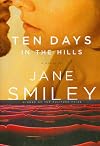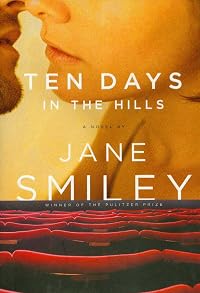
Ten Days in the Hills
by Jane Smiley
On This Page
Description
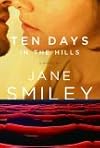
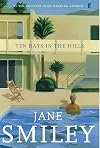
On the morning after the 2003 Academy Awards, Max--an Oscar-winning writer/director whose fame has waned--and his lover, Elena, are in bed, still groggy from last night's red-carpet festivities. They are talking about movies, talking about love, talking about the just-begun war in Iraq. But a house full of guests demands attention. They share their stories of Hollywood past and present; they watch films in Max's luxe screening room; they gossip by the swimming pool, and tussle in the many show more bedrooms. The tension mounts, sparks fly, and Smiley delivers a virtuosic, unputdownable romp of a novel about love, war, sex, politics, storytelling--and, of course, redemption--that's Hollywood! show lessTags
Recommendations



Member Recommendations

hairball The original movietown book. (Which isn't, I realize, the point of Smiley's book, but still...)
Member Reviews
Glancing at the reviews on Amazon--ranging, btw, from "I didn't finish" to very negative--I realized that for some people, this would be their first Jane Smiley novel! After which, they would never get close to one again.
So, please, don't start with this one. Even if you're a big fan, you might not want to bother. My favorite, Ordinary Love and Good Will, isn't one of her best known, I think. But it's a showcase for her sensitivity to very delicate feelings, to how cruelties and slights within the family reverberate through the years--in particular how the hurts of childhood manifest in the adults.
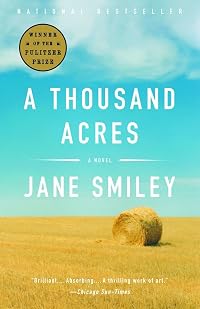
But I think Moo or A Thousand Acres or In Good Faith might be better first books because they display how good she is at sketching characters show more and their families, researching and conveying how a subculture or sub-world (academia, a large family farm, real estate) works. She can capture the zeitgeist of an era (that would be Good Faith) and then make it all a backdrop to big themes. She's funny too. No one is ever going to call Jane Smiley a chicklit writer.
I don't think I have to go into what's so tedious about this book, since other reviewers here do so. And I didn't even get to the explicit sex scenes--not something Smiley has been much known for.
But after seeing the mess of Ten Days, I will be cautious about reading any other novels Smiley has written since moving to California. I'm speculating that something about the move has made her soft in the head. Maybe it was the money that came with the movie version of A Thousand Acres? The movie itself and coming in contact with people who had made too much money from doing and thinking very little?
When writing most of her earlier books, Smiley was also living and teaching in Iowa. Maybe the earliest were written somewhere else, but it was a place like Pennsylvania or upstate New York or Ohio--somewhere populated by thinking, feeling, worrying, working human beings.
I just saw the ho-hum Librarything interview with Jane Smiley. In reply to a question about the negative reviews for this book, she says that she never reads reviews (yeah, right) and that many people have told her they like Ten Days. I don't believe either statement, unless the fans were some of the boors that inspired this novel's characters. But it bothers me that she professes no interest in the opinions of critics or readers (such as those here) when they're so overwhelmingly negative. She must have some sense that it went wrong, yet there's no possibility readers could help her see why? Doesn't she fear she'll do it again? It makes me think less of her. show less
So, please, don't start with this one. Even if you're a big fan, you might not want to bother. My favorite, Ordinary Love and Good Will, isn't one of her best known, I think. But it's a showcase for her sensitivity to very delicate feelings, to how cruelties and slights within the family reverberate through the years--in particular how the hurts of childhood manifest in the adults.
But I think Moo or A Thousand Acres or In Good Faith might be better first books because they display how good she is at sketching characters show more and their families, researching and conveying how a subculture or sub-world (academia, a large family farm, real estate) works. She can capture the zeitgeist of an era (that would be Good Faith) and then make it all a backdrop to big themes. She's funny too. No one is ever going to call Jane Smiley a chicklit writer.
I don't think I have to go into what's so tedious about this book, since other reviewers here do so. And I didn't even get to the explicit sex scenes--not something Smiley has been much known for.
But after seeing the mess of Ten Days, I will be cautious about reading any other novels Smiley has written since moving to California. I'm speculating that something about the move has made her soft in the head. Maybe it was the money that came with the movie version of A Thousand Acres? The movie itself and coming in contact with people who had made too much money from doing and thinking very little?
When writing most of her earlier books, Smiley was also living and teaching in Iowa. Maybe the earliest were written somewhere else, but it was a place like Pennsylvania or upstate New York or Ohio--somewhere populated by thinking, feeling, worrying, working human beings.
I just saw the ho-hum Librarything interview with Jane Smiley. In reply to a question about the negative reviews for this book, she says that she never reads reviews (yeah, right) and that many people have told her they like Ten Days. I don't believe either statement, unless the fans were some of the boors that inspired this novel's characters. But it bothers me that she professes no interest in the opinions of critics or readers (such as those here) when they're so overwhelmingly negative. She must have some sense that it went wrong, yet there's no possibility readers could help her see why? Doesn't she fear she'll do it again? It makes me think less of her. show less
This novel's characters annoyed me. One feels guilty about the recent invasion of Iraq. Another "accidentally" exposes himself to a female shopper while he is clothes shopping.
The only intellectually interesting part was commentary about Gogol's "Tara Bulba" in the form of a proposed movie treatment by the alpha male in the story, the head of the household where most of the ten days are spent sitting around. I became curious and read "Taras Bulba." Most of the movie treatment's focus is on the novel's anti-Semitism but that can't be more than two or three sentences in "Taras Bulba." The Jews in the story enable the plot to advance in a clever and convincing way: One smuggles Taras Bulba into the enemy city of Warsaw, the Jewish show more community shelters him there and the local Jews bridge the foreign language barrier for him. Its all very plausible because the Jews have no skin in the wars between the Ukrainians and Poles and they are motivated by Tara's generous offers of payment for their services. They never think of betraying him and selling him out once his money is gone. They are the only sensible (non-pugilistic) people in the entire story. Smiley ignores all this but I admire how she used "Taras Bulba" for her own literary purposes.
Liberals will like this book. The invasion guilt seems masterfully evoked perhaps because I had felt it so acutely myself at the time and the manner of the penis exposure is highly original. show less
The only intellectually interesting part was commentary about Gogol's "Tara Bulba" in the form of a proposed movie treatment by the alpha male in the story, the head of the household where most of the ten days are spent sitting around. I became curious and read "Taras Bulba." Most of the movie treatment's focus is on the novel's anti-Semitism but that can't be more than two or three sentences in "Taras Bulba." The Jews in the story enable the plot to advance in a clever and convincing way: One smuggles Taras Bulba into the enemy city of Warsaw, the Jewish show more community shelters him there and the local Jews bridge the foreign language barrier for him. Its all very plausible because the Jews have no skin in the wars between the Ukrainians and Poles and they are motivated by Tara's generous offers of payment for their services. They never think of betraying him and selling him out once his money is gone. They are the only sensible (non-pugilistic) people in the entire story. Smiley ignores all this but I admire how she used "Taras Bulba" for her own literary purposes.
Liberals will like this book. The invasion guilt seems masterfully evoked perhaps because I had felt it so acutely myself at the time and the manner of the penis exposure is highly original. show less
I appreciated this book because it was really well written but I didn't like it. It was sort of like My Dinner with Andre— a movie which is referenced in the book — but with a handful of movie industry-related characters instead of two guys, and everyone is very philosophical about everything, or at least constrained with a good deal of interior thinking which of course is the point but nonetheless not much fun to read. Oh the banality of banality. There are some funny parts though, lots of movie references, and if Bergman's The Seventh Seal is a favorite movie you will love this.
Ten days in two houses in the Hollywood Hills, with a cast of characters involved in the movies or in the circles revolving around that beguiling industry. Smily sets herself the challenge of writing about characters who are mostly situated comfortably or enviably financially, spiritually, emotionally; and who - at least for ten days - live in a world of great luxury, indulgence and beauty. The challenge is to make the reader care about the very intricate and detailed depiction of their emotions, interactions and actions, many of which may appear banal or trivial. All of this against a background of the start of the war in Iraq. I found it both intriguing and engaging, sensually written and daring in its structure and use of time. There show more are no particularly engaging characters or exciting events, but the book says a great deal about much more than appears on the surface - love, sex, conflict, death, resolution - and of course about the banality of much of life, amongst which great art can be made. show less
I was a little put off at first by the fact that every chapter had a sex scene for no apparent reason, but really the main point of this book was conversations. And even the sex was mostly just to give the characters something to do while complaining about the Iraq war. This book has a bunch of about loosely-related people staying in the same house in Hollywood, mostly just talking about movies and politics and their shared histories. It was very relaxing to read. :)
This story is not for everyone, and in some parts not for me, but I think Jane Smiley has brilliant introspection with her characters and a lovely way of emoting what is difficult to make come across on a page in a book.
Generally, I love Jane Smiley, and thoroughly enjoy her books. Not so with this one. It's as if Rick Moody crept in and infected her writing. Ewwwww. Plus, one would think: ten people, ten days, ten different points of view, but no, people get left out, and annoying people are thus given more than their fair share of time. Granted, I've never read The Decameron, but I was under the impression that was the whole point of the thing.
The best part of the book may be the quote about Dr. Zhivago on the back.
This book is an example of the kind of pomo that makes me want to slap someone.
The best part of the book may be the quote about Dr. Zhivago on the back.
This book is an example of the kind of pomo that makes me want to slap someone.
Members
- Recently Added By
Lists

Biggest Disappointments
606 works; 168 members
Author Information

50+ Works 25,574 Members
Jane Smiley was born in Los Angeles, California on September 26, 1949. She received a B. A. from Vassar College in 1971 and an M.F.A. and a Ph.D from the University of Iowa. From 1981 to 1996, she taught undergraduate and graduate creative writing workshops at Iowa State University. Her books include The Age of Grief, The Greenlanders, Moo, Horse show more Heaven, Ordinary Love and Good Will, Some Luck, and Early Warning. In 1985, she won an O. Henry Award for her short story Lily, which was published in The Atlantic Monthly. A Thousand Acres received both the National Book Critics Circle Award and the Pulitzer Prize. (Bowker Author Biography) show less
Awards and Honors
Awards
Distinctions
Common Knowledge
- Dedication
- To Jack Canning, Mr. Inspiration
- First words
- Max was still sleeping, neatly, as always, his head framed by the sunny white of his rectangular pillow, his eyelids smooth over the orbs of his eyes, his lips pale and soft, his bare shoulders square on the bed.
Classifications
Statistics
- Members
- 672
- Popularity
- 42,852
- Reviews
- 19
- Rating
- (2.39)
- Languages
- English, French, Italian
- Media
- Paper, Audiobook, Ebook
- ISBNs
- 25
- UPCs
- 1
- ASINs
- 5