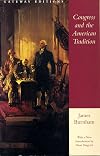
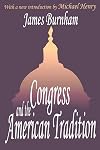
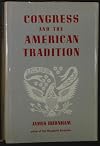
Congress and the American Tradition
by James Burnham
43 Members (4.00)
On This Page
Description
Most Americans would probably be surprised to hear that, in 1959, James Burnham, a leading political thinker questioned whether Congress would survive, and whether the Executive Branch of the American government would become a dictatorship. In the last decade, members of Congress have impeached a president, rejected or refused to consider presidential nominees, and appear in the media criticizing the chief executive. Congress does not exactly appear to be at risk of expiring. Regardless of show more how we perceive Congress today, more than forty years after Congress and the American Tradition was written, Burnham's questions, arguments, and political analysis still have much to tell us about freedom and political order. Burnham originally intended Congress and the American Tradition as a response to liberal critics of Senator McCarthy's investigations of communist influence in the United States. He developed it into a detailed analysis of the history and functioning of Congress, its changing relationship with the Executive Branch, and the danger of despotism, even in a democratic society. The book is organized into three distinct parts. "The American System of Government," analyzes the concept of government, ideology and tradition, power, and the place and function of Congress within the American government. "The Present Position of Congress," explores its law-making power, Congressional commissions, treaties, investigatory power, and proposals for Congressional reform. "The Future of Congress," discusses democracy and liberty, and ultimately asks, "Can Congress Survive?" Michael Henry's new introduction sheds much insight into Burnham's writings and worldview, combining biography and penetrating scholarly analysis. He makes it clear why this work is of continuing importance to political theoreticians, historians, philosophers, and those interested in American government. James Burnham (1905-1987) began his career as a professor of philosophy at New York University. He co-founded, with William F. Buckley, Jr., The National Review. His books include The Managerial Revolution, The Machiavellians: Defenders of Freedom, and Suicide of the West. Michael Henry received his advanced degree in political theory. He has been teaching philosophy at St. John's University in New York since 1977. show lessTags
Recommendations















Member Reviews
Members
- Recently Added By
Author Information

23+ Works 923 Members
James Burnham (1905-1987) began his career as a professor of philosophy at New York University. He co-founded, with William F. Buckley. Jr., The National Review Michael Henry received his advanced degree in political theory. He has been teaching philosophy at St. John's University in New York since 1977
Some Editions
Series
Belongs to Publisher Series
Common Knowledge
- Important places
- USA
- Original language
- English
Classifications
- Genres
- Politics and Government, Nonfiction, History, General Nonfiction, Philosophy
- DDC/MDS
- 328.73 — Society, government, & culture Political science U.S. Congress - Legislation & Legislative Process North America United States
- LCC
- JK1061 .B78 — Political Science Political institutions and public administration (United States) Political institutions and public administration United States Government. Public administration Congress. Legislative branch
- BISAC
Statistics
- Members
- 43
- Popularity
- 689,289
- Rating
- (4.00)
- Languages
- English
- Media
- Paper, Ebook
- ISBNs
- 10
- ASINs
- 1