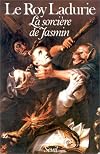
Jasmin's Witch
by Emmanuel Le Roy Ladurie
On This Page
Description
"Pearce's translation from the French preserves the flavor of Ladurie's assiduously researched history. The author, internationally praised for such landmark studies as Carnival in Romans, sought the origins of a poem written in 1840 by Jacques Boeknown as Jasminabout "Francouneto," a witch. A version of the ballad follows Laudurie's accounts of the witch's trials, as well as stories of accusations against a couple who work evil through their powerful, magic mandrake. Jasmin's quiet wit show more touches upon the bigotry among the Gascon villagers, obsessed by "devil-worship." In part three, there are details supporting Ladurie's belief that the witch, "little Francoise," an actual person, lived in the diocese of Condom during the late 17th century, not the mid-16th as the poem suggests. This is a significant distinction, for attitudes on witchcraft had changed by the latter era, which explains the heroine's survival. In a postscript to this edition, Ladurie responds to a French critic who disputes his interpretation."--Amazon.com, review Publisher's weekly. "The renowned French historian explores the roots and development of a popular tale of witchcraft accusations retold in 1840 by the Gascon poet Jacques Boe or "Jasmin." In a lively narrative the modern historian examines the place of witchcraft in traditional southern French society, translates Jasmin's "Francouneto," and tracks through archival sources and interviews its probable origins in the lives of late 17th-century villagers. The resultant insights into the minds and culture of Gascon peasants will intrigue patrons of public and college libraries."--Amazon.com, Libr. J. review by Richard C. Hoffmann. show lessTags
Recommendations
























Member Reviews
In "Jasmin's Witch," Ladurie takes on the unique project of tracing the lineage of Jacque Boé's work, "Francouneto." It is the story of a beautiful young woman who is admired by all, but through vanity and jealousy, becomes accused of being a witch. While you won't find it in the court record, Ladurie argues for it's validity. He excitedly refers to it as "unadulterated development of a peasant tradition," a micro-cosmic history completely untainted by outside influence, demonology and witch judges. It is perfectly Gascon.
First, Ladurie cross-references it with two other regional cases, that of the Mimalé family and of Marie de Sansarric for comparison. To prove that Francouneto's finer details have a basis in reality. All 3 of these show more Gascon witches have elements of 1) counter-magic 2) a theme of odor 3) the evil eye 4) werewolves. Fun fact, an animalistic transformation, especially werewolves, and a suspiciously, strange scent (good or foul) are telling of French witchcraft. It's fascinating! Second, Ladurie uses proper names and events mentioned in the story, including "the Buscou festival" "Huguenot" and "pilgrimage to Bon-Encontre" to solve Francouneto's chronology. 1620-1700! He also uses parish registries to trace the family of her lover. By the end, he narrows it down to a possible Marie Sordés as THE "Francouneto." It's really impressive!! And all done in 1983, without the use of ancestry.com or Google. Just good old-fashioned research techniques!
It's a little round-about at times, but Ladurie proves that careful examination can reveal incredible clues. It's like reading a puzzle being put together! What's more, you can read the whole tale for yourself. Ladurie was kind enough to include it. show less
First, Ladurie cross-references it with two other regional cases, that of the Mimalé family and of Marie de Sansarric for comparison. To prove that Francouneto's finer details have a basis in reality. All 3 of these show more Gascon witches have elements of 1) counter-magic 2) a theme of odor 3) the evil eye 4) werewolves. Fun fact, an animalistic transformation, especially werewolves, and a suspiciously, strange scent (good or foul) are telling of French witchcraft. It's fascinating! Second, Ladurie uses proper names and events mentioned in the story, including "the Buscou festival" "Huguenot" and "pilgrimage to Bon-Encontre" to solve Francouneto's chronology. 1620-1700! He also uses parish registries to trace the family of her lover. By the end, he narrows it down to a possible Marie Sordés as THE "Francouneto." It's really impressive!! And all done in 1983, without the use of ancestry.com or Google. Just good old-fashioned research techniques!
It's a little round-about at times, but Ladurie proves that careful examination can reveal incredible clues. It's like reading a puzzle being put together! What's more, you can read the whole tale for yourself. Ladurie was kind enough to include it. show less
Members
- Recently Added By
Author Information

Emmanuel Le Roy Ladurie is a professor at the College de France and a member of the Academie des Sciences Morales et Politiques.
Series
Belongs to Publisher Series
Common Knowledge
- Canonical title*
- La sorcière de Jasmin
- Original title
- La sorcière de Jasmin
- Original publication date
- 1983 (1e édition originale française, L'univers historique, Seuil) (1e édition originale française, L'univers historique, Seuil)
- People/Characters
- Jacques "Jasmin" Boe; Francouneto; Pascal; Laurent; Gerarde Mimale; Jean Mimale (show all 9); Pierre Mimale; Francoise Lahille; Joseph Benac
- Important places
- Roquefort, Condom, Occitanie, France; Nerac, Lot-et-Garonne, France; Montesquiou, Gers, France
- Original language*
- Français
*Some information comes from Common Knowledge in other languages. Click "Edit" for more information.
Classifications
- Genre
- Fiction and Literature
- DDC/MDS
- 849.14 — Literature & rhetoric French Literature Occitan, Catalan, Franco-Provençal literatures Occitan poetry Decadence 1500–
- LCC
- PC3402 .J27 .F73413 — Language and Literature Romanic languages Romance French Dialects. Provincialisms Modern patois of South France
- BISAC
Statistics
- Members
- 67
- Popularity
- 467,601
- Reviews
- 1
- Rating
- (4.33)
- Languages
- English, French, Spanish
- Media
- Paper
- ISBNs
- 8
- ASINs
- 1