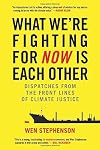
What we're fighting for now is each other
by Wen Stephenson
On This Page
Description
The science is clear: catastrophic climate change, by any humane definition, is upon us. At the same time, the fossil-fuel industry has doubled down, economically and politically, on business as usual. We face an unprecedented situation--a radical situation. As an individual of conscience, how will you respond? In 2010, journalist Wen Stephenson woke up to the true scale and urgency of the catastrophe bearing down on humanity, starting with the poorest and most vulnerable everywhere, and show more confronted what he calls "the spiritual crisis at the heart of the climate crisis." Inspired by others who refused to retreat into various forms of denial and fatalism, he walked away from his career in mainstream media and became an activist, joining those working to build a transformative movement for climate justice in America. In What We're Fighting for Now Is Each Other, Stephenson tells his own story and offers an up-close, on-the-ground look at some of the remarkable and courageous people--those he calls "new American radicals"--Who have laid everything on the line to build and inspire this fast-growing movement: old-school environmentalists and young climate-justice organizers, frontline community leaders and Texas tar-sands blockaders, Quakers and college students, evangelicals and Occupiers. Most important, Stephenson pushes beyond easy labels to understand who these people really are, what drives them, and what they're ultimately fighting for. He argues that the movement is less like environmentalism as we know it and more like the great human-rights and social-justice struggles of the nineteenth and twentieth centuries, from abolitionism to civil rights. It's a movement for human solidarity.--From publisher description. show lessTags
Recommendations










Member Reviews
This book is a rallying call to radical action in the face of catastrophic climate change. Stephenson is a journalist and activist, and this book features interviews with a number of climate justice activists mainly between 2012-2014. It was inspiring, compelling, encouraging and urgent. The author makes clear how the issue of climate change intersects with other social justice issues of the day - poverty, race, class - and how you can't tackle one without the others. I really liked how he talked to grass roots activists, not just big names, and also how he showed how many people of faith were involved in this struggle (it is really easy, particularly from this distance, to see American Christianity as just synonymous with right-wing, show more conservative, Republican voices who are predominant in the media. This book shows that the picture is much more varied than that, and I am glad). It's also given me a number of authors that I would like to read more of (particularly Bill McKibben, but I'd also like to go back to the older stuff by Wendell Berry), and challenged me to think about what am I doing for the future of the planet and the future of my child and her generation. Turning off unused lights and using Bags for Life isn't going to be enough.
There were some points where I felt the book was a bit rambling and less well focused, but overall this was a fine call to thoughtful action, and to creatively finding ways to speak truth to power and challenge the status quo. show less
There were some points where I felt the book was a bit rambling and less well focused, but overall this was a fine call to thoughtful action, and to creatively finding ways to speak truth to power and challenge the status quo. show less
We are living at a crossroads in history: The IPCC's 2014 Climate Report indicates that we are on a cataclysmic trajectory that will result in up to a 2 degree Celsius global temperature rise before the end of the century. We have crossed the 350 PPM atmospheric carbon line that environmental writer Bill McKibben and founder of 350.org has stated is the highest level of carbon that we should ever have allowed to permeate our atmosphere (we are nudging if not altogether crossed the 400 PPM line). Australia and the southern hemisphere have seen some of the hottest temperatures in recorded history, and this year drought, wildfires, floods and erratic weather patterns have wracked North America. Wen Stephenson, a journalist and climate show more justice activist, brings all of this information together in his 220-page spiritual, moral and emotional journey from Massachusetts to East Texas, following on-the-ground activists as they attempt to slow down if not stop the Keystone XL pipeline (southern leg), and the rampant mountaintop removal of coal in Virginia, Kentucky and its subsequent burning in one of the biggest coal plants on the East Coast. Stephenson highlights the works of Henry David Thoreau, Wendell Berry, Bill McKibben as well as those front-lines activists who, although not as well-known, have chained themselves to pipelines, roosted in trees, blockaded coal ships, and stood their ground for THE ONLY issue that matters to the entirety of humanity: climate change. Stephenson is one of the first writers I have read who approaches this subject (this reality) in an eclectic manner--we can no longer afford to divide ourselves by what is possible within a corrupt and broken system, we can no longer claim that "small steps" are adequate, or that we should work on other issues first. Climate change is about justice--climate justice is about the "intersection" (as he writes) among various global issues descending upon humanity at this point in history. How can we create a more just and equitable planet for those who have done little or nothing to put the Earth in such jeopardy yet who will sustain the brunt of the consequences? How can we, as privileged, wealthy (compared to more than 1/2 the Earth's population) people who make up only 5% of the planet's total humanity stand up for that which is morally right, not just because it will soothe our consciences, but because it is necessary for the generations to come?
Stephenson raises moral and spiritual questions, and seeks understanding about the ensuing climate crisis. He admonishes his reader not to ignore the call. The hard reality is that the crisis can no longer by thwarted. The pertinent question now is how will we respond and act in the face of what is coming. Will we fight for a better, more just world? Or will chaos and catastrophe make us withdraw and allow corporations to pursue greater damage and less democratic options. It's time to step outside the comfortable box we've built around ourselves, and time to make a stand--if not for ourselves, for those who will be subjected to the world we have allowed to be created.
It's a devastating book--it does not promise pie-in-the-sky happy endings. It is an admonishment to get off our asses and do something, because NOW is the moment for action. To let it slip by once more is to ensure there will be fewer moments remaining for everyone. show less
Stephenson raises moral and spiritual questions, and seeks understanding about the ensuing climate crisis. He admonishes his reader not to ignore the call. The hard reality is that the crisis can no longer by thwarted. The pertinent question now is how will we respond and act in the face of what is coming. Will we fight for a better, more just world? Or will chaos and catastrophe make us withdraw and allow corporations to pursue greater damage and less democratic options. It's time to step outside the comfortable box we've built around ourselves, and time to make a stand--if not for ourselves, for those who will be subjected to the world we have allowed to be created.
It's a devastating book--it does not promise pie-in-the-sky happy endings. It is an admonishment to get off our asses and do something, because NOW is the moment for action. To let it slip by once more is to ensure there will be fewer moments remaining for everyone. show less
 This review was written for LibraryThing Early Reviewers.
Wen Stephenson excites the reader with a story of his path to radicalization for the cause of climate change awareness. He shows us how he was radicalized and the complexity of the entire climate change issue as it creates wider gaps between the classes and endangers - if not outright kills - millions over time. He seethes in this rage against the carbon energy giants who buy governments, conduct unethical and immoral business which as he posits, have driven the earth past the tipping point from which we (yes all of us) may never recover. Like a prophet railing against a biblical king, his writing tells of many others on the same path, their experiences and yes the risks they take for this cause.
If you are interested in the mind of a show more climate justice radical, please read this book, If you are asleep about the urgency of fossil fuel independence, wake up and read this book. If you don't give a damn, don't pick up this book and go back to watching the ball game on TV - to read it may disturb your slumber. show less
If you are interested in the mind of a show more climate justice radical, please read this book, If you are asleep about the urgency of fossil fuel independence, wake up and read this book. If you don't give a damn, don't pick up this book and go back to watching the ball game on TV - to read it may disturb your slumber. show less
This review was written for LibraryThing Early Reviewers.This is a surprisingly inspiring book; surprising because it faces a very grim science without flinching away or presenting it in any more polly-annaish or optimistic tones than is merited, which--given that the science in question has outcomes ranging from "things worsen for another century than stabilize in a degraded fashion for the conceivable future" to "99% of everything dies"--doesn't typically lead one to anticipate inspiration.
And yet.
Because it takes that science as a given, because it looks at our history of inaction and what Alex Steffen calls "predatory delay" without flinching, because it allows for and even encourages authentic mourning of what we've lost and stand to lose, it has a great deal of credibility and show more legitimacy in its calls to devote our energies to saving what we can and fighting for a more equitable distribution of the goods that will remain.
p. xv: "one of the slogans for the [People's Climate March in 2014] was, 'To change everything, we need everyone.' And I couldn't agree more. That's what this book is about. But here's what would really change everything: first acknowledging that the Washington-focused environmental movement--and the mainstream, Big Green 'climate movement' that grew out of it--has failed. That we've already lost the 'climate fight,' if that means 'solving the climate crisis' and saving some semblance of the world we know. That it was lost before it began--because we started so late. That it's time now to fight like there's nothing left to lose but our humanity."
Stephenson interviews climate justice workers and activists working in a wide range of different organizations and initiatives, which can be split into two opposing, equally correct camps: 1) That, given the inequitable impacts of climate change along racial, income, geographic, gender, and class divides, we have no choice but to organize in communities to build support for just transitions (a much more familiar phrase now, thanks to AOC & the Green New Deal), and 2) that we no longer have the time for building those coalitions and communities. It's depressing on the face of it, but everyone interviewed has found a way to continue on regardless. If you are trying to find a way and a reason to keep acting when the news is so bad, and keeps getting worse, their stories will have a lot to offer you.
pp. 208-209: "...ours is now a fight for survival and a fight for justice--no for the survival of the possibility of justice and some legitimate hope for what King calls the 'beloved community.'... Is it too late? We know what the science says. What does your conscience say? What does 'too late' even mean? Too late for what? Even in the face of all we now know, will it ever be too late for some kind of faithin human decency; or to hold on to some kind of hope, however irrational it may seem, in our fellow human beings; or to love our brothers and sisters on this earth?"
How could it be too late for that? show less
And yet.
Because it takes that science as a given, because it looks at our history of inaction and what Alex Steffen calls "predatory delay" without flinching, because it allows for and even encourages authentic mourning of what we've lost and stand to lose, it has a great deal of credibility and show more legitimacy in its calls to devote our energies to saving what we can and fighting for a more equitable distribution of the goods that will remain.
p. xv: "one of the slogans for the [People's Climate March in 2014] was, 'To change everything, we need everyone.' And I couldn't agree more. That's what this book is about. But here's what would really change everything: first acknowledging that the Washington-focused environmental movement--and the mainstream, Big Green 'climate movement' that grew out of it--has failed. That we've already lost the 'climate fight,' if that means 'solving the climate crisis' and saving some semblance of the world we know. That it was lost before it began--because we started so late. That it's time now to fight like there's nothing left to lose but our humanity."
Stephenson interviews climate justice workers and activists working in a wide range of different organizations and initiatives, which can be split into two opposing, equally correct camps: 1) That, given the inequitable impacts of climate change along racial, income, geographic, gender, and class divides, we have no choice but to organize in communities to build support for just transitions (a much more familiar phrase now, thanks to AOC & the Green New Deal), and 2) that we no longer have the time for building those coalitions and communities. It's depressing on the face of it, but everyone interviewed has found a way to continue on regardless. If you are trying to find a way and a reason to keep acting when the news is so bad, and keeps getting worse, their stories will have a lot to offer you.
pp. 208-209: "...ours is now a fight for survival and a fight for justice--no for the survival of the possibility of justice and some legitimate hope for what King calls the 'beloved community.'... Is it too late? We know what the science says. What does your conscience say? What does 'too late' even mean? Too late for what? Even in the face of all we now know, will it ever be too late for some kind of faithin human decency; or to hold on to some kind of hope, however irrational it may seem, in our fellow human beings; or to love our brothers and sisters on this earth?"
How could it be too late for that? show less
This is a painful book to read. Not because it's poorly written, but because the subject matter and the indictment of our society and the way it states pretty plainly that we've created a world where our children will be worse off than the generation before. I've read a lot of dry heavily cited books and articles dealing with environmental issues over the years, but this stands out as one of the more blunt statements of where we actually stand. Our environment is past a tipping point. While we should continue to work hard to reduce the impact of climate change, we need to simultaneously figure out ways to strengthen sense of community because the coming generations are going to need it.
Back to the work - the reason I didn't give it 5 show more stars was because the set-up felt too long. The first 30 pages or so were primers on Thoreau and the author's own thoughts and awakening to the plight of the planet and society...I think it could have been shortened or skipped.
I almost gave it 4 stars because it was so uncomfortable to read, but I thought about it and realized it was a painful subject matter, not bad writing or reporting or citations. It's not pleasant to read this book, but as a citizen of the world, I think it's necessary. show less
Back to the work - the reason I didn't give it 5 show more stars was because the set-up felt too long. The first 30 pages or so were primers on Thoreau and the author's own thoughts and awakening to the plight of the planet and society...I think it could have been shortened or skipped.
I almost gave it 4 stars because it was so uncomfortable to read, but I thought about it and realized it was a painful subject matter, not bad writing or reporting or citations. It's not pleasant to read this book, but as a citizen of the world, I think it's necessary. show less
This review was written for LibraryThing Early Reviewers.This book profiles several leaders in the climate-justice movement. Well-written and engaging, but a very difficult book to read (in fact, I didn't quite finish). I picked it up after the recent election because I was feeling so much despair, especially for my young son's future. I wanted advice on what I could do personally. I can't say this book helped much with the despair; I still feel very strongly that we are in for some very difficult times, and we may not make it through. But it did help with the people aspect--I have more hope and faith, especially in young people, than I did before I read this. I ended up donating to 350.org as a result, signing up for some newsletters, and opening myself up to educating myself more, playing show more more of an activist role, and encouraging and supporting those who are doing the front-line work in any way I can. I still don't know quite what that means, but I am open. show less
Most environmental books are sad. Wen Stephenson’s “Climate Justice” publication is no different. The warning he delivers is bleak; we’re causing immense human suffering and damage to the earth, and if we continue to avoid overt battles with the fossil-fuel industry, ecological catastrophes will only intensify.
His moral call to arms will be appreciated by environmental thinkers and activists.
His impassioned plea of how the Earth’s spirit cannot be ignored in the face of greed and special interests will resonate with those who read scripture. When he writes of creation care and acknowledges that a day of reckoning will come, his message takes on a biblical tone.
After reading this book, the author’s earnest message becomes show more clear: humanity needs to save itself and it’s time for communal responsibility. After all, the earth is the birthplace of the human race and we shouldn’t let anyone destroy the only world we have.
There is no PLANet B. show less
His moral call to arms will be appreciated by environmental thinkers and activists.
His impassioned plea of how the Earth’s spirit cannot be ignored in the face of greed and special interests will resonate with those who read scripture. When he writes of creation care and acknowledges that a day of reckoning will come, his message takes on a biblical tone.
After reading this book, the author’s earnest message becomes show more clear: humanity needs to save itself and it’s time for communal responsibility. After all, the earth is the birthplace of the human race and we shouldn’t let anyone destroy the only world we have.
There is no PLANet B. show less
This review was written for LibraryThing Early Reviewers.Members
- Recently Added By
Published Reviews
Earnest and well-meaning but unlikely to sway climate deniers, Monsanto lobbyists, and others in need of convincing.
added by Sean191
There is plenty of harsh language, which may turn off some audiences, but others will be glad to see Stephenson promoting the work and commitment of an array of activists engaged in what is often a thankless battle.
added by Sean191
Lists

Exposing the Man Behind the Curtain
28 works; 3 members

Books Read in 2017
4,249 works; 130 members

Books With Complete Sentence Titles
501 works; 17 members
Author Information
2+ Works 110 Members
Wen Stephenson, an independent journalist and climate activist, is a contributor to the Nation. A former editor at the Atlantic and the Boston Globe, his writing on climate, culture, and politics has also appeared in Slate, the New York Times, Grist, and the Boston Phoenix.
Common Knowledge
- Canonical title
- What we're fighting for now is each other
- Original title
- What we're fighting for now is each other : dispatches from the front lines of climate justice
- Important events
- climate crisis
- Epigraph
- Let your life be a counter-friction to stop the machine. -- Henry David Thoreau, "Civil Disobedience"
- Dedication
- For my children, and all of our children, and their children after them.
- First words
- This is really happening.
- Last words
- (Click to show. Warning: May contain spoilers.)The sun climbs the sky.
Classifications
- Genres
- Science & Nature, Nonfiction, General Nonfiction, Politics and Government
- DDC/MDS
- 363.738 — Society, government, & culture Social problems and social services Public Safety - Police, Crime Investigation Environmental Issues - Pollution, Recycling, Global Warming Pollution Pollutants by source
- LCC
- QC903 .S74 — Science Physics Physics Meteorology. Climatology
- BISAC
Statistics
- Members
- 92
- Popularity
- 346,375
- Reviews
- 22
- Rating
- (3.83)
- Languages
- English
- Media
- Paper, Ebook
- ISBNs
- 3
- ASINs
- 3