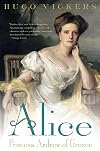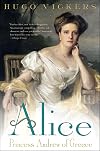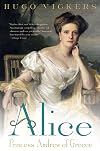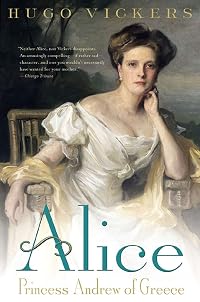
Alice: Princess Andrew of Greece
by Hugo Vickers
On This Page
Description
In 1953, at the coronation of Queen Elizabeth II, Princess Alice was dressed from head to foot in a long grey dress and a grey clock, and a nun's veil. Amidst all the jewels, and velvet and coronets, and the fine uniforms, she exuded an unworldly simplicity. As one who witnessed her process alone up the long aisle of the abbey put it, she looked as though she were walking into eternity. Seated with the royal family, she was a part of them, yet somehow distanced from them. In as much as she show more is remembered at all today, it is as this shadowy figure in grey nun's clothes... show lessTags
Recommendations





















Member Reviews
This is a pretty good book. I give it 3 stars in part because the subject matter did not hold my interest, but it does involve the treatment of people with physical handicaps and with early psychotherapy.
The book opens with the birth of Alice while her great-grandmother, Queen Victoria, stands by. There is even a photo of the 4 generations seated together with an older Queen looking as regal as ever. Vickers takes great pains to keep the proper titles and names of royalty (hence Alice's official name being "Princess Andrew" because of her marriage to Prince Andrea of Greece). He also has extensive endnotes and footnotes to capture the names of minor individuals who are mentioned in a paragraph or series of events.
All in all I was show more captured by this book. Though I'm not a student of modern European royalty, the events of the late 19th and on through the middle 20th century all touched this princess's life: Queen Victoria, the Great War, the Bolshevik Revolution (where her relations were killed as they were part of the extended Russian Royal Family), the downfall of many royal families after the Second World War, and even modern psychotherapy. This latter is a surprising event coming as it does in the middle years of Alice's life - her symptoms of extreme religiosity, her commitment to a mental health facility in Switzerland, and her final regaining of sanity thanks to some quite ordinary people.
She gave birth to four daughters and a son, who became Prince Philip of Greece the Prince Consort of Queen Elizabeth II. The separation he endured from his mother during her insanity and time in a hospital is also mentioned and might certainly point to a certain amount of his emotional distance. show less
The book opens with the birth of Alice while her great-grandmother, Queen Victoria, stands by. There is even a photo of the 4 generations seated together with an older Queen looking as regal as ever. Vickers takes great pains to keep the proper titles and names of royalty (hence Alice's official name being "Princess Andrew" because of her marriage to Prince Andrea of Greece). He also has extensive endnotes and footnotes to capture the names of minor individuals who are mentioned in a paragraph or series of events.
All in all I was show more captured by this book. Though I'm not a student of modern European royalty, the events of the late 19th and on through the middle 20th century all touched this princess's life: Queen Victoria, the Great War, the Bolshevik Revolution (where her relations were killed as they were part of the extended Russian Royal Family), the downfall of many royal families after the Second World War, and even modern psychotherapy. This latter is a surprising event coming as it does in the middle years of Alice's life - her symptoms of extreme religiosity, her commitment to a mental health facility in Switzerland, and her final regaining of sanity thanks to some quite ordinary people.
She gave birth to four daughters and a son, who became Prince Philip of Greece the Prince Consort of Queen Elizabeth II. The separation he endured from his mother during her insanity and time in a hospital is also mentioned and might certainly point to a certain amount of his emotional distance. show less
Alice: Princess Andrew of Greece is a biography by Hugo Vickers concerning Alice of Battenberg, one of Queen Victoria's numerous great-grandchildren, part of the German nobility and, most importantly for history, the mother of Philip, Consort to Elizabeth II. She lived an interesting life, starting with near total deafness from birth, which she overcame through lip-reading. She grew up in England, Germany and Malta, and eventually married Prince Andrew of Greece and Denmark, whose elder brother eventually became King of Greece (although having no Greek blood himself at all). Alice had five children, four daughters and Philip, the youngest, but by the time he was a few years old, she had fallen into a psychotic mania involving religious show more delusions that she was the sole "bride of Christ" and that God was directing her to spread her rather convoluted philosophy. As a result, she was hospitalized for some seven years, largely missing Philip's youth, but slowly she recovered and re-entered the world, albeit usually wearing a nun's habit. Her family, though aristocratic and land-holding, didn't have a lot of money, but she managed to travel almost constantly, staying with extended family members and friends throughout much of Europe, although her home base was in Greece, for the most part. There, she served as a nurse during the Balkan Wars (prior to WWI), and she also remained in Greece during WWII, helping to feed the starving population of Athens at a time when most of the royal family was in exile. She died in 1969, having witnessed much of the history of the twentieth century and having contributed to it as well. An interesting woman, although certainly a difficult one. Vickers manages somehow to keep all of the numerous famliy members in check, so that the reader can follow the often bewildering inter-relationships between various individuals, many of whom bore the same first name. He has done his research, and much of the narrative relies on letters written to and by family members, to which he was given access by the family. Despite the inherent confusion involved in handling such a large number of individuals, the author does a good job of keeping the reader on track and keeping the focus on this rather enigmatic member of the English (and Greek, and Danish) royal family. Recommended for fans of historical biography. show less
Ratings
Members
- Recently Added By
Author Information

36+ Works 1,395 Members
Some Editions
Common Knowledge
- Original publication date
- 2002
- People/Characters
- Alice, Princess of Greece and Denmark; Prince Philip, Duke of Edinburgh; Prince Andrew of Greece; Victoria Mountbatten Marchioness of Milford Haven; Cecile, Grand Duchess of Hesse and by Rhine; Princess Sophie of Greece (show all 8); Princess Margarita of Greece; Theodora of Greece, Margravine of Baden
- Important places
- Windsor, Berkshire, England, UK; Greece; Darmstadt, Grand Duchy of Hesse and by Rhine; Windsor Castle, Windsor, Berkshire, England, UK
- Important events
- World War I; Murders of the Romanovs during the Bolshevik Revolution; Exile of the Greek royal family; World War II; Marriage of Princess Elizabeth of the United Kingdom; Coronation of Queen Elizabeth II
- Dedication
- To William M. Weaver, Jr, godfather and friend
- First words
- Introduction
Alice, Princess Andrew of Greece, was a member of the British royal family, but she was also a member of the House of Hesse-Darmstadt and married into the Greek (and Danish) royal family. Her life had a st... (show all)range symmetry. She was born at Windsor because her great-grandmother, Queen Victoria, ordained that she should be, and after her funeral at Windsor, she lay there for many years for the very different reason that her son, Prince Philip, lived there.
I. The Infant Princess
Empress Frederick of Germany to Queen Victoria: 'I imagine she will be called Alice Victoria Louise Julia. Am I right?'
Queen Victoria to the Duke of Connaught: "She will be called Alice.'¹
Two arrivals were expected at Windsor Castle in February 1885. Queen Victoria was due to sail across the Solent and take up residence, and an infant was due to be born at the castle to the Queen's granddaughter, Victoria, Princess Louis of Battenberg. - Last words
- (Click to show. Warning: May contain spoilers.)Shy, sometimes austere, remote, self-sufficient beyond the point of coping, she put much into life. Had she lived in different times, it might have been possible for her to achieve more. Had she been less determined, less obstinate, her life might have been gentler. But in spite of all the disappointments and sorrows, she never flinched. Above all, she saw hers as a life of service, in which she did her best to help those less fortunate than herself.
- Original language
- English
Classifications
- Genres
- Biography & Memoir, Nonfiction, History, General Nonfiction
- DDC/MDS
- 949.507092 — History & geography History of Europe Greece, Albania, Yugoslavia, Serbia, Romania, Bulgaria Greece and the Byzantine Empire Byzantine Empire -- 323-1453 History from 1830
- LCC
- DF836 .A45 .V53 — History of Europe, Asia, Africa and Oceania Greece History of Greece Modern Greece History By period 20th century
- BISAC
Statistics
- Members
- 242
- Popularity
- 134,542
- Reviews
- 2
- Rating
- (3.48)
- Languages
- English
- Media
- Paper, Ebook
- ISBNs
- 6
- ASINs
- 1