
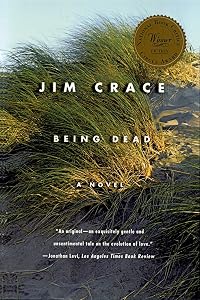
Being Dead
by Jim Crace
On This Page
Description
The discovery of a devoted couple found murdered in the dunes of Baritone Bay forms the centerpiece of a story of love and afterlife.Tags
Recommendations







Member Reviews
No, this not another zombie novel. Not even close. Actually, a better title might be “Scientists in Love”, although that fails to capture the dark, haunting tone, that shadows these pages.
Joseph and Celice, are middle-aged zoologists. In the opening chapter, they are found murdered in a remote area of the dunes. As their bodies begin to decompose, the narrative takes us on a serpentine journey through this couple’s lives and we witness their chance meeting in college, a long, sometimes bumpy thirty-year marriage, the usual joys and pitfalls, a restless, unhappy daughter and then finally their last fateful day.
There is some gruesome detail to this story but it’s described in a simple scientific manner. It is also filled with some show more lovely prose:
“Yet there was still love, the placid love that only time can cultivate, a love preserved by habit and memory. Their tree had little rising sap, perhaps, but it was held firm by deep and ancient roots.”
Highly recommended! show less
Joseph and Celice, are middle-aged zoologists. In the opening chapter, they are found murdered in a remote area of the dunes. As their bodies begin to decompose, the narrative takes us on a serpentine journey through this couple’s lives and we witness their chance meeting in college, a long, sometimes bumpy thirty-year marriage, the usual joys and pitfalls, a restless, unhappy daughter and then finally their last fateful day.
There is some gruesome detail to this story but it’s described in a simple scientific manner. It is also filled with some show more lovely prose:
“Yet there was still love, the placid love that only time can cultivate, a love preserved by habit and memory. Their tree had little rising sap, perhaps, but it was held firm by deep and ancient roots.”
Highly recommended! show less
This is a book-long sciencey poem about death with all the attending emotional hooks surrounding it. I think it's very well written.
Let me preface this by quoting Mark Twain's philosophy of death:
“I do not fear death. I had been dead for billions and billions of years before I was born, and had not suffered the slightest inconvenience from it.”
― Mark Twain
That sums up how I feel about death. So, I was unbothered by any of Being Dead. Their end was embarrassing, and that bothered me a little. But the skillful writing gave me the comfort I was looking for. In fact, I was fascinated by the long and winding passages that describe the natural processes taking place to our main character's bodies on that beach. It's the way that the show more earth deals with all manner of death, from the lowest order to the highest. We are absorbed back into our small part of the universe. Where else are we to go?
These chapters are love letters to the natural processes of continuing life cycles.
The alternating chapters describe what happens in between. The description of the couple's meeting, marriage, and entry to middle-age were touching and rang true. They connected emotionally and remained in a love that mellowed with familiarity, like most couples that stay married for a long time.
I also liked their spoiled daughter, who seemed authentically affected by their strange deaths. For most, the first parent to die always hits hardest, especially if you don't have a grandparent to mourn first. She gets a double shot at a young age. Denial and a roll into hard, rebellious coping methods are probably most realistic for a child/person like her. I felt sorry for her. Eventually, she'll find that she's more like her mother and father than she thinks. The author cleverly works bits of it into her character.
I might pick up more of Crace's books at another time. This one was excellent. show less
Let me preface this by quoting Mark Twain's philosophy of death:
“I do not fear death. I had been dead for billions and billions of years before I was born, and had not suffered the slightest inconvenience from it.”
― Mark Twain
That sums up how I feel about death. So, I was unbothered by any of Being Dead. Their end was embarrassing, and that bothered me a little. But the skillful writing gave me the comfort I was looking for. In fact, I was fascinated by the long and winding passages that describe the natural processes taking place to our main character's bodies on that beach. It's the way that the show more earth deals with all manner of death, from the lowest order to the highest. We are absorbed back into our small part of the universe. Where else are we to go?
These chapters are love letters to the natural processes of continuing life cycles.
The alternating chapters describe what happens in between. The description of the couple's meeting, marriage, and entry to middle-age were touching and rang true. They connected emotionally and remained in a love that mellowed with familiarity, like most couples that stay married for a long time.
I also liked their spoiled daughter, who seemed authentically affected by their strange deaths. For most, the first parent to die always hits hardest, especially if you don't have a grandparent to mourn first. She gets a double shot at a young age. Denial and a roll into hard, rebellious coping methods are probably most realistic for a child/person like her. I felt sorry for her. Eventually, she'll find that she's more like her mother and father than she thinks. The author cleverly works bits of it into her character.
I might pick up more of Crace's books at another time. This one was excellent. show less
This opens with a grisly murder in a beautiful spot and such counterpoints are the nature of the story and its telling. One thread of chapters starts near the “end” of the story and goes back (initially, but then forwards too), while the other thread starts many years earlier and only goes forward, building the expectation of the two threads meeting at the end of the book. It describes death and decay in detached detail in a way that is simultaneously disgusting and beautiful; passages are searingly poetic. It needs the beauty, because in may ways it is a painfully empty story, full of loss, misunderstanding, distance, waste and pointlessness. But it’s actually rather a good book.
(4) Oh dear. This was a haunting short novel that took me much longer to read than it should have. A pair of married zoologists take the day off from work to go for a hike and picnic in the dunes along the stretch of coast where they first met 30 years previous. It is not a spoiler to say they are brutally murdered and left to rot in the dunes -- not found for many days. The natural world goes about decomposing them. Because, well, that is what being dead is all about. Not gates of heaven or eternal bliss is the author's underlying thematic point. He describes the act of dying and the macabre life of corpses in beautiful, grandiose, and lyrical language. It is disturbing to say the least.
This is a powerful book. It vacillates between show more the day they first met, which ironically includes the death of their classmate; their present day condition on the dunes; and their taciturn rebellious young adult daughter's dawning discovery of her parents death. Crace fills the novel with details that are specific to Joseph and Celice but surely must be real in some way. Patterns of hair, moles, body smells and indignities that one usually just tosses around in one's subconscious. It is almost terrifying as it speaks the unvarnished truth. But is there grace in there somewhere? I think so.
I wonder if I am underrating the novel at 4 stars. Parts were stunning, but parts were a bit boring. I found some parts such as the end with the prolonged description of the lissom grasses, and some of the details of Syl's life to be overblown. And then there were some things that were left un-explored like the couple's relationship to parenting and their daughter. All in all, I am left moved and unsettled by this novel. I have never read anything quite like it, but it is surely not for everyone. show less
This is a powerful book. It vacillates between show more the day they first met, which ironically includes the death of their classmate; their present day condition on the dunes; and their taciturn rebellious young adult daughter's dawning discovery of her parents death. Crace fills the novel with details that are specific to Joseph and Celice but surely must be real in some way. Patterns of hair, moles, body smells and indignities that one usually just tosses around in one's subconscious. It is almost terrifying as it speaks the unvarnished truth. But is there grace in there somewhere? I think so.
I wonder if I am underrating the novel at 4 stars. Parts were stunning, but parts were a bit boring. I found some parts such as the end with the prolonged description of the lissom grasses, and some of the details of Syl's life to be overblown. And then there were some things that were left un-explored like the couple's relationship to parenting and their daughter. All in all, I am left moved and unsettled by this novel. I have never read anything quite like it, but it is surely not for everyone. show less
I liked this book very much, but if you don't care to read a clinical discussion of what happens to a dead body as it decomposes, you might want to skip this one. If such descriptions don't bother you, I highly recommend this book.
Celice and Joseph, married scientists in their 50's decide to take a sentimental day trip to the beach where they met and fell in love. As the last sentence of the first chapter states, "They paid a heavy price for their nostalgia," for by page 5, they have been brutally murdered in the dunes. Their bodies lay undiscovered, Joseph's hand tenderly grasping Celice's ankle, for days. In alternating chapters we are told the story of their life and given a day-by-day description of what happens to their bodies show more after death.
This book is beautifully written, and the scientific descriptions of decay meld perfectly with the intellectually curious scientific characters of Joseph and Celice. Here is the poem by Sherwin Stephens, "The Biologist's Valediction to His Wife," which is set forth on the frontispiece of this book:
Don't count on Heaven, or on Hell
You're dead. That's it. Adieu. Farewell.
Eternity awaits? Oh, sure!
It's Putrefaction and Manure
And unrelenting Rot, Rot, Rot,
As you regress, from Zoo. to Bot.
I'll grieve, of course,
Departing wife,
Though Grieving's never
Lengthened Life
Or coaxed a single extra Breath
Out of a Body touched by Death show less
Celice and Joseph, married scientists in their 50's decide to take a sentimental day trip to the beach where they met and fell in love. As the last sentence of the first chapter states, "They paid a heavy price for their nostalgia," for by page 5, they have been brutally murdered in the dunes. Their bodies lay undiscovered, Joseph's hand tenderly grasping Celice's ankle, for days. In alternating chapters we are told the story of their life and given a day-by-day description of what happens to their bodies show more after death.
This book is beautifully written, and the scientific descriptions of decay meld perfectly with the intellectually curious scientific characters of Joseph and Celice. Here is the poem by Sherwin Stephens, "The Biologist's Valediction to His Wife," which is set forth on the frontispiece of this book:
Don't count on Heaven, or on Hell
You're dead. That's it. Adieu. Farewell.
Eternity awaits? Oh, sure!
It's Putrefaction and Manure
And unrelenting Rot, Rot, Rot,
As you regress, from Zoo. to Bot.
I'll grieve, of course,
Departing wife,
Though Grieving's never
Lengthened Life
Or coaxed a single extra Breath
Out of a Body touched by Death show less
What is death? It is a question that haunts every human, as natural to our being as breathing. Many, many thousands of books have been written on the subject, most aimed at determining an afterlife of some sort, or a purpose behind it all. However, author Jim Crace is not content to mirror such themes, whether they are phantasmagorical (Richard Matheson's WHAT DREAMS MAY COME), or contemplative (M. Scott Peck's IN HEAVEN AS ON EARTH). Crace wants to understand what death is, what it means, and what is lost and gained in the process.
Crace achieves a remarkable mediation on the subject in BEING DEAD, a novel that is unnerving in its originality and tenderness. He centres on Joseph and Celice, an elderly married couple, brutally murdered show more on a quiet beach. Crace takes several offbeat tacts in portraying what these deaths mean, both biologically and emotionally.
First, the bodies themselves. Crace goes into determinedly graphic detail in his characterization of decomposition. As the bodies slowly deteriorate, the small world that surrounds them begins to interact, to reclaim the material for nature. For most of us, the thought of what happens to our bodies physically after death is a repulsive one. Yet Crace never offends, and never becomes exploitative. The lyricism and sense of melancholy Crace brings to the biological breakdown of a body are truly haunting.
Interwoven with biology is nostalgia, as Crace charts the map of Joseph and Celice's relationship. From the first awkward rush of passion, to the resignation that an elderly couple may face every day, Crace allows the reader a glimpse into their minds, a reminder that every person is unique, and what we see is only superficial. Joseph's small frame and majestic singing voice only hint at his unhappiness with his life's outcome; physical opposite Celice's apparent quiet love of her husband masks her increasing frustration with the lack of passion in her life. These small glimpses into the makeup of their lives are an abrupt change from the description of their deaths, but the contrast serves to heighten the senselessness of death, and the steadfast mysteries that life and death both contain. How can we ever believe we can comprehend death, when we cannot even begin to understand the true nature and purpose of one solitary individual?
Thirdly, Crace follows their daughter, a sullen young woman who has never gotten along with either of her parents. As she reluctantly searches for her missing mother and father, we view the way our lives continue after death, in the thoughts and memories of those we knew, and in the biological framework of our progeny. While the daughter would never admit it, she is equal parts mother and father, displaying both the good and bad traits of her parents. In Joseph and Celice's death, she finds a measure of comfort and renewal, ultimately of purpose.
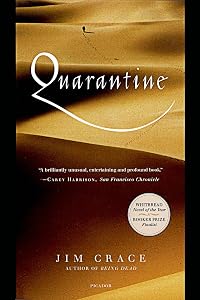
I do not mean for this to sound like a spiritual odyssey. As in his previous novel QUARANTINE (a realist version of Christ's forty days in the desert), Crace is not ready to resort to comforting platitudes on what comes next. Death is death, and what is beyond remains, and should remain, a mystery. Death is both intensely personal, and a universal experience shared by all. By providing the reader no easy answers, by never revealing the answer to the question, Crace provides an altogether mesmerizing and satisfying experience. show less
Crace achieves a remarkable mediation on the subject in BEING DEAD, a novel that is unnerving in its originality and tenderness. He centres on Joseph and Celice, an elderly married couple, brutally murdered show more on a quiet beach. Crace takes several offbeat tacts in portraying what these deaths mean, both biologically and emotionally.
First, the bodies themselves. Crace goes into determinedly graphic detail in his characterization of decomposition. As the bodies slowly deteriorate, the small world that surrounds them begins to interact, to reclaim the material for nature. For most of us, the thought of what happens to our bodies physically after death is a repulsive one. Yet Crace never offends, and never becomes exploitative. The lyricism and sense of melancholy Crace brings to the biological breakdown of a body are truly haunting.
Interwoven with biology is nostalgia, as Crace charts the map of Joseph and Celice's relationship. From the first awkward rush of passion, to the resignation that an elderly couple may face every day, Crace allows the reader a glimpse into their minds, a reminder that every person is unique, and what we see is only superficial. Joseph's small frame and majestic singing voice only hint at his unhappiness with his life's outcome; physical opposite Celice's apparent quiet love of her husband masks her increasing frustration with the lack of passion in her life. These small glimpses into the makeup of their lives are an abrupt change from the description of their deaths, but the contrast serves to heighten the senselessness of death, and the steadfast mysteries that life and death both contain. How can we ever believe we can comprehend death, when we cannot even begin to understand the true nature and purpose of one solitary individual?
Thirdly, Crace follows their daughter, a sullen young woman who has never gotten along with either of her parents. As she reluctantly searches for her missing mother and father, we view the way our lives continue after death, in the thoughts and memories of those we knew, and in the biological framework of our progeny. While the daughter would never admit it, she is equal parts mother and father, displaying both the good and bad traits of her parents. In Joseph and Celice's death, she finds a measure of comfort and renewal, ultimately of purpose.
I do not mean for this to sound like a spiritual odyssey. As in his previous novel QUARANTINE (a realist version of Christ's forty days in the desert), Crace is not ready to resort to comforting platitudes on what comes next. Death is death, and what is beyond remains, and should remain, a mystery. Death is both intensely personal, and a universal experience shared by all. By providing the reader no easy answers, by never revealing the answer to the question, Crace provides an altogether mesmerizing and satisfying experience. show less
While I can easily see the skill, research and art that went into this book, and even understand why it won awards, because of its subject - violent death presented in a very impersonal way - I found it a rather depressing read. The vivid descriptions of bodily decomposition and putrefaction, presented as they were in a most scientific manner, were concurrently morbidly fascinating and simply off-putting. The thread of absolute atheism that runs throughout the narrative was also disturbing - thought-provoking, but still disturbing, even if the reader has wrestled with his own problems of faith. Crace is quite definite in this matter, noting that "This was not death as it was advertised: a fine translation to a better place; a journey show more through the calm of afterlife into the realms of instinct and desire. The persons had not gone elsewhere,, to blink and wake ... They were, instead, as insensible as stones ..."
The murdered couple's daughter, Syl, embodies this atheism even further when she sits outside a church and listens to a congregation singing hymns, but finds no comfort - "Her father's songs, for all their mawkish sentiment, were far more powerful. Love songs transcend, transport, because there's such a thing as love. But hymns and prayers have feeble tunes because there are no gods."
There is more depressing stuff as the emotionless narrator goes on to describe how the crabs, insects, gulls and rodents "went to work" browsing the human remains.
The murderer himself is never identified or described; he is simply a means to an end, an instrument who causes this very final and very 'natural' state of "being dead."
The redeeming parts of the story come in the quirky love story that is Joseph and Celice, both zoologists, but nearly complete opposites in their outside interests and personalities. After thirty years together, they bicker and argue and make each other angry - "Yet there still was love, the placid love that only time can cultivate, a love preserved by habit and by memory."
Yes this is a very skilfully written story, but it leaves me cold. So maybe Mr. Crace did what he intended to do. Death is very final, but it's also an integral part of life. We begin to die from the moment we are conceived. I get it. But do I really want to have my face - my mind - rubbed in it? Nope. show less
The murdered couple's daughter, Syl, embodies this atheism even further when she sits outside a church and listens to a congregation singing hymns, but finds no comfort - "Her father's songs, for all their mawkish sentiment, were far more powerful. Love songs transcend, transport, because there's such a thing as love. But hymns and prayers have feeble tunes because there are no gods."
There is more depressing stuff as the emotionless narrator goes on to describe how the crabs, insects, gulls and rodents "went to work" browsing the human remains.
The murderer himself is never identified or described; he is simply a means to an end, an instrument who causes this very final and very 'natural' state of "being dead."
The redeeming parts of the story come in the quirky love story that is Joseph and Celice, both zoologists, but nearly complete opposites in their outside interests and personalities. After thirty years together, they bicker and argue and make each other angry - "Yet there still was love, the placid love that only time can cultivate, a love preserved by habit and by memory."
Yes this is a very skilfully written story, but it leaves me cold. So maybe Mr. Crace did what he intended to do. Death is very final, but it's also an integral part of life. We begin to die from the moment we are conceived. I get it. But do I really want to have my face - my mind - rubbed in it? Nope. show less
Members
- Recently Added By
Published Reviews
ThingScore 88
Yet for all the "experimental" feel that he imparts to his work, the fact is that, to say it again, Crace is working firmly within the mainstream of English fiction, and a good thing that is, for English fiction, at least. A solid yet always adventurous writer, he has done much to revitalize a tradition in danger of becoming moribund.
added by jburlinson
Some Buddhist monks practise the contemplation of decaying corpses, breathing in the smell and minutely observing every change. It is considered an advanced form of meditation. Jim Crace's Being Dead is a kind of literary equivalent of this.
Disturbed in the act of love and murdered by a deranged stranger with a rock, Joseph and Celice, a married couple in their 50s, lie naked in a remote spot show more amongst the singing sand dunes of Baritone Bay. Undiscovered they decompose for six days in the changeable coastal weather. This book, we are told, will be a "quivering," the old practice of waking the dead by shaking the house with grief before recalling the lives of those departed. The difference is that this is now, there is no god and "there's nothing after death for Joseph and Celice but 'death and nothing after'." ... From bloody violence to the morgue, we are spared nothing of these deaths and thereby see our own. The book is a modern memento mori. show less
Disturbed in the act of love and murdered by a deranged stranger with a rock, Joseph and Celice, a married couple in their 50s, lie naked in a remote spot show more amongst the singing sand dunes of Baritone Bay. Undiscovered they decompose for six days in the changeable coastal weather. This book, we are told, will be a "quivering," the old practice of waking the dead by shaking the house with grief before recalling the lives of those departed. The difference is that this is now, there is no god and "there's nothing after death for Joseph and Celice but 'death and nothing after'." ... From bloody violence to the morgue, we are spared nothing of these deaths and thereby see our own. The book is a modern memento mori. show less
added by Cynfelyn
Lists

The Guardian's 1000 Novels Everyone Must Read
1,005 works; 547 members
Author Information

22+ Works 7,530 Members
British author Jim Crace has won the 2015 International IMPAC Dublin Literary Award for his novel Harvest (Picador). The ¿100,000 (A$205,140) award is presented annually for a novel written in English or translated into English, and is chosen by judges from a selection of titles nominated by libraries across the world. (Bowker Author Biography)
Some Editions
Awards and Honors
Awards
Distinctions
Common Knowledge
- Canonical title
- Being Dead
- Original publication date
- 1999
- People/Characters
- Joseph; Celice; Syl
- Important places
- Baritone Bay
- Epigraph
- Oh, sure!
It's Putrefaction and Manure
And unrelenting Rot, Rot, Rot
As you regress, from Zoo. to Bot.
I'll Grieve, of course,
Departing wife,
Though Grieving... (show all)'s never
Lengthened Life
Or coaxed a single extra Breath
Out of a Body touched by Death
'The Biologist's Valediction to his Wife'
from Offcuts by Sherwin Stephens - Dedication
- For Pam Turton
- First words
- For old times' sake, the doctors of zoology had driven out of town that Tuesday afternoon to make a final visit to the singing salt dunes at Baritone Bay.
- Last words
- (Click to show. Warning: May contain spoilers.)These are the everending days of being dead.
- Blurbers
- Shields, Carol; Morrison, Blake; Myerson, Julie; Levi, Jonathan
- Original language
- English
- Canonical DDC/MDS
- 823.914; 823.92
- Canonical LCC
- PR6053.R228
Classifications
Statistics
- Members
- 1,642
- Popularity
- 13,639
- Reviews
- 51
- Rating
- (3.79)
- Languages
- 7 — Dutch, English, French, German, Italian, Romanian, Spanish
- Media
- Paper, Audiobook, Ebook
- ISBNs
- 29
- ASINs
- 6