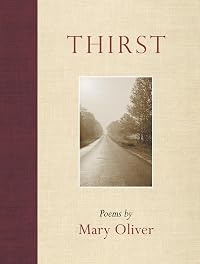
Thirst: Poems
by Mary Oliver
On This Page
Description
In this collection of 43 new poems the author grapples with grief at the death of her beloved partner of over forty years. She strives to experience sorrow as a path to spiritual progress, grief as part of loving and not it end. She also chronicles for the first time her discovery of faith, without abandoning the love of the physical world that has been a hallmark of her work for four decades.Tags
Recommendations












Member Reviews
I bought this as soon as I’d dried my tears from reading one of the poems Laysee included in her review:
Image source
"I remember love, that leaves yet never leaves."
After reading the whole collection, The Uses of Sorrow remains my favourite, but Oliver's journey through bereavement, finding joy in the beauty of the natural world, and questioning and searching for faith was a helpful, hopeful lens to view the dark world I currently inhabit. Helpful, even though faith and bereavement are decades apart for me, and I have no urge to try again to find faith.
Popularity
The poems vary show more in style and length, but all use fairly plain language to explore profound themes in insightful, beautiful, and relatable ways.
It’s easy to see why Oliver is so popular: she’s not a “difficult” poet. But don’t assume that accessibility means trivial or lightweight. There is depth and beauty in abundance, and creating that from plain ingredients is perhaps more of an achievement than that of more “literary” poets, using archaic words, and symbolism now lost to us.
Context
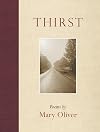
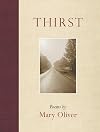
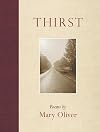
Oliver wrote these poems after the death of her partner of more than 40 years, photographer Molly Malone Cook. The beautiful sepia cover photo is “Paradise Road, Dayton, Alabama”, by MMC. A misty, tree-lined route towards watery light.
It continues with a friend telling her “It’s not the weight you carry, but how you carry it.”
There’s an excellent article about Oliver and Malone here on Brainpickings.org. It includes the observation that “they shaped each other’s way of seeing and being with the world”
More Mary Oliver
Another poem of hers I’ve come to love, but which is not in this collection, is the one below, especially the lines I’ve emboldened:
Image: Wild geese (Source.)
You can hear Mary Oliver reading Wild Geese here. The poem itself starts ~30 seconds in. show less
Image source
The Uses of Sorrow
(In my sleep I dreamed this poem)
Someone I loved once gave me
a box full of darkness.
It took me years to understand
that this, too, was a gift.
"I remember love, that leaves yet never leaves."
After reading the whole collection, The Uses of Sorrow remains my favourite, but Oliver's journey through bereavement, finding joy in the beauty of the natural world, and questioning and searching for faith was a helpful, hopeful lens to view the dark world I currently inhabit. Helpful, even though faith and bereavement are decades apart for me, and I have no urge to try again to find faith.
Popularity
The poems vary show more in style and length, but all use fairly plain language to explore profound themes in insightful, beautiful, and relatable ways.
It’s easy to see why Oliver is so popular: she’s not a “difficult” poet. But don’t assume that accessibility means trivial or lightweight. There is depth and beauty in abundance, and creating that from plain ingredients is perhaps more of an achievement than that of more “literary” poets, using archaic words, and symbolism now lost to us.
Context
Oliver wrote these poems after the death of her partner of more than 40 years, photographer Molly Malone Cook. The beautiful sepia cover photo is “Paradise Road, Dayton, Alabama”, by MMC. A misty, tree-lined route towards watery light.
Heavy
That time
I thought I could not
go any closer to grief
without dying
I went closer,
and I did not die.
Surely God
had His hand in this,
as well as friends.
It continues with a friend telling her “It’s not the weight you carry, but how you carry it.”
There’s an excellent article about Oliver and Malone here on Brainpickings.org. It includes the observation that “they shaped each other’s way of seeing and being with the world”
More Mary Oliver
Another poem of hers I’ve come to love, but which is not in this collection, is the one below, especially the lines I’ve emboldened:
Wild Geese
You do not have to be good.
You do not have to walk on your knees
For a hundred miles through the desert, repenting.
You only have to let the soft animal of your body
love what it loves.
Tell me about your despair, yours, and I will tell you mine.
Meanwhile the world goes on.
Meanwhile the sun and the clear pebbles of the rain
are moving across the landscapes,
over the prairies and the deep trees,
the mountains and the rivers.
Meanwhile the wild geese, high in the clean blue air,
are heading home again.
Whoever you are, no matter how lonely,
the world offers itself to your imagination,
calls to you like the wild geese, harsh and exciting --
over and over announcing your place
in the family of things.
Image: Wild geese (Source.)
You can hear Mary Oliver reading Wild Geese here. The poem itself starts ~30 seconds in. show less
I have a couple of collections of Mary Oliver's poems. Despite the fact that this is written as she mourns the loss of her partner of 40 some years, this collection seems less preoccupied with death than the earlier collections.
There are some beautiful pieces of hope and faith is this collection.
There are some beautiful pieces of hope and faith is this collection.
I’m parched. The most terrible thing about this work is that I bought it. Mary Oliver brings the concept of trite to a brand new level of skill. There were several instances throughout reading her work that I wanted desperately to rip out my eyes. This sentiment came with all sorts of guilt as well because this is supposedly her grand work of spiritual expression and exploration and typically that’s a labor I can appreciate. However, there’s something obnoxious about some people when they first “catch fire”, so to speak. They have a tendency to regurgitate century upon century of typical reactions to a spiritual life –and that’s all well and good because they find their own voice eventually. But I’m certain that a poet show more should never ever publish themselves in this state of being. Mary Oliver is about six years off of a good spiritual poem. show less
I am a voracious reader and I often read at a break-neck pace. The power of a good poem is stop you in your tracks, to force you to linger over a word, a image a phrase. Mary Oliver is one of my favorite poets and this is now one of my favorite books. Written shortly after the death of her partner of forty years, these poems reflect her grief, her faith, and as always, her attention to life around her. So good.
"Another morning and I wake with thirst for the goodness I do not have."
Affirmations are real! Sometimes, when you're feeling down, all you have to do is read some Mary Oliver to remind you of the gentle beauty of life. Simple and sweet and poignant. And most of all, good. (Not that it has to be.)
Affirmations are real! Sometimes, when you're feeling down, all you have to do is read some Mary Oliver to remind you of the gentle beauty of life. Simple and sweet and poignant. And most of all, good. (Not that it has to be.)
As always, beautifully written. Different than in previous volumes, Oliver directs her poems -her prayers - directly to God. She successfully places her great love of the world in the context of her love for God, yet doesn't discount a universal understanding of faith.
A prayer book, really, or a how-to-pray book.
Members
- Recently Added By
Lists

Tonikat reading completed on Librarything journals
329 works; 2 members
Author Information

54+ Works 21,173 Members
Mary Oliver was born in Cleveland, Ohio on September 10, 1935. She attended Ohio State University and Vassar College, but did not receive a degree. Her first collection of poems, No Voyage and Other Poems, was published in 1963. She wrote more than 20 volumes of poetry including The River Styx, Ohio; The Leaf and the Cloud; Evidence; Blue Horses; show more and Felicity. She received several awards including the Pulitzer Prize for American Primitive, the Christopher Award and the L. L. Winship/PEN New England Award for House of Light, and the National Book Award for New and Selected Poems. Her books of prose include A Poetry Handbook, Rules for the Dance: A Handbook for Writing and Reading Metrical Verse, and Long Life: Essays and Other Writings. She held the Catharine Osgood Foster Chair for Distinguished Teaching at Bennington College from 1995 to 2001. She died on January 17, 2019 at the age of 83. (Bowker Author Biography) show less
Common Knowledge
- Original publication date
- 2006
Classifications
Statistics
- Members
- 860
- Popularity
- 31,696
- Reviews
- 19
- Rating
- (4.15)
- Languages
- English
- Media
- Paper, Ebook
- ISBNs
- 4
- UPCs
- 1
- ASINs
- 5