On This Page
Description
Roz the robot discovers that she is alone on a remote, wild island with no memory of where she is from or why she is there, and her only hope of survival is to try to learn about her new environment from the island's hostile inhabitants.Tags
Recommendations



Member Reviews
This trilogy turned out to be so much more than I expected. I thought it would be cute and entertaining in the typical talking animals children's story kind of way.....I was delighted to discover the beautifully written and thought provoking adventure awaiting inside these pages.
Peter Brown has flawlessly blended nature and technology in a beautiful and captivating story of survival, friendship, community, trust, and heart. This story may be about a robot and animals....but the journey is very human.
I love that Brown added themes of realism to this fantastical tale.....there are very real dangers and harsh realities to life in natural elements....instead of shying away from those, Brown uses them as learning opportunities.
The show more illustrations are beautifully done. The art style is perfect for this story and adds a visual enrichment that helps bring the story to life.
There is much more I could say about this wonderful story...but, it's an award winning book and has been film adapted....it's received much well deserved acclaim, by people much more articulate than I. So, I'll just end here by saying this ranks among the absolute best books I've read in recent years, and I highly recommend it for children of all ages, and adults like. show less
Peter Brown has flawlessly blended nature and technology in a beautiful and captivating story of survival, friendship, community, trust, and heart. This story may be about a robot and animals....but the journey is very human.
I love that Brown added themes of realism to this fantastical tale.....there are very real dangers and harsh realities to life in natural elements....instead of shying away from those, Brown uses them as learning opportunities.
The show more illustrations are beautifully done. The art style is perfect for this story and adds a visual enrichment that helps bring the story to life.
There is much more I could say about this wonderful story...but, it's an award winning book and has been film adapted....it's received much well deserved acclaim, by people much more articulate than I. So, I'll just end here by saying this ranks among the absolute best books I've read in recent years, and I highly recommend it for children of all ages, and adults like. show less
The Wild Robot is a Middle Grade sci-fi/survival/talking animal book. I had seen it before and considered getting it, but I have too many books as it is. When I saw that my local public library had added it to their Overdrive audiobook collection, I pounced on it. I believe my checkout included access to accompanying files with illustrations, but I didn't attempt to find and open those files.
The Wild Robot begins with a terrible shipwreck during a hurricane (although the words "climate change" are never used, this is definitely a vision of the near future that includes some of the effects of climate change). The ship's cargo included several robots, only one of which survived the wreck. That robot, Roz, is activated by a group of show more curious otters. Over the next few months, Roz gradually learns how to survive in the wild and communicate with the animals around her. Can a robot somehow make friends and find a home in such a wild place?
I really enjoyed how this audiobook started. The beginning seemed very much like a robot survival book, as Roz attempted to figure out how to protect herself from the elements and from animals. She was programmed to be nonviolent and was therefore incapable of fighting back against any animals that attacked her. She was also programmed to keep herself clean and shiny, a serious drawback in outdoor survival, where her shininess drew attention to her and prevented her from properly hiding from dangers.
I was a bit disappointed when Roz learned to communicate with animals and this suddenly morphed from an outdoor adventure into a talking animal book. Somehow, Roz's newfound animal communication skills allowed her to talk to all animals she came across in full sentences, and allowed them to talk to her in full sentences. I had some trouble accepting that Roz and a beaver were somehow using beaver language to discuss the specifics of building a lodge. The beaver even suggested that Roz grow a garden with some help from local deer. Meanwhile, I was sitting there wondering how a beaver and deer were supposed to know anything about gardening.
Eventually, I managed to stop thinking of the book's animals as true animals so much and was able to think of them more as talking animals, which helped me enjoy the story more. (I'm guessing that the author really did intend for them to be true animals, based on details later on in the book. But animal communication doesn't work like that, so I'm just going to go with my "talking animals with a few true animal characteristics" interpretation.)
Roz's efforts to find a place for herself and make friends were nice, although the lengths she had to go to before the animals stopped considering her a monster and started considering her a friend occasionally bothered me. I mean, what if she hadn't been able to build all those lodges?
At any rate, I particularly liked her efforts to figure out motherhood after she accidentally became the mother of a gosling. I worried about where Brown planned to go with that. In theory, Roz could outlive Brightbill, her son. If you, like me, worry about fictional animals, I can tell you thatthere were a few animal deaths here and there but that, as far as I can remember, none of the animals readers are likely to be most attached to die.
I did start to worry that Roz wasn't going to make it, though. It's amazing the amount of damage she sustained in only a few months living in a forest. With no humans around, there was no way for her to acquire new parts or get any kind of maintenance. It was a relief to know that a sequel already existed. If Roz was the main character of that book as well, surely she wouldn't be destroyed at some point in The Wild Robot.
Kate Atwater's narration was wonderful. I liked most of the voices she chose for the various animals, and her robotic Roz voice somehow managed to be appealing. She was accompanied by various sound effects, such as otter squeaks and button clicks, which I thought was nicely done.
All in all, I enjoyed this and will probably read (or listen to) the next book at some point.
(Original review posted on A Library Girl's Familiar Diversions.) show less
The Wild Robot begins with a terrible shipwreck during a hurricane (although the words "climate change" are never used, this is definitely a vision of the near future that includes some of the effects of climate change). The ship's cargo included several robots, only one of which survived the wreck. That robot, Roz, is activated by a group of show more curious otters. Over the next few months, Roz gradually learns how to survive in the wild and communicate with the animals around her. Can a robot somehow make friends and find a home in such a wild place?
I really enjoyed how this audiobook started. The beginning seemed very much like a robot survival book, as Roz attempted to figure out how to protect herself from the elements and from animals. She was programmed to be nonviolent and was therefore incapable of fighting back against any animals that attacked her. She was also programmed to keep herself clean and shiny, a serious drawback in outdoor survival, where her shininess drew attention to her and prevented her from properly hiding from dangers.
I was a bit disappointed when Roz learned to communicate with animals and this suddenly morphed from an outdoor adventure into a talking animal book. Somehow, Roz's newfound animal communication skills allowed her to talk to all animals she came across in full sentences, and allowed them to talk to her in full sentences. I had some trouble accepting that Roz and a beaver were somehow using beaver language to discuss the specifics of building a lodge. The beaver even suggested that Roz grow a garden with some help from local deer. Meanwhile, I was sitting there wondering how a beaver and deer were supposed to know anything about gardening.
Eventually, I managed to stop thinking of the book's animals as true animals so much and was able to think of them more as talking animals, which helped me enjoy the story more. (I'm guessing that the author really did intend for them to be true animals, based on details later on in the book. But animal communication doesn't work like that, so I'm just going to go with my "talking animals with a few true animal characteristics" interpretation.)
Roz's efforts to find a place for herself and make friends were nice, although the lengths she had to go to before the animals stopped considering her a monster and started considering her a friend occasionally bothered me. I mean, what if she hadn't been able to build all those lodges?
At any rate, I particularly liked her efforts to figure out motherhood after she accidentally became the mother of a gosling. I worried about where Brown planned to go with that. In theory, Roz could outlive Brightbill, her son. If you, like me, worry about fictional animals, I can tell you that
I did start to worry that Roz wasn't going to make it, though. It's amazing the amount of damage she sustained in only a few months living in a forest. With no humans around, there was no way for her to acquire new parts or get any kind of maintenance. It was a relief to know that a sequel already existed. If Roz was the main character of that book as well, surely she wouldn't be destroyed at some point in The Wild Robot.
Kate Atwater's narration was wonderful. I liked most of the voices she chose for the various animals, and her robotic Roz voice somehow managed to be appealing. She was accompanied by various sound effects, such as otter squeaks and button clicks, which I thought was nicely done.
All in all, I enjoyed this and will probably read (or listen to) the next book at some point.
(Original review posted on A Library Girl's Familiar Diversions.) show less
What a silly little book, that's what I thought when I picked it up and started to read. But this is not just a silly little book, it's a journey. A book about a robot who survives to live among animals sounds silly, and most of what I'm going to say will too. This robot's life is just a sort of emotional journey. I never expected this book to be so sad or so emotional. It seemed like it would begin and end silly and that would be it.
Not knowing this is but book one, I expected that it would be ending here, like this.
Now knowing it's but book one, I feel such relief, a great soothing emotion to balm over the ending which is just sad and emotional, a real ride in ways I didn't see coming.
I can only hope the next book is just as fun, and show more has just as many emotional feels daggers at the ready, or not, Roz deserves a happy ending. show less
Not knowing this is but book one, I expected that it would be ending here, like this.
Now knowing it's but book one, I feel such relief, a great soothing emotion to balm over the ending which is just sad and emotional, a real ride in ways I didn't see coming.
I can only hope the next book is just as fun, and show more has just as many emotional feels daggers at the ready, or not, Roz deserves a happy ending. show less
Imaginative story, about a Robot stranded on an island who adapts to the wildlife instead of the environment that was planned for her. Roz is incredibly appealing, in a stoic, robot, sort or way. Short chapters with wonderful, stylized art throughout the book. I'm tempted to say something about how she discovers her humanity, but there really isn't any humanity in the book, with the exception of a murderous farmer. In some ways I find it comforting to think that wild creatures and robots would go on without us, and be much happier, too.
This captivating story follows Roz, a service robot stranded on a remote island after a storm. She learns to adapt through observing wildlife, building shelters, and—most importantly—forming relationships with the local animals when she adopts an orphaned gosling named Brightbill. With its clear prose and short chapters, The Wild Robot is ideal for middle-grade readers, including reluctant ones. Roz’s journey—about resilience, belonging, and nurturing community—resonates deeply. The heart of the story lies in Brown’s message: kindness is a survival skill, a theme echoed in both the book and its successful 2024 animated film adaptation.
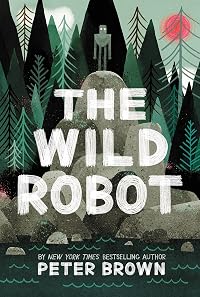
The Wild Robot by Peter Brown has both fascinated me and frightened me for at least 2 months now. I kept seeing the cover when I was shelving or visiting other branches and the image of the single robot standing on top of a pile of rocks kept leaping out at me. I finally gave up the fight when I decided that middle grade fiction was the way to cure my book reading blues. I'm glad that I did because The Wild Robot was a lot of fun to read (and it turns out it's the start of a series!) made even more amazing by the superb illustrations supplied by the author. [A/N Peter Brown is no stranger to creating books as he's a well-known children's picture book author/illustrator but this is his first attempt at middle grade fiction.] This isn't show more your standard 'robot story' but instead it's a look at climate change, the ever-evolving landscape of our world with the advent of technology, and what it means to be truly alive. In short, it's beautiful, thought-provoking literature. The illustrations peppered throughout enhance the story by adding depth to the characters (I love that they're black and white.). Roz is doing the best she can given her circumstances which is really all that anyone can do. The only difference is that she's an artificial lifeform living on an island without any humans. How will this shape her? Will her presence have any effect on the local fauna and flora? Brown's commentary on our world is perfectly geared for a younger audience but it wouldn't go amiss for the adult crowd either. ;-) I can't wait to see how this story continues to develop as Peter carries on with the series. 10/10
For a look at the book from the author's perspective check out this awesome post written by Peter about his process of getting his book published: "The Wild Robot lives!". show less
For a look at the book from the author's perspective check out this awesome post written by Peter about his process of getting his book published: "The Wild Robot lives!". show less
This book was a gem that I stumbled upon because my wife won a basket of young adult books at a church raffle. I am currently writing a book called, Wonderball Apocalypse, about robots and artificial intelligence, so The Wild Robot seemed a good choice. Wow! It is almost poetic in its language and simplicity, yet there are philosophical overtones hiding in those woods. The artwork is a spectacular accompaniment to the story, also simple and beautiful. The robot, Roz, is more endearing than many other characters I have recently met and I really want to read the sequel to see what happens next. But. This story was so perfect as is, that maybe I should just stop here and treasure it.
Members
- Recently Added By
Lists

KayStJ's to-read list
1,616 works; 11 members

Books Read in 2017
4,249 works; 130 members

Top Five Books of 2017
757 works; 231 members

For My Kids
25 works; 2 members

Hachette Book Group
152 works; 6 members

SYES Library Wishlist
1,080 works; 4 members

Torchlight Level 3
20 works; 1 member

Books Read in 2025
4,091 works; 97 members

Written and Illustrated By
805 works; 1 member

Favorite Kids Books (chapter, middle grade)
168 works; 4 members

NPR Books You Love: 100 Favorite Books For Young Readers
100 works; 1 member

Top Five Books of 2025
954 works; 303 members

Favorite Science Fiction
456 works; 218 members

Favorite Childhood Books
1,646 works; 518 members
Author Information

15+ Works 13,276 Members
Peter Brown grew up in Hopewell, New Jersey. He received a B.F.A. in Illustration from Art Center College of Design in Pasadena, California. After college, he moved to Brooklyn, New York and spent several years painting backgrounds for animated TV shows. In 2003, he got a book deal to write and illustrate his first picture book Flight of the Dodo. show more His other works include The Curious Garden, which won the 2010 E.B. White Award and the Children's Choice Award, Children Make Terrible Pets, and You Will Be My Friend. He is the illustrator of Creepy Carrots! by author Aaron Reynolds. His title Mr. Tiger Goes Wild made The New York Times Best Seller List for 2013. (Bowker Author Biography) show less
Some Editions
Awards and Honors
Awards
Distinctions
Notable Lists
Series

Work Relationships
Is contained in
Has the adaptation
Common Knowledge
- Canonical title
- The Wild Robot
- Original publication date
- 2016-04-05
- People/Characters
- Roz; Brightbill
- Important places
- The Island
- Important events
- Migration
- Related movies
- The Wild Robot (2024 | IMDb)
- Dedication
- To the robots of the future
- First words
- Our story begins on the ocean, with wind and rain and thunder and lightning and waves.
- Last words
- (Click to show. Warning: May contain spoilers.)She would find her way back home.
- Original language
- English
- Canonical DDC/MDS
- 813.6
- Canonical LCC
- PZ7.B81668Wi 2016
Classifications
Statistics
- Members
- 4,728
- Popularity
- 3,030
- Reviews
- 143
- Rating
- (4.14)
- Languages
- 11 — Chinese, Dutch, English, French, German, Italian, Korean, Portuguese, Russian, Spanish, Turkish
- Media
- Paper, Audiobook, Ebook
- ISBNs
- 64
- ASINs
- 11