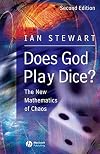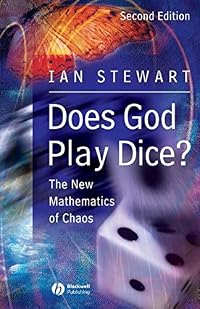
Does God Play Dice? The New Mathematics of Chaos
by Ian Stewart
On This Page
Description
Since the dramatic discovery of the mathematical concept of chaos in 1989, the controversy of its contents has settled down. This revised edition of Does God Play Dice? takes a fresh look at its achievements and potential. With a new preface and three completely new chapters, it includes the latest practical applications of chaos theory, such as developing intelligent heart pacemakers. All this provides a fascinating new answer to Einstien's question which provided the title of this book.Tags
Recommendations
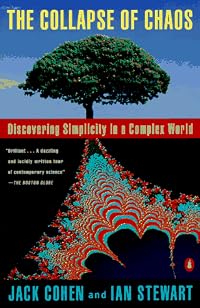
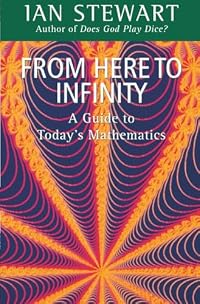
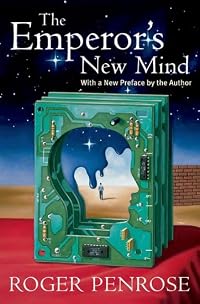
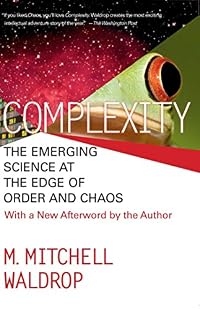








Member Reviews
It's a thankless task trying to write for a general audience about a subject as rich, varied and profound as mathematics. Especially in a culture where maths is so badly taught many adults take great pride in not being any good at it (hint: there's a lot more to maths than endlessly adding and dividing fractions!) Some fail by being too superficial, but Ian Stewart can't be accused of that. Here he takes on the relatively new field of chaos, the mathematics of systems where very small changes in parameters lead to huge differences in outcome that, to the uninformed, appear random. These chaotic systems are the true building blocks of the real world rather than the neat, straightforward formulae that create smooth, regular shapes, yet show more generations of mathematicians and physicists have shied away from them until very recently. Stewart shows how even the most shapeless systems, when looked at from the right angle, exhibit the most exquisite patterns and symmetries. His style is informal, chatty, sometimes iconoclastic, but be warned: it's not a book for mathematical novices. Some of the concepts are mind-twisting! show less
It's a thankless task trying to write for a general audience about a subject as rich, varied and profound as mathematics. Especially in a culture where maths is so badly taught many adults take great pride in not being any good at it (hint: there's a lot more to maths than endlessly adding and dividing fractions!) Some fail by being too superficial, but Ian Stewart can't be accused of that. Here he takes on the relatively new field of chaos, the mathematics of systems where very small changes in parameters lead to huge differences in outcome that, to the uninformed, appear random. These chaotic systems are the true building blocks of the real world rather than the neat, straightforward formulae that create smooth, regular shapes, yet show more generations of mathematicians and physicists have shied away from them until very recently. Stewart shows how even the most shapeless systems, when looked at from the right angle, exhibit the most exquisite patterns and symmetries. His style is informal, chatty, sometimes iconoclastic, but be warned: it's not a book for mathematical novices. Some of the concepts are mind-twisting! show less
A readable and witty introduction to chaos theory, which is only too misunderstood. This book focuses on the implications which chaos has in mathematics, with an emphasis on maps, fractals, and other such phenomenon. A solid layman introduction.
Ought to be a DVD ( wish I'd discovered Ian Stewart a long time ago ) Overall great ~
Ought to be a DVD ( wish I'd discovered Ian Stewart a long time ago ) Overall great ~
Members
- Recently Added By
Author Information

89+ Works 20,241 Members
Ian Stewart is a professor emeritus of mathematics at the University of Warwick. The author of numerous books on math, he has written for New Scientist, Discover, and Scientific American, among other publications in the United Kingdom and the United States. He lives in Coventry, England.
Series
Belongs to Publisher Series
Common Knowledge
- Original publication date
- 1989
- Epigraph
- You believe in a God who plays dice, and I in complete law and order.
Albert Einstein, Letter to Max Born
Classifications
Statistics
- Members
- 921
- Popularity
- 28,906
- Reviews
- 8
- Rating
- (3.81)
- Languages
- 12 — Czech, Dutch, English, French, German, Greek, Italian, Polish, Portuguese, Romanian, Croatian, Spanish
- Media
- Paper, Ebook
- ISBNs
- 33
- ASINs
- 6