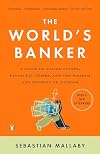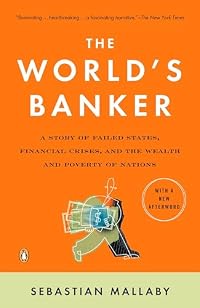
The World's Banker: A Story of Failed States, Financial Crises, and the Wealth and Poverty of Nations (Council on Foreign Relations Books (Penguin Press))
by Sebastian Mallaby
On This Page
Description
Looks inside the workings of the World Bank and global development under the leadership of James Wolfensohn, examining the role of the World Bank in a new era of globalization and international terrorism.Tags
Recommendations













Member Reviews
http://nothinginparticular.multiply.com
THROWING money at a problem to solve it is pretty much like giving alms to beggars to lift them out of poverty: it doesn’t really produce intended results, except to create publicity stunts and assuage guilty consciences.
Without addressing the root causes of global and local economic crises and poverty, any entity, however wealthy, well-connected, or
well-intentioned, will be rendered ineffective.
While this may sound trite, obvious, and old-hat, it bears repetition, especially in Asia.
Fortunately, Sebastian Mallaby, Washington Post columnist, has taken it upon himself to emphasize this point more than once while writing about the triumphs and tribulations of Australian-born James Wolfenson, the show more first non-American to become president of the World Bank.
In The World’s Banker, Mallaby has dished out a dramatic narrative combined with substantial research to illustrate what even non-economists presumably know all along: that good politics is inextricably linked with economic development and that poor governance can introduce or exacerbate a crisis.
In 1996, just a year before the Asian crisis struck, the World Bank and its Bretton Woods sister, the International Monetary Fund, pumped in billions of dollars to strengthen the balance sheets of Indonesia’s state-owned banks.
Unfortunately, most of these funds went to undeserving borrowers,
including those close to the Suharto regime.
As a result, when the contagion hit, the banks remained on the verge of collapse, the very situation that the Bank and the IMF wanted to avoid which is why they released the funds in the first place.
The banks, in the end, barely had anything to show for except bad
assets, soured loans, and poor corporate governance.
In turn, the volatile mix of financial instability and the effects of a
regional crisis culminated in the resignation of president Mohamed Suharto in May 1998.
“The [World] Bank has been engaged for years in Indonesia but its
economists’ worldview had left no room for the idea that if you don’t get
the politics roughly right a lot of development progress may be wiped out in a few weeks,” Mallaby says in a chapter about Indonesia, the Bank’s poster country for its poverty reduction strategies (or at least before 1997).
Mallaby’s assertion could very well apply to the Philippines, a heretofore willing subject of IMF-inflicted structural adjustment programs.
With a yawning fiscal deficit, the current administration has ignored calls for an independent, no-nonsense audit of the power purchase agreements made between the government-owned National Power Corporation (Napocor) and independent power plants (IPPs).
While the justice, finance, and energy departments have said that most of the contracts are on the level, various independent studies indicate exactly the opposite.
Like the huge, fraudulent debt incurred from the construction of the Bataan Nuclear Power Plant, the government continues to honor these deals, which binds Napocor and consumers to pay the IPPs for unused and even ungenerated power, which, incidentally, is the reason for the country’s current fiscal mess.
Although the administration remains optimistic that the new value added tax as well as a slew of other measures will address the fiscal deficit, it nevertheless remains politically fragile, especially with unresolved allegations of election fraud.
How then is development ever going to proceed when it appears that the country can’t even get its politics right?
Despite its reputation for swallowing every bitter economic pill that
both the IMF and the Bank have prescribed, the Philippines in the 21st
century is a stark contrast to Uganda five years before the millennium.
Burdened by a series of dictatorships and erstwhile anti-free-market policies, Uganda significantly reduced poverty incidence with the help of the hard-hitting yet sensible Emmanuel Tumusiime-Mutebile, a technocrat whom Mallaby refers to as a “hammer.”
As overall financial adviser to President Yoweri Musuveni, Tumusiime made it possible for the former British protectorate to hold its poverty conference in its very own territory, perhaps the very first country in Africa to do so.
Combined with the efforts of Wolfenson and Jim Adams, then the Bank’s director for East Africa, Uganda’s poverty reduction initiatives — previously held in Paris — were discussed by donor country representatives, nongovernment organizations, and Bank officials right at the heart of Kampala, the country’s capital.
But it was more than a change of venue.
It was also a paradigm shift, the very instance when the World Bank — or at least under Wolfenson’s term — began to re-examine its ideas about development.
Nowhere was this transformation more dramatic than in the Bank’s engagement with Uganda.
The Bank, for instance, gave Musuveni money to build more roads even though it believed that these funds could be best used for education.
But then again, Wolfenson’s Bank — as Mallaby sometimes called it — was now more open to other ideas.
“There was a good case to be made for rural road building, which would link poor farmers to markets, boosting their incomes and therefore their ability to pay for school fees,” Mallaby writes. “If the Ugandans did not want money for education, was it wise to jam it down their throats?”
As Mallaby shows, this kind of pragmatism could only have happened under Wolfenson’s term, whose early years were marked by swift, decisive, and positive action, especially when its dedicated executives intervened in Bosnia.
Although brash and impulsive, Wolfenson was able to transform the World Bank from a centralized and stodgy institution into a flexible agency which, more or less, willingly worked with nongovernment organizations to help lift millions out of poverty.
However, Wolfenson was not always on target, a fact well-documented by Mallaby who took the extra effort to ensure that the portrait he has painted is accurate and balanced.
Aside from firing old hands or forcing their resignations, Wolfenson, for better or for worse, created unnecessary tension in the Bank’s board by deliberately withholding discussions about policy shifts.
Due to Wolfenson’s single-mindedness and a mania for doing things his way, one G7 country representative recited a poem during a meeting, comparing him to Narcissus.
These anecdotes, peppered with policy framework documents and strategy papers, only underscores that The World’s Banker remains a compelling read.
Its quick narrative pace, together with its intention to avoid development jargon, has made the book accessible, especially to regular readers, giving them an inside look at the workings of what may well be the only bank in history directly participating in programs which help the
world’s poor. show less
THROWING money at a problem to solve it is pretty much like giving alms to beggars to lift them out of poverty: it doesn’t really produce intended results, except to create publicity stunts and assuage guilty consciences.
Without addressing the root causes of global and local economic crises and poverty, any entity, however wealthy, well-connected, or
well-intentioned, will be rendered ineffective.
While this may sound trite, obvious, and old-hat, it bears repetition, especially in Asia.
Fortunately, Sebastian Mallaby, Washington Post columnist, has taken it upon himself to emphasize this point more than once while writing about the triumphs and tribulations of Australian-born James Wolfenson, the show more first non-American to become president of the World Bank.
In The World’s Banker, Mallaby has dished out a dramatic narrative combined with substantial research to illustrate what even non-economists presumably know all along: that good politics is inextricably linked with economic development and that poor governance can introduce or exacerbate a crisis.
In 1996, just a year before the Asian crisis struck, the World Bank and its Bretton Woods sister, the International Monetary Fund, pumped in billions of dollars to strengthen the balance sheets of Indonesia’s state-owned banks.
Unfortunately, most of these funds went to undeserving borrowers,
including those close to the Suharto regime.
As a result, when the contagion hit, the banks remained on the verge of collapse, the very situation that the Bank and the IMF wanted to avoid which is why they released the funds in the first place.
The banks, in the end, barely had anything to show for except bad
assets, soured loans, and poor corporate governance.
In turn, the volatile mix of financial instability and the effects of a
regional crisis culminated in the resignation of president Mohamed Suharto in May 1998.
“The [World] Bank has been engaged for years in Indonesia but its
economists’ worldview had left no room for the idea that if you don’t get
the politics roughly right a lot of development progress may be wiped out in a few weeks,” Mallaby says in a chapter about Indonesia, the Bank’s poster country for its poverty reduction strategies (or at least before 1997).
Mallaby’s assertion could very well apply to the Philippines, a heretofore willing subject of IMF-inflicted structural adjustment programs.
With a yawning fiscal deficit, the current administration has ignored calls for an independent, no-nonsense audit of the power purchase agreements made between the government-owned National Power Corporation (Napocor) and independent power plants (IPPs).
While the justice, finance, and energy departments have said that most of the contracts are on the level, various independent studies indicate exactly the opposite.
Like the huge, fraudulent debt incurred from the construction of the Bataan Nuclear Power Plant, the government continues to honor these deals, which binds Napocor and consumers to pay the IPPs for unused and even ungenerated power, which, incidentally, is the reason for the country’s current fiscal mess.
Although the administration remains optimistic that the new value added tax as well as a slew of other measures will address the fiscal deficit, it nevertheless remains politically fragile, especially with unresolved allegations of election fraud.
How then is development ever going to proceed when it appears that the country can’t even get its politics right?
Despite its reputation for swallowing every bitter economic pill that
both the IMF and the Bank have prescribed, the Philippines in the 21st
century is a stark contrast to Uganda five years before the millennium.
Burdened by a series of dictatorships and erstwhile anti-free-market policies, Uganda significantly reduced poverty incidence with the help of the hard-hitting yet sensible Emmanuel Tumusiime-Mutebile, a technocrat whom Mallaby refers to as a “hammer.”
As overall financial adviser to President Yoweri Musuveni, Tumusiime made it possible for the former British protectorate to hold its poverty conference in its very own territory, perhaps the very first country in Africa to do so.
Combined with the efforts of Wolfenson and Jim Adams, then the Bank’s director for East Africa, Uganda’s poverty reduction initiatives — previously held in Paris — were discussed by donor country representatives, nongovernment organizations, and Bank officials right at the heart of Kampala, the country’s capital.
But it was more than a change of venue.
It was also a paradigm shift, the very instance when the World Bank — or at least under Wolfenson’s term — began to re-examine its ideas about development.
Nowhere was this transformation more dramatic than in the Bank’s engagement with Uganda.
The Bank, for instance, gave Musuveni money to build more roads even though it believed that these funds could be best used for education.
But then again, Wolfenson’s Bank — as Mallaby sometimes called it — was now more open to other ideas.
“There was a good case to be made for rural road building, which would link poor farmers to markets, boosting their incomes and therefore their ability to pay for school fees,” Mallaby writes. “If the Ugandans did not want money for education, was it wise to jam it down their throats?”
As Mallaby shows, this kind of pragmatism could only have happened under Wolfenson’s term, whose early years were marked by swift, decisive, and positive action, especially when its dedicated executives intervened in Bosnia.
Although brash and impulsive, Wolfenson was able to transform the World Bank from a centralized and stodgy institution into a flexible agency which, more or less, willingly worked with nongovernment organizations to help lift millions out of poverty.
However, Wolfenson was not always on target, a fact well-documented by Mallaby who took the extra effort to ensure that the portrait he has painted is accurate and balanced.
Aside from firing old hands or forcing their resignations, Wolfenson, for better or for worse, created unnecessary tension in the Bank’s board by deliberately withholding discussions about policy shifts.
Due to Wolfenson’s single-mindedness and a mania for doing things his way, one G7 country representative recited a poem during a meeting, comparing him to Narcissus.
These anecdotes, peppered with policy framework documents and strategy papers, only underscores that The World’s Banker remains a compelling read.
Its quick narrative pace, together with its intention to avoid development jargon, has made the book accessible, especially to regular readers, giving them an inside look at the workings of what may well be the only bank in history directly participating in programs which help the
world’s poor. show less
Lots of good history about the Bank but I couldn't help but feel it was a big apology. Although some criticisms of the Bank were addressed, it felt a little too sanguine about the Bank.
Pros: engaging account of the life of James Wolfensohn; glimpse of political/financial interconnections
Cons: irresponsible brush off of criticism; a naive view of the political functions of the bank; glaring omission of many important events
Cons: irresponsible brush off of criticism; a naive view of the political functions of the bank; glaring omission of many important events
Both my parents worked for the World Bank, and they feel this is one of the best books about IBRD. It's much more a biography of the Wolfensohn years than it is of Wolfensohn (although it does include accounts of him at the Olympics, Carnegie Hall, etc). Mallaby writes in a very readable, well informed style, and the book is mostly a pleasure to read.
World Bank (Subject); Wolfensohn, James (Subject)
Since 9/11, many have observed that global security depends upon improving conditions for the world's poor. But how to make that happen? No institution has grappled harder with this challenge than the World Bank. Drawing on some 200 interviews, including twenty hours of discussions with World Bank President James Wolfensohn, Washington Post editorial columnist and former Council Fellow Sebastian Mallaby takes readers inside the world's premier development institution. The World's Banker brings to life some of the bank's battles, from the reconstruction of Bosnia to the 1997 Asian crisis, to the battle against AIDS and the push to attain the Millennium Development Goals. And it maps the bank's evolution away from the macroeconomic focus show more of the "Washington Consensus" to a broader understanding of development that considers corruption, democratic participation, and the quality of political institutions. For the growing circle of people who care about international development, here is a book that explains the 800-pound gorilla of the field.
The explanation is at times unsettling. Mallaby's account shows how hard it is for a big multilateral institution to be effective. Rich countries are forever saddling the World Bank with new mandates, declaring one year that its priority must be universal education and the next year that it must concentrate on AIDS, and undermining its focus in the process. Nongovernmental groups complicate the bank's efforts, too, mounting campaigns against its projects that are sometimes dishonest and unscrupulous.
More on:
Banking
International Organizations
Economics
The World's Banker is at once a portrait of an intellectual quest for ways to turn a sliver of the rich world's plenty into progress against poverty and a case study in the frustrations of the global system. Never has the bank's work been more important, more in the public eye, or more controversial than it is today, when the emergence of terrorist sanctuaries in failed states have dramatized the connection between development and security. And never has the place of multilateral institutions in U.S. foreign policy been so politically contested. Mallaby parlays his extraordinary access to the World Bank and its leader into a revealing account of the challenges and contradictions of the West's efforts to enlarge the world's wealth. The result is a smart narrative joyride written by an author who combines enthralling storytelling with fresh and incisive analysis. show less
The explanation is at times unsettling. Mallaby's account shows how hard it is for a big multilateral institution to be effective. Rich countries are forever saddling the World Bank with new mandates, declaring one year that its priority must be universal education and the next year that it must concentrate on AIDS, and undermining its focus in the process. Nongovernmental groups complicate the bank's efforts, too, mounting campaigns against its projects that are sometimes dishonest and unscrupulous.
More on:
Banking
International Organizations
Economics
The World's Banker is at once a portrait of an intellectual quest for ways to turn a sliver of the rich world's plenty into progress against poverty and a case study in the frustrations of the global system. Never has the bank's work been more important, more in the public eye, or more controversial than it is today, when the emergence of terrorist sanctuaries in failed states have dramatized the connection between development and security. And never has the place of multilateral institutions in U.S. foreign policy been so politically contested. Mallaby parlays his extraordinary access to the World Bank and its leader into a revealing account of the challenges and contradictions of the West's efforts to enlarge the world's wealth. The result is a smart narrative joyride written by an author who combines enthralling storytelling with fresh and incisive analysis. show less
Jan 24, 2022Hungarian
Ratings
Members
- Recently Added By
Author Information

10 Works 1,073 Members
Sebastian Mallaby has been a Washington Post columnist since 1999. From 1986 to 1999, he was on the staff of The Economist, serving in Zimbabwe, London, and Japan, as well as serving as the magazine's Washington bureau chief. He spent 2003 as a Fellow at the Council on Foreign Relations and has written for Foreign Affairs, Foreign Policy, The New show more York Times, and The New Republic, among others. He was born in England and educated at Oxford, and now lives in Washington, D.C., with his wife and children show less
Series
Belongs to Publisher Series
Common Knowledge
- Canonical DDC/MDS
- 332.1532092; 332.1532; 332.1; 332; 332.1'532'092
Classifications
Statistics
- Members
- 156
- Popularity
- 209,258
- Reviews
- 6
- Rating
- (3.86)
- Languages
- English
- Media
- Paper, Ebook
- ISBNs
- 6
- ASINs
- 1