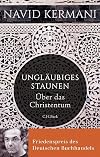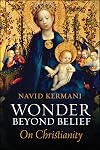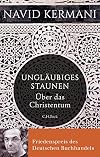
Wonder Beyond Belief: On Christianity
by Navid Kermani
On This Page
Description
What happens when one of Germany's most important writers, himself a Muslim, immerses himself in the world of Christian art? In this book, Navid Kermani is awestruck by a religion full of sacrifice and lamentation, love and wonder, the irrational and the unfathomable, the deeply human and the divine - a Christianity that today's Christians rarely speak of so earnestly, boldly and enthusiastically. With the open-minded curiosity of a non-believer - or rather a believer in another faith - show more Kermani engages with Christian art in its great richness and diversity. The result is an enchanting reflection which reinvests in Christianity both its spectacular beauty and its terror. Kermani struggles with the cross, falls in love at the sight of Mary, experiences the Orthodox Mass and appreciates the greatness of St Francis. He teaches us to see the questions of our present-day lives in the pictures of old masters such as Botticelli, Caravaggio and Rembrandt - not with lectures on art history or theology, but with an intelligent eye for the essential details and the underlying relations to seemingly remote worlds, to literature and to mystical Islam. Kermani's poetic school of seeing draws us in as we are carried along by his unique perspective on Christianity, rekindling our interest in great art at the same time. We are captivated by his unique and brilliant Islamic reading of the West. show lessTags
Recommendations






















Member Reviews
I was intrigued by the concept of this collection of essays: a series of short, inter-linked meditations on various pieces of (mostly) medieval and Renaissance Christian artworks written by a devout Muslim. I'm not a believer, but as someone raised Catholic in a country in which most people are Christians, it's impossible for me to approach this art as an outsider in the way that Navid Kermani can.
Wonder Beyond Belief certainly challenged me in some respects—how to grapple with the ideas of someone who says that he loves and admires Christianity but who rejects ecumenical pablum (fair enough) and states flat-out that Trinitiarianism is a pagan concept and that Christianity is heresy? I'm an atheist who has profound issues with the show more hierarchy of the Catholic Church, and yet I found myself with knee-jerk emotional responses to some of what Kermani wrote—there's something for me to sit with there. I'm sure that Kermani is writing in part to induce such responses—in the acknowledgments he says that sometimes in discussing artworks he "intentionally preferred interpretations or views that are controversial (to say the least) in the pertinent academic fields" because he is "often more interested in believed truth, and in aesthetic truth, than in what is considered historically true". Fair enough—even if an approach that my historian self fundamentally can't enter into.
But for me, what turned out to be my biggest problem with this book, and something that Kermani doesn't seem to consider at all, is gender: how the fact that he's a guy shapes how he views art depicting female subjects. Is there a strong strain of eroticism in Catholic art? Undeniably! Do we have medieval and early modern accounts of responses to that art which mingle the sacred and the sexual in ways which make many modern readers uncomfortable? Sure! But to refer to a fairly innocuous depiction of St Ursula as showing a "gold-tressed, plump-cheeked, buttonnosed pouter", or to Mary holding her cloak as "pressing her fingers moreover on the point just above or at the edge of her pubes, depending how wide Mary’s pubes [...] are [...] a manifestation of the Devil perhaps, her body slightly turned, her feet in a sidestep, her hips slightly tipped, her genitals practically held out towards poor Bernard"? There's being irreverent about sacred cows and then there's just being weird about women. Throughout this book there's a distinct strain of the latter. show less
Wonder Beyond Belief certainly challenged me in some respects—how to grapple with the ideas of someone who says that he loves and admires Christianity but who rejects ecumenical pablum (fair enough) and states flat-out that Trinitiarianism is a pagan concept and that Christianity is heresy? I'm an atheist who has profound issues with the show more hierarchy of the Catholic Church, and yet I found myself with knee-jerk emotional responses to some of what Kermani wrote—there's something for me to sit with there. I'm sure that Kermani is writing in part to induce such responses—in the acknowledgments he says that sometimes in discussing artworks he "intentionally preferred interpretations or views that are controversial (to say the least) in the pertinent academic fields" because he is "often more interested in believed truth, and in aesthetic truth, than in what is considered historically true". Fair enough—even if an approach that my historian self fundamentally can't enter into.
But for me, what turned out to be my biggest problem with this book, and something that Kermani doesn't seem to consider at all, is gender: how the fact that he's a guy shapes how he views art depicting female subjects. Is there a strong strain of eroticism in Catholic art? Undeniably! Do we have medieval and early modern accounts of responses to that art which mingle the sacred and the sexual in ways which make many modern readers uncomfortable? Sure! But to refer to a fairly innocuous depiction of St Ursula as showing a "gold-tressed, plump-cheeked, buttonnosed pouter", or to Mary holding her cloak as "pressing her fingers moreover on the point just above or at the edge of her pubes, depending how wide Mary’s pubes [...] are [...] a manifestation of the Devil perhaps, her body slightly turned, her feet in a sidestep, her hips slightly tipped, her genitals practically held out towards poor Bernard"? There's being irreverent about sacred cows and then there's just being weird about women. Throughout this book there's a distinct strain of the latter. show less
This book is a series of essays, mostly on works of Christian art, by a Moslem, born and raised in Germany. (He holds both German and Iranian citizenship.) Kermani is better read in the Bible and Christian theology than many Christians, but his readings of the artworks are also shaped by his knowledge of Islam.
The final essay is about St. Francis of Assisi.
The final essay is about St. Francis of Assisi.
Was geschieht, wenn einer der bedeutendsten deutschen Schriftsteller, der selbst ein Muslim ist, sich in die christliche Bildwelt versenkt? Navid Kermani sieht staunend eine Religion voller Opfer und Klage, Liebe und Wunder, unvernünftig und abgründig, zutiefst menschlich und göttlich: ein Christentum, von dem Christen in dieser Ernsthaftigkeit, Kühnheit und auch Begeisterung nur noch selten sprechen.
Es ist ein Wagnis: Offenen Herzens, mit einer geradezu kindlichen Neugier steht Navid Kermani vor den großen und vor unbekannten Werken der christlichen Kunst. Und es wird zum Geschenk: Denn seine berückend geschriebenen Meditationen geben dem Christentum den Schrecken und die Schönheit zurück. Kermani hadert mit dem Kreuz, verliebt show more sich in den Blick der Maria, erlebt die orthodoxe Messe und ermisst die Größe des heiligen Franziskus. Er lehrt uns, in den Bildern alter Meister wie Botticelli, Caravaggio oder Rembrandt auch die Fragen unserer heutigen Existenz zu erkennen – mit klarem Blick für die wesentlichen Details und die untergründigen Bezüge auch zu entfernt scheinenden Welten, zur deutschen Literatur, zum mystischen Islam und selbst zur modernen Heilgymnastik. Seine poetische Schule des Sehens macht süchtig: süchtig nach diesem speziellen Blick auf das Christentum und sehnsüchtig danach, selbst so sehen zu können.
Quelle: amazon.de show less
Es ist ein Wagnis: Offenen Herzens, mit einer geradezu kindlichen Neugier steht Navid Kermani vor den großen und vor unbekannten Werken der christlichen Kunst. Und es wird zum Geschenk: Denn seine berückend geschriebenen Meditationen geben dem Christentum den Schrecken und die Schönheit zurück. Kermani hadert mit dem Kreuz, verliebt show more sich in den Blick der Maria, erlebt die orthodoxe Messe und ermisst die Größe des heiligen Franziskus. Er lehrt uns, in den Bildern alter Meister wie Botticelli, Caravaggio oder Rembrandt auch die Fragen unserer heutigen Existenz zu erkennen – mit klarem Blick für die wesentlichen Details und die untergründigen Bezüge auch zu entfernt scheinenden Welten, zur deutschen Literatur, zum mystischen Islam und selbst zur modernen Heilgymnastik. Seine poetische Schule des Sehens macht süchtig: süchtig nach diesem speziellen Blick auf das Christentum und sehnsüchtig danach, selbst so sehen zu können.
Quelle: amazon.de show less
Jan 5, 2016German
Ratings
Members
- Recently Added By
Author Information

Navid Kermani is a writer and scholar who lives in Cologne, Germany. He has received numerous accolades for his literary and academic work, including the 2015 Peace Prize of the German Publishers' Association, Germany's most prestigious cultural award.
Some Editions
Awards and Honors
Awards
Notable Lists
Common Knowledge
- Canonical title
- Wonder Beyond Belief: On Christianity
- Original title
- Ungläubiges Staunen : über das Christentum
- Alternate titles*
- Goddelijke kunst
- Original publication date
- 2015; 2018 (English translation) (English translation)
- Original language
- German
*Some information comes from Common Knowledge in other languages. Click "Edit" for more information.
Classifications
Statistics
- Members
- 111
- Popularity
- 293,504
- Reviews
- 3
- Rating
- (3.50)
- Languages
- Dutch, English, German
- Media
- Paper, Ebook
- ISBNs
- 13
- ASINs
- 4