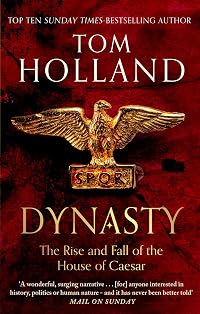
Dynasty: The Rise and Fall of the House of Caesar
by Tom Holland
On This Page
Description
"The follow-up to Rubicon picks up with the murder of Julius Caesar and vividly depicts the intrigue, murder, ambition and treachery of Emperors Augustus, Tiberius, Caligula, Claudius and Nero,"--NoveList.Tags
Recommendations





Member Reviews
This is an excellent account of the rise and fall of one of the most famous dynasties in world history, the ruling family of the Julio-Claudians that gave Rome its first five emperors who are almost all household names even now two millennia later: Augustus; Tiberius; Caligula; Claudius; and Nero. As well as being the story of a dynasty, it is of course also the story of Rome itself over the period of some 130 years from Julius Caesar's first triumvirate with Pompey and Crassus in 60 BC, to the suicide of the last male member of the dynasty Nero in 68 AD. This was not in its structure a traditional ruling house or dynasty, as succession was often by adoption and/or marriage, and never actually by direct father to son transfer. And the show more fratricidal and bloody nature of so many of the relationships kept the supply of available successors often very limited. Violence, killing, exile, starvation, and suicide punctuate this story at regular intervals, along with incest, matricide, and all manner of other activities seen then, and often (but not always) now as perversions. This of course makes for colourful, though sometimes distasteful, reading. These personalities shine brightly across two millennia, whereas so many later Roman and Medieval historical figures have been forgotten, or in some cases, never known about: "each in his own way, had succeeded in fashioning out of his rule of the world a legend that would for ever afterwards mark the House of Caesar as something eerie and more than mortal. Painted in blood and gold, its record would never cease to haunt the Roman people as a thing of mingled wonder and horror." Tom Holland is one of my favourite contemporary historians and I love the Rest is History podcast he does with Dominic Sandbrook. A great book. show less
In the follow up to his Rubicon, Holland takes up the story of the legendary Julio-Claudian emperors. With 419 pages of text, he covers all the stories of treachery, torture, matricide, fratricide, sexual depravity, assassinations, mutinies, and excess you’ve heard. To that, he explains how Roman sexual mores, religious festivals, family relations, and the plebians’ continued fascination with the dynasty that started with Julius Caesar played a part in everything.
And Holland, particularly in the chapter on Tiberius, “The Last Roman”, approaches his emperors in an empathetic if not sympathetic way.
The prose is stylish with Holland sometimes using very modern terms to give us the flavor of the strange and also familiar Roman show more imperial culture. He deftly shows how Rome’s own myths reveal something of their character. Specifically, Romans held their race started with a rape, and its resulting issue was suckled by wolves.
In the book’s pages, you find an emperor who tearfully and theatrically threw himself on the mercy of the Roman public (Augusta), an emperor who never wanted the job and descended into an old age of watching aristocratic children recruit mythological sex scenes (Tiberius), an emperor always ready for a very malicious and deadly joke on an aristocrat (Caligula), an emperor incestuously besotted with his niece (Claudius), and an emperor under the domineering thumb of his mother (Nero). But Holland doesn’t skimp on covering the other power players at this time, particularly the eventually divine wife of Augusta, Livia. She may have been married to Augustus, but her primary interest was always furthering the glory of her own family, the Claudians.
But Holland isn’t just writing an update of Suetonius’ salacious Twelve Caesars. He shows the change in Roman politics, how the Roman people and Senate were tamed, first by smooth talk, legal legerdemain, flattery and then open terror into accepting what they long despised – a king. It is a story dependent on the magical place the dynasty of Caesar had in the mind of the Roman public and “the exhaustion of cruelty” after decades of civil war.
Besides the usual index, bibliography, and maps, a dramatis personae list is included as well as numerous family trees so you can keep of the players through numerous banishments, executions, divorces and remarriages, and assassinations.
Recommended to readers with any degree of familiarity with this era of Roman history. show less
And Holland, particularly in the chapter on Tiberius, “The Last Roman”, approaches his emperors in an empathetic if not sympathetic way.
The prose is stylish with Holland sometimes using very modern terms to give us the flavor of the strange and also familiar Roman show more imperial culture. He deftly shows how Rome’s own myths reveal something of their character. Specifically, Romans held their race started with a rape, and its resulting issue was suckled by wolves.
In the book’s pages, you find an emperor who tearfully and theatrically threw himself on the mercy of the Roman public (Augusta), an emperor who never wanted the job and descended into an old age of watching aristocratic children recruit mythological sex scenes (Tiberius), an emperor always ready for a very malicious and deadly joke on an aristocrat (Caligula), an emperor incestuously besotted with his niece (Claudius), and an emperor under the domineering thumb of his mother (Nero). But Holland doesn’t skimp on covering the other power players at this time, particularly the eventually divine wife of Augusta, Livia. She may have been married to Augustus, but her primary interest was always furthering the glory of her own family, the Claudians.
But Holland isn’t just writing an update of Suetonius’ salacious Twelve Caesars. He shows the change in Roman politics, how the Roman people and Senate were tamed, first by smooth talk, legal legerdemain, flattery and then open terror into accepting what they long despised – a king. It is a story dependent on the magical place the dynasty of Caesar had in the mind of the Roman public and “the exhaustion of cruelty” after decades of civil war.
Besides the usual index, bibliography, and maps, a dramatis personae list is included as well as numerous family trees so you can keep of the players through numerous banishments, executions, divorces and remarriages, and assassinations.
Recommended to readers with any degree of familiarity with this era of Roman history. show less
Tom Holland's Dynasty: The Rise and Fall of the House of Caesar (Doubleday) is a chronicle of the doings of the Roman emperors so salacious it would take hardly anything extra to make an HBO series out of it. Holland focuses on the personal lives and vices of the five Caesars from Augustus to Nero: their paranoias, their constant machinations to keep power and get rid of anyone who stood in their way (even and perhaps especially if they happened to be related), &c.
This is a rollicking and sometimes absolutely disgusting read, but it will certainly hold your attention. Holland grapples with the source material, much of which comes from unreliable writers, and sometimes falls into what feels very much like anachronism, but also seems to show more make good use of recent scholarship and deploys generous pinches of salt where necessary. show less
This is a rollicking and sometimes absolutely disgusting read, but it will certainly hold your attention. Holland grapples with the source material, much of which comes from unreliable writers, and sometimes falls into what feels very much like anachronism, but also seems to show more make good use of recent scholarship and deploys generous pinches of salt where necessary. show less
"I would certainly not describe as mercy what was actually the exhaustion of cruelty."
Seneca
Tom Holland's Dynasty: The Rise and Fall of the House of Caesar chronicles the beginnings of Imperial Rome through lively biographies of the Julio-Claudian emperors: Augustus, Tiberius, Caligula, Claudius, and Nero. It is a popular history and exceptionally well written. A cover blurb from The New York Times book review states, "Holland has crafted a history of early Rome that has the gripping detail and narrative momentum of a novel." I have to agree.
What makes the book so compelling is the way Holland integrates the political sagas with the personal and familial dysfunction. He paints a complex portrait of Augustus, whom he admires as a show more politician and administrator who built upon Roman traditions while laying the foundations for the empire after winning a devastating Civil War. However, Holland does not shy away from sharing Augustus's excesses and faults. His ultra-conservative turn in his later years, which caused him to outlaw adultery and harshly punish suspected adulterers, is a prime example. His most notorious adultery case was against his daughter Julia, whom he banished to a deserted island where she lived in solitary confinement. He also exiled the poet Ovid to Tomis, a rural outpost in Romania, on similar charges.
While Holland depicts Claudius and, to a lesser extent, Tiberius as competent administrators, he demonstrates how their insecurities and obsessions lead to violent outcomes. However, he attributes the most notorious and flagrant abuses of power and abject cruelty to Caligula and Nero.
Some images stay with me from their biographies. Caligula entertained himself by throwing coins to the masses and watching them crush each other to death during the stampedes. Nero, who had his mother and first wife murdered and subsequently kicked his pregnant second wife to death, killing both mother and child because he didn't like the way she nagged him.
Overall, the portraits of the rulers were vivid and provided insight into their lives and times. While the book offers solid background knowledge, it is not an analytical work. It is a starting point for understanding a complex historical period and a frightening look at what can happen after a democracy dies. show less
Seneca
Tom Holland's Dynasty: The Rise and Fall of the House of Caesar chronicles the beginnings of Imperial Rome through lively biographies of the Julio-Claudian emperors: Augustus, Tiberius, Caligula, Claudius, and Nero. It is a popular history and exceptionally well written. A cover blurb from The New York Times book review states, "Holland has crafted a history of early Rome that has the gripping detail and narrative momentum of a novel." I have to agree.
What makes the book so compelling is the way Holland integrates the political sagas with the personal and familial dysfunction. He paints a complex portrait of Augustus, whom he admires as a show more politician and administrator who built upon Roman traditions while laying the foundations for the empire after winning a devastating Civil War. However, Holland does not shy away from sharing Augustus's excesses and faults. His ultra-conservative turn in his later years, which caused him to outlaw adultery and harshly punish suspected adulterers, is a prime example. His most notorious adultery case was against his daughter Julia, whom he banished to a deserted island where she lived in solitary confinement. He also exiled the poet Ovid to Tomis, a rural outpost in Romania, on similar charges.
While Holland depicts Claudius and, to a lesser extent, Tiberius as competent administrators, he demonstrates how their insecurities and obsessions lead to violent outcomes. However, he attributes the most notorious and flagrant abuses of power and abject cruelty to Caligula and Nero.
Some images stay with me from their biographies. Caligula entertained himself by throwing coins to the masses and watching them crush each other to death during the stampedes. Nero, who had his mother and first wife murdered and subsequently kicked his pregnant second wife to death, killing both mother and child because he didn't like the way she nagged him.
Overall, the portraits of the rulers were vivid and provided insight into their lives and times. While the book offers solid background knowledge, it is not an analytical work. It is a starting point for understanding a complex historical period and a frightening look at what can happen after a democracy dies. show less
From the rise of Julius Caesar to the death of Nero, five generations of the same family ruled Rome. The greatest of all was Augustus, a living God, whose machinations influenced public policy and whose belief in power meant that he manipulated his extended family to his own ends. In-fighting, murder, incest thread through the lives of the family of Augustus and in the end the family imploded. Nero, the final Emperor, was deposed and with his passing a new era dawned for Rome as a republic once more.
This book is not a doorstop, it is actually a very readable length. Holland covered a lot of history, a lot of scandal and makes many suppositions. The true story of the Caesars is shocking and quite venal and Holland does not shy away from show more the nasty end of happenings. My only complaint is one which is fairly common in recent history books which appeal the more populist end of the market and that is that fact and fiction tend to blur at times. There is much interpretation of actions in terms of thoughts and feelings which are not necessarily backed by contemporaneous sources and therefore should be treated as fictional interpretations rather than fact. However that is a minor quibble because the actual material Holland has to work with is so juicy and almost fictitious in its outrage that this is a great read as well as being a well-researched tome. show less
This book is not a doorstop, it is actually a very readable length. Holland covered a lot of history, a lot of scandal and makes many suppositions. The true story of the Caesars is shocking and quite venal and Holland does not shy away from show more the nasty end of happenings. My only complaint is one which is fairly common in recent history books which appeal the more populist end of the market and that is that fact and fiction tend to blur at times. There is much interpretation of actions in terms of thoughts and feelings which are not necessarily backed by contemporaneous sources and therefore should be treated as fictional interpretations rather than fact. However that is a minor quibble because the actual material Holland has to work with is so juicy and almost fictitious in its outrage that this is a great read as well as being a well-researched tome. show less
Dynasty is the early history of the Julio-Claudian line of the Roman emperors retold as a story. This book starts off where Rubicon ended. This is a narrative history that seeks to entertain the reader and provide a story of what happened. For me, it did not succeed with either endeavour. I don’t know much more about the “what happened” than I had before reading this book (i.e. a succession of Roman Emperors that waged war on whom ever stuck their fancy and had a fancy for despotism and murdering anyone they felt like). Nor was I entertained – I was bored and finished reading the book just to get it off my bedside table.
Holland does not attempt to put forth new scholarly conclusions, nor does he offer much analyses of complex show more events. This narrative relies almost exclusively on textual evidence in Roman literature and history, with casually inserted quotes from primary textual sources without bothering to explain their source, context or (on occasion) their relevance.
The potential storyline is strong, but Holland’s delivery manages to be weak. The writing is tedious, ponderous, overly-flowery with a disjointed and distant narrative that manages to be more selective gossip and sensationalism than actual history. It doesn’t help that in a 500 page book there are only 7 incredibly long-winded chapters, which all have mafia related headings. The author spends a ridiculous amount of ink on each emperor’s sexual proclivities and random insertions of far too much graphic sexual detail of what the author professes to be the values of the rest of the Roman citizens at the time. He rather gleefully “spices” up the narrative of these salacious details with foul and vulgar language (apparently big boys like their potty humour too), which jarred with the tone of the rest of the text. Apparently, Holland is under the impression that popular history books need to be excessively graphic, crude and vulgar to be interesting to readers.
The book is also rather limited in scope, dealing only with the Julio-Claudians and their enemies (i.e. upper-class associates and relatives), thus excluding almost entirely the everyday lives of ordinary Romans, any changes in the Roman economy, trade, and climate, and also excludes anything related to material culture unless it involves monuments relevant to the Julio-Claudians.
This book couldn’t decide whether it was supposed to be a popular history book (with footnotes and bibliography) or a work of historical fiction. Despite the inclusion of a timeline, maps and family trees, this book came across as a messy hodgepodge of people with vaguely similar names (apparently ancient Romans lacked imagination when naming their children!), who are in some way related to each other, doing various despicable deeds to each other. Talk about a dysfunctional, psychopathic family! show less
Holland does not attempt to put forth new scholarly conclusions, nor does he offer much analyses of complex show more events. This narrative relies almost exclusively on textual evidence in Roman literature and history, with casually inserted quotes from primary textual sources without bothering to explain their source, context or (on occasion) their relevance.
The potential storyline is strong, but Holland’s delivery manages to be weak. The writing is tedious, ponderous, overly-flowery with a disjointed and distant narrative that manages to be more selective gossip and sensationalism than actual history. It doesn’t help that in a 500 page book there are only 7 incredibly long-winded chapters, which all have mafia related headings. The author spends a ridiculous amount of ink on each emperor’s sexual proclivities and random insertions of far too much graphic sexual detail of what the author professes to be the values of the rest of the Roman citizens at the time. He rather gleefully “spices” up the narrative of these salacious details with foul and vulgar language (apparently big boys like their potty humour too), which jarred with the tone of the rest of the text. Apparently, Holland is under the impression that popular history books need to be excessively graphic, crude and vulgar to be interesting to readers.
The book is also rather limited in scope, dealing only with the Julio-Claudians and their enemies (i.e. upper-class associates and relatives), thus excluding almost entirely the everyday lives of ordinary Romans, any changes in the Roman economy, trade, and climate, and also excludes anything related to material culture unless it involves monuments relevant to the Julio-Claudians.
This book couldn’t decide whether it was supposed to be a popular history book (with footnotes and bibliography) or a work of historical fiction. Despite the inclusion of a timeline, maps and family trees, this book came across as a messy hodgepodge of people with vaguely similar names (apparently ancient Romans lacked imagination when naming their children!), who are in some way related to each other, doing various despicable deeds to each other. Talk about a dysfunctional, psychopathic family! show less
In Dynasty, Tom Holland plots the triumphs and failures of the 5 emperors - or more correctly, Princeps - of the family of Julius Caesar, Octavius / Augustus, Tiberius, Caligula, Claudius and Nero. As with each of his previous books, Holland is more interested in a story or narrative, than in a rigorous work of history; you almost feel that he is written this with eye to it becoming the companion book to a potential BBC - or even Discovery Channel - documentary, rather than as a work of history. The best that can be said about it its that its a work of popular history - with the emphasis on popular. As such its high on drama and low on detail.
For example we are told that the youthful Octavius was something of a "terrorist" - but given show more little detail as to what he did to deserve that description. We are told that "like a rich perfume, the aroma of Augustus' power reached into every nook and cranny of Roman life" - a fine sounding description for sure, but what does it actually mean? The book is full of this sort of writing. We have Claudius being told of his wife Messalina's infidelity with all and sundry - but no opinion as to whether this was true (or at least believed to be true) or simply the result of palace intrigue. Those who hunger for fact rather than narrative will be disappointed.
Having said that, its entertaining enough; Augustus comes out of it well - tough and ruthless but with a feeling for politics and the mood of the populace. Tiberius tries hard but becomes withdrawn and disolute in his older years. Claudius was probably a better emperor than he's usually given credit for; Nero and Caligula incorrigible meglamaniacs, although Holland posits there was some point in Caligula's wilder excesses as he tried to emphasise the predominance of the Princeps over the Senate.
But I came away feeling somewhat gorged with all the excess, but also unsatisfied. show less
For example we are told that the youthful Octavius was something of a "terrorist" - but given show more little detail as to what he did to deserve that description. We are told that "like a rich perfume, the aroma of Augustus' power reached into every nook and cranny of Roman life" - a fine sounding description for sure, but what does it actually mean? The book is full of this sort of writing. We have Claudius being told of his wife Messalina's infidelity with all and sundry - but no opinion as to whether this was true (or at least believed to be true) or simply the result of palace intrigue. Those who hunger for fact rather than narrative will be disappointed.
Having said that, its entertaining enough; Augustus comes out of it well - tough and ruthless but with a feeling for politics and the mood of the populace. Tiberius tries hard but becomes withdrawn and disolute in his older years. Claudius was probably a better emperor than he's usually given credit for; Nero and Caligula incorrigible meglamaniacs, although Holland posits there was some point in Caligula's wilder excesses as he tried to emphasise the predominance of the Princeps over the Senate.
But I came away feeling somewhat gorged with all the excess, but also unsatisfied. show less
Members
- Recently Added By
Published Reviews
ThingScore 92
"He leaves us with insights into the reach and sweep of its empire and an appreciation of how precarious life was for slaves and freemen and soldiers."
added by bookfitz
"A vivid account of five Roman emperors, emphasizing their vices and vicious behavior with less attention to the vast empire, which continued to prosper despite them."
added by bookfitz
"If Tom Holland’s Rubicon was the story of what it took to gain power in late republican Rome, then Dynasty, the thrilling follow-up, is the history of what happened when power was entrusted to men who never quite got over their mothers."
added by bookfitz
Lists

Books Read in 2016
4,666 works; 199 members

Library Non-Fiction
164 works; 1 member
Author Information

30+ Works 14,184 Members
Some Editions
Common Knowledge
- Canonical title
- Dynasty: The Rise and Fall of the House of Caesar
- Original title
- Dynasty: The Rise and Fall of the House of Caesar
- Original publication date
- 2015
- People/Characters
- Julius Caesar; Augustus Caesar; Tiberius Caesar, Roman Emperor; Caligula; Claudius I, Emperor of Rome; Nero Claudius Caesar Augustus Germanicus
- Important places
- Rome, Italy; Rome, Roman Empire
- Important events
- Pax Romana; Assassination of Julius Caesar
- Dedication
- For Katy
'at simul heroum laudes et facta parentis iam legere...' - First words
- AD 40. It is early in the year. Gaius Julius Caesar Augustus Germanicus sits on a lofty platform beside the Ocean.
- Last words
- (Click to show. Warning: May contain spoilers.)If not necessarily divine, then it had at any rate become immortal.
- Original language
- English
Classifications
- Genres
- History, General Nonfiction, Nonfiction, Biography & Memoir
- DDC/MDS
- 937.070922 — History & geography History of ancient world (to ca. 499) Italian Peninsula to 476 and adjacent territories to 476 Constitutional 31 B.C.-284 A.D.
- LCC
- DG270 .H65 — History of Europe, Asia, Africa and Oceania City History of Italy Ancient Italy. Rome to 476 History By period Empire, 27 B.C. - 476 A.D. General
- BISAC
Statistics
- Members
- 1,064
- Popularity
- 24,139
- Reviews
- 16
- Rating
- (4.00)
- Languages
- 6 — Dutch, English, German, Portuguese, Spanish, Swedish
- Media
- Paper, Audiobook, Ebook
- ISBNs
- 25
- ASINs
- 12