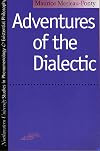
Adventures of the Dialectic (Studies in Phenomenology and Existential Philosophy)
by Maurice Merleau-Ponty
On This Page
Description
"We need a philosophy of both history and spirit to deal with the problems we touch upon here. Yet we would be unduly rigorous if we were to wait for perfectly elaborated principles before speaking philosophically of politics." Thus Merleau-Ponty introduces _Adventures of the Dialectic,_ his study of Marxist philosophy and thought. In this study, containing chapters on Weber, Lukacs, Lenin, Sartre, and Marx himself, Merleau-Ponty investigates and attempts to go beyond the dialectic.Tags
Recommendations







Member Reviews
A Dialectic without Dreams, January 13, 2005
Merleau-Ponty is generally read for his work in phenomenology, not his work on dialectics. This is both a pity and a mistake. While he certainly does deserve to be remembered as the third great phenomenologist of the past century, after Husserl & Heidegger, his being forgotten as a dialectical thinker is almost inexplicable.
I say almost inexplicable because, I fear, the reason he is ignored as a dialectical thinker is because he advocated, and superbly demonstrated, a dialectic without myths, utopia or dreams. In the great chapter (2) on Lukacs he says, "[t]he dialectic is this continued intuition, a consistent reading of actual history, the re-establishment of the tormented relations, of show more the interminable exchanges, between subject and object. There is only one knowledge, which is the knowledge of our world in a state of becoming, and this becoming embraces knowledge itself." He speaks of interminable exchanges, implies the permanence of tormented relations, affirms that knowledge always becomes. This is a dialectic scraped clean of the utopianism of the Marxist classless society, contemptuous of some miraculous Kojevean 'End of History', sans any vain 'Hegelian' promise of some never-never land in which Science will precisely equal Wisdom.
So then why dialectic, or, more precisely, why use the dialectical method if it offers no goal? Immediately after the sentences quoted above M-P says, "[b]ut it is knowledge that teaches us this." The dialectic, as M-P understands it, gives us, better - can give us, an understanding of history, and our present, but as to the future it promises exactly nothing. How could it promise more? If becoming, and the unknown, press on us forever, every totalization is always in danger of being threatened by some unanticipated contingency that changes this totalization into some unpredicted, and above all, unpredictable (until it occurs) Other.
By way of contrast let me now mention that for Hegel, finally, one could say that Dialectic remained a retrospective method and not a predictive science - at least until the precise end of the dialectical process. "The Owl of Minerva takes flight only at night." But, for Hegel, I think it is correct to say that when Subject and Object become One, Forever, we will be able to say that the all-knowing owl is always flying because the Absolute (Spirit) is always dark. We now perhaps better understand the content of the Hegelian characterization of (and objection to) the early position of Schelling - as a 'night in which all cows are black' - this position wasn't wrong; it was merely premature. Thus at the extreme end of Hegelian theory, one is always in danger of seeing it toppling over into the Kojevean 'End of History' position, which M-P in the epilogue characterizes as an idealization of death.
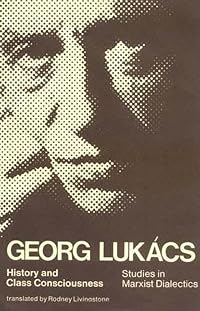
M-P holds, in this book, that this is not the position of Marx and Lukacs. "In Marx spirit becomes a thing, while things become saturated with spirit. History's course is a becoming of meanings transformed into forces or institutions. This is why there is an inertia of history in Marx and also an appeal to human invention in order to complete the dialectic. Marx cannot therefore transfer to, and lay to the account of, matter the same rationality which Hegel ascribes to spirit." Hegel is pleased to be taken to mean that Spirit is an active helpful partner of humanity in dialectic; a materialist dialectic can make no such claims of matter. What Merleau-Ponty, btw, is here denying, for those who have ears, is that there can be an end to any genuine material dialectic. ...Matter itself is permanently, in every human sense, an irrational factor. In other words, being and reason can never be one. Whatever Rationality in things we find - we find it there because we put it there. "Marxism cannot hide the Welt-geist in matter." Dialectic in which a dialectical partner is permanently non-rational becomes a science of circumstances. Thus M-P maintains that for Lukacs (and, I think, himself) that only revolutionary creativity can `guarantee' "a coherent and homogenous system."
...But no system is permanent. "A dialectical conception demands only that, between capitalism, where it exists, and its antecedents, be one of an integrated society to a less integrated one." By more integrated M-P means a more `socialized' society, societies in which, since there is more common ground, "destinies can be compared." It is ultimately here in social interaction that, for M-P, dialectical knowledge arises. But, as indicated earlier, nothing is guaranteed. "The principle of the logic of history is not that all problems posed are solved in advance, that the solution precedes the problem, or that there would be no question if the answer did not pre-exist somewhere, as if history were built on exact ideas. One should rather formulate it negatively: there is no event which does not bring further precision to the permanent problem of knowing what man and his society are..." One is here tempted to say that M-P here answers two of the questions we asked at the beginning of the review. Why resort to the method of dialectic? - It brings (or exposes a) further precision to our knowledge of the problem of man. Why no certain Telos, no end to history, no grand finale that finds Science and Wisdom in permanent embrace? - The "problem of knowing what man and his society are" is permanent.
For M-P the problems of society reside only in human history; neither spirit nor matter will save us. "The sense of history is then threatened at every step with going astray and constantly needs to be reinterpreted." "There is less a sense of history than an elimination of non-sense." Oh, and this indeed would be the 'reason' M-P, the dialectical thought of M-P, was forgotten. A dialectic, shorn of fairy tale, certainty or reward, would attract none of our scholarly saints, or even our Leninist `realists.' Over the last two centuries there have been only three reasons, often entwined, to turn to dialectic; the pursuit of Knowledge, the pursuit of utopia/revolution, or the pursuit of some always obscure inner `intuition' or joy. ...Apparently, given the way M-P is ignored by Hegelian and Marxist dialecticians, the only pursuit that was decisive was the last.
This has only been a brief commentary on a small slice, a handful of pages, of this superb book, that, I hope, will make others interested enough to read it. The discussions of Weber, Lukacs, Trotsky and Sartre are all excellent. M-P is a political philosopher who deserves to be read along with the great and important political philosophers of the 20th century: Georg Lukacs, Antonio Gramsci, Hannah Arendt, Carl Schmitt and Leo Strauss. Ignore any of them and increase your ignorance. show less
Merleau-Ponty is generally read for his work in phenomenology, not his work on dialectics. This is both a pity and a mistake. While he certainly does deserve to be remembered as the third great phenomenologist of the past century, after Husserl & Heidegger, his being forgotten as a dialectical thinker is almost inexplicable.
I say almost inexplicable because, I fear, the reason he is ignored as a dialectical thinker is because he advocated, and superbly demonstrated, a dialectic without myths, utopia or dreams. In the great chapter (2) on Lukacs he says, "[t]he dialectic is this continued intuition, a consistent reading of actual history, the re-establishment of the tormented relations, of show more the interminable exchanges, between subject and object. There is only one knowledge, which is the knowledge of our world in a state of becoming, and this becoming embraces knowledge itself." He speaks of interminable exchanges, implies the permanence of tormented relations, affirms that knowledge always becomes. This is a dialectic scraped clean of the utopianism of the Marxist classless society, contemptuous of some miraculous Kojevean 'End of History', sans any vain 'Hegelian' promise of some never-never land in which Science will precisely equal Wisdom.
So then why dialectic, or, more precisely, why use the dialectical method if it offers no goal? Immediately after the sentences quoted above M-P says, "[b]ut it is knowledge that teaches us this." The dialectic, as M-P understands it, gives us, better - can give us, an understanding of history, and our present, but as to the future it promises exactly nothing. How could it promise more? If becoming, and the unknown, press on us forever, every totalization is always in danger of being threatened by some unanticipated contingency that changes this totalization into some unpredicted, and above all, unpredictable (until it occurs) Other.
By way of contrast let me now mention that for Hegel, finally, one could say that Dialectic remained a retrospective method and not a predictive science - at least until the precise end of the dialectical process. "The Owl of Minerva takes flight only at night." But, for Hegel, I think it is correct to say that when Subject and Object become One, Forever, we will be able to say that the all-knowing owl is always flying because the Absolute (Spirit) is always dark. We now perhaps better understand the content of the Hegelian characterization of (and objection to) the early position of Schelling - as a 'night in which all cows are black' - this position wasn't wrong; it was merely premature. Thus at the extreme end of Hegelian theory, one is always in danger of seeing it toppling over into the Kojevean 'End of History' position, which M-P in the epilogue characterizes as an idealization of death.
M-P holds, in this book, that this is not the position of Marx and Lukacs. "In Marx spirit becomes a thing, while things become saturated with spirit. History's course is a becoming of meanings transformed into forces or institutions. This is why there is an inertia of history in Marx and also an appeal to human invention in order to complete the dialectic. Marx cannot therefore transfer to, and lay to the account of, matter the same rationality which Hegel ascribes to spirit." Hegel is pleased to be taken to mean that Spirit is an active helpful partner of humanity in dialectic; a materialist dialectic can make no such claims of matter. What Merleau-Ponty, btw, is here denying, for those who have ears, is that there can be an end to any genuine material dialectic. ...Matter itself is permanently, in every human sense, an irrational factor. In other words, being and reason can never be one. Whatever Rationality in things we find - we find it there because we put it there. "Marxism cannot hide the Welt-geist in matter." Dialectic in which a dialectical partner is permanently non-rational becomes a science of circumstances. Thus M-P maintains that for Lukacs (and, I think, himself) that only revolutionary creativity can `guarantee' "a coherent and homogenous system."
...But no system is permanent. "A dialectical conception demands only that, between capitalism, where it exists, and its antecedents, be one of an integrated society to a less integrated one." By more integrated M-P means a more `socialized' society, societies in which, since there is more common ground, "destinies can be compared." It is ultimately here in social interaction that, for M-P, dialectical knowledge arises. But, as indicated earlier, nothing is guaranteed. "The principle of the logic of history is not that all problems posed are solved in advance, that the solution precedes the problem, or that there would be no question if the answer did not pre-exist somewhere, as if history were built on exact ideas. One should rather formulate it negatively: there is no event which does not bring further precision to the permanent problem of knowing what man and his society are..." One is here tempted to say that M-P here answers two of the questions we asked at the beginning of the review. Why resort to the method of dialectic? - It brings (or exposes a) further precision to our knowledge of the problem of man. Why no certain Telos, no end to history, no grand finale that finds Science and Wisdom in permanent embrace? - The "problem of knowing what man and his society are" is permanent.
For M-P the problems of society reside only in human history; neither spirit nor matter will save us. "The sense of history is then threatened at every step with going astray and constantly needs to be reinterpreted." "There is less a sense of history than an elimination of non-sense." Oh, and this indeed would be the 'reason' M-P, the dialectical thought of M-P, was forgotten. A dialectic, shorn of fairy tale, certainty or reward, would attract none of our scholarly saints, or even our Leninist `realists.' Over the last two centuries there have been only three reasons, often entwined, to turn to dialectic; the pursuit of Knowledge, the pursuit of utopia/revolution, or the pursuit of some always obscure inner `intuition' or joy. ...Apparently, given the way M-P is ignored by Hegelian and Marxist dialecticians, the only pursuit that was decisive was the last.
This has only been a brief commentary on a small slice, a handful of pages, of this superb book, that, I hope, will make others interested enough to read it. The discussions of Weber, Lukacs, Trotsky and Sartre are all excellent. M-P is a political philosopher who deserves to be read along with the great and important political philosophers of the 20th century: Georg Lukacs, Antonio Gramsci, Hannah Arendt, Carl Schmitt and Leo Strauss. Ignore any of them and increase your ignorance. show less
> Babelio : https://www.babelio.com/livres/Merleau-Ponty-Les-Aventures-de-la-dialectique/816...
> " Heureux si nous pouvions inspirer à quelques-uns – ou a beaucoup – de supporter leur liberté, de ne pas l’échanger à perte, car elle n’est pas seulement leur chose, leur secret, leur plaisir, leur salut, elle intéresse tous les autres. ” —M. MERLEAU-PONTY,
Les aventures de la dialectique, 1955
—(Nouvelles Clés)
> Relire Maurice Merleau-Ponty nous permet de mesurer la distance qui nous sépare des manières de penser la politique et l’histoire dans la philosophie de l’époque, polarisée autour du marxisme.
—NonFiction, 30 décembre 2024 : show more target="_top">https://www.nonfiction.fr/article-12166-la-politique-et-lhistoire-selon-maurice-... show less
> " Heureux si nous pouvions inspirer à quelques-uns – ou a beaucoup – de supporter leur liberté, de ne pas l’échanger à perte, car elle n’est pas seulement leur chose, leur secret, leur plaisir, leur salut, elle intéresse tous les autres. ” —M. MERLEAU-PONTY,
Les aventures de la dialectique, 1955
—(Nouvelles Clés)
> Relire Maurice Merleau-Ponty nous permet de mesurer la distance qui nous sépare des manières de penser la politique et l’histoire dans la philosophie de l’époque, polarisée autour du marxisme.
—NonFiction, 30 décembre 2024 : show more target="_top">https://www.nonfiction.fr/article-12166-la-politique-et-lhistoire-selon-maurice-... show less
May 10, 2025French
Ratings
Members
- Recently Added By
Author Information

90+ Works 4,992 Members
Appointed Professor at the College de France in 1952, Maurice Merleau-Ponty was a highly esteemed professional philosopher because of his technical works in phenomenology and psychology. He was also an activist commentator on the significant cultural and political events of his time, as well as a collaborator with Jean-Paul Sartre and Simone de show more Beauvoir in the founding and editing of Les Temps Modernes in Paris immediately after World War II. Besides being influenced by Edmund Husserl and Martin Heidegger, Merleau-Ponty assimilated the contributions of experimental philosophy and Gestalt psychology to focus on perception and behavior. His work "The Structure of Behavior," although centering on the body, presented an interpretation of the distinctions among the mental, the vital (biological), and the physical that ruled out the reductionist inclinations of behaviorism. With the appearance of his work on the phenomenology of perception in 1945, his position as a philosopher ranking beside Heidegger and Sartre was established. He unveiled a theory of human subjectivity similar to theirs but with greater technical precision. From the standpoint of an existentialist thinker whose conception of subjectivity stressed the primacy of freedom, he examined Marxism and the political factions and movements fostered in the name of Karl Marx. The resulting studies, always insightful and provocative, satisfied neither the right nor the left. In the foreword to the English translation of Merleau-Ponty's inaugural lecture at the College de France, In Praise of Philosophy, John Wild and James Edie praised him for having made "important contributions to the phenomenological investigation of human existence in the life-world and its distinctive structures. He was a revolutionary, and his philosophy, even more than that of his French contemporaries, was a philosophy of the evolving, becoming historical present." Merleau-Ponty views man as an essentially historical being and history as the dialectic of meaning and non-meaning which is working itself out through the complex, unpredictable interaction of men and the world. Nothing historical ever has just one meaning; meaning is ambiguous and is seen from an infinity of viewpoints. He has been called a philosopher of ambiguity, of contradiction, of dialectic. His search is the search for "meaning."' show less
Series
Belongs to Publisher Series
Work Relationships
Is contained in
Common Knowledge
- Canonical title*
- Les aventures de la dialectique
- Original publication date
- 1955-04
- Original language*
- Francese
*Some information comes from Common Knowledge in other languages. Click "Edit" for more information.
Classifications
- Genres
- Philosophy, Nonfiction, Economics, Politics and Government, Literature Studies and Criticism
- DDC/MDS
- 335.4 — Society, government, & culture Economics Socialism and related systems Marxian systems
- LCC
- B809.8 .M4413 — Philosophy, Psychology and Religion Philosophy (General) By period Modern Special topics and schools of philosophy
- BISAC
Statistics
- Members
- 140
- Popularity
- 233,861
- Reviews
- 2
- Rating
- (4.50)
- Languages
- 6 — English, French, German, Italian, Portuguese, Spanish
- Media
- Paper, Ebook
- ISBNs
- 11
- ASINs
- 2