
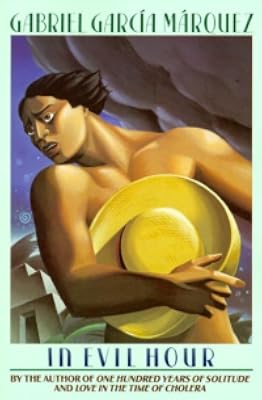
In Evil Hour
by Gabriel García Márquez
On This Page
Description
Corruption, political and individual, is steadily overtaking a small Colombian village. It comes to a head on the night a young man is killed by a jealous husband.Tags
Recommendations




















Member Reviews
‘’He offered an enigma: a man registers at a hotel at ten at night, goes to his room, and the next morning the waiter who brings him his coffee finds him dead and rotting in his bed. The autopsy shows that the guest who arrived the night before has been dead for a week.’’
A (fictional) town in Colombia is trying to overcome the aftermath of a failed coup when a series of lampoons, revealing secrets and sins of the villagers start appearing every night. The results of this mysterious action will be severe as the mayor of the town finds the perfect excuse to declare martial law, enforced by armed brutes, and take action against his political adversaries. The lampoons do more harm to the town when the villagers start accusing each show more other, exposing dirty laundry, fearful of their thoughts, fearful of a community that will soon turn into a ghost.
''There was an ominous element in the composition of noontime.''
Most of us have associated Márquez with Magical Realism but In Evil Hour, he works his winders using omens and psychology. What could be more terrible than the feeling of anticipating an invisible threat? A life where everyone's watching everyone, the unavoidable curfew and the violence originated by the lampoons? The scenery is darkened by ferocious storms that leave carcasses lying in the streets and dead rats floating in Holy Water. Márquez, an excellent ''reader'' of the human soul, elevates the lampoons into symbols with dual meaning. They represent the very fragile boundary between open criticism and slander, between freedom of speech and sacrilege, and demonstrate how populists and dictators feed on fear and suspicion. The mayor is an acute representation of the tyrants who have long plagued Central and South America and the populist leaders that have plagued the European continent over many years.
Foreboding signs, terror, shame, mystery, sarcasm. Márquez creates a tale that is terrifying in its immediacy and relevance to our times when populists receive the vote of the ignorants. This novel may seem ''simplistic'' to the readers whose knowledge of Márquez is limited to A Hundred Years of Solitude and Love In The Time of Cholera but we should remember that skilled writers don't repeat themselves. And to use the word ''skilled'' to refer to Márquez is a frightful understatement. This is one of the most mysterious and realistic works of the literary master from Colombia.
''And all because when he was drunk he said he was here to guarantee the sanctity of the ballot.''
My reviews can also be found on https://theopinionatedreaderblog.wordpress.com/ show less
A (fictional) town in Colombia is trying to overcome the aftermath of a failed coup when a series of lampoons, revealing secrets and sins of the villagers start appearing every night. The results of this mysterious action will be severe as the mayor of the town finds the perfect excuse to declare martial law, enforced by armed brutes, and take action against his political adversaries. The lampoons do more harm to the town when the villagers start accusing each show more other, exposing dirty laundry, fearful of their thoughts, fearful of a community that will soon turn into a ghost.
''There was an ominous element in the composition of noontime.''
Most of us have associated Márquez with Magical Realism but In Evil Hour, he works his winders using omens and psychology. What could be more terrible than the feeling of anticipating an invisible threat? A life where everyone's watching everyone, the unavoidable curfew and the violence originated by the lampoons? The scenery is darkened by ferocious storms that leave carcasses lying in the streets and dead rats floating in Holy Water. Márquez, an excellent ''reader'' of the human soul, elevates the lampoons into symbols with dual meaning. They represent the very fragile boundary between open criticism and slander, between freedom of speech and sacrilege, and demonstrate how populists and dictators feed on fear and suspicion. The mayor is an acute representation of the tyrants who have long plagued Central and South America and the populist leaders that have plagued the European continent over many years.
Foreboding signs, terror, shame, mystery, sarcasm. Márquez creates a tale that is terrifying in its immediacy and relevance to our times when populists receive the vote of the ignorants. This novel may seem ''simplistic'' to the readers whose knowledge of Márquez is limited to A Hundred Years of Solitude and Love In The Time of Cholera but we should remember that skilled writers don't repeat themselves. And to use the word ''skilled'' to refer to Márquez is a frightful understatement. This is one of the most mysterious and realistic works of the literary master from Colombia.
''And all because when he was drunk he said he was here to guarantee the sanctity of the ballot.''
My reviews can also be found on https://theopinionatedreaderblog.wordpress.com/ show less
After reading Liam Howley’s The Absurd Demise of Poulnabrone I felt the sudden (if not completely inexplicable) urge to read a novel by Gabriel Garcia Marquez, an author I’ve been wanting to read more of for quite some time, and as I’m a sucker for chronology, I grabbed his first published novel, In Evil Hour (only to find out later that he had published two novellas before that… ah well).
It is a very short novel but has a felt two dozen protagonists, so it is not always easy to keep everyone apart, and reading it is likely to require more attention than its language or structure might otherwise warrant. With that many characters in such a small space, you wouldn’t expect them to be fleshed out much, and indeed, they aren’t: show more Marquez is obviously not so much interested in portraying individuals but instead wants to give the collective portrait of a village, each inhabitant part of a whole rather than something in and of themselves.
The village itself is never named, which suggests that, just like he is not describing individual persons, Marquez’ is not to write about a specific village. Using the regional to portray the general while still staying true to regional idiosyncrasies is a method William Faulkner has perfected, and his influence is very, very noticeable here, not just in the way local peculiarities and wide-ranging allegory are folded into each other, but also in the way In Evil Hour never seems to be tackle its supposed subjects directly, but has a strange, and to me at least very Faulknerian way to write around them. The ostensible subject of the novel, what its claims its plot to be about and what keeps evens moving is a deluge of slanderous notes pinned to house walls the village is being plagued by. (The translator renders the Spanish word as “lampoon” which did seem a bit off to me, as the contents of the notes appears to be gossip rather than the satire the English term would imply.)
In Evil Hour starts off with a (literal) bang as the notes claim a first death (which will not be the last), and the main part of the novel shows how the village’s authority figures – the mayor (who, like the village, is never given a name), the judge and the priest – attempt to deal with the perceived threats to the village’s peace, attempts that lead to a downwards spiral of violence and oppression until the village finally slides back into the dictatorship it originally claimed to have left behind for a more enlightened and humane regime. While all this happens, we never get to see a single one of those notes (the only one that actually shows up is immediately torn into small pieces without the reader being told anything about its specific content), they are only referred to by others, and – of course – we never get to find out who actually posted them. The latter in particular seems to have infuriated quite a few readers, but I think it actually works in the novel’s favour, lending it a slightly off, unreal atmosphere, as if we were watching a dream unfold, a dream that inexorably descends into a nightmare.
So while there is nothing blatantly magical about In Evil Hour, it’s not simply realistic either – there is a pervasive sense of unreality shrouding the characters and events in the novel; it never really manifests itself but is felt all the more keenly precisely because of its intangibility. Even the characters themselves seem to be aware of that some times, it is like one of them occasionally lifts his or her head, wondering what it is they are doing, on the cusp of waking – only to sink back into the dream again an instant later. And here lies what appears to me to be a bit of an issue with In Evil Hour: It is undoubtedly an immensely political novel, offering what I think is a valid analysis of how power structures persist even after the circumstances and reasons that give rise to them have disappeared. But the political impetus would have to be one towards change, and for that the dreamlike quality of the novel which tinges everything with an air of fatalistic necessity seems very counterproductive. In Evil Hour demonstrates that change is necessary, while at the same time suggesting that it is impossible, thus getting in its own way and lessening its impact – although, of course, one also might read it as a profoundly bleak novel about the futility of political endeavour. show less
It is a very short novel but has a felt two dozen protagonists, so it is not always easy to keep everyone apart, and reading it is likely to require more attention than its language or structure might otherwise warrant. With that many characters in such a small space, you wouldn’t expect them to be fleshed out much, and indeed, they aren’t: show more Marquez is obviously not so much interested in portraying individuals but instead wants to give the collective portrait of a village, each inhabitant part of a whole rather than something in and of themselves.
The village itself is never named, which suggests that, just like he is not describing individual persons, Marquez’ is not to write about a specific village. Using the regional to portray the general while still staying true to regional idiosyncrasies is a method William Faulkner has perfected, and his influence is very, very noticeable here, not just in the way local peculiarities and wide-ranging allegory are folded into each other, but also in the way In Evil Hour never seems to be tackle its supposed subjects directly, but has a strange, and to me at least very Faulknerian way to write around them. The ostensible subject of the novel, what its claims its plot to be about and what keeps evens moving is a deluge of slanderous notes pinned to house walls the village is being plagued by. (The translator renders the Spanish word as “lampoon” which did seem a bit off to me, as the contents of the notes appears to be gossip rather than the satire the English term would imply.)
In Evil Hour starts off with a (literal) bang as the notes claim a first death (which will not be the last), and the main part of the novel shows how the village’s authority figures – the mayor (who, like the village, is never given a name), the judge and the priest – attempt to deal with the perceived threats to the village’s peace, attempts that lead to a downwards spiral of violence and oppression until the village finally slides back into the dictatorship it originally claimed to have left behind for a more enlightened and humane regime. While all this happens, we never get to see a single one of those notes (the only one that actually shows up is immediately torn into small pieces without the reader being told anything about its specific content), they are only referred to by others, and – of course – we never get to find out who actually posted them. The latter in particular seems to have infuriated quite a few readers, but I think it actually works in the novel’s favour, lending it a slightly off, unreal atmosphere, as if we were watching a dream unfold, a dream that inexorably descends into a nightmare.
So while there is nothing blatantly magical about In Evil Hour, it’s not simply realistic either – there is a pervasive sense of unreality shrouding the characters and events in the novel; it never really manifests itself but is felt all the more keenly precisely because of its intangibility. Even the characters themselves seem to be aware of that some times, it is like one of them occasionally lifts his or her head, wondering what it is they are doing, on the cusp of waking – only to sink back into the dream again an instant later. And here lies what appears to me to be a bit of an issue with In Evil Hour: It is undoubtedly an immensely political novel, offering what I think is a valid analysis of how power structures persist even after the circumstances and reasons that give rise to them have disappeared. But the political impetus would have to be one towards change, and for that the dreamlike quality of the novel which tinges everything with an air of fatalistic necessity seems very counterproductive. In Evil Hour demonstrates that change is necessary, while at the same time suggesting that it is impossible, thus getting in its own way and lessening its impact – although, of course, one also might read it as a profoundly bleak novel about the futility of political endeavour. show less
A solid story with a claustrophobic, hot atmosphere; but to understand this you need to really understand a lot more about South American politics than I do to get the satirical thrust.
13. In Evil Hour by Gabriel García Márquez
published: 1962
translation: from Spanish by Gregory Rabassa, 1979
format: 183 page paperback
acquired: March
read: March 9-11
rating: 3.5
This is maybe a really good short little novel you don't need to read. It's Marquez's first novel, but he left it in a suitcase and it wasn't published for a couple years (may have been written in 1955), and then when it was published it wasn't even as Marquez wrote it. The Spanish was altered to "proper Castilian" in the 1962 first edition. But it sets up an atmosphere and character set that would lead to several of his important short stories and later works and that's maybe where its main value lies.
The novel itself is enjoyable. It has a soft plot and seems show more to mainly be an exploration of a small fictionalized town (outside his fictional town of Macondo). The era is after a lot of violence in Columbia. The town is run by a mayor who led the military campaign to crush a revolt in the town. And characters in the town live in what felt to me a series of provocative power plays. The mayor trying to enforce a peace on the town he decimated, while manipulating his own fortunes. He works oddly with officials he appointed and the curious town priest, Father Angel, who lives a simple life of balanced compromise, which he takes out mostly on the movie purveyor. Each of these characters has his own dealings with the wealthy town families, who have their balancing acts effected by their own personal failings. And then there is the doctor, the movie purveyor, the circus master, the talkative barber, the curious town dentist, and the completely powerless Syrian merchants. The barber and the dentist are sympathetic with the revolt and the mayor has a toothache.
One top of all this is are the slanderous "lampoons". Individuals dark secrets, real or rumored, ridiculous or spot on, are written up and pasted on doors. The lampoons have riled up sleeping controversies, and marital jealousies and violent tendencies are surfacing. One missing aspect is that thing we kind of expect, the magical realism.
I never minded reading this and also never fully understood the direction and point as it's all unspoken and feels open to interpretation. Recommended for Marquez fans who have already read his later short stories and novellas.
2018
https://www.librarything.com/topic/288371#6418776 show less
published: 1962
translation: from Spanish by Gregory Rabassa, 1979
format: 183 page paperback
acquired: March
read: March 9-11
rating: 3.5
This is maybe a really good short little novel you don't need to read. It's Marquez's first novel, but he left it in a suitcase and it wasn't published for a couple years (may have been written in 1955), and then when it was published it wasn't even as Marquez wrote it. The Spanish was altered to "proper Castilian" in the 1962 first edition. But it sets up an atmosphere and character set that would lead to several of his important short stories and later works and that's maybe where its main value lies.
The novel itself is enjoyable. It has a soft plot and seems show more to mainly be an exploration of a small fictionalized town (outside his fictional town of Macondo). The era is after a lot of violence in Columbia. The town is run by a mayor who led the military campaign to crush a revolt in the town. And characters in the town live in what felt to me a series of provocative power plays. The mayor trying to enforce a peace on the town he decimated, while manipulating his own fortunes. He works oddly with officials he appointed and the curious town priest, Father Angel, who lives a simple life of balanced compromise, which he takes out mostly on the movie purveyor. Each of these characters has his own dealings with the wealthy town families, who have their balancing acts effected by their own personal failings. And then there is the doctor, the movie purveyor, the circus master, the talkative barber, the curious town dentist, and the completely powerless Syrian merchants. The barber and the dentist are sympathetic with the revolt and the mayor has a toothache.
One top of all this is are the slanderous "lampoons". Individuals dark secrets, real or rumored, ridiculous or spot on, are written up and pasted on doors. The lampoons have riled up sleeping controversies, and marital jealousies and violent tendencies are surfacing. One missing aspect is that thing we kind of expect, the magical realism.
I never minded reading this and also never fully understood the direction and point as it's all unspoken and feels open to interpretation. Recommended for Marquez fans who have already read his later short stories and novellas.
2018
https://www.librarything.com/topic/288371#6418776 show less
This is the third Márquez novel I've read, and found it not to the quality of "100 Years of Solitude". Given that there is probably a theme in the novel and references to political and social events in which the author was well versed, and that I'm not, it makes sense that I was 'lost' from some of those references. Given that, it was a quick read, and enjoyable to the extent that it's prompting me to read other works by Márquez... "Love in the Time of Cholera" sometime this next year.
There was one line, though, that I noted that due to another book I read this past year that resonated and I understood its significance... "Wherever they go, they'll remember that their umbilical cords are buried in this town." [I read a version of show more Frazer's "The Golden Bough" back in January-February... history of socio-religious practices across multiple cultures] show less
There was one line, though, that I noted that due to another book I read this past year that resonated and I understood its significance... "Wherever they go, they'll remember that their umbilical cords are buried in this town." [I read a version of show more Frazer's "The Golden Bough" back in January-February... history of socio-religious practices across multiple cultures] show less
In Evil Hour is one of Gabriel Garcia Marquez's earliest works, through virtues of wit and compassion, the rich and dreamy portrait of a mythical town, in one way or another the book preludes to the most successful One Hundred Years of Solitude. In this short novel, incendiary lampoons infested a Columbian riverside town and traduced its most respected citizens. It began as Cesar Montero marched into the house of Pastor and gunned down its master after reading a crumpled note revealing secret of an affair. What followed was an ineluctable transformation of the town that deceit, murder, inveigle, and violence replaced the inveterate tranquility.
The tooth pain-afflicted mayor, the doctor, and Father Angel joined in a cooperative effort to show more identify and locate the lampoon posters while the town strenuously clung onto the last spindle of sanity. Curfew was enforced and any suspected personnel was jailed for alleged lampoon spreading. A list of all residents who had not had lampoons put up on whom was compiled. Authorities turned to card reading to divine the origin of the traduces. The entire tale is inexorably redolent of a quiet, throbbing paranoia as the result of the lampoons, which haunted and rendered everyone insomniac.
The book, though not as flourishing as its successor (One Hundred Years of Solitude), riddles with life trivialities, constant desires for confession and absolution, and ominous signs in the minute episodes that shape daily life. Though somewhat slow-moving and trite at parts, In Evil Hour has the virtues of wit and reveals the foundation upon which the author based in his later novels - vision of some mythical small town being haunted by bits and pieces and waves of political upheaval. Characters are mere instruments and vehicles with which Marquez wrote against government oppression. show less
The tooth pain-afflicted mayor, the doctor, and Father Angel joined in a cooperative effort to show more identify and locate the lampoon posters while the town strenuously clung onto the last spindle of sanity. Curfew was enforced and any suspected personnel was jailed for alleged lampoon spreading. A list of all residents who had not had lampoons put up on whom was compiled. Authorities turned to card reading to divine the origin of the traduces. The entire tale is inexorably redolent of a quiet, throbbing paranoia as the result of the lampoons, which haunted and rendered everyone insomniac.
The book, though not as flourishing as its successor (One Hundred Years of Solitude), riddles with life trivialities, constant desires for confession and absolution, and ominous signs in the minute episodes that shape daily life. Though somewhat slow-moving and trite at parts, In Evil Hour has the virtues of wit and reveals the foundation upon which the author based in his later novels - vision of some mythical small town being haunted by bits and pieces and waves of political upheaval. Characters are mere instruments and vehicles with which Marquez wrote against government oppression. show less
Someone stalks the streets at night, pinning lampoons on doors, and while there is reason enough in his scandalous charges, it is the moralist himself who is the greatest corruptor. Sudden tragedies then begin in the town, true to the predictions of the widow Monteil who was assumed mad.
Members
- Recently Added By
Lists

A Good Read (Radio 4)
91 works; 1 member

SHOULD Read Books!
354 works; 9 members

Spanish Language in English Translation
19 works; 2 members
Author Information

388+ Works 147,110 Members
Gabriel García Márquez was born in Aracataca, Colombia on March 6, 1927. After studying law and journalism at the National University of Colombia in Bogota, he became a journalist. In 1965, he left journalism, to devote himself to writing. His works included Leaf Storm, No One Writes to the Colonel, The Evil Hour, One Hundred Years of Solitude, show more Love in the Time of Cholera, The Autumn of the Patriarch, Chronicle of a Death Foretold, The General in His Labyrinth, Clandestine in Chile, and the memoir Living to Tell the Tale. He won the Nobel Prize for Literature in 1982. He died on April 17, 2014 at the age of 87. (Bowker Author Biography) show less
Some Editions
Series
Belongs to Publisher Series
Work Relationships
Common Knowledge
- Canonical title
- In Evil Hour
- Original title
- La mala hora
- Alternate titles*
- Проклятое время; Скверное время
- Original publication date
- 1962
- Important places*
- Colombia
- First words
- Father Angel sat up with a solemn effort.
- Last words
- (Click to show. Warning: May contain spoilers.)Mina also stopped, with the empty box under her arm, and she started a nervous smile before finishing the sentence.
- Original language
- Spanish
*Some information comes from Common Knowledge in other languages. Click "Edit" for more information.
Classifications
Statistics
- Members
- 2,050
- Popularity
- 10,123
- Reviews
- 24
- Rating
- (3.54)
- Languages
- 33 — Albanian, Arabic, Czech, Danish, Dutch, English, Estonian, Finnish, French, Georgian, German, Irish, Greek, Hebrew, Hungarian, Italian, Japanese, Korean, Latvian, Norwegian, Farsi/Persian, Polish, Romanian, Russian, Serbian, Croatian, Slovenian, Spanish, Swedish, Turkish, Portuguese (Portugal), Portuguese (Brazil), Chinese, simplified
- Media
- Paper, Audiobook, Ebook
- ISBNs
- 104
- ASINs
- 26