On This Page
Description
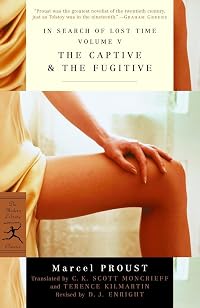
Marcel Prousts monumental seven-part novel In Search of Lost Time is considered by many to be the greatest novel of the twentieth century. The Captive and The Fugitive, the fifth and sixth volumes of Prousts masterpiece, contain some of literatures most beautiful meditations on art, music, desire, jealousy, love and loss, grieving and forgetting. In this work, Proust continues his vast satirical fresco of high society in France just prior to the outbreak of World War I. These volumes and the show more following volume were published posthumously, as Proust died when he was approximately one-third of the way through correcting the proofs for The Captive.The Fugitive was also the last volume translated by Charles Kenneth Scott Moncrieff, who did not live to finish his enormous task. This edition of the two, published together as the fifth volume, is edited and annotated by noted Proust scholar William C. Carter, who endeavors to bring the classic C. K. Scott Moncrieff translation closer to the spirit and style of the original. show lessTags
Recommendations

















Member Reviews
Epic stuff - a very slow, considered style, with considerations of every thought and twist in the narrator's personality and those of everyone around him. Staggeringly perceptive and fascinating, beautifully written, but also a slog sometimes where his observations (at a 100-page dinner party being the culprit, and not for the first time in the series) drag on just too much. Part of the problem is that the high society people he is discussing are awful, and so not pleasant company, although of course that is the point Proust is making...
I found this like the 4 volumes before it - occasionally difficult to read and sometimes a bit dull, but when it's good is as good as anything you'll ever read. The insights into human nature and life, show more and the fundamental unknowability of other people, are breathtaking. show less
I found this like the 4 volumes before it - occasionally difficult to read and sometimes a bit dull, but when it's good is as good as anything you'll ever read. The insights into human nature and life, show more and the fundamental unknowability of other people, are breathtaking. show less
I returned to volume 5 (of 7) of In search of Lost Time after a 3.5 month hiatus and found that it took me a while to get back into this, but then I ended up getting sucked back in. This volume begins the sections that were published posthumously and suffer a bit from lack of Proust's final edits. For instance, there are several characters who are discussed as dead and then very much alive later. It's definitely a completed work, though, just not as perfect as some of the early volumes.
This volume is the narrator (he sort of names himself as Marcel in this volume) at his absolute creepiest. He has convinced Albertine to come and live with him without a promise of marriage. She is the "captive" not allowed to come and go as she pleases, show more but supplied with beautiful clothes and amenities. Of course, there are also sexual favors involved - most disturbingly when the narrator chooses to enter Albertine's room as she sleeps. Yuck. Luckily, in the end Albertine leaves the narrator and I suppose she is The Fugitive in volume six.
There's an excellent set piece back in the Verdurin drawing room with the Baron de Charlus in top form and his relationship with Morel explored more deeply (troubling as well).
All in all, I enjoyed this volume, even though parts were pretty disturbing. Proust, or at least his narrator, has such an immature view of love. It's all based on possession, desire, and power. It makes me sad to think he died so young and may have never discovered a deep, quiet, trusting love.
In The Fugitive, the narrator mourns the loss of Albertine and takes a long-awaited trip to Venice with his mother. On their way back they receive letters giving them news of two marriages - Robert Saint-Loup with Gilberte Swann and Jupien's daughter with the Cambremer's son. Both of these marriages have huge class/societal implications that Proust has built up to throughout the preceding volumes. show less
This volume is the narrator (he sort of names himself as Marcel in this volume) at his absolute creepiest. He has convinced Albertine to come and live with him without a promise of marriage. She is the "captive" not allowed to come and go as she pleases, show more but supplied with beautiful clothes and amenities. Of course, there are also sexual favors involved - most disturbingly when the narrator chooses to enter Albertine's room as she sleeps. Yuck. Luckily, in the end Albertine leaves the narrator and I suppose she is The Fugitive in volume six.
There's an excellent set piece back in the Verdurin drawing room with the Baron de Charlus in top form and his relationship with Morel explored more deeply (troubling as well).
All in all, I enjoyed this volume, even though parts were pretty disturbing. Proust, or at least his narrator, has such an immature view of love. It's all based on possession, desire, and power. It makes me sad to think he died so young and may have never discovered a deep, quiet, trusting love.
In The Fugitive, the narrator mourns the loss of Albertine and takes a long-awaited trip to Venice with his mother. On their way back they receive letters giving them news of two marriages - Robert Saint-Loup with Gilberte Swann and Jupien's daughter with the Cambremer's son. Both of these marriages have huge class/societal implications that Proust has built up to throughout the preceding volumes. show less
More than a commentary on Swann’s jealousy or M. Charlus’s homosexuality or the frivolity of the Guermantes’ sorties, Marcel Proust’s monumental work In Search of Lost Time paints the unsuccessful reconstruction of a forgone world and a lost existence from fickle memories, which like morning mists would fade with the rising sun. The narrator Marcel, longing for a past that didn’t exist but must be created, sought to experience Bergson’s continuous time rather than the fragmented and still-framed instantaneous moments by attempting to blur the boundaries between Cambray and Paris, childhood and adolescence, and Swann and himself and integrate here and there, before and after, and him and me through memory fragments of show more previous objects, people and sensations. As in a neural network or a mind-map, the madeleine linked his aunt to his mother, who in turn was linked to Albertine through jealousy, which also connected Marcel with Saint Loop and Swann, who, as with his (Marcel’s) grandmother, linked his childhood and adolescence. And through recollection, Marcel would try to relive the buried years and resurrect his grandmother and Albertine.
But even during the narrative, Marcel realized memory’s willfulness and the variation in hues, shapes, pitch and timbre between the actual object and its mental reconstruction. When he encountered an old friend, the facial features were so different from his recollection and reconstruction, for better or for worse pregnant with all the emotions, preoccupation, biases, that he could not match face with voice.
Because recollected sensation can never equate with the actual experience and time, like a patient thief, steals memories a morsel at a time until one day the owner would realize he was ruined, Marcel ultimately would fail to recapture and assemble stolen sensations and decayed seconds and in the end, must create new moments, new sensations and ultimately a new biography, through the synergy between past experiences and creative imagination. From those deceased hours and decayed memories sprouted In Search of Lost Time, not only Proust’s novel but also that of the narrator.
Whether we savor Marcel’s frailness, Swann’s infatuation, Charlus’s pompousness, Franscoise’s independent-mindedness, the sorties’ frivolousness or the social revelation of the Dreyfuss Affair, we can enjoy Proust’s classic without resorting to Marxist or Freudian or Feminist critique. And the sentences, like the serpentine Amazon, seemed to flow unceasingly into the distant horizon carrying with it the sparkling sunlight. Although ascending the novel’s three thousand pages appears precipitous, the effort will be well worth the while and, at the end of the adventure, the reader can rest on the crisp apex and savor time’s transience and memory’s playfulness as if they were alpine zephyrs. show less
But even during the narrative, Marcel realized memory’s willfulness and the variation in hues, shapes, pitch and timbre between the actual object and its mental reconstruction. When he encountered an old friend, the facial features were so different from his recollection and reconstruction, for better or for worse pregnant with all the emotions, preoccupation, biases, that he could not match face with voice.
Because recollected sensation can never equate with the actual experience and time, like a patient thief, steals memories a morsel at a time until one day the owner would realize he was ruined, Marcel ultimately would fail to recapture and assemble stolen sensations and decayed seconds and in the end, must create new moments, new sensations and ultimately a new biography, through the synergy between past experiences and creative imagination. From those deceased hours and decayed memories sprouted In Search of Lost Time, not only Proust’s novel but also that of the narrator.
Whether we savor Marcel’s frailness, Swann’s infatuation, Charlus’s pompousness, Franscoise’s independent-mindedness, the sorties’ frivolousness or the social revelation of the Dreyfuss Affair, we can enjoy Proust’s classic without resorting to Marxist or Freudian or Feminist critique. And the sentences, like the serpentine Amazon, seemed to flow unceasingly into the distant horizon carrying with it the sparkling sunlight. Although ascending the novel’s three thousand pages appears precipitous, the effort will be well worth the while and, at the end of the adventure, the reader can rest on the crisp apex and savor time’s transience and memory’s playfulness as if they were alpine zephyrs. show less
Whatever you want to call this volume of Remembrance of Things Past, whether it be "The Prisoner" or "The Captive", it is also for obvious reasons called "The Albertine Novel." In the beginning of "The Captive/Prisoner" Albertine is the narrator's mistress. As soon as she wants to visit friends he (as narrator finally named Marcel at times) bribes Albertine with furs and jewels to make her stay in his family's Paris apartment. There he keeps a close eye on her. Despite this possessive nature, he (Marcel) soon grows tired of Albertine but cannot completely let her go, hence the title of prisoner or captive. He becomes progressively more jealous, possessive, obsessive to the point of borderline psychotic worrying and wondering about who show more Albertine is with, male or female. Her confession of a friendship with lesbians forces Marcel to stoop to spying to see if she has relationships with other women. As usual, Proust has his finger squarely on the pulse of human nature. Albertine is the epitome of freedom while Marcel embodies jealousy and rage. show less
It's fascinating the way Proust prompts so many curious memories. One that surfaced for me was being aware, a lifetime ago - perhaps when I was 4 or 5, that my father was somehow confined to his chair for what seemed an eternity by a strange force. He was reading Proust (in French). I have no idea how I knew that it was Proust nor how he managed to read Proust in French but the volumes had plain white paper covers. Quite unlike these wonderfully accessible Penguin volumes.
When encountering so many wonderful passages in the 5th volume of this epic journey, I found myself writing them out by hand as way of hanging on to them. Hard to know what I could possibly say about In search of Lost Time or indeed this 5th volume that wouldn't show more detract from its many dimensions. Even to quote now somehow reduces the journey to something quite trivial. But I'll do it anyway:
When encountering so many wonderful passages in the 5th volume of this epic journey, I found myself writing them out by hand as way of hanging on to them. Hard to know what I could possibly say about In search of Lost Time or indeed this 5th volume that wouldn't show more detract from its many dimensions. Even to quote now somehow reduces the journey to something quite trivial. But I'll do it anyway:
It seems that events extend further than the moments in which they happen, and cannot be completely contained within them. Certainly, they spill over into the future through the memories we retain of them, but they also demand space in the time that precedes them. Certainly you will say that at that time we do not see them as they will actually be, but are they not also changed in our memory of them? p.371
show less
- the fact that the intellect is not the most subtle, powerful and appropriate instrument for grasping the truth is only one more reason in favour of starting with the intellect rather than with the intuitions of the unconscious or with unquestioning faith in our premonitions. It is life which little by little, case by case, allows us to realise that what is most important for our hearts or our minds is taught to us not by reason but by other powers. And then it is the intellect itself, which, recognising their superiority, uses its reasoning in order to abdicate in their favour and accepts the role of collaborator and servant. p.391
But in exchange for what our imagination leads us to expect and we give ourselves so much futile trouble trying to find, life gives us something which we were very far from imagining.If you have come thus far in this search for time lost, here you may remember that, as unfeasible as it may seem, this is in fact but a part of a single work, one that built and built and has finally started to wind its way slowly down trains of thought already distilled, running on rails made efficient by readerly familiarity. It is not the end, not yet, but still there is the lingering sense of something other than the constant growth and spread of pure novelty of Swann, Flower, Guermantes, Sodom; rather than the youth of yore, the rites of maturation show more have begun. For the narrator is as gorgeously incisive as before, but in the throes of capture and flight he begins, truly begins, to consider others as being capable of the same inconsistent desire, the same instantaneous flutters of heart and habitus. Here, time begins its return.
The turnaround is slow, subtle, and fully explicated, as everything has ever been within the passes of these pages, but still much of a surprise, as while our narrator is a wonder with intimating at the countless facets of visual delight, relegating him to the category of 'spoiled brat' would be anything but too harsh a judgment. But, of course, his life has been a luxurious one, and it is a rare gift indeed to be considerate of others without ever having been forced to do so with little to no expectation of reward. If one wished to trivialize the matters bounded within the doubled novels of a single tome, it could be said that here, the narrator wins his toy long enough to become bored with it, and then has it taken away in such a manner that does not allow for any hint of retrieval, no matter how much the narrator wheedles or begs. But what is a mark of maturity if not the coming to terms with a incontrovertible refusal in such a way that enables a calmer, colder manner of evaluating the thwarting of future whims, fancies, dreams of any length and substantial measure? For if there's one thing to be said about having one's lifelong pursuits come to nothing, it's the resulting perspective and all the changes fortified on it.
In shorter, simpler terms, the narrator in the course of this 'chapter' of this over four thousand page 'novel' is reaching the aging complacency of been there, done that, but is not yet quite fully there. As this is Proust, what would normally be sketched out in a few sentences in other pieces of fiction is rhapsodized on for hundreds of pages, and what would merit only a passing glance is here expanded on to a glorious extent, to the point that one cannot simply read the changes the narrator's thought patterns undergo, the return of so many figures of his youth long ago given up for good, the application of experience painstakingly incorporated into the character to current circumstance, the slow giving way of future hopes to a more thoughtful measuring of the mix of past and present, but feel them. Life forces itself on the narrator once and for all, and with his spoiled sensibilities slighted, his anxious back and forth of flighty indecision decapitated in the street, he submits to the reality and comes out the better for it. His acute sensitivity to the flow of influence and infinite variety of observation protects him from the worst of protective mechanisms via calcification of personality, and while still fickle and overwrought, his path through life is no longer a linear one of ever constant horizons and ever rejected familiarity. Past and future are beginning to coalesce within his grasp, and the present is becoming less of a search and more of a complex interchange between self, time, and circumstance with every passing instance; a newness less pristine, a habit less condemned.
The sun has begun to set on the stage of this lengthy exploration of color, love, society, leaving a narrator beginning to learn that not all lost opportunities are worth forever mourning, that the paths of life led thus far are no less valuable for not having adhered to a past plan of action, however seemingly frivolous in nature or wasteful in scope of time. A beginning flicker of, yes, perhaps what one needs is not around the corner, an entirety necessitating a complete sacrifice of all that came before, but a hand in hand conjoining of accumulated self and subsequent surrounding. An acquiescence to the need of constant reevaluation, one inspiring and tiresome and inspiring again, fueled by nothing but a sense of one day looking back on it all and seeing something that, despite all the chaotic fumblings and discordant backtracks, shaped itself worthwhile. A day that has not yet come to pass, may never come to pass, will require so much for so long before coming to pass, and yet there is an undercurrent that will not be denied, a tidal flow that, for all its effacing tendencies on seaside shore, offers an integrated art of existence in flotsam left behind.
Composers do not remember this lost fatherland, but each of them remains all his life unconsciously attuned to it; he is delirious with joy when he sings in harmony with his native land, betrays it at times with his thirst for fame, but then, in seeking fame, turns his back on it, and it is only by scorning fame that he finds it when he breaks out into that distinctive strain the sameness of which—for whatever its subject it remains identical with itself—proves the permanence of the elements that compose his soul. But in that case is it not true that those elements—all the residuum of reality which we are obliged to keep to ourselves, which cannot be transmitted in talk, even from friend to friend, from master to disciple, from lover to mistress, that ineffable something which differentiates qualitatively what each of us has felt and what he is obliged to leave behind at the threshold of the phrases in which he can communicate with others only by limiting himself to externals, common to all and of no interest—are brought out by art, the art of a Vinteuil like that of an Elstir, which exteriorises in the colours of the spectrum the intimate composition of those worlds which we call individuals and which, but for art, we should never know? A pair of wings, a different respiratory system, which enabled us to travel through space, would in no way help us, for if we visited Mars or Venus while keeping the same senses, they would clothe everything we could see in the same aspect as the things of Earth. The only true voyage, the only bath in the Fountain of Youth, would be not to visit strange lands but to possess other eyes, to see the universe through the eyes of another, of a hundred others, to see the hundred universes that each of them sees, that each of them is; and this we can do with an Elstir, with a Vinteuil; with men like these we do really fly from star to star.show less
**For American readers who have read the first 4 volumes of the "new" Penguin-Viking translation of Proust's In Search of Lost Time and want more, you're out of luck. Believe it or not, the American copyright of Proust's final three volumes STILL HASN'T EXPIRED! I've no clue what law allows someone to maintain such exclusivity, when the original work wasn't American and the author has been dead for almost 100 years, but I think it needs some serious revision. If you're interested, you can buy the new translation reviewed here on Amazon.co.uk, or search an American used book website like abebooks--thankfully it seems our British cousins have smuggled over quite a few copies for our benefit. Anyway...
In 2002, Penguin UK announced that show more editor Christopher Prendergast was supervising an all-new translation of Marcel Proust's famous French masterpiece, "In Search of Lost Time." The original English translation had been begun in the 1920's by C.K. Scott Moncrieff, and while his work was considered a classic of the translator's art, there are many bilingual critics who argue he was unnecessarily squirmy/euphemistic about some of the book's more adult themes (including frank and frequent references to homo- and hetero-sexuality), and that his love of flowery language had made Proust's infamous style even more difficult than it was in the original French.
(For those unfamiliar with Proust's style, the following sentence may provide some idea: Proust would, for example, begin a sentence slowly, often inserting sub and sub-subclauses early on, that they might explode, like land mines long forgotten in province and matter, far down the page, and then--for if not garrulous in real life, he was, like those flowers which thrive in a shadowy, crystalline vase, even as a gardener despairs of their wilted stalks in his finely terraced courtyard, at the very least certainly capable of making up for the loss on paper--he would use this allusive color to illustrate his analysis of human nature and motive, unparalleled not only because of manner in which It was written but because, like all truly great artists, the writing expressed feelings and sensations which had never been put into words--words as rare and valuable in the history of literature as the periods scattered amongst his prose.)
The Moncrieff 'foundation' had twice been redone over the years: first by Terence Kilmartin, and then in the 1980's by DJ Enright. Both streamlined the language, undid any prudish glossing, and made use of the latest French scholarship. But the foundation continued to be Moncrieff's. One of the best examples of his translating method lies in the very title he gave to Proust's work--one which stuck for most of the 20th century: "A Remembrance of Things Past." It's elegant--Shakespearean, in fact--and certainly conveys the YEARNING Proust shows in attempting to recapture the past. But the actual title is "À recherche du temps perdu," which Kimartin, Enright, and the new Penguin volumes all render as "In Search of Lost Time." What it loses in Edwardian elegance it more than makes up for in accuracy.
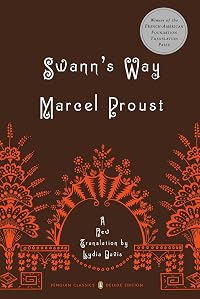
Anyway, the new Penguin translations received for the most part excellent reviews (particularly Lydia Davis's "Swann's Way"), but for some reason it had been decided that each volume would have a different translator. Possibly to speed things along, though I'm not certain. At any rate, for those reading from one volume to the next without pause (this is NOT me; it's taken me years--with numerous "vacations" from the book--to finish all seven volumes) this can be a jarring phenomenon, and what's more, not all translators are created equal. (Opinions differ as to which volume is the equalest.)
But that's beside the point, as this review is concerned with Volumes 5 and 6 (of 7): also known as "the Prisoner" and "the Fugitive." Beware: these two volumes have long considered the most tedious in the series. There is comparatively little humor to be found, and the sparkling, often hilarious parties which Proust can spend half a book describing are few and far between (though there are a couple brilliant pieces set at that Mme. Verdurin's, with more of Baron Charlus for us to enjoy). Instead, the vast majority of both books are concerned with Proust's obsessive love for the (possibly-lesbian) Albertine Simonet. From the time he somehow moves her into his flat (his parents are...out of town...) he is consumed with worry about her loyalty and affection.
Is she cheating on him? Don't worry, Proust will take pages and pages of Volume 5 to consider the subject. He becomes so possessive Albertine leaves him (thus "The Prisoner" becomes "The Fugitive") and this loss, and Proust's discovery of the truth about the woman he loved, takes most of Volume 6. Incidentally in both the M-K-E and the Penguin translations, these two volumes are usually bound together in one book, though Penguin has assigned a different translator for each! Out of all the books, these two would benefit most from a consistent voice. What's more, Proust himself was still editing these two volumes when he died (the final volume, Time Regained, was done for the most part much earlier, as a bookend to Swann's Way). Proust edited on a massive scale--even a typist's query would send him into a fury of cut-and-paste. While the French critics have reconstructed as best they could, these volumes retain an incomplete feel, especially when a character declared dead early on reappears alive at the Verdurins'. First names also mutate, and sometimes there will be references to bits of gossip or anecdotes which Proust forgot to provide.
So is the new Penguin edition that much better? In the case of these volumes, not if you already own the older translation. I feel somehow that while the Penguin versions are more taut, something of Proust's love of beauty has been lost. Sometimes it seems the two Penguin translators pruned so much that the reader winds up missing a step or two in Proust's thought processes. (When this happened I would usually wind up muttering the text aloud with peculiar emphasis, like someone trying to make sense of a poorly-written instruction manual) More than once I would compare Penguin to the M-K-E translation, and between the two managed to glean a much better idea of what was going on. show less
In 2002, Penguin UK announced that show more editor Christopher Prendergast was supervising an all-new translation of Marcel Proust's famous French masterpiece, "In Search of Lost Time." The original English translation had been begun in the 1920's by C.K. Scott Moncrieff, and while his work was considered a classic of the translator's art, there are many bilingual critics who argue he was unnecessarily squirmy/euphemistic about some of the book's more adult themes (including frank and frequent references to homo- and hetero-sexuality), and that his love of flowery language had made Proust's infamous style even more difficult than it was in the original French.
(For those unfamiliar with Proust's style, the following sentence may provide some idea: Proust would, for example, begin a sentence slowly, often inserting sub and sub-subclauses early on, that they might explode, like land mines long forgotten in province and matter, far down the page, and then--for if not garrulous in real life, he was, like those flowers which thrive in a shadowy, crystalline vase, even as a gardener despairs of their wilted stalks in his finely terraced courtyard, at the very least certainly capable of making up for the loss on paper--he would use this allusive color to illustrate his analysis of human nature and motive, unparalleled not only because of manner in which It was written but because, like all truly great artists, the writing expressed feelings and sensations which had never been put into words--words as rare and valuable in the history of literature as the periods scattered amongst his prose.)
The Moncrieff 'foundation' had twice been redone over the years: first by Terence Kilmartin, and then in the 1980's by DJ Enright. Both streamlined the language, undid any prudish glossing, and made use of the latest French scholarship. But the foundation continued to be Moncrieff's. One of the best examples of his translating method lies in the very title he gave to Proust's work--one which stuck for most of the 20th century: "A Remembrance of Things Past." It's elegant--Shakespearean, in fact--and certainly conveys the YEARNING Proust shows in attempting to recapture the past. But the actual title is "À recherche du temps perdu," which Kimartin, Enright, and the new Penguin volumes all render as "In Search of Lost Time." What it loses in Edwardian elegance it more than makes up for in accuracy.
Anyway, the new Penguin translations received for the most part excellent reviews (particularly Lydia Davis's "Swann's Way"), but for some reason it had been decided that each volume would have a different translator. Possibly to speed things along, though I'm not certain. At any rate, for those reading from one volume to the next without pause (this is NOT me; it's taken me years--with numerous "vacations" from the book--to finish all seven volumes) this can be a jarring phenomenon, and what's more, not all translators are created equal. (Opinions differ as to which volume is the equalest.)
But that's beside the point, as this review is concerned with Volumes 5 and 6 (of 7): also known as "the Prisoner" and "the Fugitive." Beware: these two volumes have long considered the most tedious in the series. There is comparatively little humor to be found, and the sparkling, often hilarious parties which Proust can spend half a book describing are few and far between (though there are a couple brilliant pieces set at that Mme. Verdurin's, with more of Baron Charlus for us to enjoy). Instead, the vast majority of both books are concerned with Proust's obsessive love for the (possibly-lesbian) Albertine Simonet. From the time he somehow moves her into his flat (his parents are...out of town...) he is consumed with worry about her loyalty and affection.
Is she cheating on him? Don't worry, Proust will take pages and pages of Volume 5 to consider the subject. He becomes so possessive Albertine leaves him (thus "The Prisoner" becomes "The Fugitive") and this loss, and Proust's discovery of the truth about the woman he loved, takes most of Volume 6. Incidentally in both the M-K-E and the Penguin translations, these two volumes are usually bound together in one book, though Penguin has assigned a different translator for each! Out of all the books, these two would benefit most from a consistent voice. What's more, Proust himself was still editing these two volumes when he died (the final volume, Time Regained, was done for the most part much earlier, as a bookend to Swann's Way). Proust edited on a massive scale--even a typist's query would send him into a fury of cut-and-paste. While the French critics have reconstructed as best they could, these volumes retain an incomplete feel, especially when a character declared dead early on reappears alive at the Verdurins'. First names also mutate, and sometimes there will be references to bits of gossip or anecdotes which Proust forgot to provide.
So is the new Penguin edition that much better? In the case of these volumes, not if you already own the older translation. I feel somehow that while the Penguin versions are more taut, something of Proust's love of beauty has been lost. Sometimes it seems the two Penguin translators pruned so much that the reader winds up missing a step or two in Proust's thought processes. (When this happened I would usually wind up muttering the text aloud with peculiar emphasis, like someone trying to make sense of a poorly-written instruction manual) More than once I would compare Penguin to the M-K-E translation, and between the two managed to glean a much better idea of what was going on. show less
Members
- Recently Added By
Lists

Top-Rated Books on LibraryThing
272 works; 116 members

In and About the 1920s
181 works; 31 members

Top Five Books of 2016
795 works; 228 members
1920s
141 works; 6 members
Le Monde - Les 100 livres du siècle
121 works; 25 members
Talk Discussions
Past Discussions
In Search of Lost Time - Volume V & VI: The Captive & The Fugitive in 1001 Books to read before you die (September 2014)
Author Information

873+ Works 47,937 Members
Proust is one of the seminal figures in modern literature, matched only in stature by Joyce, Woolf, Mann and Kafka. By the last decade of the 19th century, the charming and ambitious Proust, born into a wealthy bourgeois family, was already a famous Paris socialite who attended the most fashionable salons of the day. The death of his parents in show more the early years of the 20th century, coupled with his own increasingly ill health, made of Proust a recluse who confined himself to his cork-lined bedroom on the Boulevard Haussmann. There he concentrated on the composition of his great masterpiece, Remembrance of Things Past (1913-27). In recent years, it was discovered that he had already prepared a first draft of the work in the 1890s in Jean Santeuil, which was only published posthumously in 1952. Remembrance of Things Past resists summary. Seeming at turns to be fiction, autobiography, and essay, Remembrance is a vast meditation on the relationship between time, memory, and art. In it the narrator, who bears the same first name as the author, attempts to reconstruct his life from early childhood to middle age. In the process, he surveys French society at the turn of the century and describes the eventual decline of the aristocracy in the face of the rising middle class. The process of reconstruction of Marcel's past life is made possible by the psychological device of involuntary memory; according to this theory, all of our past lies hidden within us only to be rediscovered and brought to the surface by some unexpected sense perception. In the final volume of the work, the narrator, who has succeeded in recapturing his past, resolves to preserve it through the Work of Art, his novel. He died of pneumonia and a pulmonary abscess in 1922. He was buried in the Père Lachaise Cemetery in Paris. (Bowker Author Biography) show less
Some Editions
Series

Belongs to Publisher Series
Work Relationships
Contains
Common Knowledge
- Canonical title
- The Captive / The Fugitive
- Original title
- La Prisonnière, La Fugitive Albertine disparue; A la recherche du temps perdu: La Prisonnière; A la recherche du temps perdu: Albertine disparu
- Alternate titles
- A Remembrance of Things Past
- Original publication date
- 1923; 1925
- People/Characters
- Marcel, The Narrator; Albertine Simonet; Françoise; Robert de Saint-Loup; Baron de Charlus (Palamède de Guermantes); Oriane de Guermantes (Duchesse de Guermantes) (show all 47); Charles Morel (Charlie); Charles Swann; Andrée; M. Bergotte; Mme. Verdurin; Aimé; Albert Bloch; Prince de Guermantes; M. Brichot; Princesse de Guermantes (Marie-Gilberte); Basin de Guermantes (Duc de Guermantes); M. de Cambremer (Cancan); Professor Cottard; Mme. de Cambremer; General Deltour; Gilberte Swann (Gilberte de Saint-Loup); M. Jupien; Gisèle; Léa; M. d'Argencourt; M. de Bréauté; M. de Norpois; M. Legrandin; M. Nissim Bernard; M. Verdurin (Gustave); Marcel's Mother; Marcel's Father; Marie-Antoinette Jupien (Marie-Antoinette Cambremer); Mme. Léontine Cottard; Mme. d'Arpajon; Mme. de Mortemarte; Mme. de Valcourt; Mme. de Villeparisis; Mme. de Cambremer-Legrandin; Mme. Sazerat; Odette Swann (de Crécy, Odette de Forcheville); Prince Foggi; Princesse de Parme; M. Saniette; M. Ski; Mme. de Marsantes
- Important places
- Paris, France; Balbec, Normandy, France; Combray, Normandy, France; France; Venice, Veneto, Italy; Versailles, Île-de-France, France (show all 9); Padua, Veneto, Italy; Veneto, Italy; Italy
- Original language
- French
- Disambiguation notice
- Do not combine the English edition that includes the two novels The Captive and The Fugitive with other editions (including most non-English ones) that do not include both novels!
Classifications
Statistics
- Members
- 1,362
- Popularity
- 17,528
- Reviews
- 30
- Rating
- (4.29)
- Languages
- English, French, Portuguese, Romanian
- Media
- Paper, Audiobook, Ebook
- ISBNs
- 19
- ASINs
- 11