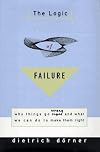
The Logic Of Failure: Recognizing And Avoiding Error In Complex Situations
by Dietrich Dörner
On This Page
Description
Why do we make mistakes? Are there certain errors common to failure, whether in a complex enterprise or daily life? In this truly indispensable book, Dietrich Dörner identifies what he calls the logic of failure",certain tendencies in our patterns of thought that, while appropriate to an older, simpler world, prove disastrous for the complex world we live in now. Working with imaginative and often hilarious computer simulations, he analyzes the roots of catastrophe, showing city planners in show more the very act of creating gridlock and disaster, or public health authorities setting the scene for starvation. The Logic of Failure is a compass for intelligent planning and decision-making that can sharpen the skills of managers, policymakers and everyone involved in the daily challenge of getting from point A to point B. show lessTags
Recommendations




































Member Recommendations
Member Reviews
The Logic of Failure is a popular translation of what appears to be some pretty hefty scholarly literature (I think-didn't bother to actually check 30 years of literature in German), that is hindered by becoming largely accepted wisdom. Dorner is a cognitive scientist who based this book on a series of studies of how people interacted with computer models: desertification in the Sahel, the economy and politics of a small town, predator and prey interactions. These studies, along with some examples drawn from recent events like Chernobyl and military history, are used to explain failure a consequence of a lack of understanding of complex systems.
Complex systems, interconnected networks with time-delays, buffering units, hidden keystone show more variables, and unclear indicators, are everywhere in the real world. Unfortunately, human minds tend to think linearly and concretely. Dorner documents several pathological thinking styles he encounters in his experiments. Some people over-correct, making dramatic changes while chasing a pointer that drowned out any data in induced oscillations. Some people get lost chasing irrelevant details, asking for more information rather than acting. And some people get trapped in methodism, following a predetermined course of action in complete disregard of the information coming in.
Against this, Dorner advocates for having a clear mental model of a system, discrete objectives, and a holistic sense of possible higher-order effects. Make small changes, seek steady states, and do not try and race a chaotic system. He points towards 'wisdom' with maddening vagueness. If there's a major problem with this book, it's that it's been overtaken by the zeitgeist. Dorner's methods are now children's toys rather than cutting edge science. We all 'get' networks and complexity, but we still lack the language to truly understand them. show less
Complex systems, interconnected networks with time-delays, buffering units, hidden keystone show more variables, and unclear indicators, are everywhere in the real world. Unfortunately, human minds tend to think linearly and concretely. Dorner documents several pathological thinking styles he encounters in his experiments. Some people over-correct, making dramatic changes while chasing a pointer that drowned out any data in induced oscillations. Some people get lost chasing irrelevant details, asking for more information rather than acting. And some people get trapped in methodism, following a predetermined course of action in complete disregard of the information coming in.
Against this, Dorner advocates for having a clear mental model of a system, discrete objectives, and a holistic sense of possible higher-order effects. Make small changes, seek steady states, and do not try and race a chaotic system. He points towards 'wisdom' with maddening vagueness. If there's a major problem with this book, it's that it's been overtaken by the zeitgeist. Dorner's methods are now children's toys rather than cutting edge science. We all 'get' networks and complexity, but we still lack the language to truly understand them. show less
An unusual book and subject matter covering the experiments the author performed on different types of people (lay or expert) in tasks involving managing of virtual villages. The main idea is humans are actually very bad at managing resources, and they are bad in certain near predictable ways. We overreact, we obsess, we reframe situations and we do not understand processes that change with a delay in time.
This book, this subject matter is of paramount importance, but I have not found much similar accessible text. The actual writing is not amazing but the content is unique.
This book, this subject matter is of paramount importance, but I have not found much similar accessible text. The actual writing is not amazing but the content is unique.
A concise, clear and thought-provoking study of how humans make decisions when confronted by complex systems, drawing upon psychological experiments using computer simulations.
Human beings often make errors when confronted a complex system. Dorner uses the results of decision-making experiments with computer simulations to describe the types of errors that people often make. Conclusions are interesting, but presentation is a bit dull and academic. There are more interesting books on this topic, like Perrow's "Normal Accidents", Tenner's "Why Things Bite Back" and Weinberg's "Introduction to General Systems Thinking".
A good book which should be read by more people. As I read it, I worried whether I was guilty of any of the errors the people described in the book were making.
A guided tour of why we tend to misunderstand complex systems. At the end of it I wanted access to the simulations to try my hand at them and learn from my own mistakes.
Dan says this book is awesome because it teaches you how to think
Members
- Recently Added By
Author Information
6 Works 717 Members
Some Editions
Series
Belongs to Publisher Series
rororo science (61578)
Common Knowledge
- Original title
- Logik des Misslingens
- People/Characters
- Carl von Clausewitz
- Original language
- German
Classifications
- Genres
- Nonfiction, General Nonfiction, Science & Nature, Business
- DDC/MDS
- 153.42 — Philosophy & psychology Psychology Conscious mental processes and intelligence Thought, thinking, reasoning, intuition, value, judgment Critical Thinking
- LCC
- BF448 .D6713 — Philosophy, Psychology and Religion Psychology Psychology Consciousness. Cognition
- BISAC
Statistics
- Members
- 682
- Popularity
- 41,952
- Reviews
- 7
- Rating
- (3.80)
- Languages
- English, French, German
- Media
- Paper, Ebook
- ISBNs
- 9
- ASINs
- 4