The Crisis of the European Mind: 1680-1715
by Paul Hazard
On This Page
Description
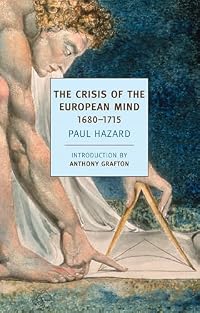
Paul Hazard's intellectual history offers an unforgettable account of the birth of the modern European mind in all its dynamic, inquiring, and uncertain glory. Beginning his story in the latter half of the seventeenth century, while also looking back to the Renaissance and forward to the future, Hazard traces the process by which new developments in the sciences, arts, philosophy, and philology came to undermine the stable foundations of the classical world, with its commitment to tradition, show more stability, proportion, and settled usage. Hazard discerned at the end of the seventeenth and the beginning of the eighteenth centuries a crisis within the European mind, a moment of profound uncertainty, une zone uncertaine, malaisée. Out of that crisis emerged a new understanding of people and nature, of government, of religion in society which, as he saw it, prepared the way for the French Revolution. At that moment emerged a mentalité discernibly enlightened and modern, one with which Hazard and his generation of liberal French intellectuals could still identify. show lessTags
Recommendations






















Member Reviews
Hazard sees in his period the crystallization of the factors which became decisive later in the century. For as he says, many of the factors which seemed innovative in 1750 were already at play in 1700. This book can serve as an introduction to secular culture glimsed at a moment in its history when its Christian roots still were intelligible.
Ratings
Members
- Recently Added By
Lists

Books Read in 2023
5,547 works; 144 members

Bibliography of How the Old World Ended by Jonathan Scott
308 works; 1 member
Author Information

18 Works 768 Members
Some Editions
Series
Belongs to Publisher Series
Common Knowledge
- Canonical title
- The Crisis of the European Mind: 1680-1715
- Original title
- Crise de la conscience européenne
- Original publication date
- 1935
- First words
- To preserve existing conditions, to keep things firm and steady, to avoid any change that might disturb an equilibrium so miraculously attained - such was the paramount preoccupation of the Classical Age.
- Last words
- (Click to show. Warning: May contain spoilers.)Applying to the moral sphere what one of them, Leibnitz, said of the political, we, too, may say: Finis saeculi novam rerum faciem aperuit: in the closing years of the XVIIth century a new order of things began its course.
Classifications
- Genres
- History, Nonfiction, General Nonfiction, Philosophy, Religion & Spirituality
- DDC/MDS
- 940.2 — History & geography History of Europe History of Europe Europe: Renaissance, Reformation, Enlightenment, Napolean
- LCC
- D273.5 .H32 — History of Europe, Asia, Africa and Oceania History (General) Modern history, 1453- 1601-1715. 17th century
- BISAC
Statistics
- Members
- 526
- Popularity
- 56,575
- Reviews
- 2
- Rating
- (3.88)
- Languages
- 7 — Dutch, English, French, German, Italian, Portuguese, Spanish
- Media
- Paper, Ebook
- ISBNs
- 24
- ASINs
- 19