
J. Lewis May
Author of Amores + Ars amatoria + Medicamina faciei femineae + Remedia amoris [in translation]
About the Author
Works by J. Lewis May
Amores + Ars amatoria + Medicamina faciei femineae + Remedia amoris [in translation] (1990) — Editor; Translator, some editions — 1,229 copies, 5 reviews
PATH THROUGH THE WOODS 2 copies
Fénelon; a study 1 copy
Cardinal Newman 1 copy
John Lane and the nineties 1 copy
Charles Lamb, a study 1 copy
George Eliot 1 copy
Associated Works
The Crisis of the European Mind: 1680-1715 (1935) — Translator, some editions — 527 copies, 2 reviews
Tagged
Common Knowledge
There is no Common Knowledge data for this author yet. You can help.
Members
Reviews
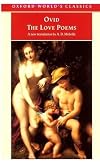
28. Ovid : The Love Poems (Oxford World's Classics) translated by A. D. Melville
Introduction: E. J. Kenney
other translations used B. P. Moore's 1935 translation of The Art of Love, & Christopher Marlowe translations for Amores 1.5, 3.7 & 3.14
published: 1990
format: Paperback
acquired: Library
read: June 18 - July 7
rating: ??
Contains four collections of poems:
Amores - 16 bce
Cosmetics for Ladies - date unclear, but before The Art of Love
The Art of Love - 2 ce
Cures for Love - date unknown, show more probably close to 2 ce
What first struck me about Ovid's [Amores] was how unromantic they are. I think I was expecting beautiful musings or something like that. While Ovid plays with muses and especially on the idea of Cupid and his arrows, these poems are largely on petty problems with woman who are married or suspicious or whatnot. They are full-out sarcasm and humor on the surface, often quite rude or offensive in a way that leaves one suspecting that was the intention. It seems Ovid was first and foremost being clever, and intent on showing how clever he is. And most of what he accomplishes, he does so through cleverness. Melville tells me Ovid successfully undermined the whole of Roman love poetry, which had a long tradition, even has he wrote it, exposing it while mastering it.
As a reader, I was left with the impression of writer who was never entirely serious, but also, at the same time, very serious. The poems drift from practical issues to mythology and back again, referencing a wide assortment of well known and obscure mythology (obscure even to well educated Romans). He also brings in a wide sense of world knowledge, referencing many writers and many oddities, even Judaism twice.
[Amores] is the most complex of the works here and hard to summarize other than to say love poetry or humor based on it. [The Art of Love] is a faux-handbook for young men on how to find love. Full of humor, it crosses lines, mainly by implication. It apparently may have been the cause of Ovid's exile from Rome, announced personally by Augustus. [Cures for Love] is pure humor on ways to get over a relationship. It reads as if it was intended to be pared with [The Art of Love]. [Cosmetics for Ladies] is only partially preserved and is the guide the title suggests it is, but just done in clever poetry, mock seriousness and humor.
Overall the tone lets the reader relax and just enjoy what Ovid's doing. I was entertained, and pretty content reading through these, casually. Sometimes I would get lost, but mostly he's fairly straightforward and Melville's translations are clear and his notes are good. Melville rhymes everything, which brings out some of the sense of play. But he's a little bland, and he can't replicate the Latin complexity. Moore read practically the same as Melville. Marlowe's additions were kind of special, but also, as I have just discovered, heavily altered by Melville.
from Amores book 3, elegia vii - "Marlowe's version slightly modernized"
(Marlowe's actual version can be found here (it helps to search for "Scythian"): https://www.gutenberg.org/files/21262/21262-h/21262-h.htm#ovid )
2017
https://www.librarything.com/topic/260412#6117227 show less
Introduction: E. J. Kenney
other translations used B. P. Moore's 1935 translation of The Art of Love, & Christopher Marlowe translations for Amores 1.5, 3.7 & 3.14
published: 1990
format: Paperback
acquired: Library
read: June 18 - July 7
rating: ??
Contains four collections of poems:
Amores - 16 bce
Cosmetics for Ladies - date unclear, but before The Art of Love
The Art of Love - 2 ce
Cures for Love - date unknown, show more probably close to 2 ce
What first struck me about Ovid's [Amores] was how unromantic they are. I think I was expecting beautiful musings or something like that. While Ovid plays with muses and especially on the idea of Cupid and his arrows, these poems are largely on petty problems with woman who are married or suspicious or whatnot. They are full-out sarcasm and humor on the surface, often quite rude or offensive in a way that leaves one suspecting that was the intention. It seems Ovid was first and foremost being clever, and intent on showing how clever he is. And most of what he accomplishes, he does so through cleverness. Melville tells me Ovid successfully undermined the whole of Roman love poetry, which had a long tradition, even has he wrote it, exposing it while mastering it.
As a reader, I was left with the impression of writer who was never entirely serious, but also, at the same time, very serious. The poems drift from practical issues to mythology and back again, referencing a wide assortment of well known and obscure mythology (obscure even to well educated Romans). He also brings in a wide sense of world knowledge, referencing many writers and many oddities, even Judaism twice.
[Amores] is the most complex of the works here and hard to summarize other than to say love poetry or humor based on it. [The Art of Love] is a faux-handbook for young men on how to find love. Full of humor, it crosses lines, mainly by implication. It apparently may have been the cause of Ovid's exile from Rome, announced personally by Augustus. [Cures for Love] is pure humor on ways to get over a relationship. It reads as if it was intended to be pared with [The Art of Love]. [Cosmetics for Ladies] is only partially preserved and is the guide the title suggests it is, but just done in clever poetry, mock seriousness and humor.
Overall the tone lets the reader relax and just enjoy what Ovid's doing. I was entertained, and pretty content reading through these, casually. Sometimes I would get lost, but mostly he's fairly straightforward and Melville's translations are clear and his notes are good. Melville rhymes everything, which brings out some of the sense of play. But he's a little bland, and he can't replicate the Latin complexity. Moore read practically the same as Melville. Marlowe's additions were kind of special, but also, as I have just discovered, heavily altered by Melville.
from Amores book 3, elegia vii - "Marlowe's version slightly modernized"
Yes, she was beautiful and well turned out,
The girl that I'd so often dream about,
Yet I lay with her limp as if I loved not,
A shameful burden on the bed that moved not.
Thought both of us were sure of our intent,
Yet could I not cast anchor where I meant.
She round my neck her ivory arms did throw,
Her arms far whiter than Scythian snow,
And eagerly she kissed me with her tongue,
And under mine her wanton thigh she flung.
Yes, and she soothed me up, and called me sire,
And used all speech that might provoke and stir.
Yet like as if cold hemlock I had drunk,
It humbled me, hung down the head, and sunk.
(Marlowe's actual version can be found here (it helps to search for "Scythian"): https://www.gutenberg.org/files/21262/21262-h/21262-h.htm#ovid )
2017
https://www.librarything.com/topic/260412#6117227 show less
Good, fun reading, though the modern translation is just a bit over the top.

From the translator who brought you Metamorphoses (above). Not as great of a work (or collection of works, I should stay), but well worth the time nonetheless.
Some things obviously never change. Some of the greatest love poetry ever written was some of the earliest recorded
Lists
Awards

You May Also Like


Associated Authors
Statistics
- Works
- 17
- Also by
- 3
- Members
- 1,287
- Popularity
- #19,915
- Rating
- 3.8
- Reviews
- 5
- ISBNs
- 22
- Languages
- 2