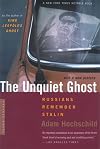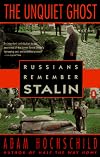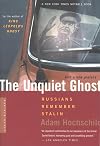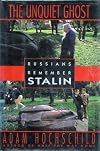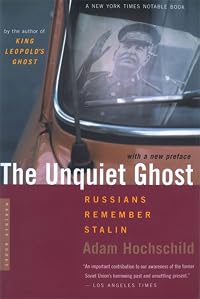
The Unquiet Ghost: Russians Remember Stalin
by Adam Hochschild
On This Page
Description
Although some twenty million people died during Stalin's reign of terror, only with the advent of glasnost did Russians begin to confront their memories of that time. In 1991, Adam Hochschild spent nearly six months in Russia talking to gulag survivors, retired concentration camp guards, and countless others. The result is a riveting evocation of a country still haunted by the ghost of Stalin.Tags
Recommendations







Member Reviews
> Throughout history, human beings have periodically slaughtered people of other countries, races, and religions. But self-inflicted mass murder is far more rare. How could a country do this to itself? Our awe also comes from the scale. In the late 1930s, according to figures cited today by Russian government officials, more than one out of every eight men, women, and children in the Soviet Union was arrested—the great majority of whom were shot, or died in prison.
> The most obvious one, of course, is the old Russian tradition of absolute power at the top and passive obedience at the bottom. Until Peter the Great made a law against it, citizens of the capital would lie down in the street when the Tsar's carriage passed. You could show more compile an encyclopedia of such features of autocracy, but the most important one was that until the middle of the last century, nearly half the Russian population were serfs. For almost all the Soviet period, historians treated serfdom merely as one more evil of the old order. Today, however, writers are much more likely to talk about it as the source of a deep passivity that allowed dictatorship to flourish long after serfdom itself had ended.
> Another important ingredient of totalitarian culture in Russia is the country's long love affair with creeds that promise a millenarian deliverance from all suffering. You can easily trace this strand from the schismatics of the medieval Russian Orthodox Church through some of Dostoevsky's characters to the rigid arrogance of the early Bolsheviks.
> the insistent pressure for everyone to join in the scapegoating. It was never enough for the NKVD merely to brand men and women "enemies of the people" and shoot them. The director of any school, factory, or office had to countersign the papers ordering an employee's arrest. And when the victims were prominent, millions of people joined in condemning them by signing group telegrams or open letters, or by voting for unanimous resolutions at compulsory meetings at their workplaces.
> "We must execute not only the guilty," said Nikolai Krylenko, Lenin's Commissar of Justice. "Execution of the innocent will impress the masses even more."
> "I'd like to tell you something about perestroika,"added Major Kirillin earnestly. "In the West, they count its days from 1985 [when Gorbachev took over]. But we Chekisti count it from 1982, from when Andropov came to power. When the government was made up of seventy-five-year-olds, they didn't realize what the real situation in the country was. The apparatus that surrounded them met their needs, and they played their game. But Yuri Vladimirovich [Andropov], having spent fifteen years in this organization, knew the situation in the country from A to Z." Echoing the assessment made by many others, he added, "Without Andropov there would have been no Gorbachev."
> Rehabilitations in the 1950s proceeded very slowly, one case at a time. Someone once asked Anastas Mikoyan, an adroit survivor who served in the Politburo both under Stalin and long after, why this was so. Couldn't all these myriad "enemies of the people" simply be declared innocent all at once? "No they can't," he replied. "If they were, it would be clear that the country was not being run by a legal government, but by a group of gangsters." He paused, then added, "Which, in point of fact, we were." The fiction that the millions of Great Purge arrests were a string of individual mistakes required each case to be laboriously proven a miscarriage of justice
> "In the documents there were orders with exact numbers given. You would be ordered to arrest and shoot, say, ten thousand people. But you could arrest twenty, thirty, forty thousand. The more 'enemies of the people' you arrested, the higher your score. As a result of such orders, the Tomsk NKVD challenged Novokuznetsk to a socialist competition. The cities were the same size. Who could arrest more people? It turned out that Tomsk arrested and executed more people than Novokuznetsk." The Tomsk authorities did indeed win the contest hands down; by some estimates, the NKVD shot roughly one out of every six residents of the city show less
> The most obvious one, of course, is the old Russian tradition of absolute power at the top and passive obedience at the bottom. Until Peter the Great made a law against it, citizens of the capital would lie down in the street when the Tsar's carriage passed. You could show more compile an encyclopedia of such features of autocracy, but the most important one was that until the middle of the last century, nearly half the Russian population were serfs. For almost all the Soviet period, historians treated serfdom merely as one more evil of the old order. Today, however, writers are much more likely to talk about it as the source of a deep passivity that allowed dictatorship to flourish long after serfdom itself had ended.
> Another important ingredient of totalitarian culture in Russia is the country's long love affair with creeds that promise a millenarian deliverance from all suffering. You can easily trace this strand from the schismatics of the medieval Russian Orthodox Church through some of Dostoevsky's characters to the rigid arrogance of the early Bolsheviks.
> the insistent pressure for everyone to join in the scapegoating. It was never enough for the NKVD merely to brand men and women "enemies of the people" and shoot them. The director of any school, factory, or office had to countersign the papers ordering an employee's arrest. And when the victims were prominent, millions of people joined in condemning them by signing group telegrams or open letters, or by voting for unanimous resolutions at compulsory meetings at their workplaces.
> "We must execute not only the guilty," said Nikolai Krylenko, Lenin's Commissar of Justice. "Execution of the innocent will impress the masses even more."
> "I'd like to tell you something about perestroika,"added Major Kirillin earnestly. "In the West, they count its days from 1985 [when Gorbachev took over]. But we Chekisti count it from 1982, from when Andropov came to power. When the government was made up of seventy-five-year-olds, they didn't realize what the real situation in the country was. The apparatus that surrounded them met their needs, and they played their game. But Yuri Vladimirovich [Andropov], having spent fifteen years in this organization, knew the situation in the country from A to Z." Echoing the assessment made by many others, he added, "Without Andropov there would have been no Gorbachev."
> Rehabilitations in the 1950s proceeded very slowly, one case at a time. Someone once asked Anastas Mikoyan, an adroit survivor who served in the Politburo both under Stalin and long after, why this was so. Couldn't all these myriad "enemies of the people" simply be declared innocent all at once? "No they can't," he replied. "If they were, it would be clear that the country was not being run by a legal government, but by a group of gangsters." He paused, then added, "Which, in point of fact, we were." The fiction that the millions of Great Purge arrests were a string of individual mistakes required each case to be laboriously proven a miscarriage of justice
> "In the documents there were orders with exact numbers given. You would be ordered to arrest and shoot, say, ten thousand people. But you could arrest twenty, thirty, forty thousand. The more 'enemies of the people' you arrested, the higher your score. As a result of such orders, the Tomsk NKVD challenged Novokuznetsk to a socialist competition. The cities were the same size. Who could arrest more people? It turned out that Tomsk arrested and executed more people than Novokuznetsk." The Tomsk authorities did indeed win the contest hands down; by some estimates, the NKVD shot roughly one out of every six residents of the city show less
It is interesting to read a book that accounts the events of the past through the prospectives of the people that lived them. You begin to ponder on your prospectives influence of how you view these events and how only through generations will the events be lost. We try to remember through the teaching of history but the cultural impact of historical events are lost as new generations grow old. People remember and are influenced to view the events by how they were impacted. The best line from the book reflects on Stalinism as a cancer that swept across the land.
When I reviewed Mr. Hochschild's ealier book King Leopold's Ghost I found it wonderfully researched and written, and I couldn't put it down, nor could I forget it. I believe he has done it again. There are many reviewers here who have done a terrific job of describing this book in detail.However,what I find fascinating about Mr. Hochschild's writing is his ability to, in the main, allow the reader to make his own judgments about these horrifying subjects. I appreciate that opportunity- too many writers bludgeon us with their own judgments and moralizing.
This book opened my eyes to the Soviet Union. Thought-provoking. Knowledgable. Reads like a novel. A truly great book.
Excellent. Highly readable and compelling.
Engaging, astounding, and heartbreaking; excerpts at: http://uvula-fr-b4.livejournal.com/75387.html
Ratings
Members
- Recently Added By
Lists

Books about Russia and the former USSR
67 works; 12 members
Author Information

16+ Works 9,751 Members
Adam Hochschild was born in New York City in 1942. As a college student, he spent a summer working on an anti-government newspaper in South Africa and worked briefly as a civil rights worker in Mississippi in 1964. He began his journalism career as a reporter at the San Francisco Chronicle. Then he worked for ten years as a magazine editor and show more writer, at Ramparts and Mother Jones, which he co-founded. He has also written for The New Yorker, Harper's Magazine, The New York Review of Books, The New York Times Magazine, and The Nation. His first book, Half the Way Home: A Memoir of Father and Son, was published in 1986. His other books include The Mirror at Midnight: A South African Journey; The Unquiet Ghost: Russians Remember Stalin; Finding the Trapdoor: Essays, Portraits, Travels; King Leopold's Ghost: A Story of Greed, Terror, and Heroism in Colonial Africa; Bury the Chains: Prophets and Rebels in the Fight to Free an Empire's Slaves; and To End All Wars: A Story of Loyalty and Rebellion, 1914-1918. He teaches writing at the Graduate School of Journalism at the University of California, Berkeley. (Bowker Author Biography) show less
Awards and Honors
Awards
Common Knowledge
- Canonical title
- The Unquiet Ghost: Russians Remember Stalin
- Original publication date
- 1994
- People/Characters
- Joseph Stalin; Nadezhda Mandelstam; Eugenia Ginzburg; Victor Serge
- Important places
- USSR; Russia; Kolyma, Siberia, Russia; Kolpashevo, Tomsk oblast, Russia; Magadan, Russia; Omsukchan
- Dedication
- For Janusz Bardach (1919-2002)
- First words
- A few days after arriving in Moscow to begin the research for this book, I trudged through the snow to go shopping at a grocery store near our rented apartment.
- Quotations
- Half the bodies were dressed. I saw them all. And they all had holes in their heads. One or two holes. Fuck them! They'd shot the prisoner in the head, and if he didn't die, then they'd shot him again. All these bodies were s... (show all)liding past us in the water. They were so well preserved, their mouths wide open-it almost seemed as if they were screaming.
Why are you so interested in all this? For the last time in Russia, I try to answer this question. One answer, I tell him, has to do with how a whole society, like an individual human being, must look deep into the past and f... (show all)ace the very worst, in order to become healed. It is this that gives Russia's long, slow recovery a moral echo that goes beyond the experience of Stalinism.
Another answer has to do with the line between victims and executioners, far less distinct than I had first imagined. You would have done the same. It was this uneasy feeling that Eugenia Ginzburg took from her seventeen years of prison, labor camps, and exile:"After all, I was the anvil, not the hammer. But might I too have become a hammer?" - Last words
- (Click to show. Warning: May contain spoilers.)And if it can begin here, in Kolyma, perhaps it can happen anywhere.
- Disambiguation notice
- Full title (1994): The unquiet ghost : Russians remember Stalin / Adam Hochschild
Classifications
- Genres
- History, Nonfiction, General Nonfiction, Politics and Government, Biography & Memoir
- DDC/MDS
- 947.084 — History & geography History of Europe Eastern European Counties and Russia Russian & Slavic History by Period 1855- 1917-1953 ; Communist period
- LCC
- DK267 .H597 — History of Europe, Asia, Africa and Oceania Russia. Soviet Union. Former Soviet Republics – Poland History of Russia. Soviet Union. Former Soviet Republics History Soviet regime, 1918-1991
- BISAC
Statistics
- Members
- 290
- Popularity
- 110,999
- Reviews
- 6
- Rating
- (4.30)
- Languages
- Dutch, English, German
- Media
- Paper, Ebook
- ISBNs
- 7
- UPCs
- 1
- ASINs
- 3