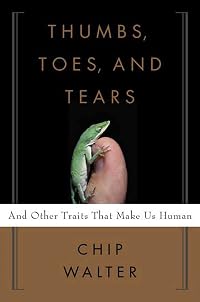
Thumbs, Toes, and Tears: And Other Traits That Make Us Human
by Chip Walter
On This Page
Description
"Among the countless traits and behaviors that separate us from the rest of the animal kingdom, six stand out - our big toe, opposable thumb, oddly shaped pharynx, and our abilities to laugh, kiss, and cry. Though seemingly unconnected, they are actually closely linked; each marks a fork in the evolutionary road where we went one way and the rest of the animal kingdom went another." "Science journalist Chip Walter tells the story of how these six unique human traits evolved, and his book show more provides insights into how we became the remarkable species we are. Drawing on complexity theory, the latest brain scanning techniques, and new insights from fields as diverse as anthropology, neurobiology, and artificial intelligence, Thumbs, Toes, and Tears reveals a creature whose social relationships, sexual behavior, and internal self-image were shaped by its ability to walk upright, make tools, use language, and bond deeply in a dangerous world." "As the story of each trait unfolds, Walter explains why our brains grew so large and complex, why we find one another sexually attractive, how toolmaking laid the mental groundwork for language, why we care about what others think, and how we became the creature that laughs and cries and falls in love."--Jacket. show lessTags
Recommendations




Member Reviews
Thumbs, Toes, and Tears: And Other Traits That Make Us Human by Chip Walter is an evolutionary story about what sets human beings apart from other animals. Walter specifically identifies six traits of humans that can be found in no other species: Big toes, opposable thumbs, the pharynx, laughter, tears, and kissing.
The big toe is important in that helped humans walk upright which in turn modified our anatomy leading to larger brains and skulls. At the same time the body adapting to walking and running means the birth canal is too small to allow easy egress of our big heads. So human infants are born far earlier in their development than other mammals and that is why humans are so helpless in their early years. In fact the long period of show more ongoing learning and development is uniquely human.
The opposable thumb is well-respected as the difference between humans and other animals, allowing us to create and manipulate tools. Our hands are also central to our ability to communicate and the genesis of language.
The pharynx is most fascinating in that it physically allows us to speak. I never knew that it does this by intersecting the airways and the esophagus, which does not happen in oher mammals. The price to pay for being the animal that speaks is that we are also the animal that can choke. Being able to speak gives rise to consciousness and the prefontal cortex of the brain.
Laughter allows us to connect emotionally to others and is rooted both in our primal urges and our ability to walk upright.
Crying is the most mysterious as humans are the only beings that have tears that well up and drip out of the eyes as a means of expressing emotion (as opposed to merely keeping the eyes clean). One theory is that crying actually brings us back into a state of equilibrium. Crying is also a means of body language to communicate emotions to other humans.
Finally, kissing is a learned cultural trait that allows us to communicate our love and affections in a way that feels really good.
Walter writes all of this in a lively style that makes it a fun and engrossing read. In many ways it is a gentler version of Desmond Morris' The Naked Ape which Walter cites several times. It's a work of popular science, and it hems & haws with a number of "probablys" and "we don't know for sures", but I think it teaches an illuminating lesson in human evolution and unique traits.
Interesting Quotes:
If we were born as fully formed and physically mature as the babies of contemporary great apes, human gestation would last not nine months, but twenty-one! This means we are born a fully year premature. We may define "full term" as nine months in the womb, but by ape standards we are fetuses that have arrived twelve months earlier than we should have. - p.34-35
We tend to think that the forces of evolution are terrifically at rooting out all wastefulness to make the brain thoroughly optimized for smooth, clean operation. But the truth is that evolution feels it way toward success, tinkering and puttering until it stumbles across marvelously inventive solutions to the problems that need for survival presents, and then shambles on. Our brain, amazing as it is, is not an efficient machine, but a maddeningly complicated organ that stubbornly resists analysis. - p. 107
Quite possibly we cry not because we are getting agitated and upset, but because it is a way for our nervous system to bring us back into equilibrium.
One study reveals, for example, that if the nerves central to the sympathetic system are paralyzed, patients cry more. But when important parasympathetic nerves are damaged, they cry less. If crying was driven by the sympathetic nervous system, it would be the other way around. In other words, we don't cry because we are upset, which is the way it feels, but because we are trying to get over being upset. That may be the real reason why feel better after we have a good cry. p. 173
Our simian cousins, gifted and intelligent as they are, don't have the capacity for the powerful marriage of thoughts and emotions. They can feel rage, frustration, or loss, but they do not reflect on them. The random emergence of genes that connected the emotional and intellectual parts of our brains to lacrimal glands that sit above our eyes gave us a new way to express those elusive feelings. And in the bargain we gained an emotional stamp we can put on our cries for help that no other creature possess. - p. 179 show less
The big toe is important in that helped humans walk upright which in turn modified our anatomy leading to larger brains and skulls. At the same time the body adapting to walking and running means the birth canal is too small to allow easy egress of our big heads. So human infants are born far earlier in their development than other mammals and that is why humans are so helpless in their early years. In fact the long period of show more ongoing learning and development is uniquely human.
The opposable thumb is well-respected as the difference between humans and other animals, allowing us to create and manipulate tools. Our hands are also central to our ability to communicate and the genesis of language.
The pharynx is most fascinating in that it physically allows us to speak. I never knew that it does this by intersecting the airways and the esophagus, which does not happen in oher mammals. The price to pay for being the animal that speaks is that we are also the animal that can choke. Being able to speak gives rise to consciousness and the prefontal cortex of the brain.
Laughter allows us to connect emotionally to others and is rooted both in our primal urges and our ability to walk upright.
Crying is the most mysterious as humans are the only beings that have tears that well up and drip out of the eyes as a means of expressing emotion (as opposed to merely keeping the eyes clean). One theory is that crying actually brings us back into a state of equilibrium. Crying is also a means of body language to communicate emotions to other humans.
Finally, kissing is a learned cultural trait that allows us to communicate our love and affections in a way that feels really good.
Walter writes all of this in a lively style that makes it a fun and engrossing read. In many ways it is a gentler version of Desmond Morris' The Naked Ape which Walter cites several times. It's a work of popular science, and it hems & haws with a number of "probablys" and "we don't know for sures", but I think it teaches an illuminating lesson in human evolution and unique traits.
Interesting Quotes:
If we were born as fully formed and physically mature as the babies of contemporary great apes, human gestation would last not nine months, but twenty-one! This means we are born a fully year premature. We may define "full term" as nine months in the womb, but by ape standards we are fetuses that have arrived twelve months earlier than we should have. - p.34-35
We tend to think that the forces of evolution are terrifically at rooting out all wastefulness to make the brain thoroughly optimized for smooth, clean operation. But the truth is that evolution feels it way toward success, tinkering and puttering until it stumbles across marvelously inventive solutions to the problems that need for survival presents, and then shambles on. Our brain, amazing as it is, is not an efficient machine, but a maddeningly complicated organ that stubbornly resists analysis. - p. 107
Quite possibly we cry not because we are getting agitated and upset, but because it is a way for our nervous system to bring us back into equilibrium.
One study reveals, for example, that if the nerves central to the sympathetic system are paralyzed, patients cry more. But when important parasympathetic nerves are damaged, they cry less. If crying was driven by the sympathetic nervous system, it would be the other way around. In other words, we don't cry because we are upset, which is the way it feels, but because we are trying to get over being upset. That may be the real reason why feel better after we have a good cry. p. 173
Our simian cousins, gifted and intelligent as they are, don't have the capacity for the powerful marriage of thoughts and emotions. They can feel rage, frustration, or loss, but they do not reflect on them. The random emergence of genes that connected the emotional and intellectual parts of our brains to lacrimal glands that sit above our eyes gave us a new way to express those elusive feelings. And in the bargain we gained an emotional stamp we can put on our cries for help that no other creature possess. - p. 179 show less
Ratings
Members
- Recently Added By
Author Information
5+ Works 371 Members
Chip Walter is the founder of the popular website AllThingsHuman.net, a former CNN bureau chief and documentary filmmaker, and an adjunct professor at Carnegie Mellon's Entertainment Technology Center. His articles have appeared in the Economist, Discover, Scientific American, and his original pieces based on Last Ape Standing appeared in the Wall show more Street Journal and Slate. He is the author of four books including Thumbs, Toes, and Tears, and he lives in Pittsburgh, Pennsylvania. Visit his website at www.chipwalter.com. show less
Common Knowledge
- Original publication date
- 2006
- People/Characters
- Charles Darwin [Charles Robert: 1809-1882]
- First words
- 2007 Foreword (by Ray Kurzweil) -- The late Stephen Jay Gould wrote that "the most important scientific revolutions all include, as their only common feature, the dethronement of human arrogance from one pedestal after anothe... (show all)r of previous convictions about our centrality in the cosmos."
Prologue -- We are -- all of us -- freaks of nature.
Classifications
- Genres
- Anthropology, Science & Nature, Nonfiction, General Nonfiction
- DDC/MDS
- 599.938 — Natural sciences & mathematics Animals Mammals Homo sapiens Genetics, sex and age characteristics, evolution Evolution
- LCC
- GN281 .W35 — Geography, Anthropology and Recreation Anthropology Anthropology Physical anthropology. Somatology Human evolution
- BISAC
Statistics
- Members
- 132
- Popularity
- 246,961
- Reviews
- 1
- Rating
- (3.68)
- Languages
- English, German, Portuguese
- Media
- Paper, Ebook
- ISBNs
- 5
- ASINs
- 2