
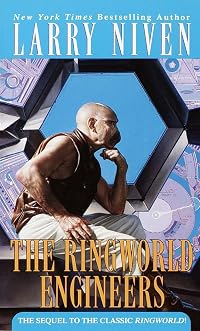
On This Page
Description
It's been twenty years since the quixotic and worlds-weary Louis Wu discovered the Ringworld. Now he and Speaker-to-Animals are going back, captives of the Hindmost, a deposed puppeteer leader.With Louis' help, the Hindmost intends to regain his status by bringing back such extraordinary treasures from the Ringworld that his fellow puppeteers will have to be impressed. But when they arrive, Louis discovers that the Ringworld is no longer stable—and will destroy itself within months. To show more survive, he must locate the control center of the legendary engineers who built the planet.
His quest becomes a wild and gripping venture blended with the mysteries and spectacular technologies that only Larry Niven can conjure.
. show less
Tags
Recommendations











Member Reviews
I didn't really enjoy the original Ringworld, and this book, the sequel, was a little worse. I only persevered in reading it out of a sense of duty: given that the Ringworld is so famously unstable, I wanted to see how Niven had responded to fans' engineering tips. Call it reading the primary source materials behind an episode in nerd history.
In his preamble, Niven states that he had had no intention to write a sequel to the earlier book, and that he only wrote Engineers to quiet down the clamoring hordes. Cue a mixture of back-pedalling, retconning and infodumps, all lacking even the modicum of inspiration that characterized Ringworld.
The storyline seemed much less self-contained than the original book: it felt as though Niven was show more cramming as much corrective physics and engineering into this volume as possible in order to please the many fans who'd mailed him their suggestions; plots and events and even character development (e.g. a recovering drug addict) took a back seat and were often mere excuses for exposition and infodumping. Just about the only thing about Engineers where it outclasses the previous volume is the moral issues: the main character does contemplate the death and destruction that the troupe's earlier romping about had caused. In a similar vein, the ending to this instalment is a little stronger than the first in that it invokes moral dilemmas; if only it wouldn't then casually brush them aside after a paragraph's shallow consideration.
One thing that Engineers did so much worse than the original was the attitudes surrounding sex -- and especially the part where the main character, as a red-blooded male, can't be expected to not have any. Ringworld had two women explicitly stating they would join the main character (Gary Stu in all but name) on a long voyage in a cramped space ship partially so he wouldn't have to sleep alone. Engineers turned that up to eleven, by introducing the concept of rishathra: ritualized inter-species sex between various species of hominids to seal agreements, solve diplomatic issues, or for anticonception purposes (due to interspecies infertility). Naturally, Mr. Stu gets to sample a wide selection of local females, because Niven keeps introducing rationalizations for why rishathra is necessary in Mr. Stu's dealings with any species he comes across.
So. I've now read two famous sf classics that come with an amusing anecdote in nerd history, and I've now more than fulfilled my nerd duties. I will not be reading the next instalments in this series. show less
In his preamble, Niven states that he had had no intention to write a sequel to the earlier book, and that he only wrote Engineers to quiet down the clamoring hordes. Cue a mixture of back-pedalling, retconning and infodumps, all lacking even the modicum of inspiration that characterized Ringworld.
The storyline seemed much less self-contained than the original book: it felt as though Niven was show more cramming as much corrective physics and engineering into this volume as possible in order to please the many fans who'd mailed him their suggestions; plots and events and even character development (e.g. a recovering drug addict) took a back seat and were often mere excuses for exposition and infodumping. Just about the only thing about Engineers where it outclasses the previous volume is the moral issues: the main character does contemplate the death and destruction that the troupe's earlier romping about had caused. In a similar vein, the ending to this instalment is a little stronger than the first in that it invokes moral dilemmas; if only it wouldn't then casually brush them aside after a paragraph's shallow consideration.
One thing that Engineers did so much worse than the original was the attitudes surrounding sex -- and especially the part where the main character, as a red-blooded male, can't be expected to not have any. Ringworld had two women explicitly stating they would join the main character (Gary Stu in all but name) on a long voyage in a cramped space ship partially so he wouldn't have to sleep alone. Engineers turned that up to eleven, by introducing the concept of rishathra: ritualized inter-species sex between various species of hominids to seal agreements, solve diplomatic issues, or for anticonception purposes (due to interspecies infertility). Naturally, Mr. Stu gets to sample a wide selection of local females, because Niven keeps introducing rationalizations for why rishathra is necessary in Mr. Stu's dealings with any species he comes across.
So. I've now read two famous sf classics that come with an amusing anecdote in nerd history, and I've now more than fulfilled my nerd duties. I will not be reading the next instalments in this series. show less
Alternative title: Louis Wu gets Busy
While not quite the crowning achievement of Ringworld, this is a solid scifi book that explores the concept of human evolution, using the Ring to expand the space of possibilities.
In the dedication, Larry Niven says he never intended to write a sequel to Ringworld. It was the continual efforts of his fans that persuaded him to do so, and provided a lot of material in the process. Including the hook that drives the action in the book: the Ringworld is not dynamically stable in orbit. A Dyson sphere is, any perturbation of the orbit tends to be cancelled out. Not so, for the Ringworld.
Thus, when Louis Wu is kidnapped and returned to the Ringworld, he finds he must save it, and the trillions of humans show more who live on it. I call them humans even though they are clearly not the same species as Louis, because "human" isn't really a biological concept at all. I get a lot of mileage out of this quote from John J. Reilly, which will be coming up in a blog post he wrote on October 3rd of 2006.
"A human is an essence (if you don't believe in essences you don't believe in human beings); a homo sapiens is a kind of monkey; and a person is a phenomenon. Perhaps I read too much science fiction, but it is not at all clear to me that every human must necessarily be a homo sapiens. As for person, which is an entity, conscious or otherwise, that you can regard as a "thou," is conflated with the notion of person, as an entity able to respond in law, either directly or through an agent."
This very well could have been the book John had in mind when he said that. The other humans on the Ringworld do share a common ancestor with Louis Wu, a really long time ago. However, in the intervening millennia, they have diversified into a vast array of different species, filling empty niches in the Ringworld's ecology, and evolving societies to match.
There are small carnivorous herders with sharp teeth, and large grazers with flat teeth, and scavengers, and so on. And this is all just in the one small part of the Ringworld Louis keeps going back to. The Ringworld is just so big, that lots and lots of evolution will occur, because the rate of favorable mutations spreading scales up with population size, and the population size on the Ringworld is really, really big.
However, it doesn't look to me [or Greg Cochran] like Niven got here in this way, but looking at what selection could do in the time and space available. It looks like he thought this was a cool idea, and he just ran with it. So, hardish scifi.
Also, I am still struck that Niven's Ringworld books are a product of their time. The glue that holds all of the various species of the Ring together is ritual sex between species, which he calls rishathra. As Louis moves through the Ring on his quest, he has sex with pretty much everything that moves, because that is just what you do there.
In fact, it turns out that literally the only temptation in the known universe that Louis cannot resist is his libido. Inbetween the first book and this one, Louis ends up spending most of his time "under the wire", Niven's slangy term for having an electrode implanted in your brain's pleasure center. This turns into a providential plot point at the end of the book, but I find it kind of funny that Louis can resist anything but sex. In the era of #MeToo, perhaps this was unintentionally prophetic. show less
While not quite the crowning achievement of Ringworld, this is a solid scifi book that explores the concept of human evolution, using the Ring to expand the space of possibilities.
In the dedication, Larry Niven says he never intended to write a sequel to Ringworld. It was the continual efforts of his fans that persuaded him to do so, and provided a lot of material in the process. Including the hook that drives the action in the book: the Ringworld is not dynamically stable in orbit. A Dyson sphere is, any perturbation of the orbit tends to be cancelled out. Not so, for the Ringworld.
Thus, when Louis Wu is kidnapped and returned to the Ringworld, he finds he must save it, and the trillions of humans show more who live on it. I call them humans even though they are clearly not the same species as Louis, because "human" isn't really a biological concept at all. I get a lot of mileage out of this quote from John J. Reilly, which will be coming up in a blog post he wrote on October 3rd of 2006.
"A human is an essence (if you don't believe in essences you don't believe in human beings); a homo sapiens is a kind of monkey; and a person is a phenomenon. Perhaps I read too much science fiction, but it is not at all clear to me that every human must necessarily be a homo sapiens. As for person, which is an entity, conscious or otherwise, that you can regard as a "thou," is conflated with the notion of person, as an entity able to respond in law, either directly or through an agent."
This very well could have been the book John had in mind when he said that. The other humans on the Ringworld do share a common ancestor with Louis Wu, a really long time ago. However, in the intervening millennia, they have diversified into a vast array of different species, filling empty niches in the Ringworld's ecology, and evolving societies to match.
There are small carnivorous herders with sharp teeth, and large grazers with flat teeth, and scavengers, and so on. And this is all just in the one small part of the Ringworld Louis keeps going back to. The Ringworld is just so big, that lots and lots of evolution will occur, because the rate of favorable mutations spreading scales up with population size, and the population size on the Ringworld is really, really big.
However, it doesn't look to me [or Greg Cochran] like Niven got here in this way, but looking at what selection could do in the time and space available. It looks like he thought this was a cool idea, and he just ran with it. So, hardish scifi.
Also, I am still struck that Niven's Ringworld books are a product of their time. The glue that holds all of the various species of the Ring together is ritual sex between species, which he calls rishathra. As Louis moves through the Ring on his quest, he has sex with pretty much everything that moves, because that is just what you do there.
In fact, it turns out that literally the only temptation in the known universe that Louis cannot resist is his libido. Inbetween the first book and this one, Louis ends up spending most of his time "under the wire", Niven's slangy term for having an electrode implanted in your brain's pleasure center. This turns into a providential plot point at the end of the book, but I find it kind of funny that Louis can resist anything but sex. In the era of #MeToo, perhaps this was unintentionally prophetic. show less
This was a reread, although I don’t recall when I previously read the book. Some time in the 1980s, I suspect. Everyone knows Ringworld, it was even No. 60 in the SF Masterworks series. Niven admits he had never intended to write a sequel, but he’d received so much correspondence about the novel - a lot of it pointing out where he’d got things wrong. Earth famously rotates the wrong way in the opening chapter of the novel (updated in later editions), but the chief complaint was that the ringworld was unstable. It needed attitude jets to keep it in orbit. So Niven decided to write The Ringworld Engineers, which is all about the attitude jets. Mostly.
Twenty-three years after the events of Ringworld, Louis Wu is a wirehead. He and show more his kzinti companion on that trip, Speaker-to-Animals, now called Chmeee, are kidnapped by a Pierson’s Puppeteer. Who is actually the mate of the Pierson’s Puppeteer from Ringworld, and was the leader of the race, the Hindmost. He was ousted and now plans to win back his position by fetching a “treasure” from the ringworld, a transmutation device.
Which doesn’t exist and never existed. But that proves irrelevant because the ringworld has been knocked from its orbit and will impact the sun in a year or so. The City Builders, the most powerful race on the ringworld, had removed the attitude jets from the ringworld’s rim, the jets that kept it in orbit, in order to power their spaceships. Hence the current situation.
Wu decides there must be a Repair Centre, a sort of central control complex for the ringworld. If he can find it, then he can prevent the ringworld from being destroyed. But first he has to find it.
The humanoid races on the ringworld have created, and maintained, treaties and coalitions through “rishathra”, which is sex between people of different hominid races. Niven obviously likes writing about sex, or rather the easy availability of it to males, but this is commercial science fiction so it’s either alluded to or entirely off the page. It leaves a bad taste.
The other problem is the distances - the ringworld is huge. Absolutely fucking enormous. With a surface area equivalent to three million Earths. Most of the action in The Ringworld Engineers takes place around the Great Ocean, an ocean so large it features archipelagos which are full-size maps of various planets in Known Space (including Earth, Mars and Kzin), and which are hundreds of thousands of miles apart. After a while, the distance gets wearying, it’s almost like some sort of scale fatigue sets in. It becomes meaningless, just words. Niven uses the right words, but there’s no sense of wonder attached to the vast scale of it all.
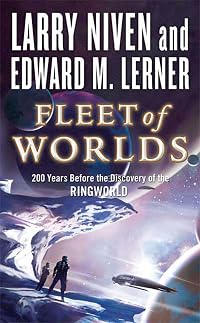
The Ringworld Engineers fixes the issue with the ringworld’s unstable orbit, and even identifies its builders - linking back to an earlier novel by Niven. He returned to the ringworld seventeen years later with The Ringworld Throne, and then again eight years after that with Ringworld’s Children. Five prequel novels, the Fleet of Worlds series, then followed.
The ringworld is a great creation, one of science fiction's most memorable. The plot of the novel which introduced it doesn't really matter. Same for its sequels. Dune had great world-building, but its plot helped bring it to life. The plot of Ringworld is irrelevant, the Big Dumb Object exists in spite of it. And so it is for The Ringworld Engineers. Which presents a disappointing, and unconvincing, explanation as the answer to the question of who built it, and never really manages to really evoke the scale of it all. show less
Twenty-three years after the events of Ringworld, Louis Wu is a wirehead. He and show more his kzinti companion on that trip, Speaker-to-Animals, now called Chmeee, are kidnapped by a Pierson’s Puppeteer. Who is actually the mate of the Pierson’s Puppeteer from Ringworld, and was the leader of the race, the Hindmost. He was ousted and now plans to win back his position by fetching a “treasure” from the ringworld, a transmutation device.
Which doesn’t exist and never existed. But that proves irrelevant because the ringworld has been knocked from its orbit and will impact the sun in a year or so. The City Builders, the most powerful race on the ringworld, had removed the attitude jets from the ringworld’s rim, the jets that kept it in orbit, in order to power their spaceships. Hence the current situation.
Wu decides there must be a Repair Centre, a sort of central control complex for the ringworld. If he can find it, then he can prevent the ringworld from being destroyed. But first he has to find it.
The humanoid races on the ringworld have created, and maintained, treaties and coalitions through “rishathra”, which is sex between people of different hominid races. Niven obviously likes writing about sex, or rather the easy availability of it to males, but this is commercial science fiction so it’s either alluded to or entirely off the page. It leaves a bad taste.
The other problem is the distances - the ringworld is huge. Absolutely fucking enormous. With a surface area equivalent to three million Earths. Most of the action in The Ringworld Engineers takes place around the Great Ocean, an ocean so large it features archipelagos which are full-size maps of various planets in Known Space (including Earth, Mars and Kzin), and which are hundreds of thousands of miles apart. After a while, the distance gets wearying, it’s almost like some sort of scale fatigue sets in. It becomes meaningless, just words. Niven uses the right words, but there’s no sense of wonder attached to the vast scale of it all.
The Ringworld Engineers fixes the issue with the ringworld’s unstable orbit, and even identifies its builders - linking back to an earlier novel by Niven. He returned to the ringworld seventeen years later with The Ringworld Throne, and then again eight years after that with Ringworld’s Children. Five prequel novels, the Fleet of Worlds series, then followed.
The ringworld is a great creation, one of science fiction's most memorable. The plot of the novel which introduced it doesn't really matter. Same for its sequels. Dune had great world-building, but its plot helped bring it to life. The plot of Ringworld is irrelevant, the Big Dumb Object exists in spite of it. And so it is for The Ringworld Engineers. Which presents a disappointing, and unconvincing, explanation as the answer to the question of who built it, and never really manages to really evoke the scale of it all. show less
The Ringworld Engineers is a direct follow-up to Ringworld in which most of the protagonists from the original novel get roped into another expedition to the Ringworld. In this book, the reader encounters a greater variety of the Ringworld's inhabitants, who are portrayed as a lot less human than the ones encountered in the first book. At the same time, we're given a reasonable explanation of why they seem human at all, which I thought was a big plot hole from the original. I really enjoyed exploring the world and meeting the different peoples, and how they've adapted to the general fall of high technology. The protagonists this time are much more interested in the mysteries of the Ringworld's origin and workings (or at least Louis is), show more giving the reader an outlet to his own curiosity--and we're actually given some answers this time. Largely absent is the "bred for luck" Teela plotline from the first book which I disliked, though she does make a brief appearance. On the whole I thought this was a better read than the first book, and more of what I really wanted from an exploration novel. show less
Niven, Larry. Ringworld Engineers. 1979. Ringworld No. 2. Del Rey, 1997.
Ringworld Engineers shows us how big projects go wrong in big ways. Louis Wu is kidnapped by a Puppeteer and returned to Ringworld, where he finds trillions of sapient beings threatened by an instability that could lead the whole Ringworld structure to crash into its star. The Puppeteer only wants to scavenge some Ringworld technology before it is too late, and it needs Wu and a Kzin ally to help him get it. Wu has become a wirehead addicted to electrical stimulation of his pleasure centers, and the Puppeteer controls him with it. The novel’s world-building is rich. There are lots of new aliens to meet. There is multispecies sex. But by far the most interesting show more character in the series is Teela Brown, who is the key to the whole business. She has inherited a gene for luck, but it doesn’t always rub off on her friends. In fact, Niven seems to be toying with the idea that the gene isn’t lucky for Teela as an individual but only for the gene itself. The ideas that would eventually give rise to Richard Dawkins’ The Selfish Gene were already in the air when Ringworld Engineers was written. Niven has said that in creating Teela, he had done the authorly equivalent of painting himself into a corner. A species with a gene for luck is not likely to have a dramatic history. 4 Stars. show less
Ringworld Engineers shows us how big projects go wrong in big ways. Louis Wu is kidnapped by a Puppeteer and returned to Ringworld, where he finds trillions of sapient beings threatened by an instability that could lead the whole Ringworld structure to crash into its star. The Puppeteer only wants to scavenge some Ringworld technology before it is too late, and it needs Wu and a Kzin ally to help him get it. Wu has become a wirehead addicted to electrical stimulation of his pleasure centers, and the Puppeteer controls him with it. The novel’s world-building is rich. There are lots of new aliens to meet. There is multispecies sex. But by far the most interesting show more character in the series is Teela Brown, who is the key to the whole business. She has inherited a gene for luck, but it doesn’t always rub off on her friends. In fact, Niven seems to be toying with the idea that the gene isn’t lucky for Teela as an individual but only for the gene itself. The ideas that would eventually give rise to Richard Dawkins’ The Selfish Gene were already in the air when Ringworld Engineers was written. Niven has said that in creating Teela, he had done the authorly equivalent of painting himself into a corner. A species with a gene for luck is not likely to have a dramatic history. 4 Stars. show less
Sequel to the Sci Fi classic "Ringworld", and I liked it better than the original. In this volume, set 23 years later, protagonist Louis Wu and his Kzinti comrade Speaker to Animals (now named Chmee) are kidnapped by another Puppeteer and brought back to the Ringworld in order to find a machine that the Puppeteer can bring back to his homeworld to reclaim his standing as leader.
Once on the Ringworld, however, the expedition discovers that the artifact has come off-center and is in danger of falling into its sun. The remainder of the book features the expedition's attempts to save the Ringworld.
Niven's strength remains that he writes plausible science, with carefully crafted physics and an imaginative world. Following the plot can be show more challenging, however, as he doesn't always explain clearly what is going on.
Anyway, a good take, and I'm hooked enough to continue and read the rest of the series. show less
Once on the Ringworld, however, the expedition discovers that the artifact has come off-center and is in danger of falling into its sun. The remainder of the book features the expedition's attempts to save the Ringworld.
Niven's strength remains that he writes plausible science, with carefully crafted physics and an imaginative world. Following the plot can be show more challenging, however, as he doesn't always explain clearly what is going on.
Anyway, a good take, and I'm hooked enough to continue and read the rest of the series. show less
This book is emblematic of what gives sci-fi it's bad rap. What should be a straightforward high-stakes adventure with interesting characters in an imaginative setting is bogged down by having to stop every few pages [not quite that often, but it felt that way] to explain some science stuff in a data dump. And then once things get going again, the main character has to stop what he's doing to have gratuitous space-sex with another alien.
And maybe I was just distracted, but I found it difficult to follow the action [wait, are they underground or on a boat or in a floating city] and the characters' motivations convoluted as they worked together to Save The World while simultaneously pursuing their own objectives and double-crossing each show more other. Things that should have been momentous reveals got lost in the weeds and seemed anti-climactic, and it was hard to stay engaged. show less
And maybe I was just distracted, but I found it difficult to follow the action [wait, are they underground or on a boat or in a floating city] and the characters' motivations convoluted as they worked together to Save The World while simultaneously pursuing their own objectives and double-crossing each show more other. Things that should have been momentous reveals got lost in the weeds and seemed anti-climactic, and it was hard to stay engaged. show less
Members
- Recently Added By
Lists

Speculative Fiction to Read
706 works; 32 members

Books Read in 2019
4,052 works; 108 members

Books Read in 2025
4,091 works; 97 members
Author Information

331+ Works 98,196 Members
Larry Niven received his B.A. in mathematics in 1962. His first novel, World of Ptavvs (1966), was a success and launched his career. Niven has won five Hugos and one Nebula award, testimony that his colleagues in the science fiction world respect his work. Perhaps Niven's most well-known creation is Ringworld, a distant planet that may be taken show more as a metaphor for Earth, as it was once great but has since fallen into decay. (Bowker Author Biography) show less
Some Editions
Awards and Honors
Awards
Series


Work Relationships
Is contained in
Common Knowledge
- Canonical title*
- Ringwelt-Ingenieure
- Original title
- The Ringworld Engineers
- Original publication date
- 1980
- People/Characters
- Louis Wu; Speaker-To-Animals (Chmeee); Hindmost; Teela Brown; Nessus; Halrloprillalar Hotrufan
- Important places
- Ringworld
- Dedication
- [a page and a half of detailing comment]
You who did all that work and wrote all those letters: be warned that this book would not exist without your unsolicited help. I hadn't the slightest intention of writing ... (show all)a sequel to Ringworld.
I dedicate this book to you. - First words
- Louis Wu was under the wire when two men came to invade his privacy.
- Last words
- (Click to show. Warning: May contain spoilers.)"Kawaresksenjajok, Harkabeeparolyn, shall we check out some legends for ourselves? And maybe make a few."
- Blurbers
- Anderson, Poul; Williamson, Jack
- Original language
- English
- Canonical DDC/MDS
- 813.08762
*Some information comes from Common Knowledge in other languages. Click "Edit" for more information.
Classifications
- Genres
- Science Fiction, Fiction and Literature
- DDC/MDS
- 813.08762 — Literature & rhetoric American literature in English American fiction in English By type Genre fiction Adventure fiction Speculative fiction Science fiction
- LCC
- PS3564 .I9 — Language and Literature American literature American literature Individual authors 1961-
- BISAC
Statistics
- Members
- 4,855
- Popularity
- 2,903
- Reviews
- 52
- Rating
- (3.57)
- Languages
- 12 — Czech, Danish, Dutch, English, Estonian, French, German, Italian, Polish, Romanian, Spanish, Turkish
- Media
- Paper, Audiobook, Ebook
- ISBNs
- 46
- ASINs
- 28