On This Page
Description
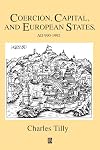
In this pathbreaking work, now available in paperback, Charles Tilly challenges all previous formulations of state development in Europe. Specifically, Tilly charges that most available explanations fail because they do not account for the great variety of kinds of states which were viable at different stages of European history, and because they assume a unilinear path of state development resolving in today's national state.Tags
Recommendations























Member Reviews
Coercion, Capital, and European States charts a grand theory of history that attempts to explain why Europe in the late 20th century looks like it does, a fairly uniform sprawl of nation-state social democracies, as opposed to the diverse variety of political systems existent over the past 1000 years: feudal baronies, city-states, sprawling empires. Tilly's basic thesis is that states make war, and vice versa. The increasing expense of maintaining gunpowder, and later armies of mass conscripts, forced centralization and fictionalization, which broke less affluent and efficient states, and lead towards the modern ideal. This is not to imply a singular and inevitable path: Tilly traces a coercion intensive path followed by Sweden, a show more capital intensive path followed by the Dutch, and a medium path typical of France, England, and Prussia.
As a relatively short book, it's hard to cover every part of the grand theory in detail, but I was dissatisfied. Clearly, coercion and capital are two major forces in history, but as variables they lack explanatory power. Armies look like unitary instruments of coercion from a distance, and in a Clausewitzian framework, are coercive elements of power between states, but this glosses over the factionalism that characterized pre-modern armies, the autonomy of a warrior elite against the agricultural masses, and the difficulty of using coercion systematically against weaker states. While Tilly is right to note that budgets increased in time of war settle at a higher baseline, and to gesture at key phase transitions in warfare, he is vague on key details. In particular, there should be more comparison between strong kings and weak kings at the mercy of major dukes, the rise and fall of the condottieri mercenary regiment, the Levée en masse of the French Revolution, and high-tech warfare of the 20th century. I'd point towards McNeill's The Pursuit of Power and Mallett's Mercenaries and the Masters for the first two, I'm not well-versed enough on the French Revolution to talk about the second one, and the third deserves an entire shelf.
Economics is an area that I am less well-versed on than military history, but I was equally dissatisfied with his explanation of capital. Cities and trade networks serve as the engines of capital accumulation, and wealth is linked to military strength as wars became increasingly financed by loans, but there is more there. The good credit of Dutch merchants helped liberate them from Spanish rule as Spain declared bankruptcy several times during the Spanish-Dutch wars, yet the wealthy city-states of Italy declined as powers past the 16th century. There are obvious benefits to being the center of the financial system, as London and New York's dominance show. Yet capital is fluid, transnational, and while states benefit from and caused monetization, capital is distinct from statehood. In particular, more attention should be paid to 'real capital', in the productive qualities of physical objects on the land, against capital that exists on paper and in the beliefs of bankers.
It's not a surprise that someone with my academic pedigree would say this, but Coercion, Capital, and European States could really use more engagement with the biopolitical theories of Foucault. Tilly completely misses the development of disciplinary administrative apparatuses as an element of power, and the circulation of disciplinary techniques between states. The nation-state, which links ethnicity, territory, and administration in a sovereign union, can only be understood from a biopolitical perspective.
The final chapter, on the extension of European style states to the the post-colonial, post-World War II order, and the continued resilience of military elites in the third world, has not aged particularly well. I can't blame someone writing at the fall of the USSR for thinking out loud about states in the 21st century and not capturing the War on Terror, the rise of transnational NGOs as instruments of power, and the concerns about failed and failing states, but this book posits an end to history and fails to see beyond it. And finally, if I were a scholar in this field, I'm not sure how I'd use the ideas here. Plot my state on Capital vs Coercion over time? Draw lines? Postulate moderation as good? show less
As a relatively short book, it's hard to cover every part of the grand theory in detail, but I was dissatisfied. Clearly, coercion and capital are two major forces in history, but as variables they lack explanatory power. Armies look like unitary instruments of coercion from a distance, and in a Clausewitzian framework, are coercive elements of power between states, but this glosses over the factionalism that characterized pre-modern armies, the autonomy of a warrior elite against the agricultural masses, and the difficulty of using coercion systematically against weaker states. While Tilly is right to note that budgets increased in time of war settle at a higher baseline, and to gesture at key phase transitions in warfare, he is vague on key details. In particular, there should be more comparison between strong kings and weak kings at the mercy of major dukes, the rise and fall of the condottieri mercenary regiment, the Levée en masse of the French Revolution, and high-tech warfare of the 20th century. I'd point towards McNeill's The Pursuit of Power and Mallett's Mercenaries and the Masters for the first two, I'm not well-versed enough on the French Revolution to talk about the second one, and the third deserves an entire shelf.
Economics is an area that I am less well-versed on than military history, but I was equally dissatisfied with his explanation of capital. Cities and trade networks serve as the engines of capital accumulation, and wealth is linked to military strength as wars became increasingly financed by loans, but there is more there. The good credit of Dutch merchants helped liberate them from Spanish rule as Spain declared bankruptcy several times during the Spanish-Dutch wars, yet the wealthy city-states of Italy declined as powers past the 16th century. There are obvious benefits to being the center of the financial system, as London and New York's dominance show. Yet capital is fluid, transnational, and while states benefit from and caused monetization, capital is distinct from statehood. In particular, more attention should be paid to 'real capital', in the productive qualities of physical objects on the land, against capital that exists on paper and in the beliefs of bankers.
It's not a surprise that someone with my academic pedigree would say this, but Coercion, Capital, and European States could really use more engagement with the biopolitical theories of Foucault. Tilly completely misses the development of disciplinary administrative apparatuses as an element of power, and the circulation of disciplinary techniques between states. The nation-state, which links ethnicity, territory, and administration in a sovereign union, can only be understood from a biopolitical perspective.
The final chapter, on the extension of European style states to the the post-colonial, post-World War II order, and the continued resilience of military elites in the third world, has not aged particularly well. I can't blame someone writing at the fall of the USSR for thinking out loud about states in the 21st century and not capturing the War on Terror, the rise of transnational NGOs as instruments of power, and the concerns about failed and failing states, but this book posits an end to history and fails to see beyond it. And finally, if I were a scholar in this field, I'm not sure how I'd use the ideas here. Plot my state on Capital vs Coercion over time? Draw lines? Postulate moderation as good? show less
inventio
Visiting Luke as follower of Ronen Bergman this was one of the skip 20 list on the comparing page.
According to some reviews it is interesting, therefore it could take some time to get it.
LOC gives 1990 and 1992 (this is the edition of 1993 0408) -
1992 -
1990 -
Wiley-Blacwell gives 2 titles with the author -
the other is European Revolutions, 1492 - 1992
bookpage publisher -
previews:
toc pdf, 2 p. -
Cities and States in World History (ch 1) pdf, 37 p. -
index pdf, 14 p. (5 empty)
-.
Ratings
Members
- Recently Added By
Author Information

61+ Works 1,876 Members
Social scientist Charles Tilly was born in Lombard, Illinois on May 27, 1929. He graduated from Harvard Univeristy with a bachelor's degree in 1950 and a docorate in sociology in 1958. He also studied at Oxford University and the Catholic University in Angers, France. During the Korean War, he served in the Navy. He taught sociology and political show more science at numerous univeristies including the University of Delaware, Harvard University, the University of Toronto, the University of Michigan and Columbia University. During his lifetime, he wrote 51 books and monographs and more than 600 scholoarly articles. He received numerous awards including the Albert O. Hirschman Award from the Social Science Research Council. He died from lymphoma on April 29, 2008. (Bowker Author Biography) show less
Series

Common Knowledge
- Canonical title
- Coercion, Capital, and European States, AD 990-1990
- Original publication date
- 1990
- Important places
- Europe
- Original language
- English
Classifications
- Genres
- Nonfiction, Sociology, History, General Nonfiction, Politics and Government
- DDC/MDS
- 940 — History & geography History of Europe History of Europe
- LCC
- JN94 .A2 .T54 — Political Science Political institutions and public administration (Europe) Political institutions and public administration (Europe) General
- BISAC
Statistics
- Members
- 300
- Popularity
- 107,223
- Reviews
- 2
- Rating
- (4.07)
- Languages
- 5 — English, French, Portuguese, Spanish, Turkish
- Media
- Paper
- ISBNs
- 6
- ASINs
- 1