On This Page
Description
A COUNTRY HOUSE MYSTERY PERFECT FOR FANS OF AGATHA CHRISTIEEvery family has secrets, but now they are turning deadly...
On a dark night, along a lonely country road, barrister Frank Amberley stops to help a young lady in distress and discovers a sports car with a corpse behind the wheel. The girl protests her innocence and Amberley believes her—at least until he gets drawn into the mystery and the evidence incriminating Shirley Brown begins to add up.
Why Shoot a Butler? is an English show more country-house murder with a twist. In this beloved classic by Georgette Heyer, the butler is the victim, every clue complicates the puzzle, and the bumbling police are well-meaning but completely baffled. Fortunately, amateur sleuth Amberley is as brilliant as he is arrogant as he ferrets out the desperate killer—even though this time he's not sure he wants to know the truth...
. show less
Tags
Recommendations


















Member Reviews
I read Why Shoot a Butler? while the kids were off at school today. I’m more familiar with Georgette Heyer’s romances, but I like her enough that I was willing to try this (besides, my sister gave it to me with a glowing recommendation.)
It turned out to be a light, fun read. Frank Amberley’s obnoxious brilliance is entertaining, so much so that I was only slightly annoyed at all the places where he investigated this or that–and then didn’t tell what he discovered. Probably best that way, because it kept me from guessing everything on the second page. As it was, even my somewhat sluggish mind had unraveled about two-thirds of the puzzle by book’s end, so if I’d known more, I probably would have guessed the whole, which show more tends to make a mystery less interesting.
Still, the dialogue is witty, the characters crisp, and the setting the type of idyllic British countryside town I love to visit in books. (I’ve never had the opportunity to visit one in person. Who knows if they even exist, and if so, whether they’d be any fun?)
Definitely worth curling up with for a couple of entertaining hours. show less
It turned out to be a light, fun read. Frank Amberley’s obnoxious brilliance is entertaining, so much so that I was only slightly annoyed at all the places where he investigated this or that–and then didn’t tell what he discovered. Probably best that way, because it kept me from guessing everything on the second page. As it was, even my somewhat sluggish mind had unraveled about two-thirds of the puzzle by book’s end, so if I’d known more, I probably would have guessed the whole, which show more tends to make a mystery less interesting.
Still, the dialogue is witty, the characters crisp, and the setting the type of idyllic British countryside town I love to visit in books. (I’ve never had the opportunity to visit one in person. Who knows if they even exist, and if so, whether they’d be any fun?)
Definitely worth curling up with for a couple of entertaining hours. show less
May contain mild spoilers.
This book has most of the weaknesses I associate with Georgette Heyer’s mysteries. It contains one-dimensional/weakly developed characters and badly developed plot points. Frank Amberley, the sleuthing hero, is cleverer than anyone else in the story and he behaves accordingly by keeping back information and sneering at people. Fortunately for me, I am currently in a cranky mood and only wish I could tell-off people like he does. So, I didn’t mind his arrogance as much as I would have had I read the book in more peaceable times. I don’t know if this is the first time I have noticed this or if this is the only book I have read in which she does this, but for some strange reason portions of the book are show more written in indirect speech. Two characters are interacting, it is written in direct speech, and then suddenly it switches to indirect speech. It is most noticeable when she is dealing with an inspector who does not like the amateur detective hero. It suspiciously comes across as if she did not know how to write his dialogues and dealt with it by just not giving him too many dialogues. The story is stretched out for no good reason and certain portions are repetitive. For example, the interactions between Amberley and Shirley Brown are all identical and does not take the plot forward in any way. He presses her for information, and she refuses to divulge anything. This happens on at least three different occasions. Also, that marriage proposal at the end came out of nowhere. There is scant development of the romantic angle to justify it. One things that did make the book somewhat enjoyable for me is the character of Lady Mathews. I enjoy vague but inherently shrewd women in my mysteries. As far as mysteries go, it is okay. I didn’t hate it and as I have said, I am currently in a mood to tick-off people. So, a book with an irritable hero was kind of therapeutic for me. show less
This book has most of the weaknesses I associate with Georgette Heyer’s mysteries. It contains one-dimensional/weakly developed characters and badly developed plot points. Frank Amberley, the sleuthing hero, is cleverer than anyone else in the story and he behaves accordingly by keeping back information and sneering at people. Fortunately for me, I am currently in a cranky mood and only wish I could tell-off people like he does. So, I didn’t mind his arrogance as much as I would have had I read the book in more peaceable times. I don’t know if this is the first time I have noticed this or if this is the only book I have read in which she does this, but for some strange reason portions of the book are show more written in indirect speech. Two characters are interacting, it is written in direct speech, and then suddenly it switches to indirect speech. It is most noticeable when she is dealing with an inspector who does not like the amateur detective hero. It suspiciously comes across as if she did not know how to write his dialogues and dealt with it by just not giving him too many dialogues. The story is stretched out for no good reason and certain portions are repetitive. For example, the interactions between Amberley and Shirley Brown are all identical and does not take the plot forward in any way. He presses her for information, and she refuses to divulge anything. This happens on at least three different occasions. Also, that marriage proposal at the end came out of nowhere. There is scant development of the romantic angle to justify it. One things that did make the book somewhat enjoyable for me is the character of Lady Mathews. I enjoy vague but inherently shrewd women in my mysteries. As far as mysteries go, it is okay. I didn’t hate it and as I have said, I am currently in a mood to tick-off people. So, a book with an irritable hero was kind of therapeutic for me. show less
When London barrister Frank Amberley gets lost on the way to his uncle’s country house, he notices a car parked on the side of the road and stops to see if he can assist anyone – only to discover that the driver is a surly young woman and that the man sitting in the passenger seat has been shot dead. Although everything seems to point to the woman as the culprit, Frank’s instincts tell him that she is innocent. When he later discovers that the victim was a butler at his uncle’s neighbor’s estate, Frank suspects that there is much more to this murder than meets the eye. After all, as one of the other characters points out, why shoot a butler?
I absolutely love Georgette Heyer, and having read most of her Regency romances, I’m show more now making a start on her mysteries. I really enjoyed this English-country-house mystery, which is similar in style to the works of Agatha Christie and Dorothy Sayers. My favorite aspect of the book was the characters, especially the clever but arrogant Frank Amberley. I also enjoyed the romantic subplot, which Heyer always does so brilliantly. The mystery itself was good too, although in places I felt that Heyer tipped her hand a bit too much. While I didn’t predict the entire solution, there are a few hints at the beginning of the story that enabled me to figure out some pretty important plot elements. Overall, though, I found this an extremely good read and look forward to reading more of Heyer’s mysteries. show less
I absolutely love Georgette Heyer, and having read most of her Regency romances, I’m show more now making a start on her mysteries. I really enjoyed this English-country-house mystery, which is similar in style to the works of Agatha Christie and Dorothy Sayers. My favorite aspect of the book was the characters, especially the clever but arrogant Frank Amberley. I also enjoyed the romantic subplot, which Heyer always does so brilliantly. The mystery itself was good too, although in places I felt that Heyer tipped her hand a bit too much. While I didn’t predict the entire solution, there are a few hints at the beginning of the story that enabled me to figure out some pretty important plot elements. Overall, though, I found this an extremely good read and look forward to reading more of Heyer’s mysteries. show less
Georgette Heyer is probably best known for being the Queen of Regency Romance, having written a barouche full of witty, clever, meticulously detailed examples of the genre over the years. I've read every one of her Regency capers, many of them more than once and some of them more than twice, but I'd never tried one of her forays into the mystery genre until now.
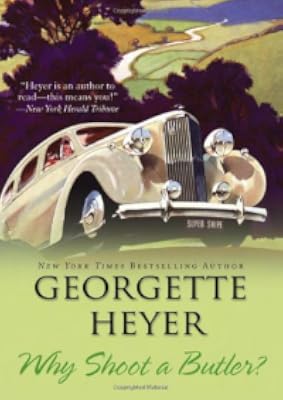
The first clue that this mystery is not set during the Regency period is that motor car on the book cover. Indeed, we are in 1930s England, where a young barrister, Frank Amberley, happens upon a car containing a dead man one evening after getting lost on a country road. There's a young woman standing next to the car, but Amberley's instincts tell him she isn't the culprit. Who show more was, and why, fills the rest of the book as Amberley conducts a parallel investigation to the official police inquiry.
The central mystery is solid, with lots of red herrings and twists to keep a reader guessing. And of course there's the obligatory romance subplot, though it's all very low-key until the very end. Heyer proves as adept at writing for her own time as she was at channeling 19th century high society, though with much less baffling slang and minute descriptions of clothes and vehicles. I don't know if I'll ever think of Heyer's mysteries on the same level as her romances, but I'm certainly willing to read more of them. show less
The first clue that this mystery is not set during the Regency period is that motor car on the book cover. Indeed, we are in 1930s England, where a young barrister, Frank Amberley, happens upon a car containing a dead man one evening after getting lost on a country road. There's a young woman standing next to the car, but Amberley's instincts tell him she isn't the culprit. Who show more was, and why, fills the rest of the book as Amberley conducts a parallel investigation to the official police inquiry.
The central mystery is solid, with lots of red herrings and twists to keep a reader guessing. And of course there's the obligatory romance subplot, though it's all very low-key until the very end. Heyer proves as adept at writing for her own time as she was at channeling 19th century high society, though with much less baffling slang and minute descriptions of clothes and vehicles. I don't know if I'll ever think of Heyer's mysteries on the same level as her romances, but I'm certainly willing to read more of them. show less
Ugh. First off, the narrator was awful. She sounded like an android reading this book, with weird pauses in the middle of the sentences and almost no inflection. Her voice is lovely, but she did a hatchet job on the narration. It did improve by the end, but too late to make me forget how painful the first half of the book was.
Additionally, Amberley is an ass. Perhaps back in the day he came across witty and insouciant but I just got ass. He felt like a slightly older Bright Young Thing. He didn't try to hide his contempt for the local constabulary (who were all, admittedly, written as idiots) or his perceived superiority over just about everybody.
Amberley is on his way to his uncle's house when he comes across a car pulled over on the show more side of a dark road, the driver shot dead in his seat and a young woman standing in the road beside him. She won't tell him anything but convinces him to let her go. When he reports the crime he chooses not to tell the police about her presence. The murder victim is revealed to be the butler for the estate next door and the constabulary enlist his help in investigating what they believe to be an unsolvable crime. He proceeds to rub their noses in his superiority, while constantly haranguing the young woman to Reveal All.
The final nail in the coffin was the ending:
After Amberley saves Shirley from death, and after an entire book in which he never, ever says anything even remotely nice to her, he proposes marriage - if you can it a proposal. "Will you marry me or not?". I don't know what's worse: that he thinks he has basis for asking or that she actually accepts!
I quite liked Footsteps in the Dark as it had at least an air of farce to it, not to mention a "ghost" story, and I loved The Grand Sophy. I knew from previous reviews that Heyer could be hit or miss, so I'm not surprised I hit on a low one. But I won't be trying any more of her mysteries on audio, as it seems every one of them are narrated by the same woman. show less
Additionally, Amberley is an ass. Perhaps back in the day he came across witty and insouciant but I just got ass. He felt like a slightly older Bright Young Thing. He didn't try to hide his contempt for the local constabulary (who were all, admittedly, written as idiots) or his perceived superiority over just about everybody.
Amberley is on his way to his uncle's house when he comes across a car pulled over on the show more side of a dark road, the driver shot dead in his seat and a young woman standing in the road beside him. She won't tell him anything but convinces him to let her go. When he reports the crime he chooses not to tell the police about her presence. The murder victim is revealed to be the butler for the estate next door and the constabulary enlist his help in investigating what they believe to be an unsolvable crime. He proceeds to rub their noses in his superiority, while constantly haranguing the young woman to Reveal All.
The final nail in the coffin was the ending:
I quite liked Footsteps in the Dark as it had at least an air of farce to it, not to mention a "ghost" story, and I loved The Grand Sophy. I knew from previous reviews that Heyer could be hit or miss, so I'm not surprised I hit on a low one. But I won't be trying any more of her mysteries on audio, as it seems every one of them are narrated by the same woman. show less
I think that of all Heyer's mysteries, this one is my favorite. I guess it could be classified as a "cozy" since the main 'detective' isn't a professional (he's a barrister, but this case isn't related to his work in any way) but it also has aspects of romantic suspense. Sort of a cross between Mary Stewart and Dorothy Sayers.
One aspect of not being a police procedural that leapt out at me during this latest reread is it allowed Heyer to give free rein to her genius for repartee. Amberley is a modern day (well, contemporary to when this was written in 1936) version of so many of her heros in the Regency historical fiction books -- intelligent, high-handed, somewhat short-tempered and sarcastic, yet reliable & kind.
I think that the show more mystery is good too, but to be honest, it is hard for me to judge at this point. I have read this several times before and remembered the solution so I was able to pick up clues and hints along the way that I am sure I missed the first time or two I read this. show less
One aspect of not being a police procedural that leapt out at me during this latest reread is it allowed Heyer to give free rein to her genius for repartee. Amberley is a modern day (well, contemporary to when this was written in 1936) version of so many of her heros in the Regency historical fiction books -- intelligent, high-handed, somewhat short-tempered and sarcastic, yet reliable & kind.
I think that the show more mystery is good too, but to be honest, it is hard for me to judge at this point. I have read this several times before and remembered the solution so I was able to pick up clues and hints along the way that I am sure I missed the first time or two I read this. show less
Frank Amberley is intrigued when he comes upon a dead man in a car on a country road, with a young lady standing nearby, a young lady whom he unaccountably doesn’t mention to the police when reporting the incident. He is on his way to visit his aunt, but he soon meets up with an old school friend who is visiting at another stately home in the area, the home of his fiance. When it turns out that the dead man was the butler at said home, Amberley begins to wonder what might have been going on, and since he’s had some success at solving puzzles, he starts to look into it all…. This is one of the “country house mysteries” written by Georgette Heyer, this one published in 1933, and it’s both amusing and somewhat horrifying - the show more former because of the witty banter slung around, the latter because of the general attitude of all the main characters with respect to their servants, very dismissive. As, of course, one can tell by the title. I quite enjoyed the story for what it was, keeping in mind that attitudes 90 years ago were, well, quite different to today; and Amberley, a clever young man, is both just rude enough and just curious enough to figure it all out; mildly recommended. show less
Members
- Recently Added By
Lists

Favorite Georgette Heyer Novels, Ranked
49 works; 29 members

Crime and Mysteries to Read
746 works; 31 members

British Mystery
469 works; 14 members

Recommend the 20 best books you've read in the last five years
2,168 works; 609 members

Murder Mysteries
57 works; 11 members

Top Five Books of 2020
982 works; 350 members

Books With Complete Sentence Titles
501 works; 17 members

Books Read in 2020
4,379 works; 124 members
Author Information

125+ Works 78,314 Members
Georgette Heyer was born on August 16, 1902 at Wimbledon, London. She wrote The Black Moth as a story for her brother Boris. Her father, impressed with his daughter's imagination, suggested that she prepare it to be published, which it was by Constable in 1921. Having scored an instant success with The Black Moth at the age of nineteen under her show more own name, Georgette Heyer, she experimented with a pseudonym, Stella Martin, for her third book, published by Mills & Boon. She continued writing and in 1925 she married Ronald Rougier, a mining engineer. After reasonable but not spectacular sales from her first few books the instant success of These Old Shades in 1926 brought her a solid source of income which was very necessary at the time since the family relied to a large extent on the income from Georgette Heyer's writing. She wrote over fifty books during her lifetime and created the Regency England genre of romance novels. She died on July 4, 1974 at the age of 71. (Bowker Author Biography) show less
Some Editions
Series

Belongs to Publisher Series
Penguin Books (429)
Doubleday Crime Club (1936.24)
Work Relationships
Is contained in
Common Knowledge
- Canonical title
- Why Shoot A Butler?
- Original title
- Why Shoot A Butler?
- Original publication date
- 1933
- People/Characters
- Dawson; Basil Fountain; Joan Fountain; Frank Amberley; Shirley Brown; Mark Brown (show all 11); Anthony Corkran; Sir Humphrey Matthews; Marion, Lady Matthews; Felicity Matthews; Albert Collins
- Important places
- England, UK
- Dedication
- To one who knows why
- First words
- The signpost was unhelpful.
- Quotations
- After all, why shoot a butler? Where's the point?
- Last words
- (Click to show. Warning: May contain spoilers.)He met Mr Amberley's eyes and repeated doggedly: 'In a jiffy, Mr Amberley. I don't say you haven't done well for an amatoor, but what you wanted, sir, was a trained mind on to it. That's what you wanted.'
- Original language
- English
Classifications
Statistics
- Members
- 1,122
- Popularity
- 22,683
- Reviews
- 46
- Rating
- (3.50)
- Languages
- Albanian, English, French, German
- Media
- Paper, Audiobook, Ebook
- ISBNs
- 35
- UPCs
- 1
- ASINs
- 29