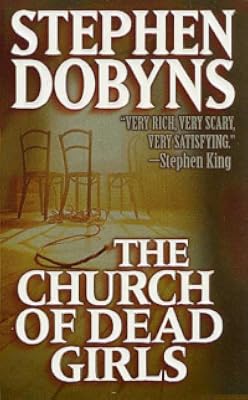
The Church of Dead Girls
by Stephen Dobyns
On This Page
Description
With the first disappearance, the townspeople begin to mistrust outsiders. When the second girl goes missing, neighbors and childhood friends start to eye each other warily. And with the third disappearance, the sleepy little town awakens to a full-blown nightmare. The Church of Dead Girls displays Stephen Dobyns' remarkable gifts for exploring human nature, probing the ruinous effects of suspicion. As panic mounts and citizens take the law into their own hands, no one is immune, and old show more rumors, old angers, and old hungers come to the surface to reveal the secret history of a seemingly genteel town and the dark impulses of its inhabitants. show lessTags
Recommendations






















Member Reviews
Wow. That was a wild ride from start to finish. Intense, complex and unique, I thoroughly devoured The Church of Dead Girls. I often read on my walk to work in the morning but today I sat down at my desk and just had to finish the last few pages, I absolutely could not tear my eyes away from the page.
Ostensibly, The Church of Dead Girls is about the disappearance of three girls in a small New York town above the Finger Lakes. Told from the outsider perspective of a high school science teacher, the lives and secrets of his fellow citizens are revealed slowly, their layers peeled away as the tension between friends and neighbours ratchets up. The abduction of the girls is both horrific and a catalyst, the townfolk growing increasingly mad show more with frustration and suspicion, and fear. Not only fear of their daughter being taken next, but of their secret desires, their illicit actions being exposed and revealed to the cruel eye of the town's populace, the only judge that matters.
As I was reading I was often reminded of Gillian Flynn's Sharp Objects, to which The Church of Dead Girls seems to be a spiritual precursor. There's a creeping, unsettling feeling that only grows as you advance in the story. Like Sharp Objects the disappearance and probable murders of the missing girls, barely in their teenage years, is only part of a larger whole. The narrator relates decades worth of information, gleaned from years of personal interactions or heard secondhand from his friends, piecing together the story from what he's been told into a rich, meaty narrative.
The real story that lurks behind the abduction of the three teenage girls is the unknowable nature of the other. Even those closest to us have their secrets, the thoughts they keep to themselves, a persona they show the world that reflects only a portion of their true self. The mercurial nature of a community influenced by gossip and speculation, suspicion and fear, is as fascinating as it is frustrating. The 'other' is always targeted, the African college professor and his Marxist reading group, gay men, anyone who stands out from the 'norm' suffering from hysterical scapegoating.
Overall, The Church of Dead Girls is slow, but taut, deftly portraying the way a small community operates, the way lives intersect and affect each other. The way the town reacts to the missing girls as scarring and long-lasting as the abductions themselves, mob mentality showing the unintended dark sides of even the innocent. show less
Ostensibly, The Church of Dead Girls is about the disappearance of three girls in a small New York town above the Finger Lakes. Told from the outsider perspective of a high school science teacher, the lives and secrets of his fellow citizens are revealed slowly, their layers peeled away as the tension between friends and neighbours ratchets up. The abduction of the girls is both horrific and a catalyst, the townfolk growing increasingly mad show more with frustration and suspicion, and fear. Not only fear of their daughter being taken next, but of their secret desires, their illicit actions being exposed and revealed to the cruel eye of the town's populace, the only judge that matters.
As I was reading I was often reminded of Gillian Flynn's Sharp Objects, to which The Church of Dead Girls seems to be a spiritual precursor. There's a creeping, unsettling feeling that only grows as you advance in the story. Like Sharp Objects the disappearance and probable murders of the missing girls, barely in their teenage years, is only part of a larger whole. The narrator relates decades worth of information, gleaned from years of personal interactions or heard secondhand from his friends, piecing together the story from what he's been told into a rich, meaty narrative.
The real story that lurks behind the abduction of the three teenage girls is the unknowable nature of the other. Even those closest to us have their secrets, the thoughts they keep to themselves, a persona they show the world that reflects only a portion of their true self. The mercurial nature of a community influenced by gossip and speculation, suspicion and fear, is as fascinating as it is frustrating. The 'other' is always targeted, the African college professor and his Marxist reading group, gay men, anyone who stands out from the 'norm' suffering from hysterical scapegoating.
Overall, The Church of Dead Girls is slow, but taut, deftly portraying the way a small community operates, the way lives intersect and affect each other. The way the town reacts to the missing girls as scarring and long-lasting as the abductions themselves, mob mentality showing the unintended dark sides of even the innocent. show less
In a nutshell: Creepy and well-executed exploration of a small town’s descent into suspicion and hysteria.
The Church of Dead Girls has been languishing on my shelves since 2004 – I don’t know why, it was just one of those books that never made it to the top of my TBR list. Had I known what I was missing, I would have gotten to it a lot sooner.
I picked it up a few days ago, expecting a typical mystery/suspense story. And while all the elements of that kind of novel are present, this book is much more. It is narrated by a man who protects his solitude, so while a part of the town, he is also apart from it. This allows the reader to understand the setting and characters from a near perspective, while also seeing it all from a certain show more remove. As young teenage girls go missing, the citizens of Aurelius, New York begin to look upon one another with increasing suspicion and a touch of hysteria descends on the town. At first, outsiders are blamed, anyone different from the established norm, but as the mystery deepens, neighbors begin to look askance at one another and families are divided.
While the mystery aspect is solid, and the suspense builds well, I was most taken with the portrait of the town and its people and their disintegration, as the community turns on itself. Dobyns does it with a light and subtle hand, so that the evolution is natural and understandable, but still haunting. show less
The Church of Dead Girls has been languishing on my shelves since 2004 – I don’t know why, it was just one of those books that never made it to the top of my TBR list. Had I known what I was missing, I would have gotten to it a lot sooner.
I picked it up a few days ago, expecting a typical mystery/suspense story. And while all the elements of that kind of novel are present, this book is much more. It is narrated by a man who protects his solitude, so while a part of the town, he is also apart from it. This allows the reader to understand the setting and characters from a near perspective, while also seeing it all from a certain show more remove. As young teenage girls go missing, the citizens of Aurelius, New York begin to look upon one another with increasing suspicion and a touch of hysteria descends on the town. At first, outsiders are blamed, anyone different from the established norm, but as the mystery deepens, neighbors begin to look askance at one another and families are divided.
While the mystery aspect is solid, and the suspense builds well, I was most taken with the portrait of the town and its people and their disintegration, as the community turns on itself. Dobyns does it with a light and subtle hand, so that the evolution is natural and understandable, but still haunting. show less
Stephen Dobyns is an underrated writer, I think. I haven’t read his mystery series, but I have read several of his standalone novels, and they remain memorable, even years later. The best of them is The Church of Dead Girls, which I just reread.
The Church of Dead Girls begins and ends with an unsettling, haunting image. I won’t give away the ending, but the opening scene describes three dead girls lined up in an attic, dressed to sparkle and shine in the light of hundreds of candles, like icons in a church. Thus, Dobyns plunges right into the central mystery of the novel: who killed these girls and why?
But this isn’t a typical serial-killer thriller. The story focuses on the community’s reactions to the girls’ disappearances, show more which fundamentally alter the small New England town where they occur. As the disappearances mount up, the townspeople become more agitated, paranoid and suspicious of one another. Any outsider, whether in appearance or behavior, is a target for suspicion. Secrets are exposed. Private lives are made public. The escalating terror drives ordinary people to do horrific things. Through the microcosm of the small town, Dobyns explores how we all react to terror, when we feel like our security and control over our lives have been wrested away. Dobyns ratchets up the tension slowly but relentlessly, and once you reach the final few chapters, it becomes very difficult to put this book down.
Part of the genius of this novel lies in the choice of narrator — not a police detective, as might be expected, but rather a middle-school science teacher who is in a position to observe everything going on in the town, yet is an outsider himself. Through his eyes, we watch the townspeople become more savage under the weight of their fears and suspicions, and we feel those suspicions directed at ourselves. Yet the reader is given reason to believe that the narrator may not be entirely trustworthy. The net effect of uncertainty and suspicion is to amplify the novel’s tension. As readers, we are living through this crisis with everyone in the town.
The Church of Dead Girls is a brilliant novel that I don’t think enough people know about. If you like thrillers, don’t overlook this one. show less
The Church of Dead Girls begins and ends with an unsettling, haunting image. I won’t give away the ending, but the opening scene describes three dead girls lined up in an attic, dressed to sparkle and shine in the light of hundreds of candles, like icons in a church. Thus, Dobyns plunges right into the central mystery of the novel: who killed these girls and why?
But this isn’t a typical serial-killer thriller. The story focuses on the community’s reactions to the girls’ disappearances, show more which fundamentally alter the small New England town where they occur. As the disappearances mount up, the townspeople become more agitated, paranoid and suspicious of one another. Any outsider, whether in appearance or behavior, is a target for suspicion. Secrets are exposed. Private lives are made public. The escalating terror drives ordinary people to do horrific things. Through the microcosm of the small town, Dobyns explores how we all react to terror, when we feel like our security and control over our lives have been wrested away. Dobyns ratchets up the tension slowly but relentlessly, and once you reach the final few chapters, it becomes very difficult to put this book down.
Part of the genius of this novel lies in the choice of narrator — not a police detective, as might be expected, but rather a middle-school science teacher who is in a position to observe everything going on in the town, yet is an outsider himself. Through his eyes, we watch the townspeople become more savage under the weight of their fears and suspicions, and we feel those suspicions directed at ourselves. Yet the reader is given reason to believe that the narrator may not be entirely trustworthy. The net effect of uncertainty and suspicion is to amplify the novel’s tension. As readers, we are living through this crisis with everyone in the town.
The Church of Dead Girls is a brilliant novel that I don’t think enough people know about. If you like thrillers, don’t overlook this one. show less
Definitely not the usual thriller with serial killer that one would expect. Forget the sensationalism of gruesome crime scene description...this is more of a psychological study of a small town and what happens when fear turns each one against the "different ones". A community that breaks down and shows how mankind is not so different from the animals it likes to think are inferior.
If you think the serial-killer story has nothing new to offer, try this. A small upstate New York town is tormented by the disappearances, presumed murders, of a succession of adolescent girls -- not to mention the murder a couple of years ago of the local nymphomaniac and the grotesque murder now of one of the town's few overt gay men. The net effect is a breakdown of the town's social order, as vigilantes presume to themselves a role that is above the law. All of this is told by a rather peculiar high school biology teacher, whose observations of his fellow citizens, while pithy, may not be entirely reliable: he has his own agenda. The style in which he narrates the events is flat, unsensational . . . and, I found, absolutely hypnotic show more (despite the annoyance of a couple of characterization inconsistencies). This is a mainstream novel whose subject matter happens to be, almost incidentally, a series of psychopathic killings. Much recommended. show less
Truly excellent psychological thriller that is also the tale of a small town and the insidiousness of suspicion. While others found the backstory of the town inhabitants too slow, I actually loved it -- the relationships were drawn so carefully and how people connect with and relate to each other does impact the plot. Well-written saga of a town. Insightful and true small-town politics and resistance to change. Good mystery, too.
I suppose on the cover this would be a mystery about three murdered girls in the small town of Aurelius in upstate New York. However, I found it to be much more than that.
This is one of those books where nothing happens for the first half- Dobyns spends a good 100 pages setting up the personalities and places in Aurelius. This set up is well worth it, since by the time I realized nothing much had happened, I was too engrossed in the details of this small town.
As Dobyns delves deeper into the personalities of his characters, the reader begins to realize that there is something dark beneath the surface of Aurelius.
This darkness takes the form a murderer, yes.
But the darkness comes through more clearly- and, for me, more frighteningly- show more in the behavior of the townspeople as the murders continue. show less
This is one of those books where nothing happens for the first half- Dobyns spends a good 100 pages setting up the personalities and places in Aurelius. This set up is well worth it, since by the time I realized nothing much had happened, I was too engrossed in the details of this small town.
As Dobyns delves deeper into the personalities of his characters, the reader begins to realize that there is something dark beneath the surface of Aurelius.
This darkness takes the form a murderer, yes.
But the darkness comes through more clearly- and, for me, more frighteningly- show more in the behavior of the townspeople as the murders continue. show less
Members
- Recently Added By
Lists

Best Crime Fiction
262 works; 39 members

Crime and Mysteries to Read
746 works; 31 members

Dark Books for Winter Reading
71 works; 11 members

Books About Murder
313 works; 7 members

Stephen King's 'On Writing' reading list
95 works; 4 members
Jones & Newman: Best Horror Books Further Recommended Reading
577 works; 4 members
Books Tagged Small Town
58 works; 1 member

Books Read in 2011
684 works; 19 members

Books With Girls in Titles
27 works; 2 members

Books Read in 2008
335 works; 8 members

Missing!
18 works; 4 members

Five star books
1,767 works; 110 members

Books Set in New York State
65 works; 11 members

Serial Killer Thrillers
56 works; 6 members
Books Set in Small Towns and Villages
278 works; 16 members

1990s
309 works; 17 members

Nineties
43 works; 10 members

Best Horror Books
281 works; 85 members
Author Information

45+ Works 3,758 Members
Stephen Dobyns was born on February 19, 1941, in Orange, New Jersey. He received a B.A. in 1964 from Wayne State University and an M.F.A. in 1967 from the University of Iowa. He was a reporter for the Detroit News and has taught at several colleges and universities including Sarah Lawrence College, Warren Wilson College, the University of Iowa, show more Syracuse University, and Boston University. He has written about ten books of poetry and twenty novels. His books of poetry include Concurring Beasts, Heat Death, Common Carnage, Pallbearers Envying the One Who Rides, The Porcupine's Kisses, and Winter's Journey. He has received several awards including the Melville Cane Award for Cemetery Nights. His novels include Saratoga Haunting, The Wrestler's Cruel Study, Saratoga Fleshpot, The Church of Dead Girls, and Boy in the Water. He is also the author of a collection of short stories, Eating Naked and a book of essays, Best Words, Best Order. (Bowker Author Biography) show less
Awards and Honors
Awards
Notable Lists
Common Knowledge
- Canonical title
- The Church of Dead Girls
- Original publication date
- 1997
- Important places
- New York, USA
- Epigraph*
- 'Heel eng, heel rijk, heel overtuigend' - Stephen King
- Dedication
- For Toby and Catherine Wolff
- First words
- Afterward everyone said it began with the disappearance of the first girl, but it began earlier than that.
This is how they looked: three dead girls propped up in three straight chairs. (from the Prologue) - Last words
- (Click to show. Warning: May contain spoilers.)And the nails, how carefully they had been trimmed.
- Blurbers
- King, Stephen; Russo, Richard; Karr, Mary; Dybek, Stuart
*Some information comes from Common Knowledge in other languages. Click "Edit" for more information.
Classifications
Statistics
- Members
- 1,024
- Popularity
- 25,358
- Reviews
- 27
- Rating
- (3.52)
- Languages
- 9 — Dutch, English, Estonian, French, German, Hungarian, Italian, Polish, Spanish
- Media
- Paper, Audiobook, Ebook
- ISBNs
- 40
- ASINs
- 8