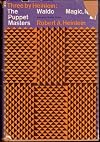
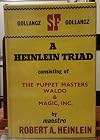
Three by Heinlein: The Puppet Masters, Waldo, and Magic, Inc.
by Robert A. Heinlein
On This Page
Tags
Recommendations
















Member Reviews
[The Puppet Masters], one of three science fiction tales in the collection, is Robert A. Henlein’s take on the classic tale of alien invasion and attempted world domination. When an ultra-secret government organization investigates a reported wrecked flying saucer in Des Moines, IA, they find parasitic organisms attached to the spines of the local residents. The slug-like creatures tap into victim’s spinal and nervous systems, rendering the victim nothing more than a numb puppet to their master’s will.
Having just finished H.G. Wells’ [War of the Worlds], [The Puppet Masters] seemed somewhat derivative in the early details of the alien landing and the alien’s strategy for taking over the world. But Heinlein’s aliens are an show more interesting wrinkle because they require human hosts to survive and perform tasks, and they are capable of a near omniscient collective memory and universal awareness throughout their population. The construction of the aliens seems designed by Heinlein as a Jonathon Swift-like satiric comment on the Red-Scare politics of the day, posing the citizenry as slaves to a devious, superior collective authority and incapable of individual thought or action.
The most enjoyable aspect of Heinlein’s novel is the marriage of hard-boiled detective fiction with science fiction, a sort of Dasheill Hammet meets, well, Heinlein. The hero of the story possesses the sharp-edged and icy mind and tongue of Sam Spade. As with
Spade and his hard-boiled brothers, this façade covers a buried wealth of emotion and a valiant spirit, none of which can be acknowledged by the character for fear of appearing weak or exposed. The ‘dames’ are curvy and sassy, but smarter and tougher than a glib, surface reading of the text allows.
Another bonus is Heinlein’s view of what the world would look like 50 years gone from his writing the novel. We haven’t come as far as Heinlein foresaw, but the imagined world is a wildly interesting one. Particularly interesting is Heinlein’s view of marriage in the future as a largely contractual and monetary agreement, heavily regulated by the government.
The only down side to the story is the slightly anti-climatic climax. Too many of these wonderfully imagined stories seem to end with a whimper rather than a bang. I’m not looking for Tolkein-sized battles, but the ending here, another derivation on H.G. Wells’ [War of the Worlds], fizzled a bit.
Bottom Line: A great science fiction classic written in the tradition of hard-boiled detective fiction. Read it if you’re a fan of either genre.
4 bones!!!! show less
Having just finished H.G. Wells’ [War of the Worlds], [The Puppet Masters] seemed somewhat derivative in the early details of the alien landing and the alien’s strategy for taking over the world. But Heinlein’s aliens are an show more interesting wrinkle because they require human hosts to survive and perform tasks, and they are capable of a near omniscient collective memory and universal awareness throughout their population. The construction of the aliens seems designed by Heinlein as a Jonathon Swift-like satiric comment on the Red-Scare politics of the day, posing the citizenry as slaves to a devious, superior collective authority and incapable of individual thought or action.
The most enjoyable aspect of Heinlein’s novel is the marriage of hard-boiled detective fiction with science fiction, a sort of Dasheill Hammet meets, well, Heinlein. The hero of the story possesses the sharp-edged and icy mind and tongue of Sam Spade. As with
Spade and his hard-boiled brothers, this façade covers a buried wealth of emotion and a valiant spirit, none of which can be acknowledged by the character for fear of appearing weak or exposed. The ‘dames’ are curvy and sassy, but smarter and tougher than a glib, surface reading of the text allows.
Another bonus is Heinlein’s view of what the world would look like 50 years gone from his writing the novel. We haven’t come as far as Heinlein foresaw, but the imagined world is a wildly interesting one. Particularly interesting is Heinlein’s view of marriage in the future as a largely contractual and monetary agreement, heavily regulated by the government.
The only down side to the story is the slightly anti-climatic climax. Too many of these wonderfully imagined stories seem to end with a whimper rather than a bang. I’m not looking for Tolkein-sized battles, but the ending here, another derivation on H.G. Wells’ [War of the Worlds], fizzled a bit.
Bottom Line: A great science fiction classic written in the tradition of hard-boiled detective fiction. Read it if you’re a fan of either genre.
4 bones!!!! show less
Ratings
Members
- Recently Added By
Author Information

458+ Works 174,011 Members
Robert Anson Heinlein was born on July 7, 1907 in Butler, Mo. The son of Rex Ivar and Bam Lyle Heinlein, Robert Heinlein had two older brothers, one younger brother, and three younger sisters. Moving to Kansas City, Mo., at a young age, Heinlein graduated from Central High School in 1924 and attended one year of college at Kansas City Community show more College. Following in his older brother's footsteps, Heinlein entered the Navel Academy in 1925. After contracting pulmonary tuberculosis, of which he was later cured, Heinlein retired from the Navy and married Leslyn MacDonald. Heinlein was said to have held jobs in real estate and photography, before he began working as a staff writer for Upton Sinclair's EPIC News in 1938. Still needing money desperately, Heinlein entered a writing contest sponsored by the science fiction magazine Thrilling Wonder Stories. Heinlein wrote and submitted the story "Life-Line," which went on to win the contest. This guaranteed Heinlein a future in writing. Using his real name and the pen names Caleb Saunders, Anson MacDonald, Lyle Monroe, John Riverside, and Simon York, Heinlein wrote numerous novels including For Us the Living, Methuselah's Children, and Starship Troopers, which was adapted into a big-budget film for Tri-Star Pictures in 1997. The Science Fiction Writers of America named Heinlein its first Grand Master in 1974, presented 1975. Officers and past presidents of the Association select a living writer for lifetime achievement. Also, the Science Fiction and Fantasy Hall of Fame inducted Heinlein in 1998. Heinlein died in 1988 from emphysema and other related health problems. Heinlein's remains were scattered from the stern of a Navy warship off the coast of California. (Bowker Author Biography) show less
Series
Belongs to Publisher Series
Work Relationships
Contains
Common Knowledge
- Canonical title
- Three by Heinlein: The Puppet Masters, Waldo, and Magic, Inc.
Classifications
Statistics
- Members
- 136
- Popularity
- 239,720
- Reviews
- 1
- Rating
- (3.98)
- Languages
- English
- Media
- Paper
- ISBNs
- 1
- ASINs
- 4