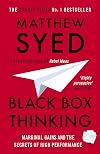
Black Box Thinking: The Surprising Truth About Success
by Matthew Syed
On This Page
Description
Nobody wants to fail. But in highly complex organizations, success can happen only when we confront our mistakes, learn from our own version of a black box, and create a climate where it's safe to fail. We all have to endure failure from time to time, whether it's underperforming at a job interview, flunking an exam, or losing a pickup basketball game. But for people working in safety-critical industries, getting it wrong can have deadly consequences. Consider the shocking fact that show more preventable medical error is the third-biggest killer in the United States, causing more than 400,000 deaths every year. More people die from mistakes made by doctors and hospitals than from traffic accidents. And most of those mistakes are never made public, because of malpractice settlements with nondisclosure clauses. For a dramatically different approach to failure, look at aviation. Every passenger aircraft in the world is equipped with an almost indestructible black box. Whenever there's any sort of mishap, major or minor, the box is opened, the data is analyzed, and experts figure out exactly what went wrong. Then the facts are published and procedures are changed, so that the same mistakes won't happen again. By applying this method in recent decades, the industry has created an astonishingly good safety record. Few of us put lives at risk in our daily work as surgeons and pilots do, but we all have a strong interest in avoiding predictable and preventable errors. So why don't we all embrace the aviation approach to failure rather than the health-care approach? As Matthew Syed shows in this eye-opening book, the answer is rooted in human psychology and organizational culture. Syed argues that the most important determinant of success in any field is an acknowledgment of failure and a willingness to engage with it. Yet most of us are stuck in a relationship with failure that impedes progress, halts innovation, and damages our careers and personal lives. We rarely acknowledge or learn from failure--even though we often claim the opposite. We think we have 20/20 hindsight, but our vision is usually fuzzy. Syed draws on a wide range of sources--from anthropology and psychology to history and complexity theory--to explore the subtle but predictable patterns of human error and our defensive responses to error. He also shares fascinating stories of individuals and organizations that have successfully embraced a black box approach to improvement, such as David Beckham, the Mercedes F1 team, and Dropbox. show lessTags
Recommendations


Member Reviews
I’ve read a few books like this lately, partly because there is a crossover with my day job, but mostly because I like ideas. This was definitely the best. It’s an extremely well written and engrossing examination of a simple concept, that failure is valuable because it helps us get better. Unlike some other similar books it never felt like it outlived it’s welcome. The examples used to illustrate the point were well chosen and often grippingly relayed. I was surprised at what a page turner ‘Black Box Thinking’ could be, and also that it moved me deeply at times.
In summary then, this is intellectually stimulating, great fun to read and full of insight. I loved it.
In summary then, this is intellectually stimulating, great fun to read and full of insight. I loved it.
4.5 stars
Years ago I joked that my new year's resolution would be "Make more mistakes" meaning that I would be pushing myself outside of my comfort zone and trying new things. This book pushes the idea one step further. Make more "mistakes" and learn from them.We should learn from the aviation industry which uses their black boxes to learn from their mistakes.
I got queasy from the stories of mistakes in the medical field leading to death. I got even more queasy reading the length the medical world would cover up their mistakes. Well, Matthew also shows when investors, judges, and corporate leaders also cover up their mistakes in the face of strong evidence.
Years ago I joked that my new year's resolution would be "Make more mistakes" meaning that I would be pushing myself outside of my comfort zone and trying new things. This book pushes the idea one step further. Make more "mistakes" and learn from them.We should learn from the aviation industry which uses their black boxes to learn from their mistakes.
I got queasy from the stories of mistakes in the medical field leading to death. I got even more queasy reading the length the medical world would cover up their mistakes. Well, Matthew also shows when investors, judges, and corporate leaders also cover up their mistakes in the face of strong evidence.
What a terrific read for anyone interested in personal or organizational performance, safety, quality improvement or change (also useful for parents and teachers). It's built around highly-readable cases taken from health, aviation, justice, sports, and industry and beautifully integrates science and philosophy. Highly recommended.
This was an engaging and interest-provoking book (I ended up with a list of referenced books and papers I now want to read) about failure and the vital importance of learning from failure. It had anecdotes and statistics from aviation, health care, criminal justice, animation, sports, education, and more. I feel like it could have been shorter, and the last section tried to be practical (as opposed to theoretical) and I think it failed at that.
Overall, a solid non-fiction read that held my interest almost to the end; and a good overview of some important topics like cognitive dissonance, marginal gains, creativity, and growth mindset.
Favorite quotes:
"The idea that the successful safety record in aviation has emerged from the rubble show more of real-world accidents is vivid, paradoxical, and profound."
"...this is invariably how progress happens. It is an interplay between the practical and the theoretical, between top-down and bottom-up, between creativity and discipline, between the small picture and the big picture...failure is a blessing, not a curse."
"If we are operating in an environment without meaningful feedback, we can't improve." show less
Overall, a solid non-fiction read that held my interest almost to the end; and a good overview of some important topics like cognitive dissonance, marginal gains, creativity, and growth mindset.
Favorite quotes:
"The idea that the successful safety record in aviation has emerged from the rubble show more of real-world accidents is vivid, paradoxical, and profound."
"...this is invariably how progress happens. It is an interplay between the practical and the theoretical, between top-down and bottom-up, between creativity and discipline, between the small picture and the big picture...failure is a blessing, not a curse."
"If we are operating in an environment without meaningful feedback, we can't improve." show less
Easy to read and interesting although most of the "insights" are nothing new. Like most of these business self-help books there's lots of "shouding" but no actual guidance on how to do these things. I work in health - I know. People in the SAME organisation don't know what other improvements are being made, never mind what other organisations are doing.
Good read. Certainly has a military bent but great application of the idea. Accurate recording of your errors is so core to making good mistakes. Recommended.
What a great book. How to improve systems and reduce error rates. This is a synthesis of many of my favourite books. As an entrepreneur and serial self-improver I love the insights this book gives
Members
- Recently Added By
Lists

2024 Reading List
49 works; 1 member

Wishlist
99 works; 1 member
Author Information

16 Works 1,710 Members
Matthew Syed is a columnist for the London Times and a commentator for the BBC, and was recently named British Sports Feature Writer of the Year by the Sports Journalists' Association and Sports Journalist of the Year at the British Press Awards. He is also the former Commonwealth table tennis champion, two-time Olympian, and a graduate of Oxford show more University. show less
Some Editions
Work Relationships
Is contained in
Has as a student's study guide
Common Knowledge
- Canonical title
- Black Box Thinking: The Surprising Truth About Success
- Original title
- Black Box Thinking
- Alternate titles
- Black Box Thinking: Why Most People Never Learn from Their Mistakes—But Some Do
Classifications
Statistics
- Members
- 588
- Popularity
- 49,955
- Reviews
- 10
- Rating
- (4.02)
- Languages
- 8 — Danish, Dutch, English, German, Korean, Polish, Portuguese, Russian
- Media
- Paper, Audiobook, Ebook
- ISBNs
- 23
- ASINs
- 12