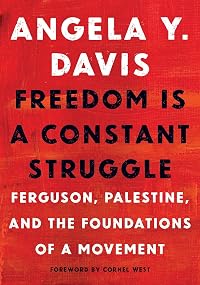
Freedom Is a Constant Struggle: Ferguson, Palestine, and the Foundations of a Movement
by Angela Y. Davis
On This Page
Description
In these newly collected essays, interviews, and speeches, world-renowned activist and scholar Angela Y. Davis illuminates the connections between struggles against state violence and oppression throughout history and around the world. Reflecting on the importance of black feminism, intersectionality, and prison abolitionism for today's struggles, Davis discusses the legacies of previous liberation struggles, from the Black Freedom Movement to the South African anti-Apartheid movement. She show more highlights connections and analyzes today's struggles against state terror, from Ferguson to Palestine. Facing a world of outrageous injustice, Davis challenges us to imagine and build the movement for human liberation. And in doing so, she reminds us that "Freedom is a constant struggle." show lessTags
Recommendations







Member Recommendations



Member Reviews
Best for: Anyone interested in fighting back.
In a nutshell: A mixture of interviews and speech transcripts that seeks to connect struggles for freedom across the world.
Line that sticks with me: “But those protest movements would not have been necessary – it would not have been necessary to create a mid-century Black freedom movement had slavery been comprehensively abolished in the nineteenth century.”
Why I Chose It: I decided to kick off participation in my fifth Cannonball Read with this book because I am hoping to be more intentional with my life, including my reading. Sure, there will be the occasional airport purchase, but what I’d like to do is choose books this year that can help me be a better activist, citizen, partner, show more and friend. Part of that means reading up on topics I don’t know enough about, and part of that means choosing authors that don’t look like me.
Review: Hopefully you’ve heard of Ms. Davis. She is a legendary activist and academic – you can read about her on her faculty page at UCSC (http://feministstudies.ucsc.edu/faculty/singleton.php?singleton=true&cruz_id=aydavis) or just employ the Google machine. I had only a passing familiarity with her work and life, but was motivated to pick up her writings after seeing her in Ava Duvernay’s excellent film “13.”
This book is deceptively brief, comprising only ten chapters and 145 pages. But those pages contain enough ideas to keep my mind going non-stop for years. One area that receives the focus of Ms. Davis’s work is prison abolition and its connection to the overall struggle for freedom. I have – partly due to my upbringing and the space I occupy in the world – found it challenging to fully understand how a world without prison could look, but I am learning, and this book helped direct me to further resources.
More importantly, the essays in this collection make the case for connection between so many struggles that may not be immediately obvious to those not well versed in history. I recall seeing murals depicting solidarity with Palestine when I was visiting the Catholic parts of Belfast in the north of Ireland, but I haven’t done the work to connect fight against occupation in Palestine with other fights for freedom. Ms. Davis makes a compelling case for the ways so many of these struggles are connected, and how much we have to learn from each other.
There are just two areas that kept me from rating this a five-star read. The first three chapters are in the form of an interview, and while Ms. Davis’s responses are full of interesting information, complex connections and suggestions for further exploration, the choice of interviewer left something to be desired. Condescending is probably too strong of a word to describe his questions, but I would have preferred to read Ms. Davis’s words uninterrupted. The second area is that while it makes sense that there would be a constancy of theme across the book, the chosen talks included often contained some repetition. For a relatively short book, I would have like to see a bit more variety. show less
In a nutshell: A mixture of interviews and speech transcripts that seeks to connect struggles for freedom across the world.
Line that sticks with me: “But those protest movements would not have been necessary – it would not have been necessary to create a mid-century Black freedom movement had slavery been comprehensively abolished in the nineteenth century.”
Why I Chose It: I decided to kick off participation in my fifth Cannonball Read with this book because I am hoping to be more intentional with my life, including my reading. Sure, there will be the occasional airport purchase, but what I’d like to do is choose books this year that can help me be a better activist, citizen, partner, show more and friend. Part of that means reading up on topics I don’t know enough about, and part of that means choosing authors that don’t look like me.
Review: Hopefully you’ve heard of Ms. Davis. She is a legendary activist and academic – you can read about her on her faculty page at UCSC (http://feministstudies.ucsc.edu/faculty/singleton.php?singleton=true&cruz_id=aydavis) or just employ the Google machine. I had only a passing familiarity with her work and life, but was motivated to pick up her writings after seeing her in Ava Duvernay’s excellent film “13.”
This book is deceptively brief, comprising only ten chapters and 145 pages. But those pages contain enough ideas to keep my mind going non-stop for years. One area that receives the focus of Ms. Davis’s work is prison abolition and its connection to the overall struggle for freedom. I have – partly due to my upbringing and the space I occupy in the world – found it challenging to fully understand how a world without prison could look, but I am learning, and this book helped direct me to further resources.
More importantly, the essays in this collection make the case for connection between so many struggles that may not be immediately obvious to those not well versed in history. I recall seeing murals depicting solidarity with Palestine when I was visiting the Catholic parts of Belfast in the north of Ireland, but I haven’t done the work to connect fight against occupation in Palestine with other fights for freedom. Ms. Davis makes a compelling case for the ways so many of these struggles are connected, and how much we have to learn from each other.
There are just two areas that kept me from rating this a five-star read. The first three chapters are in the form of an interview, and while Ms. Davis’s responses are full of interesting information, complex connections and suggestions for further exploration, the choice of interviewer left something to be desired. Condescending is probably too strong of a word to describe his questions, but I would have preferred to read Ms. Davis’s words uninterrupted. The second area is that while it makes sense that there would be a constancy of theme across the book, the chosen talks included often contained some repetition. For a relatively short book, I would have like to see a bit more variety. show less
Freedom is a Constant Struggle: Ferguson, Palestine, and the Foundations of a Movement by Angela Y. Davis is a powerful reminder to anyone who cares about society that we are all interconnected no matter how some people wish we weren't. The interview with Davis in the beginning of the book was interesting and thought provoking. The speeches that make up the rest of the book inspired me to keep looking forward in the fight for justice, equality, and true liberation around the world while never forgetting the history that brought us to this point. Davis consistently demonstrates how the struggle for freedom is ongoing but worth the effort. Freedom is a Constant Struggle reminded me that history books might be written by the victor but show more history is what actually happened not what's in the books and that history has consequences as do the actions we choose every day. show less
Great book, and Angela Davis just further radicalizes me against capitalism, imperialism, racism, sexism, and the injustices of the world.
One of the few times I think the audiobook was just as good, or better as it would have been written, since this book is a collection of Angela Davis' speeches and interviews she's given over a timeframe. These speeches generally were themed, and about the protests in Ferguson Missouri, the oppression of Palestine, the prison industrial complex, or black feminism. She has an amazing ability to weave all these topics together throughout her interviews and speeches, and to make them all linked.
Truly a powerful and inspiring collection of speeches. I definitely want to read more of her, and I also want show more to read more about the authors/activists she mentions, such as Assata Shakur, Michelle Alexander, and a few others. show less
One of the few times I think the audiobook was just as good, or better as it would have been written, since this book is a collection of Angela Davis' speeches and interviews she's given over a timeframe. These speeches generally were themed, and about the protests in Ferguson Missouri, the oppression of Palestine, the prison industrial complex, or black feminism. She has an amazing ability to weave all these topics together throughout her interviews and speeches, and to make them all linked.
Truly a powerful and inspiring collection of speeches. I definitely want to read more of her, and I also want show more to read more about the authors/activists she mentions, such as Assata Shakur, Michelle Alexander, and a few others. show less
Angela Davis is a leading and historical figure in the Civil Rights Movement in the USA, as well as being an outspoken Communist and Feminist. She has inspired countless individuals to rise up and take action against injustice and in support of freedom for all. Her book, FREEDOM IS A CONSTANT STRUGGLE, is a collection of interviews, conversations, essays, and speeches that tackle the concept of freedom in different ways.
While there are many overlapping themes in these pieces, Davis spends a significant amount of time discussing oppression and its historical roots in colonialism, apartheid, classism, caste systems, and especially during Reconstruction after the American Civil War. She makes a convincing case that nothing, throughout the show more history of the world, ever happens in a vacuum. What happens "here" is influenced by, and in turn influences, what happens "there". In every case, she makes connections between the treatment of black bodies in the USA with the treatment of "others" elsewhere in the world by the dominant societal and governmental powers. She ultimately believes that, for the rights of marginalized groups to reach true equality with those of the dominant class, we all need to recognize the intersectionality of the issues at stake. Feminism is intrinsically linked with racism, sexism, classism, and the oppression of indigenous peoples, to name a few. To succeed in one area alone may cause great harm to other areas.
The audiobook is narrated by the author, which lends a certain extra importance to the material being discussed. I will likely never have the opportunity to be in Angela Davis' presence, but through listening to FREEDOM IS A CONSTANT STRUGGLE, I feel as though I know a little bit about her, and the ideals she holds most dear. It was a joy to read this book, and certainly an inspiration for future action towards freedom and equality. show less
While there are many overlapping themes in these pieces, Davis spends a significant amount of time discussing oppression and its historical roots in colonialism, apartheid, classism, caste systems, and especially during Reconstruction after the American Civil War. She makes a convincing case that nothing, throughout the show more history of the world, ever happens in a vacuum. What happens "here" is influenced by, and in turn influences, what happens "there". In every case, she makes connections between the treatment of black bodies in the USA with the treatment of "others" elsewhere in the world by the dominant societal and governmental powers. She ultimately believes that, for the rights of marginalized groups to reach true equality with those of the dominant class, we all need to recognize the intersectionality of the issues at stake. Feminism is intrinsically linked with racism, sexism, classism, and the oppression of indigenous peoples, to name a few. To succeed in one area alone may cause great harm to other areas.
The audiobook is narrated by the author, which lends a certain extra importance to the material being discussed. I will likely never have the opportunity to be in Angela Davis' presence, but through listening to FREEDOM IS A CONSTANT STRUGGLE, I feel as though I know a little bit about her, and the ideals she holds most dear. It was a joy to read this book, and certainly an inspiration for future action towards freedom and equality. show less
This books collects several interviews with long-time activists Angela Davis as well as some articles and speeches. The downside to this collection is that she touches on some of the same issues in each of the pieces (as you would expect of someone delivering speeches to new audiences) but the format of this collection doesn't allow the reader to see Davis delve deep into any of the issues.
Davis reflects on the Civil Rights movement and feminist movies, her involvement in each, and their accomplishments. She also compares it to the revival of activism in the Black Lives Matter movement that rose out of the protests in Ferguson, Missouri against the police killing of Michael Brown. Davis urges the reader/listener to recognize the show more intersectionality of movements and that Americans need to broaden their scope to include global crises in their activism (with a particular emphasis on Palestine).
Davis always offers harsh truths but is never disparaging of efforts towards revolutionary change that are incomplete. Instead she encourages the reader to keep trying and keep struggling. I'm particular impressed by her reflections that Black Americans truly defined democracy since they are the ones who advocated for true freedom, which is more than civil rights. I have had this book for some time and to my shame only got around to reading it now, but I'm glad I've read since it speaks to issues that are front and center in the current moment.
Favorite Passages:
Davis reflects on the Civil Rights movement and feminist movies, her involvement in each, and their accomplishments. She also compares it to the revival of activism in the Black Lives Matter movement that rose out of the protests in Ferguson, Missouri against the police killing of Michael Brown. Davis urges the reader/listener to recognize the show more intersectionality of movements and that Americans need to broaden their scope to include global crises in their activism (with a particular emphasis on Palestine).
Davis always offers harsh truths but is never disparaging of efforts towards revolutionary change that are incomplete. Instead she encourages the reader to keep trying and keep struggling. I'm particular impressed by her reflections that Black Americans truly defined democracy since they are the ones who advocated for true freedom, which is more than civil rights. I have had this book for some time and to my shame only got around to reading it now, but I'm glad I've read since it speaks to issues that are front and center in the current moment.
Favorite Passages:
Trying and trying again. Never stopping. That is a victory in itself. Everyone and everything tells you that “outside” you will not succeed, that it is too late, that we live in an epoch where a revolution cannot happen anymore. Radical changes are a thing of the past. You can be an outsider, but not outside the system, and you can have political beliefs, even radical ones, but they need to stay within the bounds of the permissible, inside that bubble that has been drawn for you by the elites.show less
It is essential to resist the depiction of history as the work of heroic individuals in order for people today to recognize their potential agency as a part of an ever-expanding community of struggle.
It’s very interesting that during the commentary on Ferguson, someone pointed out that the purpose of the police is supposed to be to protect and serve. At least, that’s their slogan. Soldiers are trained to shoot to kill. We saw the way in which that manifested itself in Ferguson.
The civil rights movement was very successful in what it achieved: the legal eradication of racism and the dismantling of the apparatus of segregation. This happened and we should not underestimate its importance. The problem is that it is often assumed that the eradication of the legal apparatus is equivalent to the abolition of racism. But racism persists in a framework that is far more expansive, far vaster than the legal framework. Economic racism continues to exist. Racism can be discovered at every level in every major institution—including the military, the health care system, and the police. It’s not easy to eradicate racism that is so deeply entrenched in the structures of our society, and this is why it’s important to develop an analysis that goes beyond an understanding of individual acts of racism and this is why we need demands that go beyond the prosecution of the individual perpetrators.
I fear that if we don’t take seriously the ways in which racism is embedded in structures of institutions, if we assume that there must be an identifiable racist… The “bad apples” type of… …who is the perpetrator, then we won’t ever succeed in eradicating racism.
But if one looks at the history of struggles against racism in the US, no change has ever happened simply because the president chose to move in a more progressive direction. Every change that has happened has come as a result of mass movements—from the era of slavery, the Civil War, and the involvement of Black people in the Civil War, which really determined the outcome.
Many people are under the impression that it was Abraham Lincoln who played the major role, and he did as a matter of fact help to accelerate the move toward abolition, but it was the decision on the part of slaves to emancipate themselves and to join the Union Army—both women and men—that was primarily responsible for the victory over slavery. It was the slaves themselves and of course the abolitionist movement that led to the dismantling of slavery. When one looks at the civil rights era, it was those mass movements—anchored by women, incidentally—that pushed the government to bring about change. I don’t see why things would be any different today.
At this point, at this moment in the history of the US I don’t think that there can be policing without racism. I don’t think that the criminal justice system can operate without racism. Which is to say that if we want to imagine the possibility of a society without racism, it has to be a society without prisons. Without the kind of policing that we experience today. I think that different frameworks, perhaps restorative justice frameworks, need to be invoked in order to begin to imagine a society that is secure. I think that security is a main issue, but not the kind of security that is based on policing and incarceration. Perhaps transformative justice provides a framework for imagining a very different kind of security in the future.
Optimism is an absolute necessity, even if it’s only optimism of the will, as Gramsci said, and pessimism of the intellect. What has kept me going has been the development of new modes of community. I don’t know whether I would have survived had not movements survived, had not communities of resistance, communities of struggle. So whatever I’m doing I always feel myself directly connected to those communities and I think that this is an era where we have to encourage that sense of community particularly at a time when neoliberalism attempts to force people to think of themselves only in individual terms and not in collective terms. It is in collectivities that we find reservoirs of hope and optimism.
Deep understandings of racist violence arm us against deceptive solutions. When we are told that we simply need better police and better prisons, we counter with what we really need. We need to reimagine security, which will involve the abolition of policing and imprisonment as we know them. We will say demilitarize the police, disarm the police, abolish the institution of the police as we know it, and abolish imprisonment as the dominant mode of punishment. But we will have only just begun to tell the truth about violence in America.
As many times as I’ve spoken during Black History Month, I never tire of urging people to remember that it wasn’t a single individual or two who created that movement, that, as a matter of fact, it was largely women within collective contexts, Black women, poor Black women who were maids, washerwomen, and cooks. These were the people who collectively refused to ride the bus.
But freedom is still more expansive than civil rights. And in the sixties there were some of us who insisted that it was not simply a question of acquiring the formal rights to fully participate in a society, but rather it was also about the forty acres and the mule that was dropped from the abolitionist agenda in the nineteenth century. It was about economic freedom. It was about substantive freedoms. It was about free education. It was about free health care. Affordable housing. These are issues that should have been on the abolitionist agenda in the nineteenth century, and here we are in the twenty-first century and we still can’t say that we have affordable housing and health care, and education has thoroughly become a commodity. It has been so thoroughly commoditized that many people don’t even know how to understand the very process of acquiring knowledge because it is subordinated to the future capacity to make money. So it was about free education and free health care and affordable housing. It was about ending the racist police occupation of Black communities. These were some of the demands raised by the Black Panther Party.
I tell you that in the United States we are at such a disadvantage because we do not know how to talk about the genocide inflicted on indigenous people. We do not know how to talk about slavery. Otherwise it would not have been assumed that simply because of the election of one Black man to the presidency we would leap forward into a postracial era.
For some time now I have been involved in efforts to abolish the death penalty and imprisonment as the main modes of punishment. I should say that it is not simply out of empathy with the victims of capital punishment and the victims of prison punishment, who are overwhelmingly people of color. It is because these modes of punishment don’t work. These forms of punishment do not work when you consider that the majority of people who are in prison are there because society has failed them, because they’ve had no access to education or jobs or housing or health care. But let me say that criminalization and imprisonment could not solve other problems.
We will have to do something quite extraordinary: We will have to go to great lengths. We cannot go on as usual. We cannot pivot the center. We cannot be moderate. We will have to be willing to stand up and say no with our combined spirits, our collective intellects, and our many bodies.
By the time I finally bought this I had picked it up so many times at the bookstore and lingered over it. But I am finally getting to it today thanks to the Juneteenth Readathon.
I don't often take notes while reading unless the book is for a book group or buddy read, but I have a page of notes from this -- facts that shocked me (Nelson Mandela was on U.S. terrorist watch list until 2008!) and lines that wowed me. Don't let the small size of this book fool you -- it packs a lot of punch. And systematically -- against oppression everywhere and not letting itself be pinned down to an individual person, place, or institution.
I really need to read more by Davis.
I don't often take notes while reading unless the book is for a book group or buddy read, but I have a page of notes from this -- facts that shocked me (Nelson Mandela was on U.S. terrorist watch list until 2008!) and lines that wowed me. Don't let the small size of this book fool you -- it packs a lot of punch. And systematically -- against oppression everywhere and not letting itself be pinned down to an individual person, place, or institution.
I really need to read more by Davis.
3.5 stars
I wouldn't have called myself a political activist until November 8, 2016. And even then, it's certainly not my full-time focus as it is for Angela Davis. She's been an activist for decades, since the days of the Black Panther Party. As a part-time, neophyte activist I found this collection of speeches and an interview to be interesting. The collection is somewhat repetitive because Davis gives speeches to similar groups and has her specific causes. For me, that was actually helpful because repeated emphasis encouraged my own learning process.
Her primary message throughout is that "... there’s a message there for everyone and it is that people can unite, that democracy from below can challenge oligarchy, that imprisoned show more migrants can be freed, that fascism can be overcome, and that equality is emancipatory."
Davis verbally and actively discusses so many issues that I have a considerable future study list. Here's a list of the issues I captured, although it's likely imperfect:
Feminism
Racism
Prison Industrial complex / privatization of prisons
Immigration and immigrant detention
Rape culture
Poverty
Capitalism
Assanta Shakur on the terrorist most wanted list
The 10 principles of the Black Panther Party
Discrimination and violence against oppressed peoples, including LGBTQ and indigenous peoples
This is a short book full of heavy ideas. I listened to the audiobook, which Davis narrates in a professorial voice that worked for me. It was well worth the time for me.
Lest you think this is all angry pessimism, I'll leave you with another quote:
“I don't think we have any alternative other than remaining optimistic. Optimism is an absolute necessity, even if it's only optimism of the will, as Gramsci said, and pessimism of the intellect.” show less
I wouldn't have called myself a political activist until November 8, 2016. And even then, it's certainly not my full-time focus as it is for Angela Davis. She's been an activist for decades, since the days of the Black Panther Party. As a part-time, neophyte activist I found this collection of speeches and an interview to be interesting. The collection is somewhat repetitive because Davis gives speeches to similar groups and has her specific causes. For me, that was actually helpful because repeated emphasis encouraged my own learning process.
Her primary message throughout is that "... there’s a message there for everyone and it is that people can unite, that democracy from below can challenge oligarchy, that imprisoned show more migrants can be freed, that fascism can be overcome, and that equality is emancipatory."
Davis verbally and actively discusses so many issues that I have a considerable future study list. Here's a list of the issues I captured, although it's likely imperfect:
Feminism
Racism
Prison Industrial complex / privatization of prisons
Immigration and immigrant detention
Rape culture
Poverty
Capitalism
Assanta Shakur on the terrorist most wanted list
The 10 principles of the Black Panther Party
Discrimination and violence against oppressed peoples, including LGBTQ and indigenous peoples
This is a short book full of heavy ideas. I listened to the audiobook, which Davis narrates in a professorial voice that worked for me. It was well worth the time for me.
Lest you think this is all angry pessimism, I'll leave you with another quote:
“I don't think we have any alternative other than remaining optimistic. Optimism is an absolute necessity, even if it's only optimism of the will, as Gramsci said, and pessimism of the intellect.” show less
Members
- Recently Added By
Lists

Top Five Books of 2016
795 works; 229 members

Revolutions
72 works; 5 members

Zora Canon
100 works; 6 members

The Zora Canon
98 works; 4 members

Decolonize Palestine's Reading List
126 works; 3 members

World
18 works; 1 member
Author Information

46+ Works 9,810 Members
Some Editions
Awards and Honors
Common Knowledge
- Original publication date
- 2015
- First words
- I am writing this sitting in my small office in Brussels.
- Last words
- (Click to show. Warning: May contain spoilers.)We will have to be willing to stand up and say no with our combined spirits, our collective intellects, and our many bodies.
Classifications
- Genres
- General Nonfiction, Politics and Government, Nonfiction, Sexuality and Gender Studies, History
- DDC/MDS
- 323 — Society, government, & culture Political science Civil Rights & Liberties/ Human Rights
- LCC
- JC571 .D33275 — Political Science Political theory Political theory. The state. Theories of the state Purpose, functions, and relations of the state
- BISAC
Statistics
- Members
- 1,751
- Popularity
- 12,590
- Reviews
- 21
- Rating
- (4.25)
- Languages
- 8 — Basque, English, French, German, Italian, Spanish, Swedish, Portuguese (Portugal)
- Media
- Paper, Audiobook, Ebook
- ISBNs
- 20
- ASINs
- 7