
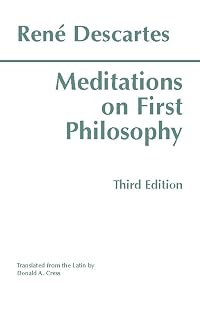
Meditations on First Philosophy
by René Descartes
On This Page
Description
A landmark in the history of thought, Rene Descartes' Meditations helped bring critical thinking and skepticism to the Western world. Modern philosophers are still captivated by Descartes' radical and controversial departure from his previous beliefs, which has both inspired reverence and provoked anger.Tags
Recommendations

















Member Reviews
لعلّ أكثر أقوال الفلاسفة شهرة واقتباساً هو قول ديكارت «أنا أفكر، فأنا موجود». لكن ما هو حقيقةً مدى المعرفة به وبنظرياته خارج الأوساط الأكاديمية؟ محدود جداً، إن لم يكن معدوماً.
هنا يأتي دور ”تأملات في الفلسفة الأولى“ الذي يشرح المفاهيم الأساسية المحتواة في أشهر أعمال ديكارت الفلسفية، والتي بقراءتها يصبح الاقتباس السابق أكثر منطقية ووضوحاً.
يركّز ديكارت على عدم كفاية الحواس لفهم العالم، فهي كثيراً ما show more تخدعنا ولا يمكن من خلالها التماس اليقين في معظم الأحيان. العقل وحده يصل إلى ما تعجز عنه الحواس ويثبت اليقين الوحيد، الوجود. بحسب ديكارت، فإن جميع الأشياء في الكون "موجودة" في ثلاثة مستويات: المستوى الأعلى هو لما ندركه بالعقل وحده (كالرياضيات)، يليه ما يصلنا بالحواس ولا يد لنا به (كحرارة النار)، وآخرها هي المفاهيم التخيلية المخترعة التي لا وجود لها في الواقع.
يصل ديكارت إلى خلاصة مفادها أنه بما أننا نعطي الأشياء واقعيتها بتفكيرنا بها، وأنّ هذه القدرة المتأصلة على التفكير والتعقّل بالأمور نملكها منذ الولادة، فلا بد أن تكون قد أعطيت لنا من كائن على مستوى أعلى من الوجود. فلا شيء يمكنه أن يتسبب بشيء آخر بدون أن يكون موجوداً ويحمل نفس الصفة. على سبيل المثال، لاشيء بدون حرارة (كالنار) يمكنه مد شيء آخر بالحرارة. وهذا كان دليل ديكارت على وجود الإله. بالإضافة إلى ذلك، وبما أن العقل موجود على مستوى أعلى من أي شيء مادي، فالعقل والجسم مستقلان وجودياً عن بعضهما، وهكذا يستمر العقل أو "الروح" بالوجود بعد فناء الجسد.
طبعاً لا يمكن الحكم على فلسفة ديكارت إلا ضمن الإطار الزمني الذي نشأت خلاله، ورغم مآخذي الكثيرة عليها (وبالأخص حجته الواهية على وجود الإله) وجدت نفسي معجباً بفكره السابق لعصره. show less
هنا يأتي دور ”تأملات في الفلسفة الأولى“ الذي يشرح المفاهيم الأساسية المحتواة في أشهر أعمال ديكارت الفلسفية، والتي بقراءتها يصبح الاقتباس السابق أكثر منطقية ووضوحاً.
يركّز ديكارت على عدم كفاية الحواس لفهم العالم، فهي كثيراً ما show more تخدعنا ولا يمكن من خلالها التماس اليقين في معظم الأحيان. العقل وحده يصل إلى ما تعجز عنه الحواس ويثبت اليقين الوحيد، الوجود. بحسب ديكارت، فإن جميع الأشياء في الكون "موجودة" في ثلاثة مستويات: المستوى الأعلى هو لما ندركه بالعقل وحده (كالرياضيات)، يليه ما يصلنا بالحواس ولا يد لنا به (كحرارة النار)، وآخرها هي المفاهيم التخيلية المخترعة التي لا وجود لها في الواقع.
يصل ديكارت إلى خلاصة مفادها أنه بما أننا نعطي الأشياء واقعيتها بتفكيرنا بها، وأنّ هذه القدرة المتأصلة على التفكير والتعقّل بالأمور نملكها منذ الولادة، فلا بد أن تكون قد أعطيت لنا من كائن على مستوى أعلى من الوجود. فلا شيء يمكنه أن يتسبب بشيء آخر بدون أن يكون موجوداً ويحمل نفس الصفة. على سبيل المثال، لاشيء بدون حرارة (كالنار) يمكنه مد شيء آخر بالحرارة. وهذا كان دليل ديكارت على وجود الإله. بالإضافة إلى ذلك، وبما أن العقل موجود على مستوى أعلى من أي شيء مادي، فالعقل والجسم مستقلان وجودياً عن بعضهما، وهكذا يستمر العقل أو "الروح" بالوجود بعد فناء الجسد.
طبعاً لا يمكن الحكم على فلسفة ديكارت إلا ضمن الإطار الزمني الذي نشأت خلاله، ورغم مآخذي الكثيرة عليها (وبالأخص حجته الواهية على وجود الإله) وجدت نفسي معجباً بفكره السابق لعصره. show less
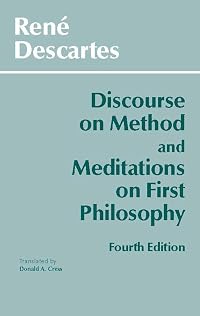
For all his doubting, there seems to be a direct line connecting the Cartesian quest for certitude with that of Augustine (of Hippo); they almost appear to join hands across the centuries in their limitless craving for absolute certainty, without which they simply cannot exist. (Pun intended.) But not only in just that: In many and obvious ways, Descartes is still steeped in the medieval tradition, despite often being called the first modern philosopher – a distinction that more obviously belongs with Spinoza, who is the first to make a decisive break with religious tradition, as has been pointed out by Spinoza scholar H.A. Wolfson. Still, Descartes was an important influence for Spinoza (something he hardly would have appreciated, I show more reckon), as he was for many others. - If you first are going to read the Meditations, there are many good reasons to chose this Hackett edition, which includes the Objections and Replies (that were included in the first publication in 1641) and also an enlightening introduction by Roger Ariew, where he discusses how Descartes own thought developed as he responded to the different objections – and concludes that "All in all, Descartes’ bloc of certainty looks more like a sedimentary rock, a geological stratum with cracks and fissures, able to be read in historical terms." – However, if you maintain that you’ve had your fill with the Meditations alone, I can’t say I blame you – also, the additional material is not exactly an easy read and I freely confess to have simply skimmed through certain parts of it. I had already read the translation of Meditations by Donald Cress in another Hackett edition, and as I have not read in the original language, all I can say about it is that the translation flows well. For sure, the philosophical inconsistencies, whenever they occur, are Descartes’ own. At least as far as this particular work is concerned, I find Monsieur Descartes a rather presumptuous kind of fellow (and I suspect some of the authors of the Objections would be inclined to agree with that assessment.) I can respect a good argument even if I don’t necessarily agree with the conclusion, but here Descartes seems simply sloppy at times. There’s no disputing his importance for Western philosophy and science though – it is in view of this fact that it’s worth the read – and thankfully, the Meditations is a short book.
This work is licensed under a Creative Commons Attribution-NonCommercial-ShareAlike 3.0 Unported License. show less
This work is licensed under a Creative Commons Attribution-NonCommercial-ShareAlike 3.0 Unported License. show less
My feelings about this book are a bit complicated.
Let's start with the broad positives:
First, there's the fact that Rene Descartes achieved something monumental in this work, specifically regarding probably the first conclusive metaphysical examination of apodictic recognition of self-existence that has survived the passage of time. His elaboration of the idea is, I believe, deeply underappreciated, particularly since the rise of popular postmodernist materialism and those who become its adherents only by way of faddish self-conscious image cultivation. The frequency with which I encounter supposedly astute intellectuals who miss the real significance of the Cartesian ontological self examination due to self-conscious philosophical show more jadedness is deeply dismaying. Rene Descartes has, in part through subsequent commentaries that improve the form of the argument buried in the rambling Meditations, provided a succinct and lucid foundation that impressively fortifies any philosophical reasoning that can benefit from it.
Second, this is a relatively well-structured presentation of the Meditations, plus selected Objections and Replies. The informative footnotes, integration of information from both Latin and French original editions, and cross-referencing footnotes are all helpfully presented for the sake of keeping track of, and understanding, the material. It offers essential context in a pair of introductory commentaries.
This is important work, and deserves attention and (in the case of Rene's enduring contribution) a better reputation from students and scholars of philosophy.
Now, the negatives:
The introductory commentaries seem written from the perspective of someone who assumes a certain amount of formal philosophical scholarship, so the target audience is clear. I believe they might be more helpful, as written, following the primary material rather than before it. Some amount of context establishment is important before diving into the Meditations themselves, but as written I think much of the significance of preceding analysis is lost by the time a first-time reader of the Meditations actually gets to the addressed sections of Rene's work.
The manner of labelling the selected Objections and Replies after the primary text is more difficult to follow than would be ideal. In particular, additional notes (presented with the Objection instead of solely in the introductory material at the beginning of the book) about who is behind each Objection could offer substantial improvement in readers' ability to understand the perspectives of the writers.
I would like to see a commentary on Meditations that addresses the particulars of the strength of each argument, for the sake of the introductory reader; this book does not offer that. There are deeply flawed arguments, genuinely important questions, and quite effective arguments against parts of Rene's elaborations in Meditations that arise, and among Rene's Replies I find a similarly wide range of positive and negative in the reasoning. One source of Objections in particular ranges between attacks on the Meditations that are petty and superficial at times, and those that are thoroughly well-reasoned at other times -- where Rene tends to handle the former acerbically and condescendingly but with excellent reasoning clarity, and tends to handle the latter acerbically and condescendingly without any meaningful substance to his arguments.
Finally, while the rigor of Rene's reasoning varies wildly after (very slowly) reaching the important apodictism of the Cogito (the famous "I think, therefore I am" statement, less succinct than that in Meditations), much of even the best reasoning to follow that is largely wasted except as a demonstration of the skill, because of intervening flaws in logic and unexamined assumptions.
Overall, the importance of Rene's contributions to metaphysical philosophy -- both in concrete foundations for later work and in methodological practice -- are monumental, and all too often overlooked for their value, but the "negatives" I mentioned above make reading this a less than ideal experience, at some times frustrating, at others tedious. An attentive and honest thinker who has not benefited from an illuminating encounter with Rene in the past can learn a lot from this work, and it is mercifully short for the sake of its shortcomings relative to a lot of the rest of my habitual reading. show less
Let's start with the broad positives:
First, there's the fact that Rene Descartes achieved something monumental in this work, specifically regarding probably the first conclusive metaphysical examination of apodictic recognition of self-existence that has survived the passage of time. His elaboration of the idea is, I believe, deeply underappreciated, particularly since the rise of popular postmodernist materialism and those who become its adherents only by way of faddish self-conscious image cultivation. The frequency with which I encounter supposedly astute intellectuals who miss the real significance of the Cartesian ontological self examination due to self-conscious philosophical show more jadedness is deeply dismaying. Rene Descartes has, in part through subsequent commentaries that improve the form of the argument buried in the rambling Meditations, provided a succinct and lucid foundation that impressively fortifies any philosophical reasoning that can benefit from it.
Second, this is a relatively well-structured presentation of the Meditations, plus selected Objections and Replies. The informative footnotes, integration of information from both Latin and French original editions, and cross-referencing footnotes are all helpfully presented for the sake of keeping track of, and understanding, the material. It offers essential context in a pair of introductory commentaries.
This is important work, and deserves attention and (in the case of Rene's enduring contribution) a better reputation from students and scholars of philosophy.
Now, the negatives:
The introductory commentaries seem written from the perspective of someone who assumes a certain amount of formal philosophical scholarship, so the target audience is clear. I believe they might be more helpful, as written, following the primary material rather than before it. Some amount of context establishment is important before diving into the Meditations themselves, but as written I think much of the significance of preceding analysis is lost by the time a first-time reader of the Meditations actually gets to the addressed sections of Rene's work.
The manner of labelling the selected Objections and Replies after the primary text is more difficult to follow than would be ideal. In particular, additional notes (presented with the Objection instead of solely in the introductory material at the beginning of the book) about who is behind each Objection could offer substantial improvement in readers' ability to understand the perspectives of the writers.
I would like to see a commentary on Meditations that addresses the particulars of the strength of each argument, for the sake of the introductory reader; this book does not offer that. There are deeply flawed arguments, genuinely important questions, and quite effective arguments against parts of Rene's elaborations in Meditations that arise, and among Rene's Replies I find a similarly wide range of positive and negative in the reasoning. One source of Objections in particular ranges between attacks on the Meditations that are petty and superficial at times, and those that are thoroughly well-reasoned at other times -- where Rene tends to handle the former acerbically and condescendingly but with excellent reasoning clarity, and tends to handle the latter acerbically and condescendingly without any meaningful substance to his arguments.
Finally, while the rigor of Rene's reasoning varies wildly after (very slowly) reaching the important apodictism of the Cogito (the famous "I think, therefore I am" statement, less succinct than that in Meditations), much of even the best reasoning to follow that is largely wasted except as a demonstration of the skill, because of intervening flaws in logic and unexamined assumptions.
Overall, the importance of Rene's contributions to metaphysical philosophy -- both in concrete foundations for later work and in methodological practice -- are monumental, and all too often overlooked for their value, but the "negatives" I mentioned above make reading this a less than ideal experience, at some times frustrating, at others tedious. An attentive and honest thinker who has not benefited from an illuminating encounter with Rene in the past can learn a lot from this work, and it is mercifully short for the sake of its shortcomings relative to a lot of the rest of my habitual reading. show less
Descartes is of course famous for “Cogito Ergo Sum”, or “I think, therefore I am”, an argument which is laid out in these meditations … and OK, if one needs to spend the mental energy to prove one exists, fine. Hats off to the man for thinking deep thoughts and putting quill to parchment in 1641. But he then builds upon this to “prove” that God exists. I won’t recreate that argument here because it’s ridiculous, and a good example of how a philosopher can wrap himself up too much in a pseudo-intellectual argument to reach his desired conclusion, whatever it might be. Of course the Meditations have value and a solid place in the history of Western Philosophy, but I’d recommend turning to the philosophy of the East show more instead. I got very little out of these writings. show less
Reading this gave me a perception that Descartes argument for the existence of God, or really anything past Meditation Two, is paper-thin.
And to anyone who disagrees, know that this perception of mine was clear & distinct, so therefore it must be true.
And to anyone who disagrees, know that this perception of mine was clear & distinct, so therefore it must be true.
I don't doubt it is an important work in the development of 'The Great Conversation', but I rate a book according to how much I get out of it, and how much I enjoy it. It seems like a bit of a let down after reading Discourse on Method: but I suppose I should have taken the last 2 parts of that book (5 and 6) as a warning of what was to come. The first two meditations (again, of 6) to me are an echo of the Discourse; longer and less clear.
There are good lines here and there, but after proving his own existence he goes off the 'right path'as he calls it, with his argument for god: I couldn't think of a perfect being unless there was one already. Simon Blackburn (Think, 1999) provides an excuse for Descartes, suggeesting that the idea of show more cause and effect have changed considerably since then: apparently at that point in history, whatever causes, neccesarily passes something on, like a baton in a relay race, to the thing it causes. I half-heartedly continued into meditation 4 onwards, but I began to skip sections once I found "God" coming up every two or three lines. A key point in our history, but not so accessible today. Discourse is lovely though! show less
There are good lines here and there, but after proving his own existence he goes off the 'right path'as he calls it, with his argument for god: I couldn't think of a perfect being unless there was one already. Simon Blackburn (Think, 1999) provides an excuse for Descartes, suggeesting that the idea of show more cause and effect have changed considerably since then: apparently at that point in history, whatever causes, neccesarily passes something on, like a baton in a relay race, to the thing it causes. I half-heartedly continued into meditation 4 onwards, but I began to skip sections once I found "God" coming up every two or three lines. A key point in our history, but not so accessible today. Discourse is lovely though! show less
Descartes' previous book of "discourses" was about half autobiography, one bit philosophy, and one bit explaining how the circulatory system works. for some reason. these "meditations" are essentially an expansion on his fourth discourse, the most concretely philosophical one, and consequently has all the same problems as that one did. chiefly, it still strikes me as rather suspicious that Descartes uses his belief - or perhaps excuse - that "god is not deceitful" as a means to assure himself of much truth that he theretofore expressed considerable doubt about. still, the much greater cohesion this work allowed me more enjoyment than his discourses, and there were a few interesting points scattered among all the ontological silliness, show more particularly in the first two meditations. show less
Members
- Recently Added By
Lists

100 Books to Read in a Lifetime (That Are Older Than 200 Years)
415 works; 175 members

Top Five Books of 2013
1,562 works; 721 members

Filosofía - Clásicos
217 works; 1 member

Well-Educated Mind
150 works; 3 members

Books Read in 2013
1,630 works; 51 members
My List
302 works; 1 member

Works cited in The New Science of the Enchanted Universe by Marshall Sahlin
141 works; 1 member

The Well-Educated Mind, Susan Wise Bauer, 2016
179 works; 3 members

Book Titles Mentioned In Newberry Medal And Honor Books
884 works; 3 members

readingList
38 works; 1 member

Books Read in 2010
631 works; 10 members

Greatest Books, allegedly
484 works; 9 members

Book wishlist
78 works; 1 member

Philosophy, Politics and Economics
61 works; 1 member

How to Read a Book's Recommended Reading List
309 works; 10 members

Books read in 2015
213 works; 5 members

Literary Works Read in College
316 works; 15 members

GreatBooks Worldview Academy Lists
133 works; 4 members

Books Cited in Blueprint by Nicholas Christakis
261 works; 1 member
Author Information

Best known for the quote from his Meditations de prima philosophia, or Meditations on First Philosophy (1641), "I think therefore I am," philosopher and mathematician Rene Descartes also devoted much of his time to the studies of medicine, anatomy and meteorology. Part of his Discourse on the Method for Rightly Conducting One's Reason and show more Searching for the Truth in the Sciences (1637) became the foundation for analytic geometry. Descartes is also credited with designing a machine to grind hyperbolic lenses, as part of his interest in optics. Rene Descartes was born in 1596 in La Haye, France. He began his schooling at a Jesuit college before going to Paris to study mathematics and to Poitiers in 1616 to study law. He served in both the Dutch and Bavarian military and settled in Holland in 1629. In 1649, he moved to Stockholm to be a philosophy tutor to Queen Christina of Sweden. He died there in 1650. Because of his general fame and philosophic study of the existence of God, some devout Catholics, thinking he would be canonized a saint, collected relics from his body as it was being transported to France for burial. (Bowker Author Biography) show less
Some Editions
Awards and Honors
Awards
Series
Belongs to Publisher Series
Work Relationships
Is contained in
Schlüsselwerke der Philosophie : die philosophische Basisbibliothek ; mehr als 20.000 Seiten! ; Logik, Ethik, Erkenntni by Mathias Bertram (indirect)
3 Volumes of Modern Library: The English Philosophers From Bacon to Mill, The European Philosophers From Descartes to Nietzche, The Basic Writings of Sigmund Freud by A. A. Brill (indirect)
Descartes: Meditaciones metafísicas: Conversación con Burman: Correspondencia con Burman: Correspondencia con Isabel de Bohemia. by René Descartes
Teokset. II : Mietiskelyjä ensimmäisestä filosofiasta ; Kirjeitä 1640-1641 / suomentaneet ja selitykset laatineet Tuomo Aho ja Mikko Yrjönsuuri ; johdannon kirjaitanut Lilli Alanen by René Descartes
The Rationalists: Descartes: Discourse on Method & Meditations; Spinoza: Ethics; Leibniz: Monadology & Discourse on Metaphysics by René Descartes
Has as a reference guide/companion
Has as a study
Has as a student's study guide
Common Knowledge
- Canonical title
- Meditations on First Philosophy
- Original title
- Meditationes de Prima Philosophia, in qua Dei existentia et animæ immortalitas demonstratur
- Alternate titles
- Disquito Metaphysica; Meditations; Meditations on First Philosophy, in which the existence of God and the immortality of the soul are demonstrated
- Original publication date
- 1641
- People/Characters
- René Descartes
- Important places*
- Descartes, Centre-Val de Loire, Frankrijk
- Important events
- Enlightenment; 17th century
- Dedication
- To those Most Wise and Distinguished Men, the Dean and Doctors of the Faculty of Sacred Theology of Paris
Rene Descartes Sends Greetings - First words
- I have a very good reason for offering this book to you, and I am confident that you will have an equally good reason for giving it your protection once you understand the principle behind my undertaking; so much so, that my ... (show all)best way of commending it to you will be to tell you briefly of the goal which I shall be aiming at in the book.
- Last words
- (Click to show. Warning: May contain spoilers.)But since the pressure of things to be done does not allow us to stop and make such a meticulous check, it must be admitted that in this human life we are often liable to make mistakes about particular things, and we must acknowledge the weakness of our nature.
- Blurbers
- Grene, Marjorie; Ariew, Roger
- Original language
- Latin
*Some information comes from Common Knowledge in other languages. Click "Edit" for more information.
Classifications
Statistics
- Members
- 4,355
- Popularity
- 3,440
- Reviews
- 27
- Rating
- (3.47)
- Languages
- 23 — Catalan, Czech, Danish, Dutch, English, Estonian, Finnish, French, German, Hebrew, Hungarian, Italian, Japanese, Latin, Malay, Polish, Portuguese, Romanian, Russian, Slovak, Slovenian, Spanish, Turkish
- Media
- Paper, Audiobook, Ebook
- ISBNs
- 191
- ASINs
- 58