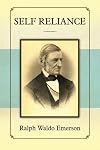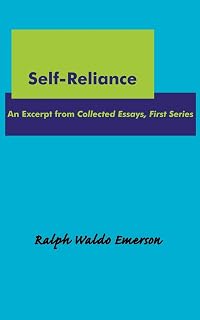
Self-Reliance
by Ralph Waldo Emerson 
On This Page
Description
Self-Reliance is an 1841 essay written by American transcendentalist philosopher and essayist Ralph Waldo Emerson. It contains a stirring call for each individual to avoid conformity and false consistency, and to follow their own instincts and ideas. It contains one of Emerson's most famous quotations: A foolish consistency is the hobgoblin of little minds, adored by little statesmen and philosophers and divines." The essay, possibly Emerson's most famous, is an analysis into the nature of show more the "aboriginal self on which a universal reliance may be grounded." It was first published in his 1841 collection, Essays: First Series. Emerson helped start the beginning of the Transcendentalist movement in America. show lessTags
Recommendations





















Member Reviews
I'd only read quotes by Emerson and wondered what surrounded those quotes. It turns out they were surrounded by still more quotes. Like Elmore Leonard who has said he leaves out of his books the parts people skim over, Emerson leaves out the parts that can't stand alone as quotes. I can't imagine what it must be like to write like this. What did his first draft look like?
Reading it, however, was like eating an entire chocolate cake. It's delicious but there's something sickening about it. You think you want more but in the background you're nauseated. You've had too much and it starts to taste peculiar in an undefinable way. You understand the meaning of the phrase "too much of a good thing." But it doesn't stop there. Not even for a show more brief rest.
And then sometimes you're completely lost. What does it mean? It seems to mean something but maybe you just don't get it. There are contradictions but the opposite of a profound truth is another profound truth (I just googled and that's a misquote of Niels Bohr) and besides, didn't he say not to worry about consistency? Or only worry if it's foolish. And then you feel foolish. But then you don't because of what you just read and what you feel is that you were foolish before you read it. But also you weren't because he was just saying what you and everyone else already knew in their (shared) soul only they might not have known they knew it which is why he had to say it.
And that's why you have to say it to. Not what he said but what you know to be true and thus everyone else does too but you need to remind them. But what was it again? And is it really true? If you are doubting it, then like Descartes, you exist. What's it like to exist? And why do I need to ask you? show less
Reading it, however, was like eating an entire chocolate cake. It's delicious but there's something sickening about it. You think you want more but in the background you're nauseated. You've had too much and it starts to taste peculiar in an undefinable way. You understand the meaning of the phrase "too much of a good thing." But it doesn't stop there. Not even for a show more brief rest.
And then sometimes you're completely lost. What does it mean? It seems to mean something but maybe you just don't get it. There are contradictions but the opposite of a profound truth is another profound truth (I just googled and that's a misquote of Niels Bohr) and besides, didn't he say not to worry about consistency? Or only worry if it's foolish. And then you feel foolish. But then you don't because of what you just read and what you feel is that you were foolish before you read it. But also you weren't because he was just saying what you and everyone else already knew in their (shared) soul only they might not have known they knew it which is why he had to say it.
And that's why you have to say it to. Not what he said but what you know to be true and thus everyone else does too but you need to remind them. But what was it again? And is it really true? If you are doubting it, then like Descartes, you exist. What's it like to exist? And why do I need to ask you? show less
Emerson's Self-Reliance is considered by many to be integral to the beginning of the transcendentalist movement, and while I am not especially a fan of transcendentalism as a whole, I do believe that this work is one of the more coherent proponents of the individual over society. Some of Emerson's arguments against the individual obtaining anything useful from societal, familial, religious, or governmental organizations may lend themselves towards an increasing slide towards solipsism - nothing exists in a vacuum - and his apparent distaste for travel seems xenophobic in nature (if not intention), his overall treatise that exceptional individuals (he tends to focus on 'artistic geniuses' more often than not) become so by rejecting show more cultural norms and accepted knowledge and distancing themselves from the common man and his organizational trappings. There are definitely holes in some of his arguments that could be exploited in an open debate, but the bulk of this essay speaks honestly of the need for the individual to seek its own path. show less
Read “Self-Reliance” and “The Divinity School Address,” that’s about it. Not knocked out but I have a hard time grasping older writing so I assume the shortcoming is mine and not the text. Also things like this I’ve probably absorbed so much of it secondhand in my life that the stuff seems obvious or banal or whatever - I’m sure it wasn’t in his day, and he must have seemed original and shocking , but it just doesn’t set me on fire.
LOVED this admonishment to be one's self, and speak one's mind! Here's a brief excerpt--
"To believe your own thought, to believe what is true for you in your private heart, is true for all men, --that is genius. Speak your latent conviction, and it shall be the universal sense; for always the inmost in due time becomes the outmost, --and our first thought is rendered back to us by the trumpets of the Last Judgment. Familiar as the voice of the mind is to each, the highest merit we ascribe to Moses, Plato, and Milton, is that they set at naught books and traditions, and spoke not what men, but what they thought. A man should learn to detect and watch that gleam of light which flashes across his mind from within, more than the lustre of show more the firmament of bards and sages. Yet he dismisses without notice his thought, because it is his. In every work of genius we recognize our own rejected thoughts: they come back to us with a certain alienated majesty. Great works of art have no more affecting lesson for us than this. They teach us to abide by our spontaneous impression with good-humored inflexibility then most when the cry of voices is on the other side. Else, to-morrow a stranger will say with masterly good sense precisely what we have thought and felt all the time, and we shall be forced to take with shame our own opinion from another." show less
"To believe your own thought, to believe what is true for you in your private heart, is true for all men, --that is genius. Speak your latent conviction, and it shall be the universal sense; for always the inmost in due time becomes the outmost, --and our first thought is rendered back to us by the trumpets of the Last Judgment. Familiar as the voice of the mind is to each, the highest merit we ascribe to Moses, Plato, and Milton, is that they set at naught books and traditions, and spoke not what men, but what they thought. A man should learn to detect and watch that gleam of light which flashes across his mind from within, more than the lustre of show more the firmament of bards and sages. Yet he dismisses without notice his thought, because it is his. In every work of genius we recognize our own rejected thoughts: they come back to us with a certain alienated majesty. Great works of art have no more affecting lesson for us than this. They teach us to abide by our spontaneous impression with good-humored inflexibility then most when the cry of voices is on the other side. Else, to-morrow a stranger will say with masterly good sense precisely what we have thought and felt all the time, and we shall be forced to take with shame our own opinion from another." show less
This classic is a tough read because it's written in the English of more than a hundred and fifty years ago. Yet, some of the passages seem very fresh. It's worth the time.
This short read/listen is a collection of thoughts published by the author. It it urges readers to trust your gut feeling, rather than follow the herd. It was a difficult listen because of it's English construction dates from it's birth in 1841;also, it seemed like a stream of consciousness.
This book is Emerson’s compilation of many years’ works and the archetype for his transcendental philosophies. Throughout the essay he gives a defense for his famous catch-phrase “trust thyself.” This argument follows three major points: the self-contained genius, the disapproval of the world, and the value of self-worth. Tough read and must be read with guidance.
Members
- Recently Added By
Lists

Books recommended by Barack Obama
295 works; 29 members

Internationale Romantik
15 works; 1 member
Author Information

802+ Works 21,165 Members
Known primarily as the leader of the philosophical movement transcendentalism, which stresses the ties of humans to nature, Ralph Waldo Emerson, American poet and essayist, was born in Boston in 1803. From a long line of religious leaders, Emerson became the minister of the Second Church (Unitarian) in 1829. He left the church in 1832 because of show more profound differences in interpretation and doubts about church doctrine. He visited England and met with British writers and philosophers. It was during this first excursion abroad that Emerson formulated his ideas for Self-Reliance. He returned to the United States in 1833 and settled in Concord, Massachusetts. He began lecturing in Boston. His first book, Nature (1836), published anonymously, detailed his belief and has come to be regarded as his most significant original work on the essence of his philosophy of transcendentalism. The first volume of Essays (1841) contained some of Emerson's most popular works, including the renowned Self-Reliance. Emerson befriended and influenced a number of American authors including Henry David Thoreau. It was Emerson's practice of keeping a journal that inspired Thoreau to do the same and set the stage for Thoreau's experiences at Walden Pond. Emerson married twice (his first wife Ellen died in 1831 of tuberculosis) and had four children (two boys and two girls) with his second wife, Lydia. His first born, Waldo, died at age six. Emerson died in Concord on April 27, 1882 at the age of 78 due to pneumonia and is buried in Sleepy Hollow Cemetery in Concord, Massachusetts. (Bowker Author Biography) show less
Ralph Waldo Emerson has a Legacy Library. Legacy libraries are the personal libraries of famous readers, entered by LibraryThing members from the Legacy Libraries group.
Some Editions
Series
Belongs to Publisher Series
Sammlung Hofenberg (Emerson)
Work Relationships
Is contained in
Is abridged in
A Set of Short Stories (The Concord Hymn, An Excerpt from Self-Reliance, The Last Leaf, Old Ironsides, The Batte Hymn of the Republic, The Children's Hour, Paul Revere's Ride, The Village Blacksmith, Two Excerpts from Walden, Barbara Frietchie, The Barefoot Boy) by Holmes Emerson, Howe, Longfellow, Thoreau and Whittier
Inspired
Has as a student's study guide
Common Knowledge
- Canonical title*
- Selbständigkeit
- Original title
- Self-Reliance
- Alternate titles*
- Vertraue dir selbst! - Ein Aufruf zur Selbständigkeit des Menschen
- Original publication date
- 1841
- Quotations
- Nothing is at last sacred but the integrity of your own mind.
- Original language
- English
*Some information comes from Common Knowledge in other languages. Click "Edit" for more information.
Classifications
Statistics
- Members
- 992
- Popularity
- 26,567
- Reviews
- 10
- Rating
- (3.97)
- Languages
- 7 — Chinese, English, German, Italian, Portuguese, Slovenian, Spanish
- Media
- Paper, Audiobook, Ebook
- ISBNs
- 58
- ASINs
- 22