On This Page
Description
The Laundry Files' Charles Stross assigns a day trader to a permanent position on the night shift... After stumbling upon the algorithm that turned him and his fellow merchant bankers into vampires, Alex Schwartz was drafted by The Laundry, Britain's secret counter-occult agency that's humanity's first line of defense against the forces of darkness. Dependent on his new employers for his continued existence-as Alex has no stomach for predatory bloodsucking-he has little choice but to accept show more his new role as an operative-in-training. Dispatched to Leeds, Alex's first assignment is to help assess the costs of renovating a 1950s Cold War bunker into The Laundry's new headquarters. Unfortunately, Leeds is Alex's hometown, and the thought of breaking the news to his parents that he's left banking for civil service, while hiding his undead condition, is causing more anxiety than learning how to live as a vampire secret agent preparing to confront multiple apocalypses. Alex's only saving grace is Cassie Brewer, a drama student appearing in the local Goth Festival who is inexplicably attracted to him despite his awkward personality and massive amounts of sunblock. But Cassie has secrets of her own-secrets that make Alex's night life behaviors seem positively normal... show lessTags
Recommendations









Member Reviews
At the outset, the Laundry Files series by Charles Stross consisted of a latter-day mash-up of two well-defined genres: Cold War espionage and Lovecraftian weird horror. And for several volumes it continued thus. As the focus has shifted off of the original protagonist Bob Howard, elements of other genres have been introduced. For example, the vampires of more traditional gothic horror were the crux of the last book Bob narrated, The Rhesus Chart. When Bob's wife Mo took over as the narrator for The Annihilation Score, the caped superhero genre contributed to the central plot. In this seventh book, narrator duties have passed to junior recruit Alex Schwartz, and it is the high fantasy genre that gets tapped for its oddness. A chief show more character in this book is in point of fact the King of Elfland's daughter (in quiet homage to Dunsany among many others), so that Alex/Alveric's romancing of the unearthly "princess/assassin of the Unseelie Court" sits in a rich inter-textual tradition, complete with frequent references to the works of Tolkien and a Laundry operative named the Dungeon Master (or DM).
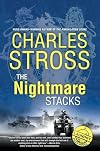
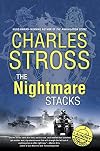
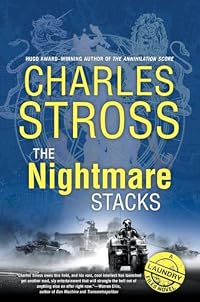
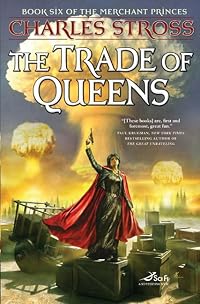
The return of vicar Pete in a more conspicuous role was something I already expected, and it's a neat fit somehow to make him Alex's mentor. However, I did not imagine that Pete would turn out to bethe character who is depicted on the book jacket driving a Nazi half-track in full medieval plate armor .
Despite foreshadowings regarding bureaucratic fallout, as well as family and public comeuppances, this book is entirely bereft of denouement. It gallops to the climax and then stops. I guess that's a little more forgivable for the seventh entry in a series, inasmuch as readers can expect to get some resolution of loose ends in the now-assured further installment.
I did enjoy this one very much, laughing out loud at it repeatedly, despite the frequently macabre events described--all of which is par for the course in this series. I'm not sure how well it would hold up as a point of entry, but with the benefit of all the foregoing books, I found this one to be among my favorites so far. Like the others, the fast pace of the action makes it a compelling read, and the character chemistry was quite endearing from my perspective. show less
The return of vicar Pete in a more conspicuous role was something I already expected, and it's a neat fit somehow to make him Alex's mentor. However, I did not imagine that Pete would turn out to be
Despite foreshadowings regarding bureaucratic fallout, as well as family and public comeuppances, this book is entirely bereft of denouement. It gallops to the climax and then stops. I guess that's a little more forgivable for the seventh entry in a series, inasmuch as readers can expect to get some resolution of loose ends in the now-assured further installment.
I did enjoy this one very much, laughing out loud at it repeatedly, despite the frequently macabre events described--all of which is par for the course in this series. I'm not sure how well it would hold up as a point of entry, but with the benefit of all the foregoing books, I found this one to be among my favorites so far. Like the others, the fast pace of the action makes it a compelling read, and the character chemistry was quite endearing from my perspective. show less
The Nightmare Stacks is a return to a more classic Laundry novel, with a new protagonist, a new enemy, and metric shittons of style. The story follows Alex, one of the PHANGS (Vampires with sorcerous abilities from The Rhesus Chart), as he's coming to terms with his new life as a civil servant and combat mage, and an unsatisfying assignment back in his hometown of Leeds.
While Alex is scouting out squalid Cold War bunkers as a new HQ, a cold and vasty intelligence has turned it's eyes towards Earth. In this case it's elves, who Stross' perfectly casts as the post-apocalyptic remnants of a high magic civilization turned into a perfect fascist imperial machine through mind control magic. CASE NIGHTMARE RED (oh yes, there is a whole show more rainbow of CASE NIGHTMARES!) involves extraplanar invasion by intelligent beings, and Stross does an incredible job showcasing the Cthulhuoid bio-horror military of the elves going up the scanty rapid response forces the diminished British military can throw together. Stross's ambition in this book was to treat folklore about elves with about the same coherence as an Afghan villager's account of why SEAL Team 6 shot up his village, and it works! This is the best world-building in the series since book one, and promises a major shift of events for the next book.
That said, as a protagonist Alex is kind of a wet squib. Yet another math nerd with women issues and a developing moral compass. He's a lot like early Bob Howard, without the sarcasm or the fun. The supporting cast exceeds. "Cassie", elven spy and princess, does a great job with her confusion at Earthly mores and her very predatory alien mindset. Pinky and Brains are back, along with their refurbished Kettenkrad. And the Most Awkward Family Dinner in History adds some solid human drama. show less
While Alex is scouting out squalid Cold War bunkers as a new HQ, a cold and vasty intelligence has turned it's eyes towards Earth. In this case it's elves, who Stross' perfectly casts as the post-apocalyptic remnants of a high magic civilization turned into a perfect fascist imperial machine through mind control magic. CASE NIGHTMARE RED (oh yes, there is a whole show more rainbow of CASE NIGHTMARES!) involves extraplanar invasion by intelligent beings, and Stross does an incredible job showcasing the Cthulhuoid bio-horror military of the elves going up the scanty rapid response forces the diminished British military can throw together. Stross's ambition in this book was to treat folklore about elves with about the same coherence as an Afghan villager's account of why SEAL Team 6 shot up his village, and it works! This is the best world-building in the series since book one, and promises a major shift of events for the next book.
That said, as a protagonist Alex is kind of a wet squib. Yet another math nerd with women issues and a developing moral compass. He's a lot like early Bob Howard, without the sarcasm or the fun. The supporting cast exceeds. "Cassie", elven spy and princess, does a great job with her confusion at Earthly mores and her very predatory alien mindset. Pinky and Brains are back, along with their refurbished Kettenkrad. And the Most Awkward Family Dinner in History adds some solid human drama. show less
Charlie Stross reboots the Laundry series as neophyte operative Alex Schwartz comes to terms with being seconded into the British Government's secretive paranormal defence establishment. This is the second volume in which readers have seen Bob Howard on sabbatical (having been powered up to such an extent that it is harder to sympathise with his plight).
By contrast, having Alex in the driver's seat allows us to experience with fresh eyes the insane joys of bureaucratic labyrinths, pennypinching accountancy departments, and the peculiarly stupid protocols and hierarchies of the military. Alex of course, is coping with losing his high flying job as a mathematics whiz at an investment bank, whilst adapting to the very special disease of show more vampirism, which he has contracted through by dabbling too deeply in arcane mathematics. Alex's mundane task is to scope out the ground for a relocation of the Laundry operations to Leeds. The location is less than pleasing to Alex, whose grandchild deprived parents are residents of that fair city, and who are likely to be disappointed by Alex's reduced circumstances.
Meanwhile, in another dimension, the girl of Alex's dreams/nightmares is on a mission to find refuge for the remnant of her people, who have been just a little too enthusiastic in their warring on each other for primacy. Breaking up their moon was, in retrospect, not the best of ideas.
Needless to say, these star-crossed lovers cross paths, and mayhem ensues show less
By contrast, having Alex in the driver's seat allows us to experience with fresh eyes the insane joys of bureaucratic labyrinths, pennypinching accountancy departments, and the peculiarly stupid protocols and hierarchies of the military. Alex of course, is coping with losing his high flying job as a mathematics whiz at an investment bank, whilst adapting to the very special disease of show more vampirism, which he has contracted through by dabbling too deeply in arcane mathematics. Alex's mundane task is to scope out the ground for a relocation of the Laundry operations to Leeds. The location is less than pleasing to Alex, whose grandchild deprived parents are residents of that fair city, and who are likely to be disappointed by Alex's reduced circumstances.
Meanwhile, in another dimension, the girl of Alex's dreams/nightmares is on a mission to find refuge for the remnant of her people, who have been just a little too enthusiastic in their warring on each other for primacy. Breaking up their moon was, in retrospect, not the best of ideas.
Needless to say, these star-crossed lovers cross paths, and mayhem ensues show less
One of my absolute favorite books in this series. Full-scale parallel world invasion by "Elves," who are much less mystical and far deadlier than the sort we might have been accustomed to. Stross is great, as always, at estimating the systemic impacts of such an incursion on the British military and other authorities, the rippling air traffic control impacts from dragon-based close air support, and the dire results of the 2010 SDSR, as there isn't nearly enough heavy armor available in close proximity to Leeds.
The Nightmare Stacks is another turn in the Laundry series, which has moved firmly away from following Bob Howard to being about the world that Bob inhabits. The main point of view in this story is Alex, one of the vampires from [b:The Rhesus Chart|18211295|The Rhesus Chart (Laundry Files, #5)|Charles Stross|https://d.gr-assets.com/books/1383475235s/18211295.jpg|25632880]. We also see some from Cassie's point of view (a new character) and Pinky & Brains return and play a strong supporting part in the story. We also see Pete the Vicar as Alex's mentor.
Alex is not a cynical snarky commentator. Instead we have a primary character that is focussed on work and lacking some of the social skills, especially in dealing with the opposite sex, show more that are more commonplace. Alex is getting used to the changes of being a vampire, and how this affects his life. He's still in contact with the other surviving PHANGs, but they've obviously been separated for safety reasons. Like a lot of people in their 20s he's still under pressure from his parents to settle down, and this forms a bit of sub-plot to the book. There is a hugely entertaining scene where he takes Cassie to dinner with his parents at the same time as his younger sister introduces her partner too. This manages to build some interesting character development as well as help the general plot along too.
What I enjoyed most about the book though was the exploration of the Laundryverse that Charlie Stross has done by switching characters. He has also played with some interesting tropes in doing so as well. Cassie as a Manic Pixie Dream Girl being the most obvious. The whole nature of magic (by computation) is developed in the Nightmare Stacks. We are presented with another civilisation based on the same magic that the Laundry tries to keep in check. This civilisation is completely internally consistent and follows a logical progression from what we've seen already. It's also quite alien, but understandable. However when it comes into contact with our humanity it finds us more alien.
The contact (CASE NIGHTMARE RED) is a nightmare indeed. If the [b:The Annihilation Score|23154785|The Annihilation Score (Laundry Files, #6)|Charles Stross|https://d.gr-assets.com/books/1426160476s/23154785.jpg|42702127] gave us some overt effects of CASE NIGHTMARE GREEN, then The Nightmare Stacks is 9/11 style coverage of the nightmare. We have a full mobilisation of the UK armed forces, COBR meeting and also thousands of deaths. There's dragons vs typhoon jet fighters, and an interesting take on a modern armoured cavalry brigade. We also see full on magical warfare.
Overall this is one of the more visual and interesting Laundry books, and if I was to pick one for a movie this would be spectacular. It would need to be a cert 18 apocalyptic horror, but then it is a Laundry story... show less
Alex is not a cynical snarky commentator. Instead we have a primary character that is focussed on work and lacking some of the social skills, especially in dealing with the opposite sex, show more that are more commonplace. Alex is getting used to the changes of being a vampire, and how this affects his life. He's still in contact with the other surviving PHANGs, but they've obviously been separated for safety reasons. Like a lot of people in their 20s he's still under pressure from his parents to settle down, and this forms a bit of sub-plot to the book. There is a hugely entertaining scene where he takes Cassie to dinner with his parents at the same time as his younger sister introduces her partner too. This manages to build some interesting character development as well as help the general plot along too.
What I enjoyed most about the book though was the exploration of the Laundryverse that Charlie Stross has done by switching characters. He has also played with some interesting tropes in doing so as well. Cassie as a Manic Pixie Dream Girl being the most obvious. The whole nature of magic (by computation) is developed in the Nightmare Stacks. We are presented with another civilisation based on the same magic that the Laundry tries to keep in check. This civilisation is completely internally consistent and follows a logical progression from what we've seen already. It's also quite alien, but understandable. However when it comes into contact with our humanity it finds us more alien.
The contact (CASE NIGHTMARE RED) is a nightmare indeed. If the [b:The Annihilation Score|23154785|The Annihilation Score (Laundry Files, #6)|Charles Stross|https://d.gr-assets.com/books/1426160476s/23154785.jpg|42702127] gave us some overt effects of CASE NIGHTMARE GREEN, then The Nightmare Stacks is 9/11 style coverage of the nightmare. We have a full mobilisation of the UK armed forces, COBR meeting and also thousands of deaths. There's dragons vs typhoon jet fighters, and an interesting take on a modern armoured cavalry brigade. We also see full on magical warfare.
Overall this is one of the more visual and interesting Laundry books, and if I was to pick one for a movie this would be spectacular. It would need to be a cert 18 apocalyptic horror, but then it is a Laundry story... show less
Minor spoilers.
The Nightmare Stacks is, I think, best approached as a generalization of the previous Laundry Files novels. Although the novel is about Alex, it's not about his reactions in the same way that the early novels were about Bob's reactions (usually for humorous effects). This is about the role of the Laundry as a whole in a world shifting towards Nightmare.
Interestingly enough, the background suggests that the invasion is driven not by developments along our timeline, but by those along the elves' timeline. That they happen to erupt into an England shifting towards CASE NIGHTMARE GREEN is just bad (or perhaps good) luck.
Thematically, Stross has moved on from looking at enforcement to the very image of authority itself.
His show more elves have hierarchy to a degree no historical monarchy in human history has had: to get close, you have to cross the absolutism of Louis XIV and James II (see Steve Pincus' 1688 for a detailed discussion of James II and how new this model was) with the god-kings of some ancient cultures. Most human "monarchies" have tended to be oligarchies with a constrained leader: piss off enough of your nobility and you end up dead (William II, Edward II, Richard II, Henry VI, Richard III) or embroiled in much civil strife (Stephen, John). (Charles I and James II fall into special classes of their own, facing a broader opposition in Parliament.) The elves have a strict hierarchy driven by absolute authority (and an almost Eddorian penchant for undermining each other).
For all that, they also stand for our past. Understanding not only social but natural order as hierarchical has a long history, and Ulysses' speech in Troilus and Cressida merely sets out a generally accepted commonplace. And if we're too dull to miss the point, we're given, late on, a Cabinet meeting where the PM makes all the same types of mistakes, on the same types of assumptions, that the Elvish All-Highest does.
Because one of the themes of the book is that top-down hierarchies don't work very well. Just about every single decision made by the elves is bad, because it prioritizes retaining or exerting power over seeing the world as it is and responding appropriately.
They would have lost, eventually, no matter what; if not in England then when they had to deal with the Black Chamber or BLUE HADES or were simply nuked from orbit. What the story tells is how, even with missteps, losses were minimized, partly by sheer luck (Cassie's personality, Alex's existence, itself improbable until very shortly before, accidents of timing).
Another thing to think about is civilization. The elves are, in one sense, more "civilized" than we are: better aesthetics, more advanced in their technology than we are in ours. Their word for us, as Stross presents it, is the Tolkienian Elvish word for "orcs". (Some of this is not a new perception: both Chesterton and Lewis noted that a medieval perception of the modern world would be dominated by the word "drab" in a great many contexts.) But they are also destructive, violent, and brutal. So civilization has two senses which are here opposed.
I like the shift to Alex's viewpoint: aside from the way in which his lack of seniority is required for the mechanics of the plot to work, triangulation gives a better perspective.
In one sense, the action plot - lots of things that deliver an Earth-shattering kaboom - makes this an easily accessible book, and we do get a high-level overview of CASE NIGHTMARE RAINBOW, so it could be considered a reasonable point of entry into the series (especially as it calls for no back story re Bob and Mo), but I'm inclined to think that it gains more from knowledge of the already established context, so I would recommend beginning earlier and coming to this with that background under one's belt. show less
The Nightmare Stacks is, I think, best approached as a generalization of the previous Laundry Files novels. Although the novel is about Alex, it's not about his reactions in the same way that the early novels were about Bob's reactions (usually for humorous effects). This is about the role of the Laundry as a whole in a world shifting towards Nightmare.
Interestingly enough, the background suggests that the invasion is driven not by developments along our timeline, but by those along the elves' timeline. That they happen to erupt into an England shifting towards CASE NIGHTMARE GREEN is just bad (or perhaps good) luck.
Thematically, Stross has moved on from looking at enforcement to the very image of authority itself.
His show more elves have hierarchy to a degree no historical monarchy in human history has had: to get close, you have to cross the absolutism of Louis XIV and James II (see Steve Pincus' 1688 for a detailed discussion of James II and how new this model was) with the god-kings of some ancient cultures. Most human "monarchies" have tended to be oligarchies with a constrained leader: piss off enough of your nobility and you end up dead (William II, Edward II, Richard II, Henry VI, Richard III) or embroiled in much civil strife (Stephen, John). (Charles I and James II fall into special classes of their own, facing a broader opposition in Parliament.) The elves have a strict hierarchy driven by absolute authority (and an almost Eddorian penchant for undermining each other).
For all that, they also stand for our past. Understanding not only social but natural order as hierarchical has a long history, and Ulysses' speech in Troilus and Cressida merely sets out a generally accepted commonplace. And if we're too dull to miss the point, we're given, late on, a Cabinet meeting where the PM makes all the same types of mistakes, on the same types of assumptions, that the Elvish All-Highest does.
Because one of the themes of the book is that top-down hierarchies don't work very well. Just about every single decision made by the elves is bad, because it prioritizes retaining or exerting power over seeing the world as it is and responding appropriately.
They would have lost, eventually, no matter what; if not in England then when they had to deal with the Black Chamber or BLUE HADES or were simply nuked from orbit. What the story tells is how, even with missteps, losses were minimized, partly by sheer luck (Cassie's personality, Alex's existence, itself improbable until very shortly before, accidents of timing).
Another thing to think about is civilization. The elves are, in one sense, more "civilized" than we are: better aesthetics, more advanced in their technology than we are in ours. Their word for us, as Stross presents it, is the Tolkienian Elvish word for "orcs". (Some of this is not a new perception: both Chesterton and Lewis noted that a medieval perception of the modern world would be dominated by the word "drab" in a great many contexts.) But they are also destructive, violent, and brutal. So civilization has two senses which are here opposed.
I like the shift to Alex's viewpoint: aside from the way in which his lack of seniority is required for the mechanics of the plot to work, triangulation gives a better perspective.
In one sense, the action plot - lots of things that deliver an Earth-shattering kaboom - makes this an easily accessible book, and we do get a high-level overview of CASE NIGHTMARE RAINBOW, so it could be considered a reasonable point of entry into the series (especially as it calls for no back story re Bob and Mo), but I'm inclined to think that it gains more from knowledge of the already established context, so I would recommend beginning earlier and coming to this with that background under one's belt. show less
Re-read 7/20/18:
I really can't squeal more than I squealed the first time around, but I will add that it's STILL AS GOOD AS THE FIRST TIME. I love Alex! I love Cassie! And of course, the whole setup and denouement was fantastic!
I mean, just the whole horrific action scenes, the stark immediacy of being a victim of genocide, doing everything possible to save your people, including an ignorant invasion of Earth... I GET IT. The possibilities after that end, though... that's what sticks with me. Spoilers, of course, but it's the whole refugee status that kicks my butt. Never mind the outright funny elements, although they are great. At the core, this novel is extremely serious. And for the action, it's a ramp-up on the epic scale brought show more home to London.
Original Review:
I'm always looking forward to the Laundry Files novels, now, and with good reason.
These tales always breathe fresh life into old story concepts.
Mix a bunch of nightmare bureaucracy into a mass of Cthulhu Spy Fiction and add a memBrain of multiverses, massive geek humor, Pinky and Brains, and a truly clever take on vampirism/magus, but in this one, let's mix in a younger protagonist, the redoubtable 24 year old vampire math geek, Alex, and pretty spearhead of a nearly decimated alien invasion force who happen to be running for their lives from the Elder Gods, all of whom are willing to go to war with innocents for their ultimate survival (with England an the rest of humanity, please read,) and be a woman who just happens to be up in line for the rulership of the entire alien Host of Air and Darkness, full of eldritch magic and might.
Is Alex out of his league?
CASE NIGHTMARE RED, people. CASE NIGHTMARE RED.
I love this. It is sooooo damn fun. Okay, so I miss Bob and Mo a bit, and they're somewhere in the background, but Alex and Cass are soooooo damn cute together! Younger crowd. A little blood, a little war, a little mess-up with the Basilisk network that turns all security cameras into Medusa's Stare, *shiver*, and we've got an all-out conflict that's actually a real nightmare.
Is this fine to read as a standalone? Yes, it is. Is it scary for the crowd that has been reading all the novels and great novellas up to date? Yes, yes it is. Very much so. Every page is full of deliciously savvy tech, math, magic, myth, and wry, dry humor.
Fanboy is still squeeing. :) :) show less
I really can't squeal more than I squealed the first time around, but I will add that it's STILL AS GOOD AS THE FIRST TIME. I love Alex! I love Cassie! And of course, the whole setup and denouement was fantastic!
I mean, just the whole horrific action scenes, the stark immediacy of being a victim of genocide, doing everything possible to save your people, including an ignorant invasion of Earth... I GET IT. The possibilities after that end, though... that's what sticks with me. Spoilers, of course, but it's the whole refugee status that kicks my butt. Never mind the outright funny elements, although they are great. At the core, this novel is extremely serious. And for the action, it's a ramp-up on the epic scale brought show more home to London.
Original Review:
I'm always looking forward to the Laundry Files novels, now, and with good reason.
These tales always breathe fresh life into old story concepts.
Mix a bunch of nightmare bureaucracy into a mass of Cthulhu Spy Fiction and add a memBrain of multiverses, massive geek humor, Pinky and Brains, and a truly clever take on vampirism/magus, but in this one, let's mix in a younger protagonist, the redoubtable 24 year old vampire math geek, Alex, and pretty spearhead of a nearly decimated alien invasion force who happen to be running for their lives from the Elder Gods, all of whom are willing to go to war with innocents for their ultimate survival (with England an the rest of humanity, please read,) and be a woman who just happens to be up in line for the rulership of the entire alien Host of Air and Darkness, full of eldritch magic and might.
Is Alex out of his league?
CASE NIGHTMARE RED, people. CASE NIGHTMARE RED.
I love this. It is sooooo damn fun. Okay, so I miss Bob and Mo a bit, and they're somewhere in the background, but Alex and Cass are soooooo damn cute together! Younger crowd. A little blood, a little war, a little mess-up with the Basilisk network that turns all security cameras into Medusa's Stare, *shiver*, and we've got an all-out conflict that's actually a real nightmare.
Is this fine to read as a standalone? Yes, it is. Is it scary for the crowd that has been reading all the novels and great novellas up to date? Yes, yes it is. Very much so. Every page is full of deliciously savvy tech, math, magic, myth, and wry, dry humor.
Fanboy is still squeeing. :) :) show less
Members
- Recently Added By
Lists

Recommended Faerie books
67 works; 22 members

2017 Hugo Eligible Novels
145 works; 14 members

Civil Service Spec Fic
36 works; 4 members

Princess Tales
130 works; 4 members

Hugo Award 2019 Reading List
126 works; 4 members

Books Read in 2016
4,666 works; 197 members

Books Read in 2022
5,164 works; 113 members

Books Read in 2017
4,249 works; 130 members

Books Read in 2026
1,691 works; 62 members
Author Information

119+ Works 45,354 Members
Born in Leeds, England, Charles Stross knew he wanted to be a science fiction writer from the age of six. Despite this, he went to university in London and qualified as a Pharmacist. He made his first writing sale to Interzone in 1986, and sold about a dozen stories elsewhere throughout the late 1980s and early 1990s. He now writes fiction show more full-time, has sold about 16 novels, has won one Hugo award and been nominated nearly a dozen times, and has been translated into about a dozen languages. He is the author of the Merchant Princes series. His latest book, The Revolution Business, is the fifth in this series. He lives in Edinburgh, Scotland, with his wife Feorag. (Bowker Author Biography) show less
Some Editions
Awards and Honors
Awards
Series

Common Knowledge
- Canonical title
- The Nightmare Stacks
- Original title
- The Nightmare Stacks
- Original publication date
- 2016-06-28
- People/Characters
- Alex Schwartz; Cassie Brewer; Pinky; Pete Russell; Gerry Lockhart; Brains (show all 9); Cassie; Derek Blacker; Jez Wilson
- Important places
- Leeds, England, UK
- Epigraph
- Treason doth never prosper: what's the reason? Why, if it prosper, none dare call it treason.
--John Harington (16th century)
No one would have believed in the last years of the nineteenth century that this world was being watched keenly and closely by intelligences greater than man's and yet as mortal as his own; that as men busied themselves about... (show all) their various concerns they were scrutinised and studied, perhaps almost as narrowly as a man with a microscope might scrutinise the transient creatures than swarm and multiply in a drop of water. With infinite complacency men went to and fro over this globe about their little affairs ... No one gave a thought to the older worlds of space as sources of human danger ... Yet across the gulf of space, minds that are to our minds as ours are to those of the beasts that perish, intellects vast and cool and unsympathetic, regarded this earth with envious eyes, and slowly and surely drew their plans against us.
--H. G. Wells, The War of the Worlds - Dedication
- In memory of Terry Pratchett, who showed us all how it's done
- First words
- A vampire is haunting Whitby; it's traditional.
- Last words
- (Click to show. Warning: May contain spoilers.)Then she walks into his open arms and they stand there, together for a while.
- Blurbers
- Scalzi, John; Ellis, Warren
- Original language
- English
Classifications
Statistics
- Members
- 717
- Popularity
- 39,367
- Reviews
- 28
- Rating
- (4.01)
- Languages
- English
- Media
- Paper, Audiobook, Ebook
- ISBNs
- 8
- ASINs
- 4