On This Page
Description
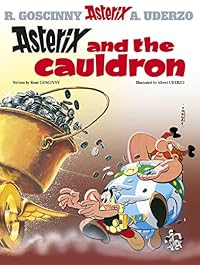
A neighboring Gaulish chief asks the people of Asterix's village to help guard a cauldron full of money from the Romans. But the sneaky chief plans to double-cross everyone. So he steals back the cash just when Asterix is standing sentinel. Can Asterix and Obelix recover the riches?Tags
Recommendations


















Member Reviews
Well, a chief of a nearby village whose name is Moralsarelastix (that is the Chieftain's name, not the village's name) arrives at the little Gaulish village that we know so well with a cauldron full of money. As it turns out Ceaser has become bankrupt due to all of the wars that he has been fighting and so that he can continue fighting the wars, he has decided to raise some more taxes. However, despite the fact that Moralsarelastix happens to be a Roman collaborator, he is that patriotic in that he is willing to hand over his hard earned money, so he decides to hide it all in the village under Asterix's watchful eye. However, the money is stolen and Asterix is banished from the village until he can get the money back.
Like the other show more albums in this series, this has a lot of almost classic moments. When Moralsarelastix arrives, Vitalstatistix calls a council meeting, and it turns out that the members of the village council are Getafix, Asterix, Obelix, and Dogmatix. While I can accept that Asterix and Getafix would be on the council, I am a little baffled as to how Obelix got there, but this has probably more to do with the fact that Obelix pretty much follows Asterix everywhere (and Dogmatix follows Obelix everywhere). Another scene has Asterix being tried before the village court, and this time the people who sit on the court are Geriatrix and Cacofonix (as well as Vitalstatistix, who, by the way, does all of the talking – it seems that Geriatrix and Cacofonix are there for window dressing).
Much of the humour in this album comes from the fact that the little Gaulish village actually has no need for money. They simply exist on a barter system and since they regularly halt the advance of civilisation into their little corner of paradise, the need for money (and tax collecting) has never arisen. Thus it seems that Asterix and Obelix, who seem to be able to get through all of their adventures by beating people up, have met their match. Hey, they even try robbing a Roman bank to discover that Ceaser has been there before them and has taken all the money for himself.
My favourite part of the album was where Obelix realises that they can make money by getting Dogmatix to do tricks because he sees this guy with some dogs doing tricks and people throwing money at him. So he goes to teach Dogmatix to do tricks and when he looks up he sees a heap of dogs looking at him cheering. There is the part where they are attempting to make money selling boars, but they have no understanding of the concept of supply and demand, so sell all of their boars for such a ridiculously low amount that the bottom falls out of the boar market.
At least the pirates have a good turn in this one. show less
Like the other show more albums in this series, this has a lot of almost classic moments. When Moralsarelastix arrives, Vitalstatistix calls a council meeting, and it turns out that the members of the village council are Getafix, Asterix, Obelix, and Dogmatix. While I can accept that Asterix and Getafix would be on the council, I am a little baffled as to how Obelix got there, but this has probably more to do with the fact that Obelix pretty much follows Asterix everywhere (and Dogmatix follows Obelix everywhere). Another scene has Asterix being tried before the village court, and this time the people who sit on the court are Geriatrix and Cacofonix (as well as Vitalstatistix, who, by the way, does all of the talking – it seems that Geriatrix and Cacofonix are there for window dressing).
Much of the humour in this album comes from the fact that the little Gaulish village actually has no need for money. They simply exist on a barter system and since they regularly halt the advance of civilisation into their little corner of paradise, the need for money (and tax collecting) has never arisen. Thus it seems that Asterix and Obelix, who seem to be able to get through all of their adventures by beating people up, have met their match. Hey, they even try robbing a Roman bank to discover that Ceaser has been there before them and has taken all the money for himself.
My favourite part of the album was where Obelix realises that they can make money by getting Dogmatix to do tricks because he sees this guy with some dogs doing tricks and people throwing money at him. So he goes to teach Dogmatix to do tricks and when he looks up he sees a heap of dogs looking at him cheering. There is the part where they are attempting to make money selling boars, but they have no understanding of the concept of supply and demand, so sell all of their boars for such a ridiculously low amount that the bottom falls out of the boar market.
At least the pirates have a good turn in this one. show less
A bit a disappointment after reading Obelix in Britain.
only one joke made me smile. The bankname 'Credit Latin'
only one joke made me smile. The bankname 'Credit Latin'
The boys, entrusted with a cauldron of money by an unscrupulous Gaulish chief, embark on a journey to bring back the money when it is stolen while in their care. Eventually they find that the chief had stolen his own money from them, and then relied on their sense of honor to replace it. So-so story.
Six out of ten. CBR format.
A neighbouring Gaulish chief asks Asterix to protect a cauldron full of money from the Romans. They agree but what happens when the cauldron is stolen?
Encore une fois...Asterix.
Zal hebzucht de eenheid van het dorp verstoren? Voor het eerst nemen René Goscinny en Albert Uderzo dit trieste menselijke karaktertrekje onder de loep. Gelukkig zijn Asterix, Obelix en Panoramix er om in te grijpen!
De karikatuur van de menselijke komedie tekent zich in elke strip duidelijker af. Kan het zijn dat René en Albert zich niet meer zo thuis voelden in de sfeer bij het weekblad Pilote na de gebeurtenissen van mei 1968? De kwaliteit van hun stripalbums heeft er in ieder geval niet onder geleden.
De karikatuur van de menselijke komedie tekent zich in elke strip duidelijker af. Kan het zijn dat René en Albert zich niet meer zo thuis voelden in de sfeer bij het weekblad Pilote na de gebeurtenissen van mei 1968? De kwaliteit van hun stripalbums heeft er in ieder geval niet onder geleden.
Jun 13, 2024Dutch
År 50 før Kristi fødsel, Gallien.
En lumsk gallerhøvding ved navn Elastix (som er i romernes sold) deponerer en skat i gallerbyen (angiveligt for at slippe for at betale skat til romerne). Skatten er en mængde sølvmønter anbragt i en suppegryde, der har været brugt til at koge løgsuppe i for nylig. Desværre forsvinder skatten mens den er i Asterix' varetægt og han drager ud for at fylde gryden igen, gerne på romernes bekostning. Asterix og Obelix er langt omkring, men er alligevel tæt på at vende tomhændede hjem.
Til sidst napper de pengene ved en romersk skatteinddrager og opdager at det er de samme penge, som blev stjålet. Ergo var det Elastix, der selv stjal pengene og endda for noget så usselt som at betale skat til show more romerne.
Både gryden og Elastix får et los, og gryden og pengene ryger ud over en skrænt og ned til sørøverne, der for en gangs skyld får noget godt ud af at støde på Asterix og Obelix.
Vel hjemme bliver der festet om det lange bord.
Udmærket historie om elastisk moral og løgsuppe. show less
En lumsk gallerhøvding ved navn Elastix (som er i romernes sold) deponerer en skat i gallerbyen (angiveligt for at slippe for at betale skat til romerne). Skatten er en mængde sølvmønter anbragt i en suppegryde, der har været brugt til at koge løgsuppe i for nylig. Desværre forsvinder skatten mens den er i Asterix' varetægt og han drager ud for at fylde gryden igen, gerne på romernes bekostning. Asterix og Obelix er langt omkring, men er alligevel tæt på at vende tomhændede hjem.
Til sidst napper de pengene ved en romersk skatteinddrager og opdager at det er de samme penge, som blev stjålet. Ergo var det Elastix, der selv stjal pengene og endda for noget så usselt som at betale skat til show more romerne.
Både gryden og Elastix får et los, og gryden og pengene ryger ud over en skrænt og ned til sørøverne, der for en gangs skyld får noget godt ud af at støde på Asterix og Obelix.
Vel hjemme bliver der festet om det lange bord.
Udmærket historie om elastisk moral og løgsuppe. show less
Feb 4, 2012 (Edited)Danish
Members
- Recently Added By
Lists

1960s, Best books published therein
254 works; 22 members

Best Sellers / Popular 1968
237 works; 5 members

Books Read in 2024
4,623 works; 126 members
Author Information


Albert Uderzo was born on April 25, 1927 in Fismes, France as Alberto Aleondro Uderzo. In 1940, when he was just 13, he worked for Paris Publishing Society where he learned the basics for his profession - designing text and letters and editing photos. During World War II he worked on a farm and later as a furniture maker with his father. His show more drawing skills were put aside until 1945 when he entered a comic strip competition and later worked on a cartoon film titled Clic Clac. In the mean time he moved to Paris and worked on the magazine O.K. where he created several comics such as Arys Buck and Belloy. It was then that he met Rene Goscinny and the two worked on new comic book characters like Ompah-pah, Jehan Pistolet and Luc Junior. In 1959 they started a magazine called Pilote aimed at older children. It was the first issue that introduced the character Asterix and it was a big hit. By 1967 the comic became so popular that they decided to devote all their time to the series. Albert Uderzo was the illustator of all thirty Asterix adventures and the writer of the last eight adventures. show less
Some Editions
Series

Belongs to Publisher Series
Work Relationships
Is contained in
Has the adaptation
Common Knowledge
- Canonical title
- Asterix and the Cauldron
- Original title
- Astérix et le chaudron
- Alternate titles*
- Keine Kohle mehr im Pott
- Original publication date
- 1969
- People/Characters
- Astérix; Obélix; Idéfix; Obelix
- Important places*
- Gallien
- Important events
- Roman Empire
- First words*
- Der Frühjahrsrhythmus in dem kleinen uns wohlbekannten, gallischen Dorf wird gestört durch die Ankündigung eines offiziellen Besuchs ...
- Last words*
- (Click to show. Warning: May contain spoilers.)Was ich immer noch nicht begriffen habe, ist, warum man Geld statt Suppe in den Kessel getan hat.
- Original language*
- Französisch
*Some information comes from Common Knowledge in other languages. Click "Edit" for more information.
Classifications
- Genre
- Graphic Novels & Comics
- DDC/MDS
- 741.5 — Arts & recreation Drawing & decorative arts Drawing Comic books, graphic novels, fotonovelas, cartoons, caricatures, comic strips
- LCC
- PN6747 — Language and Literature Literature (General) Literature (General) Collections of general literature Comic books, strips, etc.
- BISAC
Statistics
- Members
- 1,666
- Popularity
- 13,351
- Reviews
- 8
- Rating
- (3.94)
- Languages
- 19 — Catalan, Czech, Danish, Dutch, English, Finnish, French, Germanic (Other), German, Greek, Hungarian, Italian, Norwegian (Bokmål), Polish, Portuguese, Spanish, Swedish, Turkish, Welsh
- Media
- Paper, Ebook
- ISBNs
- 92
- ASINs
- 33