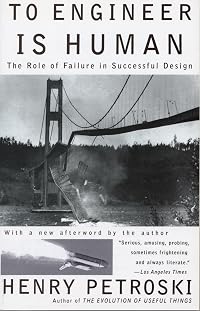
To Engineer Is Human: The Role of Failure in Successful Design
by Henry Petroski
On This Page
Description
How did a simple design error cause one of the great disasters of the 1980s-the collapse of the walkways at the Kansas City Hyatt Regency Hotel? What made the graceful and innovative Tacoma Narrows Bridge twist apart in a mild wind in 1940? How did an oversized waterlily inspire the magnificent Crystal Palace, the crowning achievement of Victorian architecture and engineering? These are some of the failures and successes that Henry Petroski, author of the acclaimed The Pencil, examines in show more this engaging, wonderfully literate book. More than a series of fascinating case studies, To Engineer Is Human is a work that looks at our deepest notions of progress and perfection, tracing the fine connection between the quantifiable realm of science and the chaotic realities of everyday life. show lessTags
Recommendations














Member Reviews
Petroski doing what he does best, explaining practical engineering to outsiders. In this case the linking theme of his essays is the role of failure in structural design — both in terms of what we can learn for the future from failed structures and in terms of how engineers use their knowledge of how structures can fail to design new structures that will be safe in use. There are digressions into the metallurgy of fatigue cracking, the most common mechanism for failure in metal structures, there are case studies of some of the best-known failures (Tacoma Narrows bridge, Comet, Kansas City Hyatt Regency, etc.) and of at least one innovative design that avoided structural failure by rigorous testing during construction, Paxton’s show more Crystal Palace. He also goes into the risks of the shift from slide-rule engineering to computer modelling, where engineers can find themselves dealing with structures so complex that it isn’t possible to do sensible plausibility checks on what the computer model reports.
Nothing very profound, but fun and with some quite interesting background, and probably well worth a read if you are contemplating a step into the engineering world of the 1980s. show less
Nothing very profound, but fun and with some quite interesting background, and probably well worth a read if you are contemplating a step into the engineering world of the 1980s. show less
I can read about engineering failures and successes over and over and over. It never seems to bore me. It's gravy when the problems and solutions in literature are attacked from different angles, but even coming at it the same way still holds my interest. The author does a great job explaining the poetry and art of the trade, and does a fantastic job of explaining certain complexities with apt metaphors. Then he gets into some excellent nitty-gritty, and covers the morality and responsibility of the field as well. I suspect I'll be reading more of his works, and more on engineering in general. What an excellent choice to whet the appetite.
Whenever I see a book of Petroski's I pick them up as they're always fascinating reads with his sharp eye on engineering and how he knows how to explain the concerns behind engineering. The focus of the essays in this book is on how failure is one of the best ways to learn how to improve and the mistakes of predecessors help improve in the future. He looks at well known engineering failures such as the Tacoma-Narrows and lesser known ones. As someone who hasn't studied engineering but is fascinated by how the world is put together, I recommend his books, they're always quick and satisfying reads.
Perhaps I rate this too highly. Problem is I love technology and its issues and Petroski is one of my favorite writers on civil engineering.
On the 50th anniversary of the Golden Gate Bridge, May 27, 1987, almost 1,000,000 people showed up to celebrate and to walk across a bridge that was designed using the same basic technology as the infamous Tacoma Narrows bridge. Only about 250,000 were able to squeeze on the bridge, and fortunately no panic occurred as the Golden Gate Bridge began to sway gently from side to side. Hangar cables became slack -- something that was not supposed to happen, and the main span's arch flattened out to a "noticeable degree." The bridge had been over-designed with an ample margin of safety, unlike the show more walkways at the Hyatt in Kansas City, which were essentially small bridges. Over 100 people were killed when the walkways collapsed. Engineers determined quickly that a change made to make installation of the walkways simpler reduced the ability of the walkways to handle even their own weight let alone that of several hundred people.
Henry Petroski, in To Engineer is Human: The Role of Failure in Successful Design, is interested in engineering failures. He suggests these are terribly important to study, for they provide the clues to resolving the inherent paradox in engineering, which is that "...successful structural concepts devolve into failures, while the colossal failures contributed to the evolution of innovative and inspiring structures."
Structures that never fail -- actually they all will eventually, if one takes them beyond their intended life -- are assumed to be over-designed, i.e., they are much stronger than need be. Engineers, in order to be more economical and aesthetic, will make changes in the design that may ultimately lead to sensational failures like that of the Tacoma Narrows bridge. It's designers ignored considerable evidence that was readily available on the effect of wind on non-stiffened structures.
Petroski is concerned that the current atmosphere of liability and law suits will lead to a suppression of free discussion of the reasons behind structural (and now computer program) failures. "Engineering is a human endeavor and thus subject to error." Catastrophes are rare, but Petroski discusses why failures may be impossible to avoid and also why, paradoxically, we may not want to make them impossible. show less
On the 50th anniversary of the Golden Gate Bridge, May 27, 1987, almost 1,000,000 people showed up to celebrate and to walk across a bridge that was designed using the same basic technology as the infamous Tacoma Narrows bridge. Only about 250,000 were able to squeeze on the bridge, and fortunately no panic occurred as the Golden Gate Bridge began to sway gently from side to side. Hangar cables became slack -- something that was not supposed to happen, and the main span's arch flattened out to a "noticeable degree." The bridge had been over-designed with an ample margin of safety, unlike the show more walkways at the Hyatt in Kansas City, which were essentially small bridges. Over 100 people were killed when the walkways collapsed. Engineers determined quickly that a change made to make installation of the walkways simpler reduced the ability of the walkways to handle even their own weight let alone that of several hundred people.
Henry Petroski, in To Engineer is Human: The Role of Failure in Successful Design, is interested in engineering failures. He suggests these are terribly important to study, for they provide the clues to resolving the inherent paradox in engineering, which is that "...successful structural concepts devolve into failures, while the colossal failures contributed to the evolution of innovative and inspiring structures."
Structures that never fail -- actually they all will eventually, if one takes them beyond their intended life -- are assumed to be over-designed, i.e., they are much stronger than need be. Engineers, in order to be more economical and aesthetic, will make changes in the design that may ultimately lead to sensational failures like that of the Tacoma Narrows bridge. It's designers ignored considerable evidence that was readily available on the effect of wind on non-stiffened structures.
Petroski is concerned that the current atmosphere of liability and law suits will lead to a suppression of free discussion of the reasons behind structural (and now computer program) failures. "Engineering is a human endeavor and thus subject to error." Catastrophes are rare, but Petroski discusses why failures may be impossible to avoid and also why, paradoxically, we may not want to make them impossible. show less
To Engineer Is Human by Henry Petroski
The subtitle of this 1985 book--The Role of Failure in Successful Design--establishes the theme of the book.
In his introduction, Petroski, a professor of civil engineering at Duke, writes:
I believe that the concept of failure…is central to understanding engineering, for engineering design has as its first and foremost objective the obviation of failure. Thus, colossal disasters that do occur are ultimately failures of design, but the lessons learned from those disasters can do more to advance engineering knowledge than all the successful machines and structures in the world…To understand what engineering is and what engineers do is to understand how failures can happen and how they can show more contribute more than successes to advance technology.
To elaborate on this statement, the author cites several famous engineering failures as case studies. What happened? What was learned? How is that new knowledge applied by engineers?
One example is the collapse of the Tacoma Narrows Bridge.
This suspension bridge linked the mainland of Washington State to its Olympic Peninsula and was built in 1940, a year after a bridge of similar design, the Bronx-Whitestone, was completed and opened to traffic. Both bridges used an unconventional stiffened-girder design that reduced the thickness of the roadway structure, giving it a slender silhouette. But even during construction, the Narrows bridge displayed frightening instability in crosswinds, even relatively mild ones. Its two-lane, half-mile-long deck would undulate and twist, quickly earning the bridge the sobriquet "Galloping Gerty." After only a few months of use, its imminent failure being obvious, it was closed and soon thereafter the deck tore completely apart. The only casualty was the bridge itself.
Petroski points out that the Bronx-Whitestone Bridge has a wider, six-lane roadway, but that it too displayed unsettling flexibility. Even as the Narrows bridge was going up, the Bronx-Whitestone was being altered with extra cables and stiffening devices. Alterations to the bridge continued into the 1980s.
The fault in the design of these bridges, writes Petroski, was that "the bridge span acted much like an airplane wing subjected to uncontrolled turbulence." At the time, the aerodynamic aspect of bridge design was not considered. It is now, of course, with designs being "tested in wind tunnels much the way new airplace designs are."
Other examples cited include the mid-flight explosions in the early 1950s that destroyed several DeHavilland Comets, the world's first commercial jet passenger aircraft (killing all on board each time); the collapse of pedestrian bridges spanning the vast lobby of the Kansas City Hyatt Regency Hotel at second, third, and fourth floor levels (killing and injuring hundreds).
The shortcoming of the book is its age. "From Slide Rule to Computer: Forgetting How It Used to Be Done" is a chapter near the book's end in which Petroski frets about problems that may stem from the computers supplanting manual computations, and in the process, lulling engineers into complacency. "{T}he engineer who employs the computer in design must still ask the crucial questions…" The lessons the book teaches are timeless, but a host of new case studies have presented themselves in the last twenty+ years. show less
The subtitle of this 1985 book--The Role of Failure in Successful Design--establishes the theme of the book.
In his introduction, Petroski, a professor of civil engineering at Duke, writes:
I believe that the concept of failure…is central to understanding engineering, for engineering design has as its first and foremost objective the obviation of failure. Thus, colossal disasters that do occur are ultimately failures of design, but the lessons learned from those disasters can do more to advance engineering knowledge than all the successful machines and structures in the world…To understand what engineering is and what engineers do is to understand how failures can happen and how they can show more contribute more than successes to advance technology.
To elaborate on this statement, the author cites several famous engineering failures as case studies. What happened? What was learned? How is that new knowledge applied by engineers?
One example is the collapse of the Tacoma Narrows Bridge.
This suspension bridge linked the mainland of Washington State to its Olympic Peninsula and was built in 1940, a year after a bridge of similar design, the Bronx-Whitestone, was completed and opened to traffic. Both bridges used an unconventional stiffened-girder design that reduced the thickness of the roadway structure, giving it a slender silhouette. But even during construction, the Narrows bridge displayed frightening instability in crosswinds, even relatively mild ones. Its two-lane, half-mile-long deck would undulate and twist, quickly earning the bridge the sobriquet "Galloping Gerty." After only a few months of use, its imminent failure being obvious, it was closed and soon thereafter the deck tore completely apart. The only casualty was the bridge itself.
Petroski points out that the Bronx-Whitestone Bridge has a wider, six-lane roadway, but that it too displayed unsettling flexibility. Even as the Narrows bridge was going up, the Bronx-Whitestone was being altered with extra cables and stiffening devices. Alterations to the bridge continued into the 1980s.
The fault in the design of these bridges, writes Petroski, was that "the bridge span acted much like an airplane wing subjected to uncontrolled turbulence." At the time, the aerodynamic aspect of bridge design was not considered. It is now, of course, with designs being "tested in wind tunnels much the way new airplace designs are."
Other examples cited include the mid-flight explosions in the early 1950s that destroyed several DeHavilland Comets, the world's first commercial jet passenger aircraft (killing all on board each time); the collapse of pedestrian bridges spanning the vast lobby of the Kansas City Hyatt Regency Hotel at second, third, and fourth floor levels (killing and injuring hundreds).
The shortcoming of the book is its age. "From Slide Rule to Computer: Forgetting How It Used to Be Done" is a chapter near the book's end in which Petroski frets about problems that may stem from the computers supplanting manual computations, and in the process, lulling engineers into complacency. "{T}he engineer who employs the computer in design must still ask the crucial questions…" The lessons the book teaches are timeless, but a host of new case studies have presented themselves in the last twenty+ years. show less
I've had this book for years and pulled it off the shelf hoping to learn the physics and mathematics about some famous engineering disasters. This is really more a collection of reflective, even philosophical essays from the author. There is even a paean to the slide rule. Probably the closest to what I expected is the analysis for the The Hyatt Regency hotel walkway collapse that occurred at the Hyatt Regency Kansas City in Kansas City, Missouri on Friday, July 17, 1981.
First half poor, second half thought-provoking: I nearly gave up around page 21 where there is, considering the author's credentials, an astonishing error. The author explains how he demonstrates metal fatigue to his classes: by bending a paper clip back and forth until it breaks. He concludes "...that, I tell the class, is failure by fatigue". Well no actually, its work hardening. In chapter 4, the author appears to confuse hypothesis and presupposition. At another point, he uses the term "stresses and strains of modern life". This is not wrong in itself but it further shakes ones confidence. Engineers tend not to use the phrase in this commonplace way because "stress" and "strain" have quite specific (and totally different) meanings show more in engineering. It is a bit like those war films where the radio operator says "over and out". It jars because a professional would say "over" or "out" but not both. There is more. The English is pretty bad at times ("ingeniousness" instead of "ingenuity" on page 16 and "fail-proofness" on page 44). Much of the first half came over to me as a poorly structured stream of consciousness.The second half, for me, made it worth wading through all this; although the author still did not always follow through the thoughts that he fired off. The section on the crystal palace was fascinating, as was the story of the 50th anniversary of the Golden Gate bridge in the Afterword to the Vintage edition
For me, the whole book was worth the single sentence "designed objects change the future into which they will age"; in other words new technology leads to ...new ways of doing things which leads to ...new possibilities of failure which ...were not covered in the design because people didn't do things that way then.
Not a brilliant book, and some pretty basic gaffes which are difficult to understand - but worth reading as a whole. show less
Members
- Recently Added By
Lists

Mechanical Engineering
10 works; 1 member
Author Information

24+ Works 9,789 Members
Henry Petroski is an American engineer with wide-ranging historical and sociocultural interests. He earned a Ph.D. in theoretical and applied mechanics from the University of Illinois at Urbana-Champaign in 1968, and became Aleksandar S. Vesic professor and chair of the Department of Civil and Environmental Engineering at Duke University. Petroski show more teaches traditional engineering subjects, as well as courses for nonengineering students, that place the field in a broad social context. One of the major themes that transcends his technical and nontechnical publications is the role of failure and its contribution to successful design. This is the central theme in his study To Engineer Is Human: The Role of Failure in Successful Design, which is accessible to both engineers and general readers. This theme is also incorporated into Petroski's The Pencil: A History of Design and Circumstance (1990), which relates the history of the pencil to broader sociocultural themes. The theme is expanded further, illustrating the relationship of engineering to our everyday life in The Evolution of Useful Things (1992). Petroski's most recent book, Design Paradigms: Case Histories of Error and Judgment in Engineering, is planned for publication in 1994. After that, he will begin a study of the complex interrelationships between engineering and culture. Widely recognized and supported by both the technical and humanities communities, Petroski's work has effectively conveyed the richness and essence of engineering in its societal context for the general reader. (Bowker Author Biography) show less
Common Knowledge
- Original publication date
- 1985; 1992-04 (First Vintage Books Edition) (First Vintage Books Edition)
- Dedication
- To Catherine
- First words
- Shortly after the Kansas City Hyatt Regency Hotel skywalks collapsed in 1981, one of my neighbors asked me how such a thing could happen.
- Disambiguation notice
- Some of this material has appeared, often in somewhat different form, in Technology and Culture, Technology Review, and The Washington Post.
Classifications
- Genres
- Nonfiction, Art & Design, General Nonfiction, Science & Nature, Technology, History
- DDC/MDS
- 620.0042 — Applied science & technology Engineering Mechanical & Civil Engineering General Engineering Special Topics Design
- LCC
- TA174 .P474 — Technology Engineering Civil engineering (General). Engineering (General). Civil engineering (General) Engineering design
- BISAC
Statistics
- Members
- 1,460
- Popularity
- 16,111
- Reviews
- 21
- Rating
- (3.60)
- Languages
- English, French, Spanish
- Media
- Paper, Audiobook, Ebook
- ISBNs
- 11
- ASINs
- 6