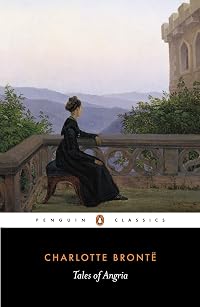
Tales of Angria
by Charlotte Brontë
On This Page
Description
In 1834, Charlotte Brontë and her brother Branwell created the imaginary kingdom of Angria in a series of tiny handmade books. Continuing their saga some years later, the five 'novelettes' in this volume were written by Charlotte when she was in her early twenties, and depict a aristocratic beau monde in witty, racy and ironic language. She creates an exotic, scandalous atmosphere of intrigue and destructive passions, with a cast ranging from the ageing rake Northangerland and his Byronic show more son-in-law Zamorna, King of Angria, to Mary Percy, Zamorna's lovesick wife, and Charles Townshend, the cynical, gossipy narrator. Together the tales provide a fascinating glimpse into the mind and creative processes of the young writer who was to become one of the world's great novelists. show lessTags
Recommendations










Member Reviews
The Brontë children (there were six, but Maria and Elizabeth died young) amused themselves by creating imaginary worlds – not uncommon, but the Brontës kept up with them into adolescence and even adulthood. The protagonists were originally based on Branwell Brontë’s toy soldiers, who were imagined to be a set of English explorers in west Africa, founders of the kingdoms of Angria and Gondal.
Branwell and Charlotte specialized in Angria, while Anne and Emily adopted Gondal. As might be expected, Branwell developed a military history of Angria, which Charlotte used to provide backgrounds for her stories. Although they are geographically dubious – West Africa seems amazingly like rural England, including heavy snowstorms, and the show more territory north of Angria is unimaginatively called “Frenchyland” – the Angria tales are much more risqué than Charlotte’s adult works. Women of negotiable virtue are prominent, and in one case an adolescent girl sets out to seduce her much older guardian – and succeeds. Pretty heavy stuff for a clergyman’s daughter from Victorian rural Yorkshire. You almost feel guilty reading these – as if you had accidentally upset the Brontë misses’ laundry basket and found a collection of kinky lingerie hidden under the petticoats.
Although readable enough, the Angria stories are not great literature and would be totally forgotten if the author was Jane Doe rather than Charlotte Brontë. Still, there is some insight here into how Jane Eyre ended up with Mr. Rochester. Read if you’re curious. show less
Branwell and Charlotte specialized in Angria, while Anne and Emily adopted Gondal. As might be expected, Branwell developed a military history of Angria, which Charlotte used to provide backgrounds for her stories. Although they are geographically dubious – West Africa seems amazingly like rural England, including heavy snowstorms, and the show more territory north of Angria is unimaginatively called “Frenchyland” – the Angria tales are much more risqué than Charlotte’s adult works. Women of negotiable virtue are prominent, and in one case an adolescent girl sets out to seduce her much older guardian – and succeeds. Pretty heavy stuff for a clergyman’s daughter from Victorian rural Yorkshire. You almost feel guilty reading these – as if you had accidentally upset the Brontë misses’ laundry basket and found a collection of kinky lingerie hidden under the petticoats.
Although readable enough, the Angria stories are not great literature and would be totally forgotten if the author was Jane Doe rather than Charlotte Brontë. Still, there is some insight here into how Jane Eyre ended up with Mr. Rochester. Read if you’re curious. show less
Prior to reading these short stories I had not met a Charlotte Bronte work that I did not read voraciously. It could be due to the subject matter or to the less-mature style in which they were written, but I found these early writings somewhat difficult to read. While they provide an interesting perspective into her growth as an author, but there is not much else to recommend them.
This review is written with a GPL 4.0 license and the rights contained therein shall supersede all TOS by any and all websites in regards to copying and sharing without proper authorization and permissions. Crossposted at WordPress, Blogspot, & Librarything by Bookstooge’s Exalted Permission
Title: Tales of Angria
Series: ----------
Author: Charlotte Bronte
Rating: 1 of 5 Stars
Genre: Romance
Pages: DNF 10/786
Words: DNF 3k/227K
Synopsis:
From Wikipedia
In 1834, Charlotte Brontë and her brother Branwell created the imaginary kingdom of Angria in a series of tiny handmade books. Continuing their saga some years later, the five 'novelettes' in this volume were written by Charlotte when she was in her early twenties, and depict a aristocratic show more beau monde in witty, racy and ironic language. She creates an exotic, scandalous atmosphere of intrigue and destructive passions, with a cast ranging from the ageing rake Northangerland and his Byronic son-in-law Zamorna, King of Angria, to Mary Percy, Zamorna's lovesick wife, and Charles Townshend, the cynical, gossipy narrator. Together the tales provide a fascinating glimpse into the mind and creative processes of the young writer who was to become one of the world's great novelists.
My Thoughts:
When the story starts out with a heroine actively trying to emotionally seduce a married man, that was all it took for me to DNF this. I believe this is the last entry for Charlotte Bronte and my goodness, that is good. Outside of Jane Eyre and Villette, none of her stories have really stood up as far as I'm concerned.
It probably also didn't help that the last couple of books have both been 1stars, dnf's or both. Having three books in a row all be 1stars is wicked disheartening and the only thing I have to say is that the rest of the month better improve or I'll be writing some seriously inappropriate book reviews where I get mean and ugly.
Bleh.
★☆☆☆☆ show less
Title: Tales of Angria
Series: ----------
Author: Charlotte Bronte
Rating: 1 of 5 Stars
Genre: Romance
Pages: DNF 10/786
Words: DNF 3k/227K
Synopsis:
From Wikipedia
In 1834, Charlotte Brontë and her brother Branwell created the imaginary kingdom of Angria in a series of tiny handmade books. Continuing their saga some years later, the five 'novelettes' in this volume were written by Charlotte when she was in her early twenties, and depict a aristocratic show more beau monde in witty, racy and ironic language. She creates an exotic, scandalous atmosphere of intrigue and destructive passions, with a cast ranging from the ageing rake Northangerland and his Byronic son-in-law Zamorna, King of Angria, to Mary Percy, Zamorna's lovesick wife, and Charles Townshend, the cynical, gossipy narrator. Together the tales provide a fascinating glimpse into the mind and creative processes of the young writer who was to become one of the world's great novelists.
My Thoughts:
When the story starts out with a heroine actively trying to emotionally seduce a married man, that was all it took for me to DNF this. I believe this is the last entry for Charlotte Bronte and my goodness, that is good. Outside of Jane Eyre and Villette, none of her stories have really stood up as far as I'm concerned.
It probably also didn't help that the last couple of books have both been 1stars, dnf's or both. Having three books in a row all be 1stars is wicked disheartening and the only thing I have to say is that the rest of the month better improve or I'll be writing some seriously inappropriate book reviews where I get mean and ugly.
Bleh.
★☆☆☆☆ show less
Ratings
Members
- Recently Added By
Author Information

355+ Works 98,058 Members
Charlotte Bronte, the third of six children, was born April 21, 1816, to the Reverend Patrick Bronte and Maria Branwell Bronte in Yorkshire, England. Along with her sisters, Emily and Anne, she produced some of the most impressive writings of the 19th century. The Brontes lived in a time when women used pseudonyms to conceal their female identity, show more hence Bronte's pseudonym, Currer Bell. Charlotte Bronte was only five when her mother died of cancer. In 1824, she and three of her sisters attended the Clergy Daughter's School in Cowan Bridge. The inspiration for the Lowood School in the classic Jane Eyre was formed by Bronte's experiences at the Clergy Daughter's School. Her two older sisters died of consumption because of the malnutrition and harsh treatment they suffered at the school. Charlotte and Emily Bronte returned home after the tragedy. The Bronte sisters fueled each other's creativity throughout their lives. As young children, they wrote long stories together about a complex imaginary kingdom they created from a set of wooden soldiers. In 1846, Charlotte Bronte, with her sisters Emily and Anne published a thin volume titled Poems by Currer, Ellis, and Acton Bell. In the same year, Charlotte Bronte attempted to publish her novel, The Professor, but was rejected. One year later, she published Jane Eyre, which was instantly well received. Charlotte Bronte's life was touched by tragedy many times. Despite several proposals of marriage, she did not accept an offer until 1854 when she married the Reverend A. B. Nicholls. One year later, at the age of 39, she died of pneumonia while she was pregnant. Her previously rejected novel, The Professor, was published posthumously in 1857. (Bowker Author Biography) show less
All Editions
Some Editions
Series
Belongs to Publisher Series
Work Relationships
Common Knowledge
- Canonical title
- Tales of Angria
- Original title
- Tales of Angria
- Original publication date
- 1834
- People/Characters
- Charles Townshend
- Important places
- Angria
Classifications
Statistics
- Members
- 189
- Popularity
- 173,323
- Reviews
- 3
- Rating
- (2.97)
- Languages
- English, German
- Media
- Paper, Ebook
- ISBNs
- 6
- ASINs
- 2