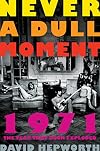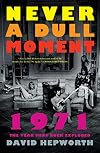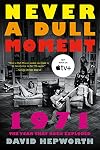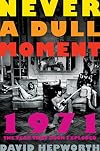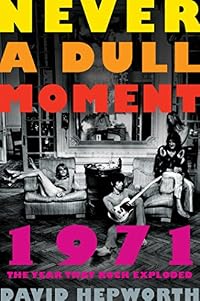
Never a Dull Moment: 1971 - The Year That Rock Exploded
by David Hepworth
On This Page
Description
"David Hepworth, an ardent music fan and well regarded critic, was twenty-one in '71, the same age as many of the legendary artists who arrived on the scene. Taking us on a tour of the major moments, the events and songs of this remarkable year, he shows how musicians came together to form the perfect storm of rock and roll greatness, starting a musical era that would last longer than anyone predicted. Those who joined bands to escape things that lasted found themselves in a new age, its show more colossal start being part of the genre's staying power"--Amazon.com. show lessTags
Recommendations








Member Reviews
In Never a Dull Moment, influential music journalist David Hepworth postulates that 1971 was the seminal for rock music – the Beatles disbanding in 1970 marked the end of an era, yet influential bands (the Who, Rolling Stones Led Zeppelin, Marvin Gaye) were producing arguably their best work their best music while other stalwarts (Carole King, David Bowie) were just beginning their careers.
Hepworth makes an entertaining and informative argument. Like many books by journalists more accustomed to writing article-length pieces, Never a Dull Moment assumes that the reader is already somewhat familiar with the subject matter and can at times be rambling and muddy, but when it hits its stride – as it does early on when discussing Carole show more King’s Tapestry, it shines. Hepworth's strength is in providing inside stories and describing the background details and supporting cast, and circumstances surrounding each musician– the meetings and relationships that influenced each album release.
Overall, the book felt much talking with good friends over a few too many drinks - unpretentious, memorable, and fun. Never a Dull Moment is conversational, interesting, and grounded in a true love for the music of 1971. Recommended for music and history fans of all ages. show less
Hepworth makes an entertaining and informative argument. Like many books by journalists more accustomed to writing article-length pieces, Never a Dull Moment assumes that the reader is already somewhat familiar with the subject matter and can at times be rambling and muddy, but when it hits its stride – as it does early on when discussing Carole show more King’s Tapestry, it shines. Hepworth's strength is in providing inside stories and describing the background details and supporting cast, and circumstances surrounding each musician– the meetings and relationships that influenced each album release.
Overall, the book felt much talking with good friends over a few too many drinks - unpretentious, memorable, and fun. Never a Dull Moment is conversational, interesting, and grounded in a true love for the music of 1971. Recommended for music and history fans of all ages. show less
 This review was written for LibraryThing Early Reviewers.
Reading this is like spending an evening in the company of a loquacious, knowledgeable, and highly opinionated rock fan. Like all true music obsessives Hepworth has a tendency to state very debatable opinions as though they were self-evident truths. The book argues that 1971 was ‘the most creative, most innovative, most interesting and longest-resounding year’ in the history of rock music. As it also happened to be the year Hepworth turned twenty-one I can’t help suspecting he is just nostalgic for his youth. In his prologue he acknowledges that everyone has a soft spot for the music they loved when young, but then comes the punchline: ‘There’s an important difference in the case of me and 1971. The difference is this: I’m show more right’.
I’m not convinced. Personally I think the halcyon years of rock were roughly between 1966 and 1980. This was a period when a narrative appeared to be unfolding through the music year by year and innovation and originality seemed as natural as breathing. Singling out any particular year within this timeframe as the best or most influential strikes me as more than a touch arbitrary. One could write a book with the same thesis on 1967 or 1978 or (insert year of your own choice here) which would be equally convincing and equally full of holes. It’s also noticeable that Hepworth never strays very far from the household names: Led Zeppelin, the Who, Rod Stewart, the Rolling Stones, Bowie (wasn’t 1972 Bowie’s big year?). Some of my own favourite albums of 1971 (by Kevin Ayers, Caravan, Van Der Graaf Generator, Gong and Roy Harper) are either not mentioned at all or only in passing, and none of them feature in his list of 100 great albums at the back of the book.
But you don’t have to agree with a writer to be engaged by what they have to say, and Hepworth is extremely engaging. He throws out ideas and theories like confetti and part of the pleasure I got from this book was in disagreeing with him. He says that Carole King’s Tapestry ‘invented the album business’. And there I was thinking that the shift from singles to albums started in the mid-sixties, the big explosion coming after Sgt. Pepper. More persuasive was his suggestion that Elvis Presley’s 1971 tour, in which audiences and artist came together to celebrate a shared past and mythology, set the template for what all the famous acts of 1971 would be doing in the decades to come: heritage rock.
Hepworth certainly deserves Brownie points for his complete lack of pretension. (Why has pop music, of all things, produced so much pretentious writing about it? It’s one of the great mysteries). His prose style is so deceptively unassuming that it sometimes takes a moment to realise how provocative he is being. 1971 is a contentious yet entertaining mixture of opinion, anecdotes, history, music criticism and nostalgia. It’s an enjoyable read and, for all its questionable assertions, a powerful refutation of the popular myth that the early seventies were a musical wasteland awaiting the rejuvenation of punk rock. show less
I’m not convinced. Personally I think the halcyon years of rock were roughly between 1966 and 1980. This was a period when a narrative appeared to be unfolding through the music year by year and innovation and originality seemed as natural as breathing. Singling out any particular year within this timeframe as the best or most influential strikes me as more than a touch arbitrary. One could write a book with the same thesis on 1967 or 1978 or (insert year of your own choice here) which would be equally convincing and equally full of holes. It’s also noticeable that Hepworth never strays very far from the household names: Led Zeppelin, the Who, Rod Stewart, the Rolling Stones, Bowie (wasn’t 1972 Bowie’s big year?). Some of my own favourite albums of 1971 (by Kevin Ayers, Caravan, Van Der Graaf Generator, Gong and Roy Harper) are either not mentioned at all or only in passing, and none of them feature in his list of 100 great albums at the back of the book.
But you don’t have to agree with a writer to be engaged by what they have to say, and Hepworth is extremely engaging. He throws out ideas and theories like confetti and part of the pleasure I got from this book was in disagreeing with him. He says that Carole King’s Tapestry ‘invented the album business’. And there I was thinking that the shift from singles to albums started in the mid-sixties, the big explosion coming after Sgt. Pepper. More persuasive was his suggestion that Elvis Presley’s 1971 tour, in which audiences and artist came together to celebrate a shared past and mythology, set the template for what all the famous acts of 1971 would be doing in the decades to come: heritage rock.
Hepworth certainly deserves Brownie points for his complete lack of pretension. (Why has pop music, of all things, produced so much pretentious writing about it? It’s one of the great mysteries). His prose style is so deceptively unassuming that it sometimes takes a moment to realise how provocative he is being. 1971 is a contentious yet entertaining mixture of opinion, anecdotes, history, music criticism and nostalgia. It’s an enjoyable read and, for all its questionable assertions, a powerful refutation of the popular myth that the early seventies were a musical wasteland awaiting the rejuvenation of punk rock. show less
Whether you buy the author's thesis that 1971 was the most seminal year in rock-n-roll history or not, you will come away from Never a Dull Moment with a better understanding of how this year bridged the transition of rock music from a singles business to album-focused business and had some of the biggest stars release their most influential albums.
Author David Hepworth, who was 21 during "the year that rock exploded," notes that he is not an impartial critic. This was the music that he grew up with and influenced him. While some of the anecdotes and cultural history don't always strengthen the book, they do give a good sense of what was happening that year, which was two before I was born. The analysis of the acts, their influence, and show more their albums is fantastic, and often takes a contrarian view to the established acclaim. For instance, I was surprised by his view of Marvin Gaye's What's Going On as less of a concept album than I always thought of it. The pieces on David Bowie, at the beginning of his career here, were interesting to me in light of his recent death.
Where I was most on board with Hepworth was in his analysis of how 1971 is when rock artists started looking backwards by playing greatest hits and releasing back catalog material. I also enjoyed how the recent break up the Beatles had reverberations throughout the industry, not just with the Fab Four, now newly solo.
For those interested in rock history, Never a Dull Moment is worth picking up. I'm expecting someone my age to write a similar book about 1991-92 in forty years, as that time seemed to have a similar impact of my peers as 1971 had on Hepworth. show less
Author David Hepworth, who was 21 during "the year that rock exploded," notes that he is not an impartial critic. This was the music that he grew up with and influenced him. While some of the anecdotes and cultural history don't always strengthen the book, they do give a good sense of what was happening that year, which was two before I was born. The analysis of the acts, their influence, and show more their albums is fantastic, and often takes a contrarian view to the established acclaim. For instance, I was surprised by his view of Marvin Gaye's What's Going On as less of a concept album than I always thought of it. The pieces on David Bowie, at the beginning of his career here, were interesting to me in light of his recent death.
Where I was most on board with Hepworth was in his analysis of how 1971 is when rock artists started looking backwards by playing greatest hits and releasing back catalog material. I also enjoyed how the recent break up the Beatles had reverberations throughout the industry, not just with the Fab Four, now newly solo.
For those interested in rock history, Never a Dull Moment is worth picking up. I'm expecting someone my age to write a similar book about 1991-92 in forty years, as that time seemed to have a similar impact of my peers as 1971 had on Hepworth. show less
This review was written for LibraryThing Early Reviewers.Being 50 years old, people may assume I prefer to listen to ‘classic’ rock. Actually, I would much rather stand and hear a local band playing songs they wrote themselves than sit in a stadium and hear a band from my youth play those same old songs yet again. Luckily for me, I’m also a voracious reader; otherwise, I might have missed out on this thoroughly enjoyable and enlightening book!
I loved the way the author gave me a whole view of music making. Song writers were featured, band members, producers, engineers, and more. There were even some interesting snippets of information on the making of record covers. I learned a lot! There were some ‘inside’ stories about bands and they were tastefully written. There were a few show more delightful ‘gotcha’ moments in which, after reading several paragraphs about some obscure-to-me young people getting together and playing this or that, the story sums up with the formation of a band, one that turns out to be very well known to me.
The author skillfully wove the music in and around the events important to the times. As a child, when I was crooning, “It’s Too Late” along with the radio, was I a part of a larger movement of women who would live a very different life than our mothers? Yes. Was Carole King’s music something that inspired and urged that metamorphosis to happen? That’s a question I never even knew to ask before!
In ‘Never a Dull Moment’, the author makes some very good points regarding the impact of the music of the past. He seems lukewarm at times about the future of music. I’ve come to agree that 1971 was a pivotal year in music, but I don’t at all think we’ve stopped expanding musically. Given that this book was written specifically to explore the music of a bygone year, it makes sense that Mr. Hepworth stuck to the point. But I resonated most to those stories in the book that I imagined being events that might affect music far beyond 1971. David Bowie goes ‘here’ and does ‘this’ and years later ‘that’ affects ‘these’ people. I loved those sorts of moments! Knowing more about how bands and musicians like The Rolling Stones, Stevie Wonder, and The Doobie Brothers brought cutting-edge music to the world gives me fuller appreciation of the frontier-expanding musical offerings of current bands like Russian Circles, Pretty Please, and Agalloch.
Music can hold a moment perfectly in time, yet music itself never stands still. David Hepworth’s book does a fine job of illustrating that point. show less
I loved the way the author gave me a whole view of music making. Song writers were featured, band members, producers, engineers, and more. There were even some interesting snippets of information on the making of record covers. I learned a lot! There were some ‘inside’ stories about bands and they were tastefully written. There were a few show more delightful ‘gotcha’ moments in which, after reading several paragraphs about some obscure-to-me young people getting together and playing this or that, the story sums up with the formation of a band, one that turns out to be very well known to me.
The author skillfully wove the music in and around the events important to the times. As a child, when I was crooning, “It’s Too Late” along with the radio, was I a part of a larger movement of women who would live a very different life than our mothers? Yes. Was Carole King’s music something that inspired and urged that metamorphosis to happen? That’s a question I never even knew to ask before!
In ‘Never a Dull Moment’, the author makes some very good points regarding the impact of the music of the past. He seems lukewarm at times about the future of music. I’ve come to agree that 1971 was a pivotal year in music, but I don’t at all think we’ve stopped expanding musically. Given that this book was written specifically to explore the music of a bygone year, it makes sense that Mr. Hepworth stuck to the point. But I resonated most to those stories in the book that I imagined being events that might affect music far beyond 1971. David Bowie goes ‘here’ and does ‘this’ and years later ‘that’ affects ‘these’ people. I loved those sorts of moments! Knowing more about how bands and musicians like The Rolling Stones, Stevie Wonder, and The Doobie Brothers brought cutting-edge music to the world gives me fuller appreciation of the frontier-expanding musical offerings of current bands like Russian Circles, Pretty Please, and Agalloch.
Music can hold a moment perfectly in time, yet music itself never stands still. David Hepworth’s book does a fine job of illustrating that point. show less
This review was written for LibraryThing Early Reviewers.Couldn't tell you how many times I've uttered these words: "I don't know much about music; but I know what I like." Perhaps you have, too? I don't know a back beat from a riff. However, I DO crystal-clear remember exactly where I was and what I was doing when first hearing Elvis Presley sing "Jailhouse Rock" -- it was cookin' from someone's car radio as I was pedaling my tricycle in front of my home, and I knew I'd never heard anything like THAT before. Seven years on, and "I Want to Hold Your Hand" became the first music purchase of my life. Another seven years found me attempting vainly to be "Baba O'Riley"'s Roger Daltrey -- when I wasn't pining after Grace Slick.
I've just-this-moment finished David Hepworth's "Never A Dull Moment: show more 1971, The Year That Rock Exploded." Usually, I prefer to digest a book for a while before writing about it, and sharing it with y'all through the courtesy of LTER. But the immediacy of 1971 that Mr Hepworth captures with his book compels me to scribble right away, just as 1971 felt, back in 1971. It WAS immediate; I was in a hurry; to discover ... what, exactly? Perhaps, with a thoroughly gray beard and bifocals now, I still don't exactly know, or realize, it all. But the music kept me grounded, all the while allowing my mind to roam free with imaginings and possibilities.
Which is what this book is all about: How the music changed. How it influenced and changed the music industry and, in turn, simultaneously, the industry could influence the music. And how both contributed to the altering of the societies and cultures that we lived in back then, and live in now. In that respect, the book is as much sociological study (if not more so) than musical history. Mr Hepworth blends and weaves a wonderful narrative as a medieval minstrel might have done, skillfully mixing music and personalities, history and context (I'd forgotten that George Harrison's "All Things Must Pass" cost me a truly princely $6.98 in the second week of 1971). Some I remembered within the pages, much I learned anew. To be perfectly truthful, I was not expecting a much from this book as I received.
If you will allow me to borrow Mr Hepworth's words: "At this point, you raise a skpetical eyebrow and ay that for you too the music of the year when you were twenty-one or eighteen ... still speaks to you in a way that no other year does. That's natural. That;s just growing up....
"There's an important difference in the case of me and 1971.
"The difference is this. I'm right."
And he is right. Read this amazing journey of a book and discover just why he (and I) are; you'll find me hoarsely off-key'ing "Baba O'Riley" and looking for Grace Slick when you get back; we can grab a slice of American pie if you'd like. show less
I've just-this-moment finished David Hepworth's "Never A Dull Moment: show more 1971, The Year That Rock Exploded." Usually, I prefer to digest a book for a while before writing about it, and sharing it with y'all through the courtesy of LTER. But the immediacy of 1971 that Mr Hepworth captures with his book compels me to scribble right away, just as 1971 felt, back in 1971. It WAS immediate; I was in a hurry; to discover ... what, exactly? Perhaps, with a thoroughly gray beard and bifocals now, I still don't exactly know, or realize, it all. But the music kept me grounded, all the while allowing my mind to roam free with imaginings and possibilities.
Which is what this book is all about: How the music changed. How it influenced and changed the music industry and, in turn, simultaneously, the industry could influence the music. And how both contributed to the altering of the societies and cultures that we lived in back then, and live in now. In that respect, the book is as much sociological study (if not more so) than musical history. Mr Hepworth blends and weaves a wonderful narrative as a medieval minstrel might have done, skillfully mixing music and personalities, history and context (I'd forgotten that George Harrison's "All Things Must Pass" cost me a truly princely $6.98 in the second week of 1971). Some I remembered within the pages, much I learned anew. To be perfectly truthful, I was not expecting a much from this book as I received.
If you will allow me to borrow Mr Hepworth's words: "At this point, you raise a skpetical eyebrow and ay that for you too the music of the year when you were twenty-one or eighteen ... still speaks to you in a way that no other year does. That's natural. That;s just growing up....
"There's an important difference in the case of me and 1971.
"The difference is this. I'm right."
And he is right. Read this amazing journey of a book and discover just why he (and I) are; you'll find me hoarsely off-key'ing "Baba O'Riley" and looking for Grace Slick when you get back; we can grab a slice of American pie if you'd like. show less
This review was written for LibraryThing Early Reviewers.In the forward to David Hepworth’s book about rock and roll in the year 1971, he notes “…you raise a skeptical eyebrow and say that for you too the music of the year when you were twenty-one, or eighteen or sixteen or whenever you felt most alive, still speaks to you in a way that no other year does…There’s an important difference in the case of me and 1971. The difference is this. I’m right.”
Okay, we’ve got that out of the way – the admission that the author has a prejudice for the year. Meaning, that a basic thesis of this book – that 1971 was the year “rock exploded” (the subtitle of the book) – is definitely jaded by the author’s preconceptions. Unfortunately, that prejudice clouds the book. It feels as show more if Hepworth works too hard to make his case. And in the process, he occasionally throws in a few kitchen sinks.
However, with that caveat out of the way, this book is enjoyable and full of interesting stories about an important (not the most important – but definitely important) year in rock and roll. Hepworth has definitely identified some pivotal moments in rock and roll including the emergence of the singer/songwriter, the transition to arena rock and festivals, and the evolution of the album as the primary mode of music delivery (including album-oriented radio.) And he tells some good stories about performers such as David Bowie, the Who, the Stones, Cat Stevens, and Carole King (to name just a very few), as well as some of the less well known. He also gets into some of the historical rock moments such as John and Yoko’s appearance on Dick Cavett, the Concert for Bangladesh, and the origin of England’s Glastonbury Festival.
Had he stopped there, it would have been good. But the temptation is too great, and in some instances he goes beyond rock and roll to talk about the changing times. The world was in significant transition, and those transitions are important, but they do not make the case for 1971 being the most important year in rock, nor do they provide support to the material that is being presented.
Which gets to my major problem with this book – the lack of a coherent thread throughout the narrative. This feels more like a collection of articles and essays than a book with an overall thesis and arch. If this is, indeed, a way of repurposing previous articles, then everyone would have been better served by leaving the articles intact and not trying to “fold” them together this way. On the other hand, if this is Hepworth’s approach to writing a book, then he still needs work on making the transition from journalist to book author.
In spite of this, I enjoyed the book. The disjointedness and the author’s occasional focus on events that may have been more important to him than to others is distracting. But my suggestion is to read the book for the stories, don’t worry about an overall arch, and ignore the conceit that 1971 was the most important year ever.
It may not have been the most important, but it was weird, transitional, and a lot of fun. show less
Okay, we’ve got that out of the way – the admission that the author has a prejudice for the year. Meaning, that a basic thesis of this book – that 1971 was the year “rock exploded” (the subtitle of the book) – is definitely jaded by the author’s preconceptions. Unfortunately, that prejudice clouds the book. It feels as show more if Hepworth works too hard to make his case. And in the process, he occasionally throws in a few kitchen sinks.
However, with that caveat out of the way, this book is enjoyable and full of interesting stories about an important (not the most important – but definitely important) year in rock and roll. Hepworth has definitely identified some pivotal moments in rock and roll including the emergence of the singer/songwriter, the transition to arena rock and festivals, and the evolution of the album as the primary mode of music delivery (including album-oriented radio.) And he tells some good stories about performers such as David Bowie, the Who, the Stones, Cat Stevens, and Carole King (to name just a very few), as well as some of the less well known. He also gets into some of the historical rock moments such as John and Yoko’s appearance on Dick Cavett, the Concert for Bangladesh, and the origin of England’s Glastonbury Festival.
Had he stopped there, it would have been good. But the temptation is too great, and in some instances he goes beyond rock and roll to talk about the changing times. The world was in significant transition, and those transitions are important, but they do not make the case for 1971 being the most important year in rock, nor do they provide support to the material that is being presented.
Which gets to my major problem with this book – the lack of a coherent thread throughout the narrative. This feels more like a collection of articles and essays than a book with an overall thesis and arch. If this is, indeed, a way of repurposing previous articles, then everyone would have been better served by leaving the articles intact and not trying to “fold” them together this way. On the other hand, if this is Hepworth’s approach to writing a book, then he still needs work on making the transition from journalist to book author.
In spite of this, I enjoyed the book. The disjointedness and the author’s occasional focus on events that may have been more important to him than to others is distracting. But my suggestion is to read the book for the stories, don’t worry about an overall arch, and ignore the conceit that 1971 was the most important year ever.
It may not have been the most important, but it was weird, transitional, and a lot of fun. show less
This review was written for LibraryThing Early Reviewers.I loved this book! Hepworth brings the reader music facts so outrageous you’ll be flipping back to the bibliography to verify he’s not just making them up, as well as brief pop cultural events to put those tall tales into context. The only reason you won’t be able not devour it one sitting is you’ll be logging onto your music streaming service of choice to hunt down the recommended listening tracks the author includes at the end of the chapter.
Highly recommended.
5 Stars
Highly recommended.
5 Stars
This review was written for LibraryThing Early Reviewers.Members
- Recently Added By
Lists

Chronological 2016
33 works; 1 member

Music
89 works; 1 member

Books Read in 2016
4,666 works; 197 members
Author Information
11+ Works 805 Members
David Hepworth is a music journalist, writer, broadcaster, and publishing industry analyst who has launched several legendary British magazines, including Q, Mojo, and The Word, among many others. He was a presenter of the BBC's rock music program Whistle Test and anchored the BBC's coverage of Live Aid in 1985. He has won Editor of the Year and show more Writer of the Year from the Professional Publishers Association and the Mark Boxer Award from the British Society of Magazine Editors. He writes about radio for The Guardian, comments on cultural and media issues for many magazines and newspapers, and blogs at whatsheonaboutnow.blogspot.com. show less
Awards and Honors
Awards
Distinctions
The Guardian Book of the Day (2016-04-05)
Series
Belongs to Publisher Series
Common Knowledge
- Canonical title
- Never a Dull Moment: 1971 - The Year That Rock Exploded
- Original title
- Never a Dull Moment: 1971 - The Year That Rock Exploded
- Original publication date
- 2016
- People/Characters
- The Beatles; Rolling Stones; Led Zeppelin; The Who; David Bowie; Carole King (show all 16); Bob Dylan; The Band; The Eagles; Elvis Presley; Lou Reed; Don McLean; Eric Clapton; Sly and the Family Stone; Marvin Gaye; Joni Mitchell
- Important places
- Olympic Studios; Tittenhurst Park
- Dedication
- For Alyson
- First words
- On New Year's Eve 1970, Paul McCartney instructed his lawyers to issue a writ at the High Court in London to wind up the Beatles.
- Last words
- (Click to show. Warning: May contain spoilers.)Now it belongs to everybody.
- Original language*
- Inglese
*Some information comes from Common Knowledge in other languages. Click "Edit" for more information.
Classifications
- Genres
- Music, Nonfiction, History, General Nonfiction
- DDC/MDS
- 781.6609 — Arts & recreation Music General principles and musical forms Traditions of music Rock (Rock 'n' roll) History, geographic treatment, biography
- LCC
- ML3534 .H465 — Music Literature on music Literature on music History and criticism Popular music
- BISAC
Statistics
- Members
- 352
- Popularity
- 89,172
- Reviews
- 25
- Rating
- (4.09)
- Languages
- English, Italian
- Media
- Paper, Audiobook, Ebook
- ISBNs
- 12
- ASINs
- 4