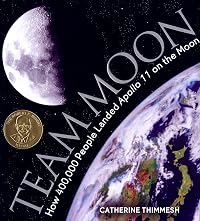
Team Moon: How 400,000 People Landed Apollo 11 on the Moon
by Catherine Thimmesh
On This Page
Description
Culled from direct quotes from the people behind the scenes, NASA transcripts, national archives and NASA photos, the whole story of Apollo 11 and the first moon landing emerges.Tags
Recommendations

































Member Reviews
Somehow I missed this book when it came out. Catherine Thimmesh has done a fantastic job extracting information from the reams available, to write this engrossing title for children (and it certainly holds adult interest). The subtitle - How 400,000 People Landed Apollo 11 on the Moon- certainly conveys the enormous task, both the moon landing and the researching of it. Despite reading this over 40 years after the fact, she impresses upon us the enormity of the mission, to land on the moon AND return to earth alive.
The famous aspects (Grumman engineering of the LEM), and those lesser known (design of film which could withstand decontamination) are all here. There are lesser known griping moments, such as men risking their lives during a show more fierce Australian windstorm so the world could view the images from the moon on their televisions. The selection of photography included and its integration with the text is excellent.
If I were to recommend only one book to children on Apollo 11, this would be it. show less
The famous aspects (Grumman engineering of the LEM), and those lesser known (design of film which could withstand decontamination) are all here. There are lesser known griping moments, such as men risking their lives during a show more fierce Australian windstorm so the world could view the images from the moon on their televisions. The selection of photography included and its integration with the text is excellent.
If I were to recommend only one book to children on Apollo 11, this would be it. show less
It’s July 1969, moments after the Lunar Module Eagle had separated from the Command Module Columbia, and 33, 500 feet above the surface of the moon. The Eagle is just beginning its decent.
"Suddenly, the master alarm in the lunar module rang out for attention with all the racket of a fire bell going off in a broom closet. “Program alarm,” astronaut Neil Armstrong called from the LM (‘LEM’) in a clipped but calm voice. “It’s a twelve-oh-two.”
…
Translation: We have a problem! What is it? Do we land? Do we abort? Are we in danger? Are we blowing up? Tell us what to do. Hurry!"
The speech for President Nixon to deliver in the event the astronauts died on the moon had already been written. Fortunately, other back-up plans were show more in place. Back on earth at mission control in Houston, the Flight Controller looked to mission controller for guidance and navigation, who intern was in touch with the computer programmer in the back room, meanwhile the Capsule Communicator (CapCom) recalled a similar alarm in a simulated training mission. The LM’s computer was momentarily too busy. Twenty seconds from the call from Eagle the CapCom relayed the message to proceed with the landing as long as the alarm was not constant. Eleven minutes later Neil Armstrong and Buzz Aldrin became the first humans to land a spacecraft on the moon.
The subtitle says it all, 400,000 people were working with the astronauts, everyone in Mission Control, the engineers working for the contractors that built the Eagle, the Columbia and the parachute system that would return them to earth, the computer programmers, the seamstresses who sewed the spacesuits for the moonwalk, and the radio telescope operators in Australia battling 70 mile an hour winds to capture the television signal and transmit it to an anxious planet.
Thimmesh has carefully selected stories of people behind the headlines and presented them in a marvelously illustrated chronicle of the near-crisis by near-crisis events from lift off to splash down during the first moon landing. The Association for Library Service to Children, a division of the American Library Association awarded the author the 2007 Robert F. Sibert Informational Book Medal for the most distinguished informational book published in English during the preceding year. show less
"Suddenly, the master alarm in the lunar module rang out for attention with all the racket of a fire bell going off in a broom closet. “Program alarm,” astronaut Neil Armstrong called from the LM (‘LEM’) in a clipped but calm voice. “It’s a twelve-oh-two.”
…
Translation: We have a problem! What is it? Do we land? Do we abort? Are we in danger? Are we blowing up? Tell us what to do. Hurry!"
The speech for President Nixon to deliver in the event the astronauts died on the moon had already been written. Fortunately, other back-up plans were show more in place. Back on earth at mission control in Houston, the Flight Controller looked to mission controller for guidance and navigation, who intern was in touch with the computer programmer in the back room, meanwhile the Capsule Communicator (CapCom) recalled a similar alarm in a simulated training mission. The LM’s computer was momentarily too busy. Twenty seconds from the call from Eagle the CapCom relayed the message to proceed with the landing as long as the alarm was not constant. Eleven minutes later Neil Armstrong and Buzz Aldrin became the first humans to land a spacecraft on the moon.
The subtitle says it all, 400,000 people were working with the astronauts, everyone in Mission Control, the engineers working for the contractors that built the Eagle, the Columbia and the parachute system that would return them to earth, the computer programmers, the seamstresses who sewed the spacesuits for the moonwalk, and the radio telescope operators in Australia battling 70 mile an hour winds to capture the television signal and transmit it to an anxious planet.
Thimmesh has carefully selected stories of people behind the headlines and presented them in a marvelously illustrated chronicle of the near-crisis by near-crisis events from lift off to splash down during the first moon landing. The Association for Library Service to Children, a division of the American Library Association awarded the author the 2007 Robert F. Sibert Informational Book Medal for the most distinguished informational book published in English during the preceding year. show less
This account of the almost unbelievable effort it took to land the Apollo 11 astronauts on the Moon grips the reader from the start by quoting the speech that President Nixon had been prepared to give in the event that Armstrong and Aldrin died in the attempt. ("Fate has ordained that the men who went to the moon to explore in peace will stay on the moon to rest in peace.... ") There is a lot of text, but that text is dramatic, quoting dozens of the participants on Apollo's massive backstage, both well-known and obscure; It is lavishly illustrated with photographs, and beautifully designed. A treat in the last several pages is snapshots of the people who are quoted in the book. Although the publisher states that the book is for older show more elementary students, like Almost Astronauts, I think it's suitable and fascinating for older kids and even adults; there are several pages of notes and bibliography at the end to inspire further research. show less
This beautiful book gives a play-by-play of the first moon landing with Apollo 11. We've all heard of Buzz Aldrin and Neil Armstrong. Maybe we've also heard of Michael Collins (the third member of the crew, who flew the ship but did not walk on the moon). But did you have any idea that there were 400,000 other people behind the scenes of the first moon landing? I didn't.
Team Moon goes into detail about problems that the astronauts encountered on their trip and the people who rushed to solve them. It includes information about engineers who had to quickly determine why alarms kept going off in the ship and whether they should abort the moon landing, the people who kept the Australian satellite dish steady through high winds so that the show more images would reach the public on TV, and many others. Information is also provided about the people who worked developing equipment that would help the astronauts. It tells about the seamstresses that helped put together the space suits, the space suit tester, the people who invented the lunar module (the part of the ship that actually touched down on the moon).
This book is packed full of information, but short chapters and stunning photos (complete with captions) make it a delight to take in. Very cool book. show less
Team Moon goes into detail about problems that the astronauts encountered on their trip and the people who rushed to solve them. It includes information about engineers who had to quickly determine why alarms kept going off in the ship and whether they should abort the moon landing, the people who kept the Australian satellite dish steady through high winds so that the show more images would reach the public on TV, and many others. Information is also provided about the people who worked developing equipment that would help the astronauts. It tells about the seamstresses that helped put together the space suits, the space suit tester, the people who invented the lunar module (the part of the ship that actually touched down on the moon).
This book is packed full of information, but short chapters and stunning photos (complete with captions) make it a delight to take in. Very cool book. show less
When I was a student, my vision of science was centered on amazing individuals like Albert Einstein and Marie Curie. I read everything I could about George Washington Carver and there was a time I said that I wanted to be Thomas Edison when I grew up. In my mind science required a genius. As I teach, I recognize more and more the essential need for a group approach to science. No longer does science insist on genius; far more essential is the hard work and team efforts of people putting in that sweat equity. Team Moon shows this in a gorgeous book that reads like a thriller. Mere seconds were the difference between Apollo 11 landing on the moon and changing the national psyche and failure, which has consequences we may only know in our show more imaginations. The Apollo landing is a massive scientific project involving around 400,000 people, some smarter than others, but all cooperating and reaching for a shared goal. This is a more accurate picture of the scientific community on a day-to-day basis. We all want to find that next Einstein. Even if we do find her, however, science requires each of us to work hard and do our part. This book is beautifully bound and produced. The photos are stunning. The references are complete. Team Moon is this year’s Sibert award winner and it is well deserved. A must buy for every library in the country! show less
Retelling: This is a thrilling account of the Apollo 11 mission to the moon. Author Catherine Thimmesh emphasizes two characteristics of the mission. First, the shear number of people involved in the landing (400,000). Also, the degree of unpredictability and preparedness. One by one, she retells major fears on the day of the landing with many actual quotes from the engineers and technicians involved.
Thoughts and Feelings: WOW! Can you imagine 40,000 people coordinating their efforts to achieve a single purpose, landing a man on the moon. This book called up a few memories from my not so distant past that allowed me to fully appreciate the level of planning and attention to detail Apollo 11 needed to have. In my first job at a theater show more company, I remember leaving a light off in the lobby, making it more difficult to patrons to navigate. If I had been a NASA engineer, a single switch could have spelled the end of a life and a nation's dream.
I also remembered becoming frustrated with a plastic parachute guy from the dollar-store when it failed to open. NASA solved that problem beautifully with real people using their ingenuity to invent a pilot parachute to force the much larger parachutes attached out of their storage unit.
The NASA team took the expression "better safe than sorry" when they quarantined the astronauts for a month after landing and invented a special chemical de-toxification substance for the canister of film with footage of the landing, just in case there were life-threatening viruses on a space rock with conditions that made it completely uninhabitable by any living thing.
...400,000! show less
Thoughts and Feelings: WOW! Can you imagine 40,000 people coordinating their efforts to achieve a single purpose, landing a man on the moon. This book called up a few memories from my not so distant past that allowed me to fully appreciate the level of planning and attention to detail Apollo 11 needed to have. In my first job at a theater show more company, I remember leaving a light off in the lobby, making it more difficult to patrons to navigate. If I had been a NASA engineer, a single switch could have spelled the end of a life and a nation's dream.
I also remembered becoming frustrated with a plastic parachute guy from the dollar-store when it failed to open. NASA solved that problem beautifully with real people using their ingenuity to invent a pilot parachute to force the much larger parachutes attached out of their storage unit.
The NASA team took the expression "better safe than sorry" when they quarantined the astronauts for a month after landing and invented a special chemical de-toxification substance for the canister of film with footage of the landing, just in case there were life-threatening viruses on a space rock with conditions that made it completely uninhabitable by any living thing.
...400,000! show less
No, I did not read every word... I'm just not quite that interested in the subject. But the thing is, I was trying just to page through this for a group read, and I kept getting sucked in to reading more closely. Important, fascinating, beautiful.
Members
- Recently Added By
Lists

Children's Books About Science and Math
461 works; 12 members

Robert F. Sibert Informational Book Medal
102 works; 1 member
Author Information

12 Works 2,595 Members
Some Editions
Awards and Honors
Awards
Distinctions
Common Knowledge
- Canonical title
- Team Moon: How 400,000 People Landed Apollo 11 on the Moon
- Original publication date
- 2006
- People/Characters
- Buzz Aldrin; Steven Bales (call name GUIDO); Robert Carlton; Michael Collins, astronaut; John Coursen; Walter Cronkite (show all 30); Manning Dandridge; Charlie Duke; Richard Ellis; Max Faget; Eleanor Foracker; Jack Garman (call name AGC); Joe Galvin; Kirby Hinson; Jay Honeycutt; Caldwell Johnson; Tom Kelly; John F. Kennedy; Gene Kranz; Charlie Mars; Neil Mason ("Fox"); James McBarron; Bob Nance; Ernie Reyes; Tom Sanzone; Wally Schirra; Terry Slezak; Cliff Smith; Fred Southard; Richard Underwood ("Dick")
- Important places
- The Moon
- Important events
- Apollo program (1961 | 1975); Apollo 11 (1969-07-16 | 1969-07-24); Apollo 11 Moon Landing (1969-07-20)
- Dedication
- For the kids of all those thousands and thousands of people who worked on Apollo. For the sacrifices you made -- the birthday parties, ballgames, and bedtime stories that your parents had to miss because the moon was calling... (show all), and demanding their time. It must have been hard sometimes. But look at what they did! Thanks for sharing them with the world when we needed them most.
And for TeamMoon -- all four hundred thousand of you -- scattered around the United States, the globe; some, sadly, passed on. At age two and a half, I missed the main event. But hardly an evening goes by that I don't find ... (show all)myself momentarily transfixed by that glowing sphere in the sky. I'm arrested and awestruck at first by its sheer beauty; and then, by an awareness -- trying to suppress both smile and tears -- "My God, they actually did it!" All I can say is thank you.
To the memory of Max Faget, NASA chief engineer and space guru, who would not allow his ailing health to disrupt his generosity of spirit and agreed to speak with me during my research to share his enormous knowledge of Apol... (show all)lo in hopes of inspiring the kids of today. - First words
- It was mind-boggling.
- Quotations
- All this is possible only through the blood, sweat and tears of a number of people.... All you see [are] the three of us, but beneath the surface are thousands and thousands of others." - Apollo 11 astronaut Michael Collins
- Last words
- (Click to show. Warning: May contain spoilers.)Looks just like Heaven.
- Blurbers
- Lovell, James A.; Aldrin, Buzz; Chaikin, Andrew
Classifications
Statistics
- Members
- 580
- Popularity
- 50,685
- Reviews
- 34
- Rating
- (4.21)
- Languages
- English
- Media
- Paper, Audiobook, Ebook
- ISBNs
- 12
- UPCs
- 1
- ASINs
- 4